 plumi
Particles, antiparticles and photons: AQA A‑Level Physics questions
AQA A-Level Physics past-paper questions on 3.2.1.3 Particles, antiparticles and photons, 2008–2025, with mark schemes and examiner’s reports where available.
Paper
All papers
Exam
All years
Calculations
Q03.2
The whole paper ↗
Q03.3
The whole paper ↗Q02.3
The whole paper ↗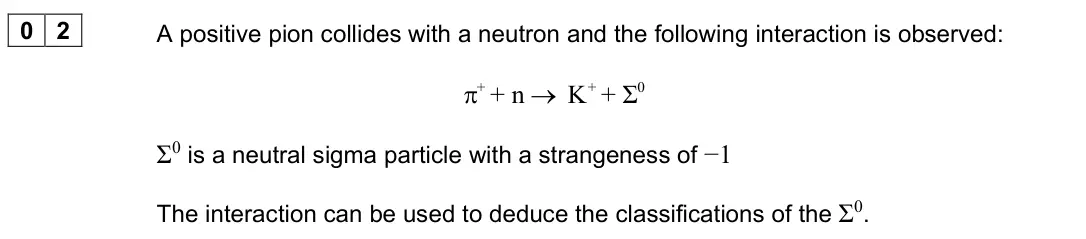
Q02.4
The whole paper ↗Q01.3
The whole paper ↗
Q01.4
The whole paper ↗Q01.2
The whole paper ↗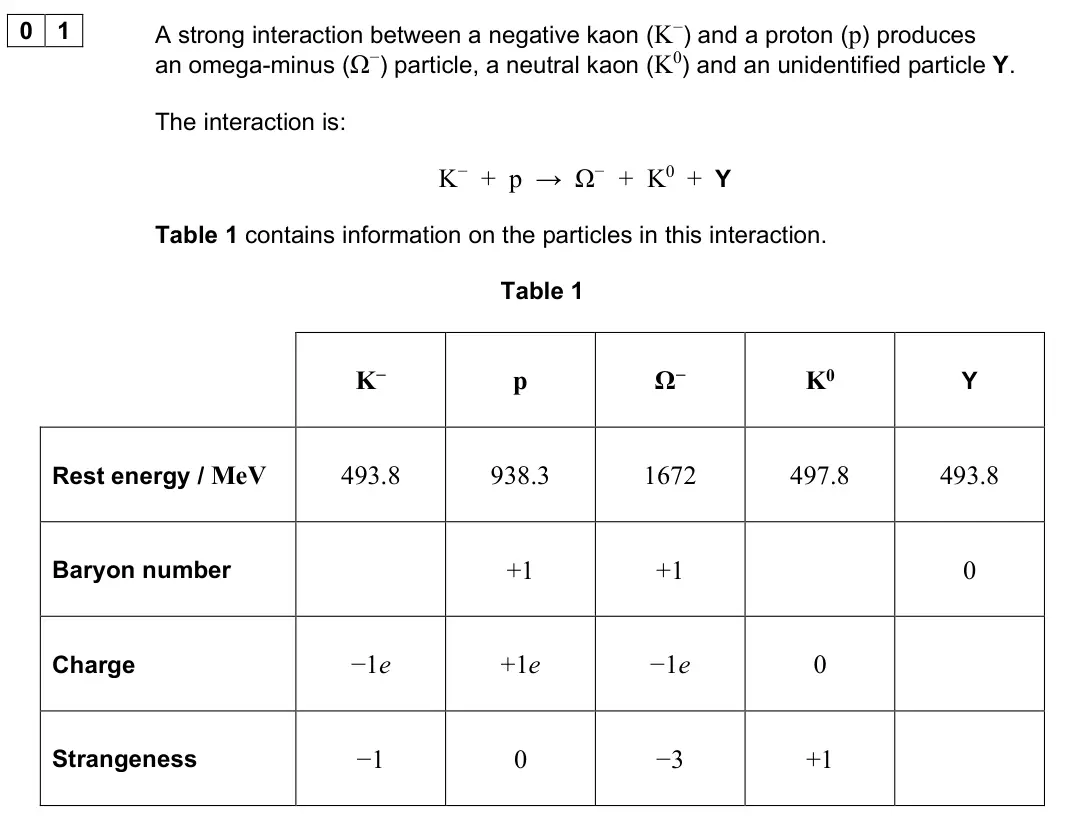
Q01.3
The whole paper ↗Q01.5
The whole paper ↗Q02.4
The whole paper ↗
Q02.4
The whole paper ↗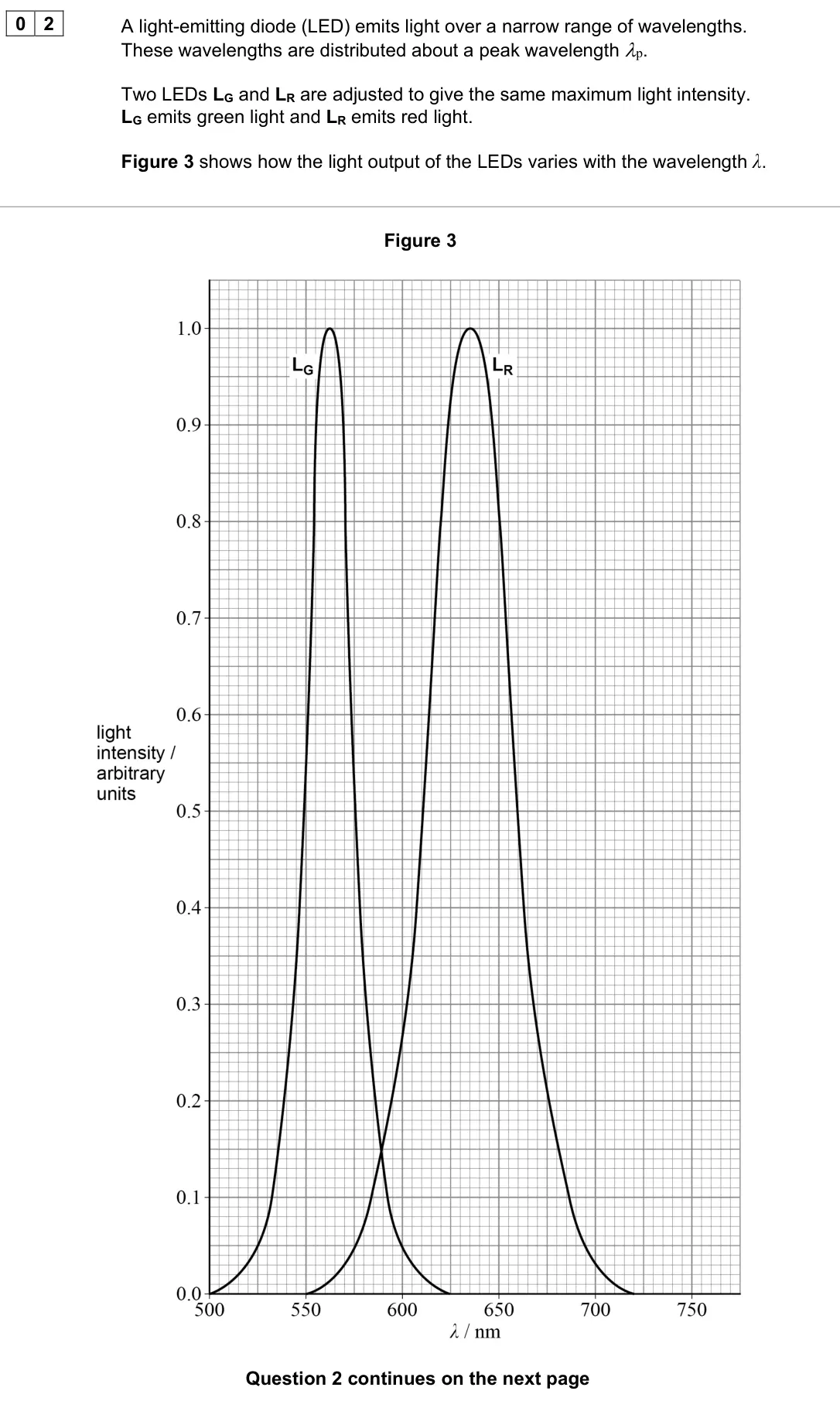
Q01.6
The whole paper ↗Q05.1
The whole paper ↗Q05.2
The whole paper ↗Q06.1
The whole paper ↗
Q06.2
The whole paper ↗Q06.3
The whole paper ↗Q03.2
The whole paper ↗
All 56 questions on Particles, antiparticles and photons, as a list
- June 2025, AS Paper 1, Q03.2 (2 marks): Calculate, in nm, the wavelength of a photon with this energy. [2 marks] wavelength = nm
- June 2025, AS Paper 1, Q03.3 (2 marks): The fluorescent tube has an input power of 18 W. 82% of the input power is converted into ultraviolet photons, each of energy 7.83 × 10⁻¹⁹ J. Calculate the numb
- June 2024, Paper 1, Q02.3 (2 marks): Compare the rest energies of the particles involved in this decay. [2 marks]
- June 2024, Paper 1, Q02.4 (1 mark): The decay of the neutral pion leads to the production of further gamma photons. Explain why. [1 mark]
- June 2023, Paper 1, Q01.3 (1 mark): An antiparticle of the neutral lambda particle decays into a neutral pion and particle X. Identify X. [1 mark]
- June 2023, Paper 1, Q01.4 (1 mark): The rest energy of a Λ0 is equal to the energy of a photon with a frequency of 2.69 × 10²³ Hz. Determine, in MeV, the rest energy of a Λ0. [1 mark] rest energy
- June 2023, AS Paper 1, Q01.2 (2 marks): Calculate, in J, the rest energy of the Ω−. [2 marks] rest energy = J
- June 2023, AS Paper 1, Q01.3 (2 marks): Suggest how energy is conserved in this interaction. Refer to the rest energies of the particles in Table 1. [2 marks]
- June 2023, AS Paper 1, Q01.5 (2 marks): The π0 decays into gamma photons. Each gamma photon has a wavelength of 1.25 × 10⁻¹⁴ m. Calculate the energy of one of these photons. [2 marks] energy of photon
- June 2023, AS Paper 2, Q14 (1 mark): An electron and a positron annihilate each other. Which quantity is not conserved in the annihilation? [1 mark] A electric charge B kinetic energy C lepton numb
- June 2022, Paper 1, Q02.4 (3 marks): The positron released in this interaction is annihilated when it encounters an electron. A pair of gamma photons is then produced. Particle X can be absorbed by
- November 2021, Paper 3A, Q02.4 (2 marks): It can be shown that: A p hc V e = where h = the Planck constant. Deduce a value for the Planck constant based on the data given about the LEDs. [2 marks] h = J
- November 2021, AS Paper 1, Q01.6 (3 marks): The positron produced in the interaction in Figure 2 slows down and collides with a lepton in a molecule of water. Describe the process that occurs when the pos
- November 2021, AS Paper 2, Q05.1 (2 marks): A light emitting diode (LED) emits blue light with a wavelength of 440 nm. The rate of photon emission is 3.0 × 10¹⁶ s−1. Show that the power output of the LED
- November 2021, AS Paper 2, Q05.2 (3 marks): A different LED emits red light with a wavelength of 660 nm. Figure 12 shows how the rate of photon emission varies with current up to the maximum operating cur
- November 2021, AS Paper 2, Q09 (1 mark): A muon and an antimuon annihilate to produce the minimum number of photons. What is the maximum wavelength of the photons? [1 mark] A 5.9 × 10⁻¹⁵ m B 1.2 × 10⁻¹
- June 2019, AS Paper 1, Q06.1 (2 marks): State what is meant by an antiparticle. [2 marks]
- June 2019, AS Paper 1, Q06.2 (2 marks): Complete Table 2 with the names of the antiparticles in an atom of antihydrogen. [2 marks] Table 2 Name of particle Name of antiparticle proton electron
- June 2019, AS Paper 1, Q06.3 (3 marks): The particles in antihydrogen can be made by pair production. Calculate the total minimum energy, in J, needed to produce the particles in one atom of antihydro
- June 2019, AS Paper 2, Q03.2 (2 marks): The positron interacts with an electron, resulting in annihilation. As a result, gamma photons are produced. The energy of each gamma photon is 0.52 MeV. Calcul
- June 2019, AS Paper 2, Q03.3 (1 mark): Figure 5 shows a cross-sectional view of the patient’s head inside a ring of gamma detectors during the PET scan. Figure 5 A positron and an electron meet and a
- June 2019, AS Paper 2, Q03.4 (2 marks): Explain your answer to question 03.3. [2 marks]
- June 2018, Paper 1, Q10 (1 mark): Two gamma photons are produced when a muon and an antimuon annihilate each other. What is the minimum frequency of the gamma radiation that could be produced? [
- June 2017, Paper 1, Q01.3 (3 marks): One decay mechanism for the decay of K 19 40 results in the argon nucleus having an excess energy of 1.46 MeV. It loses this energy by emitting a single gamma p
- June 2017, AS Paper 2, Q22 (1 mark): Which graph best shows the relationship between photon energy E and wavelength of a photon of electromagnetic radiation? [1 mark] A B C D
- June 2016, AS Paper 1, Q06.2 (2 marks): Explain why two photons are formed instead of a single photon when a helium nucleus annihilates with the anti-helium nucleus. [2 marks]
- June 2016, AS Paper 1, Q06.3 (4 marks): Calculate, using data from the passage, the maximum frequency of the photons produced in this annihilation of a He 2 4 nucleus. [4 marks] frequency = __________
- June 2016, AS Paper 2, Q06 (1 mark): Which equation shows the process of annihilation? [1 mark] A 𝜋−+ 𝜋→𝛾 B p + p →𝛾+ 𝛾 C 𝛽−+ p →𝛾 D 𝛾+ 𝛾→𝛽+ + 𝛽−
- June 2016, PHYA1 (old spec), Q3(a) (1 mark): State the name of this process. [1 mark] ______________________________________________________________________________
- June 2016, PHYA1 (old spec), Q3(b)(i) (2 marks): Explain why there is a minimum energy. [2 marks] ______________________________________________________________________________ ________________________________
- June 2016, PHYA1 (old spec), Q3(b)(ii) (1 mark): Show that this minimum energy is about 1 MeV. Use values from the Data and Formulae Booklet. [1 mark]
- June 2016, PHYA1 (old spec), Q3(b)(iii) (1 mark): Explain what happens to the excess energy when the photon energy is greater than the minimum energy. [1 mark] __________________________________________________
- June 2016, PHYA1 (old spec), Q3(b)(iv) (4 marks): A photon has an energy of 1.0 MeV. Calculate the frequency associated with this photon energy. State an appropriate unit in your answer. [4 marks] frequency = –
- June 2014, PHYA1 (old spec), Q1(a)(iii) (1 mark): What is the antiparticle of the K+? [1 mark]
- June 2014, PHYA1 (old spec), Q4(b)(i) (2 marks): Calculate the frequency of the photons. [2 marks] frequency Hz
- June 2014, PHYA1 (old spec), Q4(b)(ii) (2 marks): Calculate the energy of the photons in electron volts (eV). [2 marks] energy eV
- June 2013, PHYA1 (old spec), Q3(b)(i) (1 mark): Give one example of a particle and its corresponding antiparticle. particle antiparticle (1 mark)
- June 2013, PHYA1 (old spec), Q3(b)(ii) (1 mark): State one difference between this particle and its antiparticle. (1 mark)
- January 2013, PHYA1 (old spec), Q2(a) (1 mark): State what this process is called. (1 mark)
- January 2013, PHYA1 (old spec), Q2(b) (3 marks): A photon must have a minimum energy in order to create an electron and a positron. Calculate the minimum energy of the photon in joules. Give your answer to an
- January 2013, PHYA1 (old spec), Q2(c) (1 mark): A photon of slightly higher energy than that calculated in part(b) is converted into an electron and a positron. State what happens to the excess energy. (1 mar
- January 2013, PHYA1 (old spec), Q2(d) (2 marks): Describe what is likely to happen to the positron shortly after its creation. (2 marks)
- June 2012, PHYA5 Turning points (old spec), Q3(b)(ii) (1 mark): Calculate the energy of a photon of wavelength 1.24 × 10⁻¹² m. answer = J (1 mark)
- January 2012, PHYA1 (old spec), Q1(b)(i) (1 mark): Give one example of a baryon particle and its corresponding antiparticle. particle antiparticle (1 mark)
- January 2012, PHYA1 (old spec), Q1(b)(ii) (1 mark): State the quark structure of an antibaryon. (1 mark)
- January 2012, PHYA1 (old spec), Q1(b)(iii) (2 marks): Give one property of an antiparticle that is the same for its corresponding particle and one property that is different. Same Different (2 marks)
- January 2012, PHYA1 (old spec), Q3(a) (2 marks): Pair production can occur when a photon interacts with matter. Explain the process of pair production. (2 marks)
- January 2012, PHYA1 (old spec), Q3(b) (3 marks): Explain why pair production cannot take place if the frequency of the photon is below a certain value.
- January 2011, PHYA1 (old spec), Q3(i) (1 mark): What is the name of this process? (1 mark)
- January 2011, PHYA1 (old spec), Q3(ii) (2 marks): Give one reason why the photon could not produce a single electron instead of an electron and a positron. (2 marks)
- January 2011, PHYA1 (old spec), Q3(iii) (1 mark): Make use of the Data and Formulae booklet to show that the minimum energy of the photon required for this process is 1.02MeV. (1 mark)
- January 2011, PHYA1 (old spec), Q3(iv) (4 marks): Photons whose wavelength exceeds a certain value will not cause this process. Calculate the maximum wavelength for the process to occur stating your answer to a
- January 2011, PHYA1 (old spec), Q3(v) (2 marks): Explain what will happen to the positron produced by the interaction. (2 marks)
- January 2010, PHYA1 (old spec), Q1(b) (2 marks): State one similarity and one difference between a particle and its antiparticle. similarity difference (2 marks)
- January 2010, PHYA1 (old spec), Q4(b)(i) (2 marks): Calculate the energy of a single photon of this light. answer = J (2 marks)
- January 2008, PA01 (2008 spec), Q3(c) (3 marks): (c) In a head-on collision between a proton and an antiproton the following reaction was observed. p + p 4π + + 4π – (i) What name is given to the type of proce
Questions, mark schemes and examiner’s reports are © AQA, from their published past papers. Plumi isn’t affiliated with any exam board. Want whole papers? AQA A-Level Physics past papers.
The Plumi iPad app also offers exam-style questions with AI feedback on your handwritten working.