 plumi
Constituents of the atom: AQA A‑Level Physics questions
AQA A-Level Physics past-paper questions on 3.2.1.1 Constituents of the atom, 2008–2025, with mark schemes and examiner’s reports where available.
Paper
All papers
Exam
All years
Calculations
Q01.3
The whole paper ↗
Q01.1
The whole paper ↗
Q01.2
The whole paper ↗Q01.2
The whole paper ↗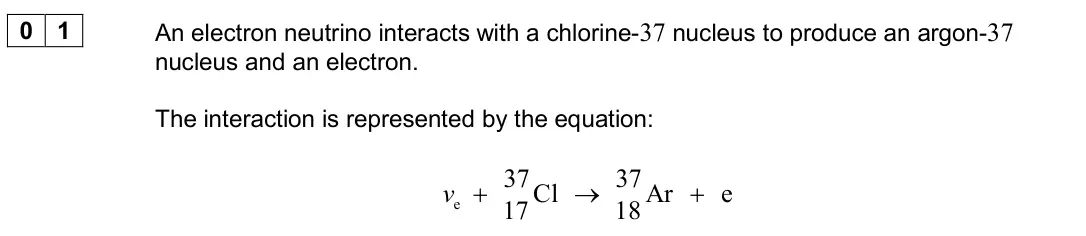
Q01.3
The whole paper ↗
Q02.1
The whole paper ↗
Q02.2
The whole paper ↗Q02.3
The whole paper ↗Q01.1
The whole paper ↗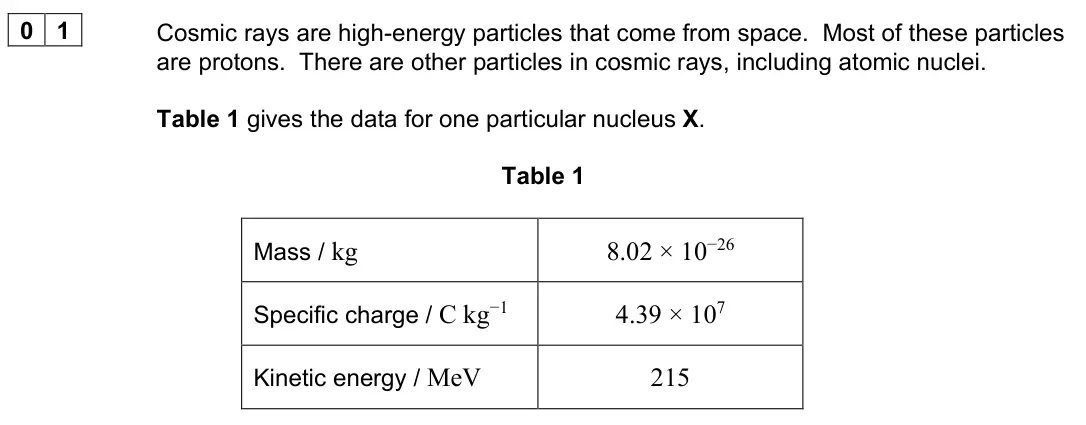
Q01.1
The whole paper ↗Q04.1
The whole paper ↗
Q04.2
The whole paper ↗Q04.3
The whole paper ↗Q04.4
The whole paper ↗
All 75 questions on Constituents of the atom, as a list
- June 2025, Paper 1, Q01.3 (2 marks): A nucleus of this isotope of titanium has a proton number of 22 and a specific charge of 4.8 × 10⁷ C kg−1. Determine the number of neutrons in this nucleus. [2
- June 2025, AS Paper 1, Q01.1 (2 marks): Calculate the specific charge of a nucleus of hydrogen-3. [2 marks] specific charge = C kg−1
- June 2025, AS Paper 1, Q01.2 (2 marks): The specific charge of the hydrogen-3 nucleus is less than the specific charges of the nuclei of the other two isotopes. Suggest why. [2 marks]
- June 2024, Paper 1, Q08 (1 mark): [multiple choice] Which nuclear change results in the nucleus with the greatest specific charge? [1 mark] A the alpha decay of a 209Po 82 nucleus B the beta-min
- June 2024, AS Paper 1, Q01.2 (2 marks): Calculate the specific charge of the argon-37 nucleus. [2 marks] specific charge = C kg−1
- June 2024, AS Paper 2, Q08 (1 mark): The alpha particle, positron and proton have different charge-to-mass ratios. Which row shows the particles that have the greatest and the smallest value of thi
- June 2023, Paper 1, Q09 (1 mark): A nucleus contains N neutrons and Z protons. Which combination of N and Z gives a nucleus with the greatest specific charge? [1 mark] N Z A 6 5 B 8 7 C 16 13 D
- June 2022, Paper 1, Q10 (1 mark): What is the specific charge of a 13 6C nucleus? [1 mark] A 4.4 × 10⁷ C kg–1 B 5.2 × 10⁷ C kg–1 C 8.3 × 10⁷ C kg–1 D 2.1 × 10⁸ C kg–1
- June 2022, AS Paper 1, Q01.3 (3 marks): Deduce which particle, π+ or Y, has the greater charge-to-mass ratio. Justify your conclusion. [3 marks]
- June 2022, AS Paper 1, Q02.1 (2 marks): In the experiment, the gas is ionised by a beam of electrons. Explain how the beam of electrons causes a particle of the gas to have a charge of +1e. [2 marks]
- June 2022, AS Paper 1, Q02.2 (2 marks): Bromine has a proton number of 35 The two isotopes in the sample have different nucleon numbers. Calculate the number of neutrons for the isotope that has the g
- June 2022, AS Paper 1, Q02.3 (2 marks): Deduce the percentage of each isotope in the gas. Justify your conclusion. [2 marks]
- June 2022, AS Paper 2, Q05 (1 mark): [multiple choice] Which row has the largest value for specific charge of the particle in column ? specific charge of the particle in column X Y [1 mark] X Y A e
- November 2021, Paper 1, Q01.1 (3 marks): Determine the number of neutrons in nucleus X. [3 marks] number of neutrons =
- November 2021, AS Paper 1, Q01.1 (1 mark): Identify the number of neutrons in a nucleus of polonium-210 ( ) 210Po 84 . Tick () one box. [1 mark] 84 126 210 294
- November 2021, AS Paper 2, Q06 (1 mark): [multiple choice] An atom of oxygen-15 ( ) 15O 8 gains two electrons to form an ion. What is the specific charge of the ion? [1 mark] A −1.3 × 10⁷ C kg−1 B −2.4
- November 2020, AS Paper 1, Q04.1 (1 mark): The sample is ionised, producing ions each with a charge of +1.6 × 10⁻¹⁹ C. The specific charge of an ion of X is 8.7 × 10⁶ C kg–1. Calculate the mass of an ion
- November 2020, AS Paper 1, Q04.2 (2 marks): Determine the number of nucleons in a nucleus of X. mass of a nucleon = 1.7 × 10⁻²⁷ kg [2 marks] number of nucleons =
- November 2020, AS Paper 1, Q04.3 (2 marks): Compare the nuclear compositions of X and Y. [2 marks]
- November 2020, AS Paper 1, Q04.4 (2 marks): Ions of Y have the same charge as ions of X. State and explain how the specific charge of an ion of X compares with that of an ion of Y. [2 marks]
- November 2020, AS Paper 1, Q04.5 (3 marks): Table 1 contains data about two completely ionised samples of pure boron. Each sample contains only isotopes X and Y. Table 1 Sample number Number of ions in sa
- June 2019, Paper 1, Q01.1 (1 mark): Two isotopes of iodine are 125 53 I and 131 53 I. Determine, for these two isotopes, the difference between the constituents of the nuclei. [1 mark]
- June 2019, Paper 1, Q01.3 (2 marks): A 125 53 I nuclide decays by electron capture to form a tellurium nuclide. State two differences between the constituents of the iodine nucleus and the telluriu
- June 2019, AS Paper 1, Q01.1 (2 marks): Deuterium is an isotope of hydrogen. Its nucleus contains one proton and one neutron. Calculate the specific charge of the deuterium nucleus. [2 marks] specific
- June 2019, AS Paper 2, Q06 (1 mark): Which is a graph of neutron number N plotted against proton number Z for the isotopes of a given element? [1 mark] A B C D A B C D
- June 2018, Paper 1, Q09 (1 mark): Fluoride ions are produced by the addition of a single electron to an atom of fluorine F 9 19 . What is the magnitude of specific charge of the fluoride ion? [1
- June 2018, AS Paper 2, Q03.1 (2 marks): Show that the velocity of an alpha particle with kinetic energy 8.1 × 10⁻¹³ J is approximately 2 × 10⁷ m s–1 specific charge of an alpha particle = 4.81 × 10⁷ C
- June 2018, AS Paper 2, Q05 (1 mark): [multiple choice] The graph of neutron number against proton number shows three nuclei P, Q and R. Which row identifies an isotope of P and the nucleon number o
- June 2017, Paper 1, Q08 (1 mark): [multiple choice] An atom of N 7 16 gains 3 electrons. What is the specific charge of the ion? [1 mark] A 1.80 × 10⁷ C kg–1 B −1.80 × 10⁷ C kg–1 C 4.19 × 10⁷ C
- June 2017, AS Paper 2, Q04.1 (2 marks): The mass of a Xe+ ion is 2.18 × 10⁻²⁵ kg. Calculate the specific charge of a Xe+ ion. Give an appropriate unit for your answer. [2 marks] specific charge = unit
- June 2016, AS Paper 1, Q06.1 (2 marks): State what is meant by isotopes. [2 marks]
- Specimen, Paper 1, Q01.1 (2 marks): A common type of smoke detector contains a very small amount of americium-241, Am 95 241 0 1 Determine the number of each type of nucleon in one americium-241 n
- June 2016, PHYA1 (old spec), Q1(a) (2 marks): Explain what is meant by an isotope. [2 marks] ______________________________________________________________________________ __________________________________
- June 2016, PHYA1 (old spec), Q1(b) (2 marks): Determine the charge in coulomb of the 237 92U nucleus. [2 marks] charge = ___________________________ C
- June 2016, PHYA1 (old spec), Q1(c) (2 marks): A positive ion of 237 92U has a charge of +4.80 × 10⁻¹⁹ C. Determine the number of electrons in the ion. [2 marks] number of electrons = _______________________
- June 2015, PHYA1 (old spec), Q1(a) (4 marks): Complete Table 1 by ticking one box in each row to identify the appropriate isotope. The first row has been completed for you. [4 marks]
- June 2015, PHYA1 (old spec), Q1(b)(i) (1 mark): An atom of one of the radium isotopes in Table 1 is ionised so that it has a charge of +3.2 × 10⁻¹⁹ C. State what happens in the process of ionising this radium
- June 2015, PHYA1 (old spec), Q1(b)(ii) (3 marks): The specific charge of the ion formed is 8.57 × 10⁵ C kg–1. Deduce which isotope in the table has been ionised. Assume that both the mass of a proton and the ma
- June 2014, PHYA1 (old spec), Q2(a)(i) (1 mark): Which nucleus contains the fewest protons? [1 mark] nucleus
- June 2014, PHYA1 (old spec), Q2(a)(ii) (1 mark): Which two nuclei are isotopes of the same element? [1 mark] nuclei and
- June 2014, PHYA1 (old spec), Q2(a)(iii) (2 marks): State and explain which nucleus has the smallest specific charge. [2 marks]
- June 2013, PHYA1 (old spec), Q1(i) (3 marks): State the number of protons, neutrons and electrons in the ion formed. protons neutrons electrons (3 marks)
- June 2013, PHYA1 (old spec), Q1(ii) (1 mark): Calculate the charge of the ion. charge C (1 mark)
- June 2013, PHYA1 (old spec), Q1(iii) (2 marks): Calculate the specific charge of the ion. specific charge Ckg–1 (2 marks)
- January 2013, PHYA1 (old spec), Q1(a)(i) (1 mark): has zero charge, (1 mark)
- January 2013, PHYA1 (old spec), Q1(a)(ii) (1 mark): has the largest specific charge, (1 mark)
- January 2013, PHYA1 (old spec), Q1(a)(iii) (1 mark): when removed leaves a different isotope of the element. (1 mark)
- January 2013, PHYA1 (old spec), Q1(b)(iii) (4 marks): Calculate the specific charge of the technetium–99 (99 43Tc) nucleus. State an appropriate unit for your answer. specific charge = unit (4 marks)
- June 2012, PHYA1 (old spec), Q2(a)(i) (1 mark): State what is meant by nucleon number and proton number. nucleon number proton number
- June 2012, PHYA1 (old spec), Q2(a)(ii) (1 mark): Calculate the number of neutrons in the nucleus of this atom. answer = (1 mark)
- June 2012, PHYA1 (old spec), Q2(a)(iii) (3 marks): Calculate the specific charge of the nucleus. answer = Ckg–1 (3 marks)
- June 2012, PHYA1 (old spec), Q2(b)(i) (2 marks): State what is meant by an isotope. (2 marks)
- June 2012, PHYA1 (old spec), Q2(b)(ii) (3 marks): Calculate the number of neutrons in this isotope. answer = (3 marks)
- January 2012, PHYA1 (old spec), Q2(a) (2 marks): State what is meant by the specific charge of a nucleus and give an appropriate unit for this quantity. unit: (2 marks)
- January 2012, PHYA1 (old spec), Q2(b)(i) (2 marks): Explain, in terms of protons and neutrons, why the specific charge of X is greater than that of Y. (2 marks)
- January 2012, PHYA1 (old spec), Q2(b)(ii) (4 marks): Nucleus X is B. Deduce the number of protons and the number of neutrons in nucleus Y. number of protons number of neutrons (4 marks) 10 5
- June 2011, PHYA1 (old spec), Q2(i) (2 marks): State what is meant by isotopes. (2 marks)
- June 2011, PHYA1 (old spec), Q2(iii) (4 marks): Calculate the specific charge of an alpha particle, stating an appropriate unit. answer = (4 marks)
- January 2011, PHYA1 (old spec), Q2(a)(i) (3 marks): Name the constituents of this atom and state how many of each are present. (3 marks)
- January 2011, PHYA1 (old spec), Q2(a)(ii) (1 mark): Which constituent of an atom has the largest specific charge? (1 mark)
- January 2011, PHYA1 (old spec), Q2(b) (2 marks): A ZRa is a neutral atom of a different isotope of radium. State a possible value for A and for Z. A: Z: (2 marks)
- June 2010, PHYA1 (old spec), Q2(c)(i) (2 marks): State what is meant by isotopes. (2 marks)
- June 2009, PHYA1 (old spec), Q1(a) (2 marks): Explain what is meant by an isotope. (2 marks)
- June 2009, PHYA1 (old spec), Q1(b)(i) (1 mark): Write the unit for the specific charge in the heading of the last column of the table. (1 mark)
- June 2009, PHYA1 (old spec), Q1(b)(ii) (1 mark): In the above table write down the number of protons in the second isotope in the table. (1 mark)
- June 2009, PHYA1 (old spec), Q1(b)(iii) (3 marks): Calculate the specific charge of the first isotope and write this in the table. (3 marks)
- June 2009, PHYA1 (old spec), Q1(b)(iv) (3 marks): Calculate the number of neutrons in the second isotope and put this number in the table (3 marks)
- January 2009, PA01 (2008 spec), Q1(a) (2 marks): 1 (a) What is meant by the word isotope? (2 marks)
- January 2009, PA01 (2008 spec), Q1(b) (1 mark): 1 (b) How many hadrons are there in an atom of 40K 19 ? (1 mark)
- January 2009, PA01 (2008 spec), Q1(c) (3 marks): 1 (c) Calculate the charge mass ratio for a nucleus of an atom of 40K 19 . (3 marks)
- June 2008, PA01 (2008 spec), Q1(a) (2 marks): 1 (a) How many protons, neutrons and electrons are there in an atom of 95Rb 37 ? protons neutrons electrons (2 marks)
- June 2008, PA01 (2008 spec), Q1(b) (1 mark): 1 (b) Determine for a nucleus of X 1 (b) (i) the mass number, A, 1 (b) (ii) the atomic number, Z. (1 mark)
- June 2008, PA01 (2008 spec), Q1(c) (2 marks): 1 (c) Calculate the charge mass ratio of a 95Rb 37 nucleus, in C kg –1. (2 marks)
- January 2008, PA01 (2008 spec), Q1(a) (3 marks): (a) (i) Determine the number of protons and neutrons in nucleus X. protons neutrons (ii) Only one isotope of X produces this reaction. Explain what is meant by
- January 2008, PA01 (2008 spec), Q1(b)(ii) (3 marks): (ii) Show that the charge mass ratio for the 18F 9 nucleus is larger than that of nucleus X. (3 marks)
Questions, mark schemes and examiner’s reports are © AQA, from their published past papers. Plumi isn’t affiliated with any exam board. Want whole papers? AQA A-Level Physics past papers.
The Plumi iPad app also offers exam-style questions with AI feedback on your handwritten working.