 plumi
Nuclear instability: AQA A‑Level Physics questions
AQA A-Level Physics past-paper questions on 3.8.1.4 Nuclear instability, 2008–2025, with mark schemes and examiner’s reports where available.
Paper
All papers
Exam
All years
Calculations
Q01.1
The whole paper ↗
Q06.4
The whole paper ↗
Q01.2
The whole paper ↗
Q01.3
The whole paper ↗Q07.1
The whole paper ↗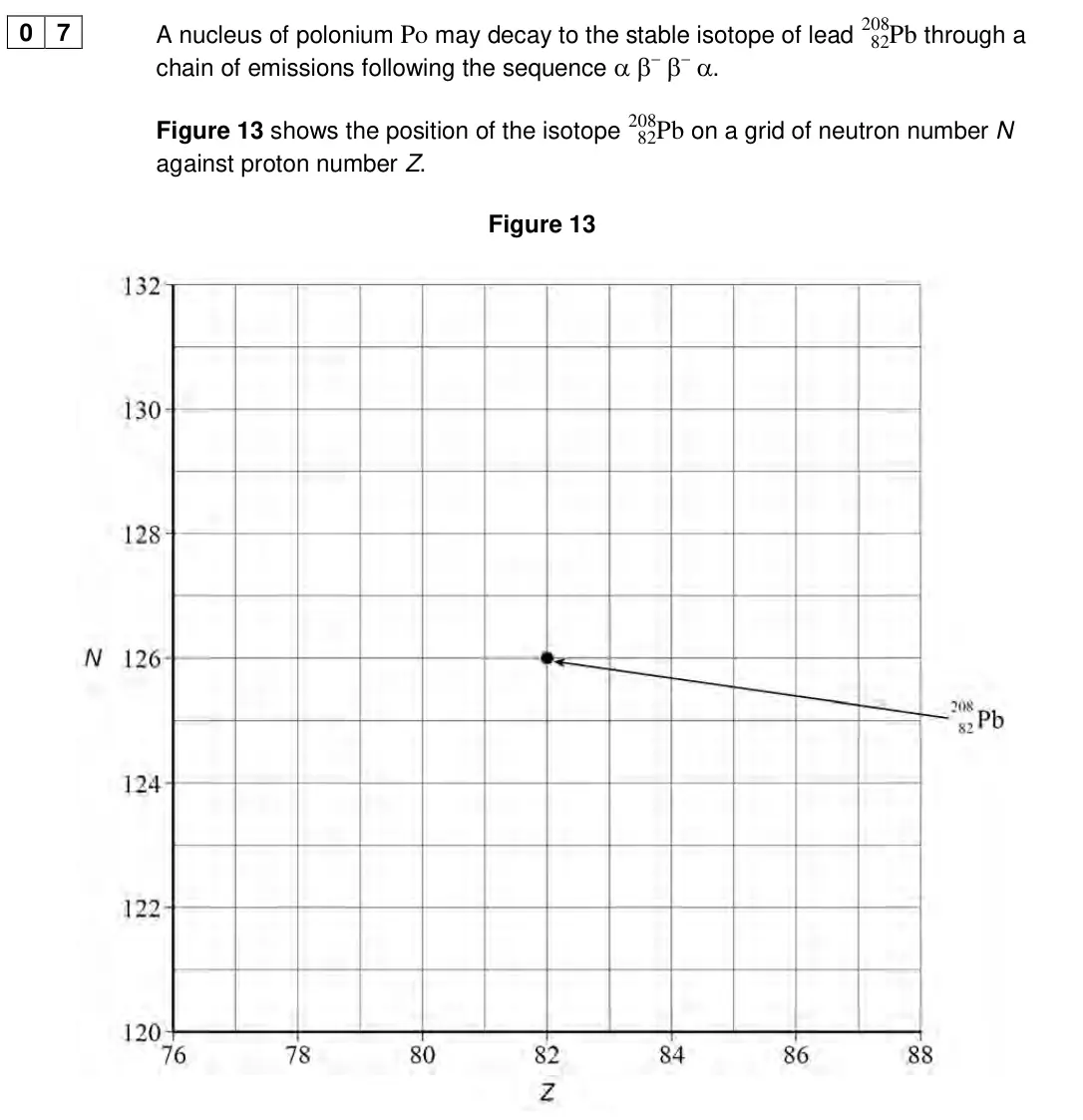
Q07.2
The whole paper ↗Q07.3
The whole paper ↗Q07.4
The whole paper ↗Q07.5
The whole paper ↗Q01.4
The whole paper ↗
Q05.2
The whole paper ↗Q05.3
The whole paper ↗
All 37 questions on Nuclear instability, as a list
- June 2025, Paper 2, Q26 (1 mark): 241Am 95 decays to one of two excited states of 237 Np 93 by emitting an alpha particle. The excited 237 Np 93 nucleus then decays with the emission of a gamma
- June 2025, Paper 2, Q27 (1 mark): Which decay produces an atom with electrons in excited states? [1 mark] A 223 219 4 Ra Rn + 88 86 2α → B e 90 90 Sr Y + e + 38 39 v − → C + e 23 23 Mg Na + e +
- June 2024, Paper 2, Q30 (1 mark): The graph shows a plot of neutron number N against proton number Z for the known atomic nuclei. The nuclide 115 Rh 45 is likely to decay by [1 mark] A α emissio
- June 2024, Paper 2, Q31 (1 mark): Uranium-238 absorbs a neutron in the first stage in a series of nuclear reactions that end in a nucleus Z. 238U n X 92 + → e X Y v + + − → β e Y Z v + + − → β H
- June 2022, Paper 1, Q01.1 (2 marks): An atom of 4 2He is produced in a rock that contains uranium. It is produced following the radioactive decay of a 238 92U atom. The decay also creates an atom o
- June 2022, Paper 2, Q06.4 (3 marks): Figure 11 shows a graph of N against Z for stable nuclides. Figure 11 Deduce the likely initial mode of decay of F1 and F2. Refer to Figure 11 in your answer. [
- June 2022, Paper 2, Q29 (1 mark): Which provides evidence for the existence of energy levels in nuclei? [1 mark] A the Rutherford alpha particle scattering experiment B the existence of X-ray li
- November 2021, Paper 1, Q10 (1 mark): The proton number of uranium is 92 and the proton number of radon is 88 Which series of decays turns a uranium nucleus into a radon nucleus? [1 mark] A α + β− +
- November 2021, Paper 2, Q31 (1 mark): 27Mg 12 can decay by beta minus emission to one of two possible excited states of 27Al. 13 Both excited states decay by the emission of a gamma photon directly
- November 2020, Paper 1, Q10 (1 mark): The radioactive nuclide 232Th 90 decays by one α emission followed by two β− emissions. Which nuclide is formed as a result of these decays? [1 mark] A 238U 92
- June 2019, Paper 3A, Q01.2 (1 mark): A sealed source contains radium-226 ( 226 88Ra ). 226 88Ra decays by emitting α and β– particles to produce 206 82Pb which is stable. Figure 2 is a graph of neu
- June 2019, Paper 3A, Q01.3 (3 marks): Identify which of the nuclei A to M are common to all the possible ways that 226 88Ra decays into 206 82Pb . [3 marks]
- June 2018, Paper 2, Q07.1 (2 marks): Draw four arrows on Figure 13 to show the sequence of changes to N and Z that occur as the polonium nucleus is transformed into Pb 82 208 . [2 marks]
- June 2018, Paper 2, Q07.2 (4 marks): A nucleus of the stable isotope Pb 82 208 has more neutrons than protons. Explain why there is this imbalance between proton and neutron numbers by referring to
- June 2018, Paper 2, Q07.3 (1 mark): Many, but not all, isotopes of lead are stable. For example, Pb 82 205 decays by electron capture to become an isotope of thallium, Tl. Write the equation to re
- June 2018, Paper 2, Q07.4 (2 marks): The thallium nucleus is formed in an excited state. Electromagnetic radiation is emitted from the thallium atom following its formation. Explain the origin and
- June 2018, Paper 2, Q07.5 (2 marks): Other nuclides also emit electromagnetic radiation. Explain why the metastable form of the isotope of technetium Tc 43 99 is a radioactive source suitable for u
- June 2017, Paper 1, Q01.4 (3 marks): The potassium isotope can also decay by a second decay process to form a calcium-40 nuclide ( Ca 20 40 ). Suggest how the emissions from a nucleus of decaying p
- June 2017, Paper 2, Q05.2 (2 marks): A nucleus of iron Fe-59 decays into a stable nucleus of cobalt Co-59. It decays by β− emission followed by the emission of γ-radiation as the Co-59 nucleus de-e
- June 2017, Paper 2, Q05.3 (1 mark): Following the production of excited states of Co 27 59 , γ-radiation of discrete wavelengths is emitted. State the maximum number of discrete wavelengths that c
- June 2017, Paper 2, Q05.4 (3 marks): Calculate the longest wavelength of the emitted γ-radiation. [3 marks] longest wavelength = m
- Specimen, Paper 1, Q01.3 (3 marks): A common type of smoke detector contains a very small amount of americium-241, Am 95 241 0 1 An americium-241 nucleus decays into nuclide X by emitting an alpha
- Specimen, Paper 2, Q27 (1 mark): A radioactive nucleus emits a β− particle then an α particle and finally another β− particle. The final nuclide is [1 mark] A an isotope of the original element
- June 2016, PHYA4 Section B (old spec), Q3(c)(i) (1 mark): The isotope of radon 220 86Rn decays by emitting an α particle. State the nucleon number of the recoiling nucleus. [1 mark] nucleon number = ___________________
- June 2015, PHYA5 Section A (old spec), Q3(a) (2 marks): Write down the nuclear equation that represents the decay of neptunium-239 into plutonium-239. [2 marks]
- June 2014, PHYA5 Section A (old spec), Q1(c)(i) (1 mark): On Figure 1 sketch a graph of neutron number, N, against proton number, Z, for stable nuclei. [1 mark] Figure 1 140 120 100 80 60 40 20 0 0 proton number, Z neu
- June 2014, PHYA5 Section A (old spec), Q1(c)(ii) (3 marks): With reference to Figure 1, explain why fission fragments are unstable and explain what type of radiation they are likely to emit initially. [3 marks]
- June 2013, PHYA5 Section A (old spec), Q1(c)(i) (3 marks): In massive stars, nuclei of hydrogen 1 1 H are processed into nuclei of helium 4 2 He through a series of interactions involving carbon, nitrogen and oxygen cal
- June 2013, PHYA5 Section A (old spec), Q2(c)(i) (2 marks): Describe and explain the nature of the radiation that may be emitted from an excited nucleus of the moderator. (2 marks)
- January 2013, PHYA4 Section B (old spec), Q1(b)(i) (1 mark): Complete the following decay equation. (1 mark) 144 60Nd→ Ce + α
- June 2012, PHYA5 Section A (old spec), Q2(a) (1 mark): In this series of decays, α decay occurs 8 times and b– decay occurs n times. Calculate n. answer = (1 mark)
- June 2011, PHYA5 Section A (old spec), Q1(a) (2 marks): Complete the following equation to show the b−decay of protactinium. (2 marks) Pa →233 92U + b −+
- June 2011, PHYA5 Section A (old spec), Q1(b) (2 marks): Two other nuclei, P and Q, can also decay into 233 92U. P decays by b+ decay to produce 233 92U. Q decays by α emission to produce 233 92U. Figure 1 shows a gri
- June 2011, PHYA5 Section A (old spec), Q2(a) (1 mark): Complete the following nuclear equation by identifying the missing particle. (1 mark) 27 13Al + a →30 15P +
- June 2010, PHYA1 (old spec), Q2(b)(ii) (2 marks): Complete the equation below to represent the emission of an α particle by a 238 92U nucleus. (2 marks) 238 92U→ Th + α
- June 2010, PHYA1 (old spec), Q2(c)(ii) (3 marks): If there are eight alpha decays involved in the sequence of decays from 238 92U to 206 82Pb deduce how many β– decays are involved. answer = (3 marks)
- June 2008, PHA5CORE (2008 spec), Q1(c) (3 marks): 1 (c) Explain why sources of β radiation often also produce γ rays of discrete frequencies. You may be awarded additional marks to those shown in brackets for t
Questions, mark schemes and examiner’s reports are © AQA, from their published past papers. Plumi isn’t affiliated with any exam board. Want whole papers? AQA A-Level Physics past papers.
The Plumi iPad app also offers exam-style questions with AI feedback on your handwritten working.