 plumi
Applications of conservation laws: AQA A‑Level Physics questions
AQA A-Level Physics past-paper questions on 3.2.1.7 Applications of conservation laws, 2008–2025, with mark schemes and examiner’s reports where available.
Paper
All papers
Exam
All years
Calculations
Q01.1
The whole paper ↗
Q01.3
The whole paper ↗
Q01.4
The whole paper ↗Q02.2
The whole paper ↗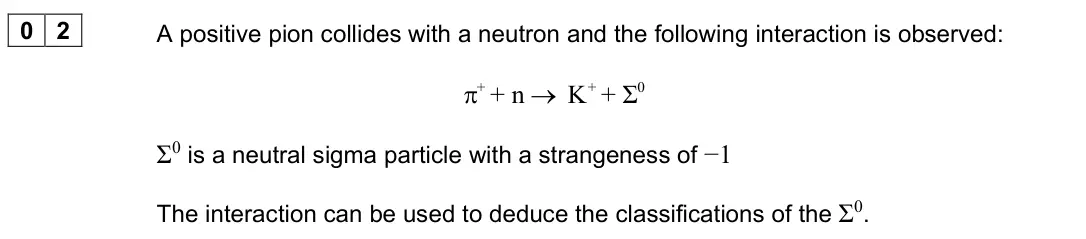
Q01.1
The whole paper ↗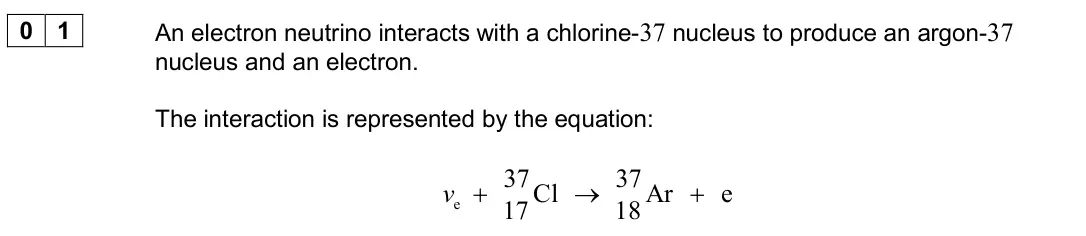
Q01.2
The whole paper ↗
Q01.3
The whole paper ↗Q01.1
The whole paper ↗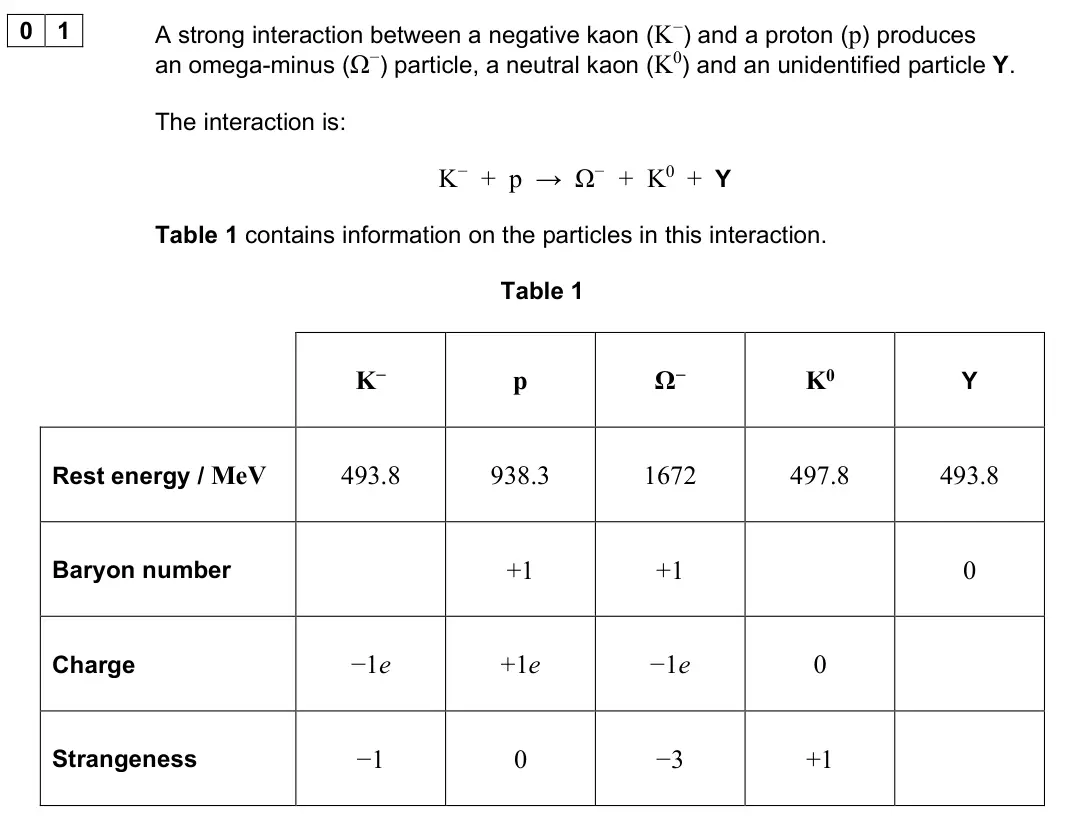
Q01.3
The whole paper ↗Q01.4
The whole paper ↗Q01.6
The whole paper ↗Q02.1
The whole paper ↗
Q02.3
The whole paper ↗Q01.1
The whole paper ↗
Q01.3
The whole paper ↗
All 64 questions on Applications of conservation laws, as a list
- June 2025, Paper 1, Q01.1 (3 marks): Complete Figure 1 to show the quark change that occurs during electron capture. Label the incoming and outgoing particles and the exchange particle. [3 marks] F
- June 2025, Paper 1, Q09 (1 mark): [multiple choice] The following equation represents a strong interaction between particle X and a proton. 0 + p n + π → X What is the quark configuration of X?
- June 2025, Paper 1, Q10 (1 mark): In β− decay: [1 mark] A energy is conserved. B an up quark changes into a down quark. C the interaction occurs outside the nucleus of an atom. D momentum is not
- June 2025, AS Paper 1, Q01.3 (3 marks): Deduce, with reference to appropriate conservation laws, the quark structure of the K0 produced in this reaction. [3 marks] quark structure =
- June 2025, AS Paper 1, Q01.4 (2 marks): One possible decay of a π+ particle is π+ → A + B where A is a charged lepton. Suggest, with reference to appropriate conservation laws, the name of A and the n
- June 2025, AS Paper 2, Q32 (1 mark): A nucleus of 15O 8 emits a beta-plus particle. Which row shows the number of protons and the number of neutrons in the resulting nucleus? [1 mark] Number of pro
- June 2024, Paper 1, Q02.2 (3 marks): A conservation rule predicts that the following interaction cannot occur: 0 + n Σ + − − π →Κ State the conservation rule. Go on to explain your answer. [3 marks
- June 2024, AS Paper 1, Q01.1 (2 marks): Explain, with reference to appropriate conservation laws, why the electron is emitted in this interaction. [2 marks]
- June 2023, Paper 1, Q01.2 (2 marks): State and explain which interaction is involved in this decay. [2 marks]
- June 2023, Paper 1, Q01.3 (1 mark): An antiparticle of the neutral lambda particle decays into a neutral pion and particle X. Identify X. [1 mark]
- June 2023, Paper 1, Q11 (1 mark): The diagram represents a quark change in which an electron antineutrino is produced. What are E, F and G? [1 mark] E F G A up quark down quark β− B down quark u
- June 2023, AS Paper 1, Q01.1 (2 marks): Complete Table 1. [2 marks]
- June 2023, AS Paper 1, Q01.3 (2 marks): Suggest how energy is conserved in this interaction. Refer to the rest energies of the particles in Table 1. [2 marks]
- June 2023, AS Paper 1, Q01.4 (4 marks): Deduce the quark structure of the Λ0 particle. [4 marks] quark structure of Λ0 =
- June 2023, AS Paper 1, Q01.6 (1 mark): The negative pion π− decays. Which row shows the particles that could be created in this decay? Tick () one box. [1 mark] μ− + νμ e e + v − e e + ν − e + e + e
- June 2023, AS Paper 2, Q14 (1 mark): An electron and a positron annihilate each other. Which quantity is not conserved in the annihilation? [1 mark] A electric charge B kinetic energy C lepton numb
- June 2022, Paper 1, Q02.1 (1 mark): State the change of quark character in β− decay. [1 mark]
- June 2022, Paper 1, Q02.3 (1 mark): Identify particle X. [1 mark]
- June 2022, AS Paper 1, Q01.1 (2 marks): Complete Table 1 to show the baryon number B, charge Q and strangeness S for the particles in this interaction. [2 marks] Table 1 π+ p Σ+ Y B 0 Q +1 +1 +1 S +1
- November 2021, Paper 1, Q01.3 (2 marks): The π+ decays to produce a positron and an electron neutrino. Show how the conservation laws apply to this decay. [2 marks]
- November 2021, Paper 1, Q01.4 (2 marks): The K+ decays to produce an anti-muon and a muon neutrino. Explain how strangeness applies in this decay. [2 marks]
- November 2021, Paper 1, Q01.5 (2 marks): Write an equation for a K+ decay that involves only hadrons. [2 marks]
- November 2021, AS Paper 1, Q01.4 (2 marks): This third particle is an electron antineutrino. Explain why an electron antineutrino, rather than an electron neutrino, is produced during β− decay. [2 marks]
- November 2021, AS Paper 2, Q08 (1 mark): A particular baryon has a quark structure dss and decays by the weak interaction. What are possible decay products of this baryon? The quark structure of Λ0 is
- November 2020, Paper 1, Q01.1 (2 marks): Determine whether the following reaction is a possible decay for the neutral pion π0. π0 → e− + μ+ + ev [2 marks]
- November 2020, AS Paper 1, Q01.1 (2 marks): Determine the lepton number, strangeness and charge of particle X. [2 marks] lepton number = strangeness = charge =
- November 2020, AS Paper 1, Q01.2 (1 mark): Identify particle X. [1 mark]
- November 2020, AS Paper 1, Q01.3 (1 mark): A possible decay of a negative pion is π− → e− + Y What is particle Y? Tick () one box. [1 mark] νതe ve π0 n 0 1
- November 2020, AS Paper 2, Q09 (1 mark): Which decay of a positive kaon (K+) particle is possible? [1 mark] A K+ → π0 + e+ + v e B K+ → p + vμ C K+ → π+ + π+ + π0 D K+ → μ+ + vμ
- June 2018, AS Paper 1, Q01.2 (3 marks): Nuclei can decay by alpha decay and by beta decay. In alpha decay only one particle is emitted but in beta decay there are two emitted particles. Explain how ba
- June 2018, AS Paper 1, Q01.3 (2 marks): Kaons are mesons that can be produced by the strong interaction between pions and protons. The equation shows a reaction in which a kaon and a lambda particle a
- June 2018, AS Paper 2, Q08 (1 mark): The decay of a neutral kaon K0 is given by the equation e 0 K X Y → + +v What are X and Y? [1 mark] X and Y A e+ and e– B μ+ and e– C π+ and e– D π– and e+
- June 2017, AS Paper 1, Q01.4 (2 marks): Show clearly how charge and baryon number are conserved in this interaction. You should include reference to all the particles, including the quarks, in your an
- June 2016, AS Paper 1, Q06.4 (2 marks): Complete this equation for the possible decay of an antineutron. [2 marks]
- June 2016, AS Paper 2, Q09 (1 mark): The equation represents the weak interaction between a negative pion and a proton. 𝜋−+ p →K0 + X What is the charge, baryon number and strangeness of particle X
- June 2016, PHYA1 (old spec), Q2(b)(i) (1 mark): Show that lepton number is conserved in this decay. [1 mark]
- June 2016, PHYA1 (old spec), Q2(b)(ii) (1 mark): State a quantity that is not conserved in this decay. [1 mark] ______________________________________________________________________________
- June 2016, PHYA1 (old spec), Q2(c) (3 marks): The positive kaon can also decay to form a π+ and one other particle X. Deduce the identity of X. [3 marks] ____________________________________________________
- June 2015, PHYA1 (old spec), Q2(a)(i) (2 marks): State and explain whether X is a charged particle. [2 marks]
- June 2015, PHYA1 (old spec), Q2(a)(ii) (2 marks): State and explain whether X is a lepton, baryon or meson. [2 marks]
- June 2015, PHYA1 (old spec), Q2(a)(iv) (3 marks): Strangeness is conserved in the interaction. Determine, explaining your answer, the quark structure of X. [3 marks]
- June 2014, PHYA1 (old spec), Q1(b)(ii) (2 marks): In this decay, charge, energy and momentum are conserved. Give another quantity that is conserved in this decay and one that is not conserved. [2 marks] Conserv
- June 2014, PHYA1 (old spec), Q1(c)(i) (1 mark): Identify X by ticking one box from the following list. [1 mark] electron muon negative pion neutral pion neutrino neutron positron
- June 2014, PHYA1 (old spec), Q1(c)(ii) (1 mark): Give one reason for your choice in part (c)(i). [1 mark]
- June 2013, PHYA1 (old spec), Q2(c) (4 marks): Energy and momentum have to be conserved in this process. State two other quantities that need to be conserved and show that they are conserved in the process.
- January 2013, PHYA1 (old spec), Q3(c)(ii) (1 mark): Explain why, when electron capture occurs, a neutrino rather than an antineutrino is produced. (1 mark)
- June 2012, PHYA1 (old spec), Q1(b)(ii) (3 marks): Energy and momentum are conserved when the W– particle is produced. State two other quantities that are also conserved and one that is not. conserved conserved
- June 2012, PHYA1 (old spec), Q1(b)(iii) (2 marks): Complete this equation for the decay of a K– meson. K– → + + (2 marks)
- January 2012, PHYA1 (old spec), Q3(c) (2 marks): Energy and momentum are conserved during pair production. State two other quantities that must also be conserved. (2 marks)
- June 2011, PHYA1 (old spec), Q1(b)(ii) (2 marks): One of the following equations represent a possible decay of the K+ kaon. K + →π+ + π0 K + →µ+ + νµ State, with a reason, which one of these decays is not possi
- June 2011, PHYA1 (old spec), Q1(c)(ii) (1 mark): Show that X must be a neutral particle. (1 mark)
- June 2011, PHYA1 (old spec), Q1(c)(iii) (2 marks): Deduce whether X is a meson, baryon or lepton, explaining how you arrive at your answer. (2 marks)
- June 2011, PHYA1 (old spec), Q3(b)(iii) (1 mark): Explain why this reaction has to produce a neutrino rather than an antineutrino. (1 mark)
- January 2011, PHYA1 (old spec), Q1(b) (2 marks): The Feynman Diagram in Figure 1 represents an interaction known as electron capture. Figure 1 1 (b) State a conservation laws obeyed in this interaction. Show h
- January 2011, PHYA1 (old spec), Q3(ii) (2 marks): Give one reason why the photon could not produce a single electron instead of an electron and a positron. (2 marks)
- January 2010, PHYA1 (old spec), Q1(d)(i) (2 marks): State, with a reason, what interaction is responsible for this decay. (2 marks)
- January 2010, PHYA1 (old spec), Q1(d)(ii) (2 marks): State two properties, other than energy and momentum, that are conserved in this decay. (2 marks)
- January 2010, PHYA1 (old spec), Q3(b)(ii) (2 marks): State and explain which conservation law may be used to show that it is an anti-neutrino rather than a neutrino that is released. (2 marks)
- June 2009, PHYA1 (old spec), Q3(b)(i) (2 marks): State two quantities that are conserved in this reaction. (2 marks)
- June 2009, PHYA1 (old spec), Q3(b)(ii) (1 mark): State a quantity that is not conserved in this reaction. (1 mark)
- January 2009, PHYA1 (old spec), Q3(a)(ii) (2 marks): State two quantities other than energy and momentum, that are conserved in this interaction. (2 marks)
- January 2009, PHYA1 (old spec), Q3(b)(iii) (4 marks): Energy and momentum are conserved in this interaction. State two other quantities that must be conserved and show that they are conserved in this interaction. (
- January 2009, PA01 (2008 spec), Q5(b) (4 marks): 5 (b) In electron capture as represented by the equation p + e – n + ve energy, momentum and strangeness are all conserved. Identify three other conserved prope
- June 2008, PA01 (2008 spec), Q3(c) (2 marks): 3 (c) (i) By which fundamental interaction does the K° decay? 3 (c) (ii) Give a reason for your answer. (2 marks)
Questions, mark schemes and examiner’s reports are © AQA, from their published past papers. Plumi isn’t affiliated with any exam board. Want whole papers? AQA A-Level Physics past papers.
The Plumi iPad app also offers exam-style questions with AI feedback on your handwritten working.