 plumi
Circular motion: AQA A‑Level Physics questions
AQA A-Level Physics past-paper questions on 3.6.1.1 Circular motion, 2008–2025, with mark schemes and examiner’s reports where available.
Paper
All papers
Exam
All years
Calculations
Q07.1
The whole paper ↗
Q07.2
The whole paper ↗Q07.3
The whole paper ↗Q07.4
The whole paper ↗Q07.5
The whole paper ↗Q06.1
The whole paper ↗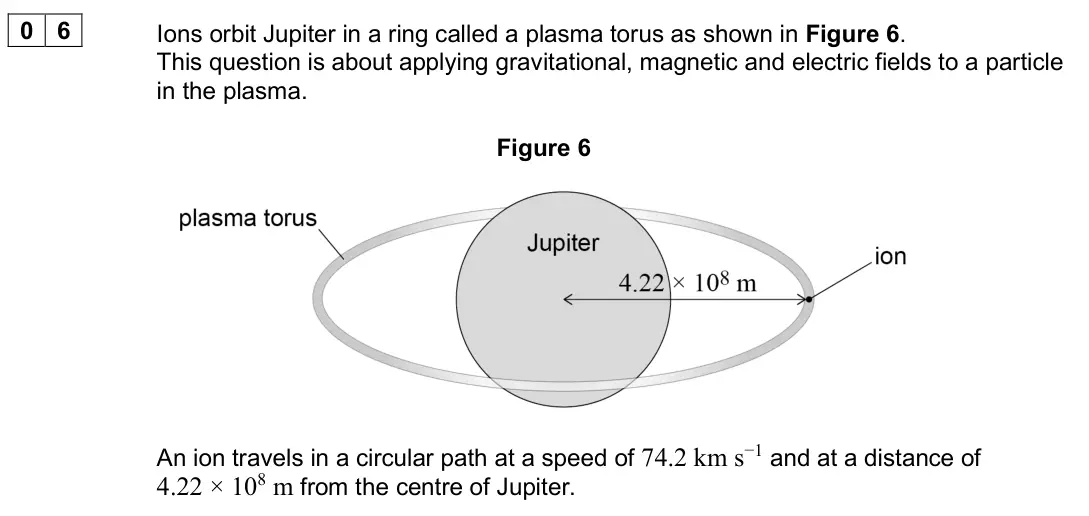
Q05.1
The whole paper ↗
Q05.2
The whole paper ↗Q05.3
The whole paper ↗Q05.4
The whole paper ↗Q04.1
The whole paper ↗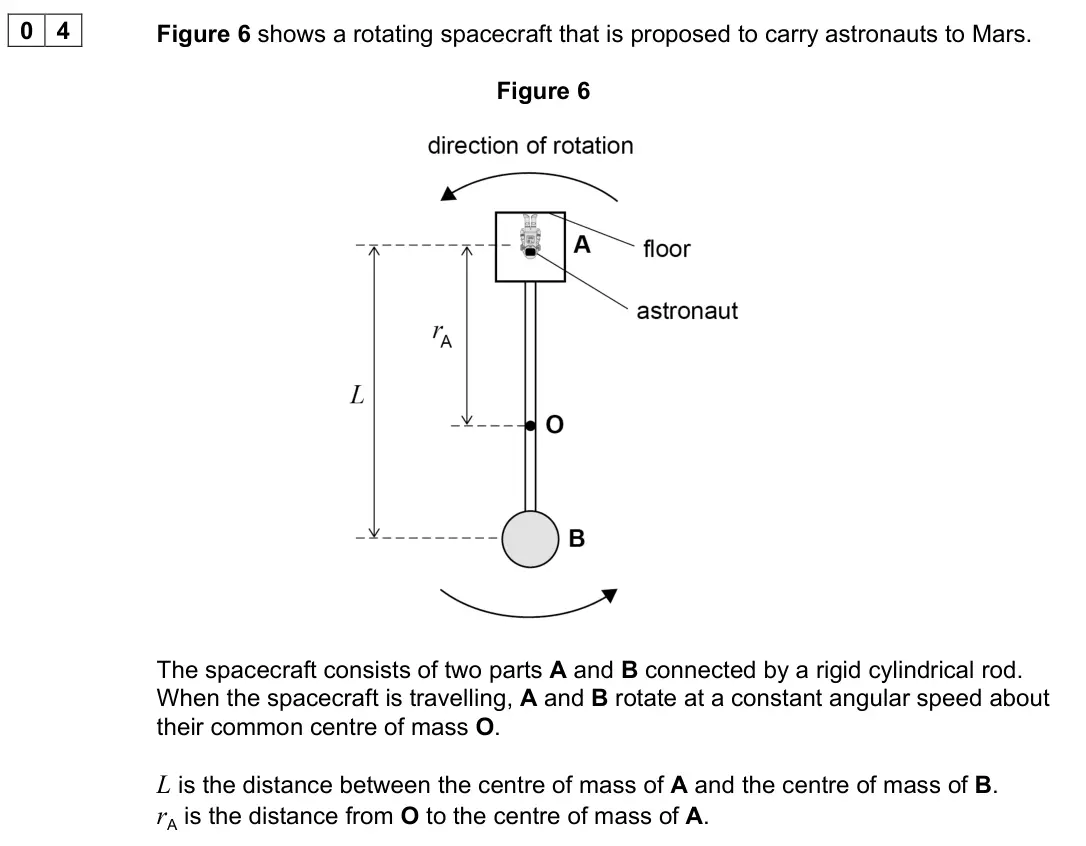
Q04.2
The whole paper ↗Q04.3
The whole paper ↗Q03.2
The whole paper ↗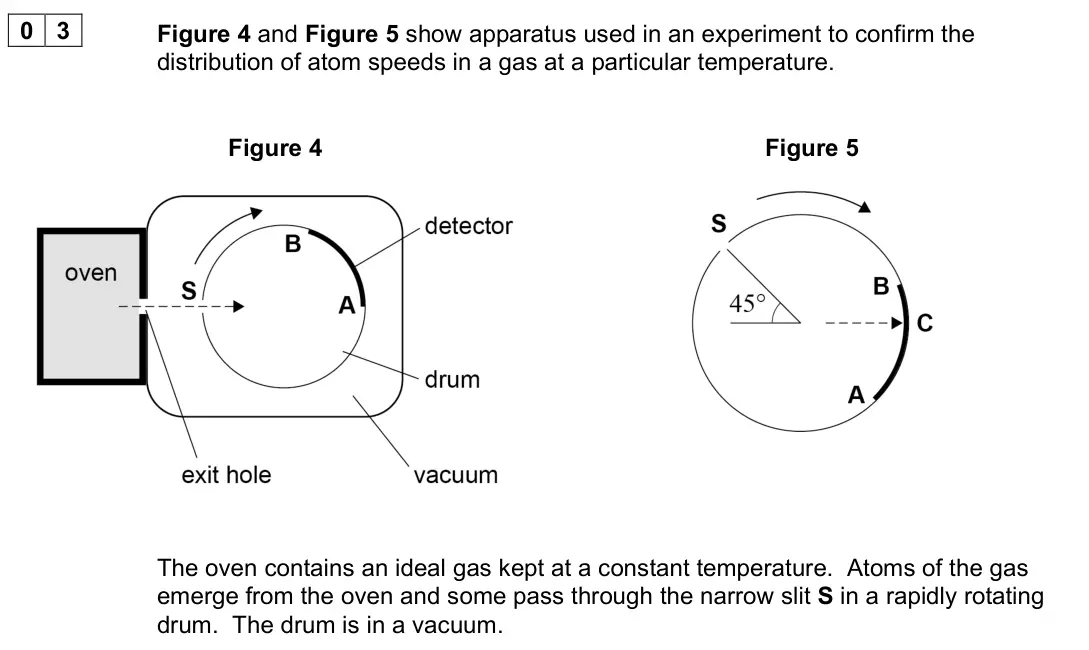
Q04.5
The whole paper ↗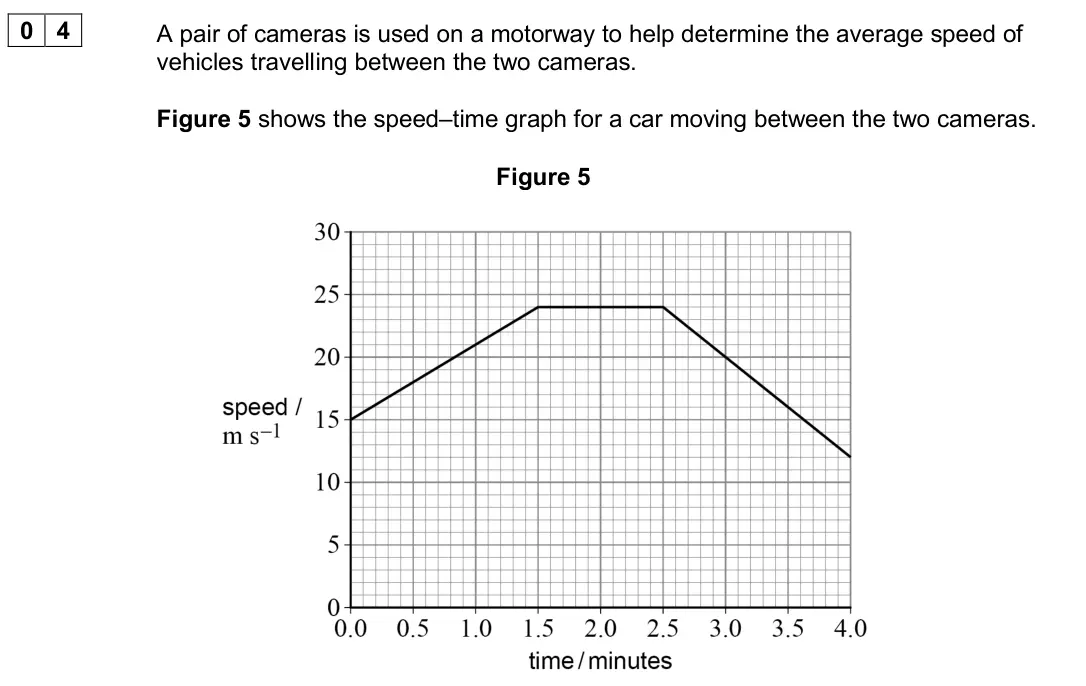
All 73 questions on Circular motion, as a list
- June 2025, Paper 1, Q07.1 (2 marks): At the instant shown in Figure 10 the car is moving with constant speed v in a circle of radius R. Figure 10 The car has kinetic energy Ek. The resultant force
- June 2025, Paper 1, Q07.2 (1 mark): The car just starts to slip when it travels on the track in a circular path of radius 230 m. Deduce the speed of the car. [1 mark] speed = m s−1
- June 2025, Paper 1, Q07.3 (1 mark): The driver wishes to drive this car around the curved section of the track, without slipping, at a speed greater than your answer to Question 07.2. Suggest one
- June 2025, Paper 1, Q07.4 (2 marks): The car in Figure 11 stays at the same height on the curved section of the track. There is no tendency for the car to slip up or down the track and therefore th
- June 2025, Paper 1, Q07.5 (2 marks): A car has a greater maximum speed on a sloped track than on a horizontal track of the same radius. Explain why. [2 marks]
- June 2025, Paper 2, Q06.1 (3 marks): Student A suggests that the gravitational force acting on the ion due to Jupiter provides the centripetal acceleration of the ion. Deduce whether this suggestio
- June 2024, Paper 1, Q28 (1 mark): A small mass is placed at P on a horizontal turntable. The turntable rotates clockwise with a constant angular speed about a vertical axis through its centre O.
- June 2024, Paper 1, Q29 (1 mark): A particle of mass m moves in a circle of radius r. The number of revolutions completed per second is f. What is the kinetic energy of the particle? [1 mark] A
- June 2023, Paper 1, Q28 (1 mark): Two circular discs made of card rotate at constant speed on a common axle. The discs are 2.00 m apart. An air-gun pellet is fired parallel to the axle. The pell
- June 2023, Paper 1, Q30 (1 mark): When an aircraft turns in a horizontal circular path, it banks at an angle θ. The aircraft has mass m and travels at constant speed v in a horizontal circular p
- June 2022, Paper 1, Q05.1 (2 marks): Calculate the time taken for the turntable to complete one revolution. [2 marks] time = s
- June 2022, Paper 1, Q05.2 (1 mark): Figure 10 shows a plan view of the turntable and block. The turntable rotates in a clockwise direction. Draw an arrow on Figure 10 to show the direction of the
- June 2022, Paper 1, Q05.3 (2 marks): The mass of the block is 0.12 kg. Calculate the magnitude of the resultant force on the block. [2 marks] magnitude of force = N
- June 2022, Paper 1, Q05.4 (2 marks): Describe, with reference to one of Newton’s laws of motion, the evidence that a resultant force is acting on the block. [2 marks]
- June 2022, Paper 2, Q10 (1 mark): The Moon orbits the Earth in 27 days. What is the angular speed of the Moon’s orbit? [1 mark] A 4.3 × 10⁻⁷ rad s−1 B 2.7 × 10⁻⁶ rad s−1 C 3.7 × 10⁻² rad s−1 D 2
- November 2021, Paper 1, Q04.1 (2 marks): As the spacecraft rotates, a force that imitates the effect of gravity acts on an astronaut who is in contact with the floor. Explain why. [2 marks]
- November 2021, Paper 1, Q04.2 (2 marks): The forces exerted on A and B by the connecting rod have the same magnitude. mA is the mass of A mB is the mass of B Show, by considering the centripetal forces
- November 2021, Paper 1, Q04.3 (2 marks): In this spacecraft mA < mB. Deduce whether the centre of mass of A or the centre of mass of B rotates with a greater linear speed. [2 marks]
- November 2021, Paper 2, Q03.2 (2 marks): Show that the atom is moving at a speed of about 500 m s−1. [2 marks]
- November 2020, Paper 1, Q04.5 (4 marks): At bends on motorways the road is sloped so that a car is less likely to slide out of its lane when travelling at a high speed. Figure 7 shows a car of mass 120
- June 2019, Paper 1, Q28 (1 mark): An object of mass m moves in a circle of radius r. It completes n revolutions every second. What is the kinetic energy of the object? [1 mark] A 2 2 2 8π mn r B
- June 2018, Paper 1, Q05.1 (2 marks): Show that the linear speed of the acrobats is about 4.5 m s−1 [2 marks]
- June 2018, Paper 1, Q05.2 (3 marks): Determine the tension in each rope that supports the acrobats. [3 marks] tension = N
- June 2018, Paper 1, Q05.3 (3 marks): Discuss the consequences for the forces acting on the pole when one acrobat has a much greater mass than the other. [3 marks]
- June 2017, Paper 1, Q30 (1 mark): A bob of mass 0.50 kg is suspended from the end of a piece of string 0.45 m long. The bob is rotated in a vertical circle at a constant rate of 120 revolutions
- Specimen, Paper 1, Q29 (1 mark): A string passes through a smooth thin tube. Masses m and M are attached to the ends of the string. The tube is moved so that the mass m travels in a horizontal
- Specimen, Paper 2, Q06.4 (3 marks): Read the following passage and answer the questions that follow Satellites used for telecommunications are usually in geostationary orbits. Using suitable dishe
- June 2016, PHYA4 Section A (old spec), Q3 (1 mark): What is the angular speed of a car wheel of diameter 0.400 m when the speed of the car is 108 km h–1? A 75 rad s–1 B 150 rad s–1 C 270 rad s–1 D 540 rad s–1
- June 2016, PHYA4 Section A (old spec), Q4 (1 mark): A ball of mass 0.30 kg is attached to a string and moves in a vertical circle of radius 0.60 m at a constant speed of 5.0 m s–1. Which line, A to D, in the tabl
- June 2015, PHYA4 Section B (old spec), Q5(a)(i) (3 marks): Calculate the angle, in degrees, through which the string turns in 0.40 s. [3 marks] angle degree
- June 2015, PHYA4 Section B (old spec), Q5(a)(ii) (2 marks): Calculate the tension in the string. You may assume that the string is horizontal. [2 marks] tension N
- June 2015, PHYA4 Section B (old spec), Q5(b) (2 marks): The string will break when the tension exceeds 60 N. Calculate the number of revolutions that the ball makes in one second when the tension is 60 N. [2 marks] n
- June 2015, PHYA4 Section B (old spec), Q5(c) (6 marks): Discuss the motion of the ball in terms of the forces that act on it. In your answer you should: l explain how Newton’s three laws of motion apply to its motion
- June 2014, PHYA4 Section A (old spec), Q4 (1 mark): A model car moves in a circular path of radius 0.80m at an angular speed of – rads–1. What is its displacement from point P 6.0s after passing P? A zero B 0.4πm
- June 2014, PHYA4 Section A (old spec), Q5 (1 mark): A small mass is placed at P on a horizontal disc which has its centre at O. The disc rotates anti-clockwise about a vertical axis through O with constant angula
- June 2014, PHYA4 Section A (old spec), Q6 (1 mark): A 0.20kg mass is whirled round in a vertical circle on the end of a light string of length 0.90m. At the top point of the circle the speed of the mass is 8.2 m
- June 2013, PHYA4 Section A (old spec), Q5 (1 mark): The wheel of the London Eye has a diameter of 130m and rotates at a steady speed, completing one rotation every 30 minutes. What is the centripetal acceleration
- June 2013, PHYA4 Section A (old spec), Q6 (1 mark): A small body of mass m rests on a horizontal turntable at a distance r from the centre. If the maximum frictional force between the body and the turntable is ––
- June 2013, PHYA4 Section A (old spec), Q7 (1 mark): A body of mass 0.50kg, fixed to one end of a string, is rotated in a vertical circle of radius 1.5m at an angular speed of 5.0rads–1. What is the maximum tensio
- January 2013, PHYA4 Section A (old spec), Q4 (1 mark): For a particle moving in a circle with uniform speed, which one of the following statements is incorrect? A There is no displacement of the particle in the dire
- January 2013, PHYA4 Section A (old spec), Q5 (1 mark): A revolving mountain top restaurant turns slowly, completing a full rotation in 50 minutes. A man is sitting in the restaurant 15m from the axis of rotation. Wh
- January 2013, PHYA4 Section B (old spec), Q2(a)(ii) (2 marks): Calculate the centripetal force acting on the polar orbiting satellite if its mass is 650kg. centripetal force N (2 marks)
- June 2012, PHYA4 Section A (old spec), Q4 (1 mark): The Earth moves around the Sun in a circular orbit with a radius of 1.5 × 10⁸km. What is the Earth’s approximate speed? A 1.5 × 10³ms–1 B 5.0 × 10³ms–1 C 1.0 ×
- June 2012, PHYA4 Section A (old spec), Q5 (1 mark): A particle moves in a circular path at constant speed. Which one of the following statements is correct? A The velocity of the particle is directed towards the
- June 2012, PHYA4 Section A (old spec), Q6 (1 mark): The diagram shows a smooth thin tube through which passes a string with masses m and M attached to its ends. The tube is moved so that the mass m travels in a h
- June 2012, PHYA4 Section B (old spec), Q3(b)(i) (3 marks): The charged particles travelling around the LHC may be protons. Calculate the centripetal force acting on a proton when travelling in a circular path of circumf
- January 2012, PHYA4 Section A (old spec), Q3 (1 mark): A ball of mass m, which is fixed to the end of a light string of length l, is released from rest at X. It swings in a circular path, passing through the lowest
- January 2012, PHYA4 Section A (old spec), Q4 (1 mark): A disc of diameter D is turning at a steady angular speed at frequency f about an axis through its centre. What is the centripetal force on a small object O of
- January 2012, PHYA4 Section A (old spec), Q5 (1 mark): What is the angular speed of a car wheel of diameter 0.400m when the speed of the car is 108kmh–1? A 175rads–1 B 150rads–1 C 270rads–1 D 540rads–1
- June 2011, PHYA4 Section A (old spec), Q4 (1 mark): For a particle moving in a circle with uniform speed, which one of the following statements is correct? A The kinetic energy of the particle is constant. B The
- June 2011, PHYA4 Section A (old spec), Q5 (1 mark): A young child of mass 20kg stands at the centre of a uniform horizontal platform which rotates at a constant angular speed of 3.0rads–1. The child begins to wal
- June 2011, PHYA4 Section A (old spec), Q6 (1 mark): A particle travels at a constant speed around a circle of radius r with centripetal acceleration a. What is the time taken for ten complete rotations? A B C 20π
- June 2011, PHYA4 Section B (old spec), Q1(a)(i) (1 mark): Draw arrows on Figure 2 below to show the forces that act on the parcel as it passes over the highest point of the bridge. Label these forces. (1 mark) parcel f
- June 2011, PHYA4 Section B (old spec), Q1(a)(ii) (1 mark): Write down an equation that relates the contact force, R, between the parcel and the floor of the van to m, v, r and the gravitational field strength, g. (1 mar
- June 2011, PHYA4 Section B (old spec), Q1(a)(iii) (2 marks): Calculate R if m = 12kg, r = 23m, and v = 11ms–1. answer = N (2 marks)
- June 2011, PHYA4 Section B (old spec), Q1(b) (3 marks): Explain what would happen to the magnitude of R if the van passed over the bridge at a higher speed. What would be the significance of any van speed greater tha
- January 2011, PHYA4 Section A (old spec), Q2 (1 mark): The diagram shows a disc of diameter 120mm that can turn about an axis through its centre. The disc is turned through an angle of 30o in 20 ms. What is the aver
- January 2011, PHYA4 Section A (old spec), Q3 (1 mark): A particle of mass m moves in a circle of radius r at a uniform speed with frequency f. What is the kinetic energy of the particle? A B C 2π2 mf 2r 2 D 4π2 mf 2
- January 2011, PHYA4 Section A (old spec), Q10 (1 mark): The diagram shows two positions, X and Y, on the Earth’s surface. Which line, A to D, in the table gives correct comparisons at X and Y for gravitational potent
- January 2011, PHYA4 Section A (old spec), Q11 (1 mark): What would the period of rotation of the Earth need to be if objects at the equator were to appear weightless? radius of Earth = 6.4 × 10⁶ m A 4.5 × 10⁻² hours
- January 2011, PHYA4 Section B (old spec), Q1(a) (3 marks): Calculate the angular speed of the Hubble telescope, stating an appropriate unit. answer = (3 marks)
- January 2011, PHYA4 Section B (old spec), Q1(b)(ii) (2 marks): The mass of the Hubble telescope is 1.1 × 10⁴ kg. Calculate the magnitude of the centripetal force that acts on it. answer = N (2 marks)
- June 2010, PHYA4 Section A (old spec), Q4 (1 mark): A mass on the end of a string is whirled round in a horizontal circle at increasing speed until the string breaks. The subsequent path taken by the mass is A a
- June 2010, PHYA4 Section A (old spec), Q5 (1 mark): A particle of mass m moves in a circle of radius r at uniform speed, taking time T for each revolution. What is the kinetic energy of the particle? A B C D π2mr
- June 2010, PHYA4 Section B (old spec), Q4(b) (2 marks): Explain why the electron is accelerating even though it is travelling at constant speed.
- June 2010, PHYA4 Section B (old spec), Q4(c)(i) (2 marks): By considering the centripetal force acting on the electron, show that its speed is 5.6 × 10⁶ms–1. (2 marks)
- June 2010, PHYA4 Section B (old spec), Q4(c)(ii) (2 marks): Calculate the angular speed of the electron, giving an appropriate unit. answer = (2 marks)
- June 2010, PHYA4 Section B (old spec), Q4(c)(iii) (2 marks): How many times does the electron travel around the circle in one minute? answer = (2 marks)
- January 2010, PHYA4 Section A (old spec), Q4 (1 mark): What is the angular speed of a point on the Earth’s equator? A 7.3 × 10⁻⁵rads–1 B 4.2 × 10⁻³rads–1 C 2.6 × 10⁻¹rads–1 D 15rads–1
- January 2010, PHYA4 Section A (old spec), Q5 (1 mark): Which one of the following does not involve a centripetal force? A an electron in orbit around a nucleus B a car going round a bend C an α particle in a magneti
- June 2008, PA04A (2008 spec), Q8 (2 marks): 8 The wheel of the London Eye has a diameter of 130 m and can rotate at a steady speed, completing one rotation every 30 minutes. What is the centripetal accele
- January 2008, PA04A (2008 spec), Q9 (2 marks): 9 A small body of mass m rests on a horizontal turntable at a distance r from the centre. If the maximum frictional force between the body and the turntable is
- January 2008, PA04B (2008 spec), Q5(b) (5 marks): (b) One of the moons of Jupiter, Ganymede, is the largest satellite in the solar system. Its orbital period is equal to 7.15 Earth days and the radius of its or
Questions, mark schemes and examiner’s reports are © AQA, from their published past papers. Plumi isn’t affiliated with any exam board. Want whole papers? AQA A-Level Physics past papers.
The Plumi iPad app also offers exam-style questions with AI feedback on your handwritten working.