 plumi
Electromagnetic waves: AQA A‑Level Physics questions
AQA A-Level Physics past-paper questions on 3.12.2.3 Electromagnetic waves, 2008–2025, with mark schemes and examiner’s reports where available.
Paper
All papers
Exam
All years
Calculations
Q03.1
The whole paper ↗
Q03.2
The whole paper ↗Q04.1
The whole paper ↗
Q03.1
The whole paper ↗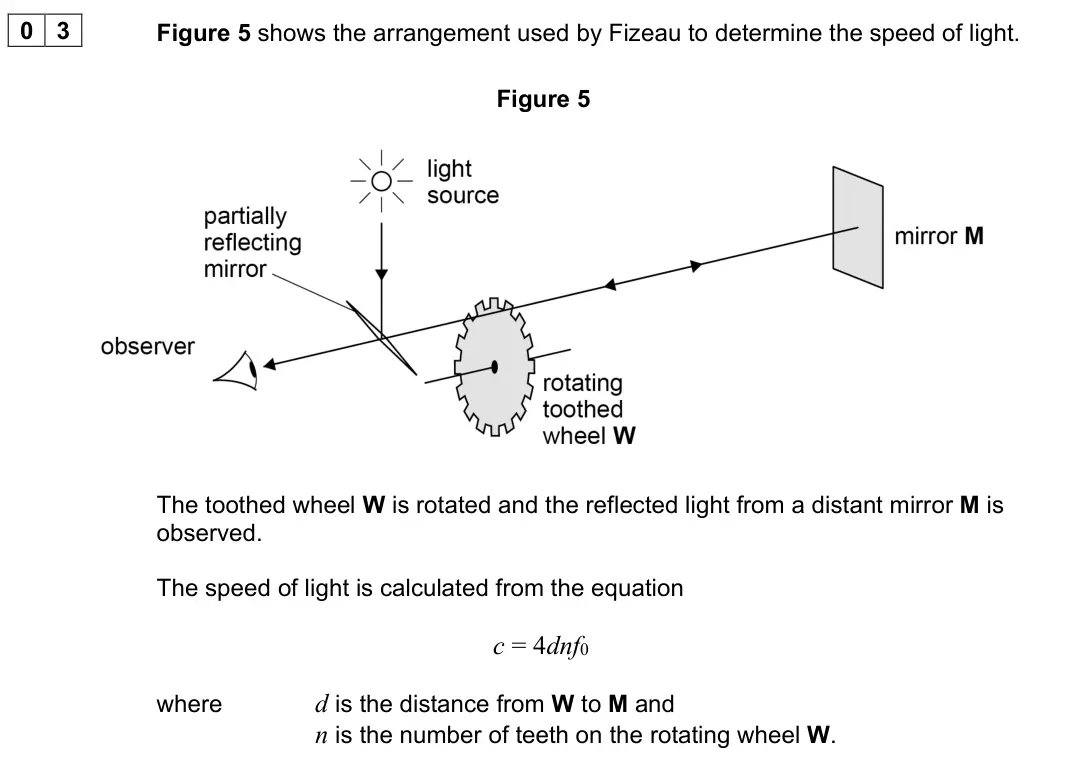
Q03.2
The whole paper ↗Q03.3
The whole paper ↗Q02.1
The whole paper ↗
Q02.2
The whole paper ↗Q02.3
The whole paper ↗Q02.3
The whole paper ↗
Q02.1
The whole paper ↗
Q02.2
The whole paper ↗Q02.1
The whole paper ↗
Q02.2
The whole paper ↗Q02.3
The whole paper ↗Q02.4
The whole paper ↗Q3(a)
The whole paper ↗Q3(b)(i)
The whole paper ↗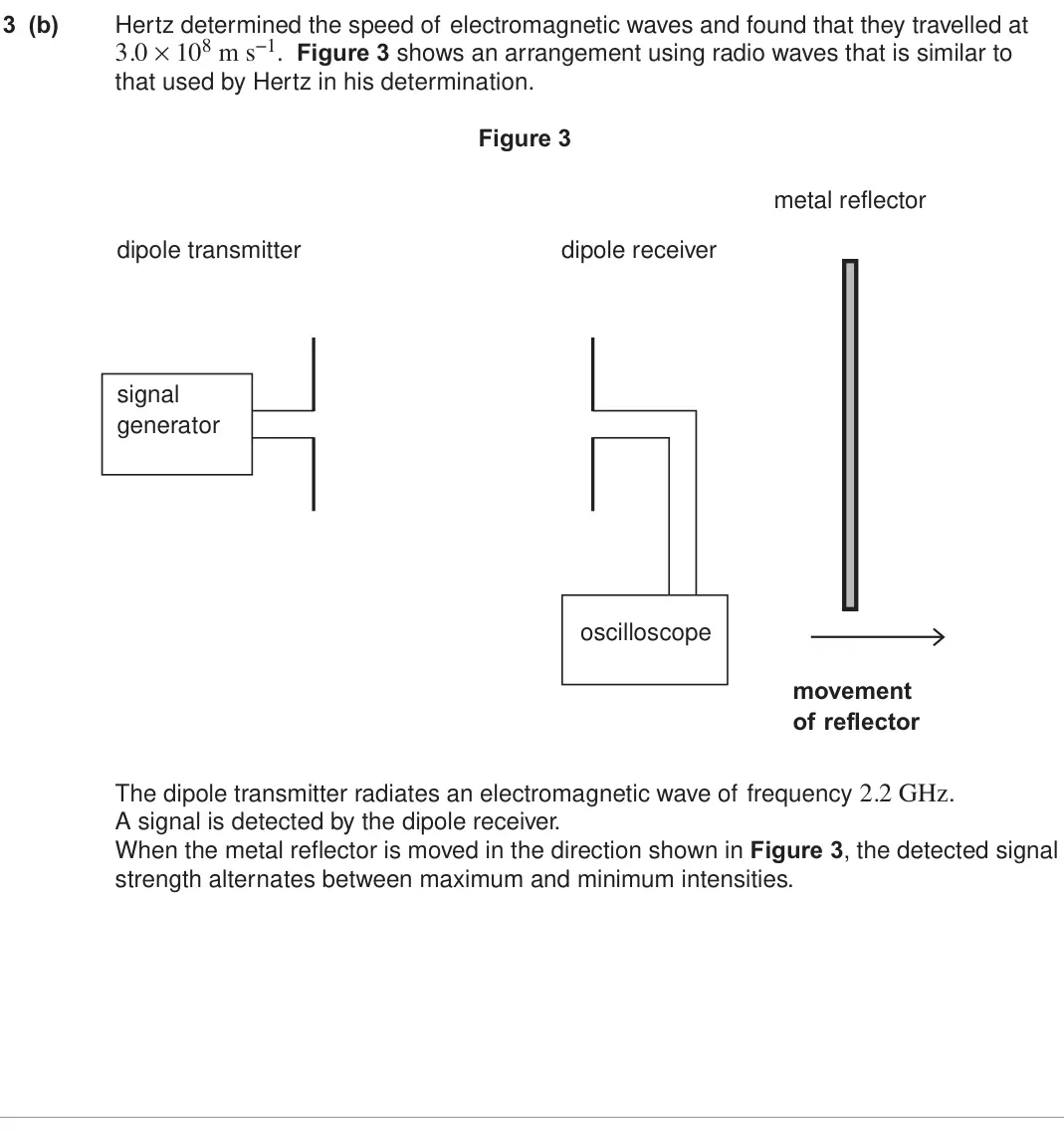
All 28 questions on Electromagnetic waves, as a list
- June 2025, Paper 3 Turning points, Q03 (6 marks): The work of Fizeau, Foucault, Hertz and Maxwell contributed to our understanding of the nature of light. Fizeau measured the speed of light in air. Foucault con
- June 2024, Paper 3 Turning points, Q03 (5 marks): Hertz did an experiment to determine the speed of radio waves. Describe this experiment. In your answer you should: • include a labelled diagram • state the mea
- June 2023, Paper 3 Turning points, Q03.1 (1 mark): Draw and label on Figure 3: • the corresponding electric field • the direction of propagation of the wave. [1 mark]
- June 2023, Paper 3 Turning points, Q03.2 (1 mark): Which scientist proposed the electromagnetic wave model of light? Tick () one box. [1 mark] Hertz Huygens Maxwell Young
- June 2023, Paper 3 Turning points, Q04.1 (2 marks): State the other postulate and explain how it is consistent with the equation: c = 0 0 1 [2 marks]
- June 2022, Paper 3 Turning points, Q03.1 (2 marks): State what f0 represents in the equation. [2 marks]
- June 2022, Paper 3 Turning points, Q03.2 (2 marks): The experiment is attempted using a rotating wheel with 720 teeth that can be rotated at up to 620 revolutions per minute. The distance between W and M is 8.5 k
- June 2022, Paper 3 Turning points, Q03.3 (2 marks): The determination of the speed of light took on extra significance when Maxwell derived the wave-speed equation c = 0 0 1 State how ε0 and µ0 are related to the
- November 2021, Paper 3 Turning points, Q02.1 (2 marks): Show that Maxwell’s theory agrees with the accepted value for the speed of light in a vacuum. Use information from the Data and Formulae Booklet in your answer.
- November 2021, Paper 3 Turning points, Q02.2 (4 marks): T is switched on so that an oscillating current is produced in the metal rods. An emf is detected in the conducting loop aerial. Explain this experiment with re
- November 2021, Paper 3 Turning points, Q02.3 (4 marks): In a different experiment Hertz used stationary waves to determine the speed of radio waves. Figure 4 shows an experimental arrangement similar to the arrangeme
- June 2019, Paper 3 Turning points, Q02.3 (3 marks): Light is now known to behave as an electromagnetic wave. Describe a plane-polarised electromagnetic wave travelling through a vacuum. You may wish to draw a lab
- June 2018, Paper 3 Turning points, Q02.1 (3 marks): Sketch a graph on Figure 4 to show how the amplitude detected by the dipole receiver varies with angle of rotation as the receiver is turned through 360° Start
- June 2018, Paper 3 Turning points, Q02.2 (2 marks): Maxwell derived the equation for the speed c of electromagnetic waves, where 0 is the permeability of free space and 𝜀𝜀0 is the permittivity of free space. Expl
- June 2017, Paper 3 Turning points, Q02.1 (2 marks): Explain these observations. [2 marks] Observation A Observation B
- June 2017, Paper 3 Turning points, Q02.2 (2 marks): Table 1 shows data from Fizeau’s experiment at the instant when observation B is made. Table 1 d, distance from M to W 8.6 km f, number of wheel revolutions per
- June 2017, Paper 3 Turning points, Q02.3 (2 marks): The speed of the wheel is further increased. Deduce the value of f when the observer would next be unable to see light returning from the mirror. [2 marks]
- June 2017, Paper 3 Turning points, Q02.4 (3 marks): Explain how the nature of light is implied by Maxwell’s theory of electromagnetic waves and Fizeau’s result. [3 marks]
- June 2016, PHYA5 Turning points (old spec), Q3(a) (2 marks): Maxwell predicted the existence of electromagnetic waves that travelled in free space. Identify the two quantities that vary in an electromagnetic wave and stat
- June 2016, PHYA5 Turning points (old spec), Q3(b)(i) (3 marks): Explain why the detected signal strength changes from a maximum to a minimum as the metal reflector is moved. [3 marks] ________________________________________
- June 2016, PHYA5 Turning points (old spec), Q3(b)(ii) (2 marks): Determine the least distance the reflector has to move for the detected signal strength to change from a maximum to a minimum to confirm Hertz’s value for the s
- June 2016, PHYA5 Turning points (old spec), Q3(c) (1 mark): Which one of the following observations originally led to the conclusion that light is an electromagnetic wave? Place a tick () in the right-hand column to sho
- June 2013, PHYA5 Turning points (old spec), Q3(a) (6 marks): Explain why stationary waves are formed in this arrangement and describe how the wavelength of the radio waves can be determined by moving a suitable detector a
- June 2013, PHYA5 Turning points (old spec), Q3(b) (2 marks): Hertz knew the frequency of the radio waves from the electrical characteristics of the transmitter. He found the wavelength from the investigation described in
- June 2012, PHYA5 Turning points (old spec), Q2(a) (3 marks): Describe, in terms of electric and magnetic fields, a plane polarised electromagnetic wave travelling in a vacuum. You may wish to draw a labelled diagram.
- June 2012, PHYA5 Turning points (old spec), Q2(b) (2 marks): In his theory of electromagnetic waves, Maxwell predicted that the speed of all electromagnetic waves travelling through free space is given by c = –––––– where
- June 2012, PHYA5 Turning points (old spec), Q2(c)(i) (3 marks): Explain why an alternating emf is induced in the loop when it is in this position.
- June 2012, PHYA5 Turning points (old spec), Q2(c)(ii) (1 mark): Explain why an alternating emf cannot be detected if the detector loop is turned through 90o about the axis XY. (1 mark)
Questions, mark schemes and examiner’s reports are © AQA, from their published past papers. Plumi isn’t affiliated with any exam board. Want whole papers? AQA A-Level Physics past papers.
The Plumi iPad app also offers exam-style questions with AI feedback on your handwritten working.