 plumi
The discovery of photoelectricity: AQA A‑Level Physics questions
AQA A-Level Physics past-paper questions on 3.12.2.4 The discovery of photoelectricity, 2008–2025, with mark schemes and examiner’s reports where available.
Paper
All papers
Exam
All years
Calculations
Q02.1
The whole paper ↗
Q02.2
The whole paper ↗Q02.1
The whole paper ↗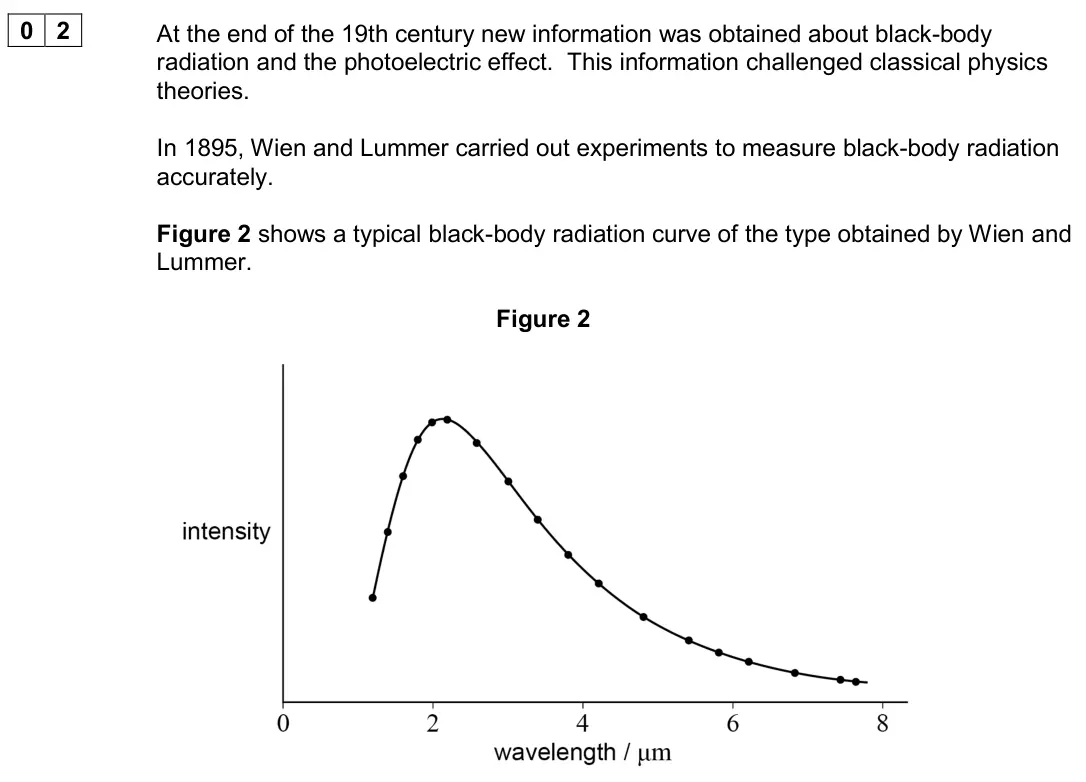
Q02.2
The whole paper ↗Q02.3
The whole paper ↗Q02.4
The whole paper ↗Q03.1
The whole paper ↗
Q03.2
The whole paper ↗Q03.3
The whole paper ↗Q03.4
The whole paper ↗Q2(a)
The whole paper ↗Q2(b)(i)
The whole paper ↗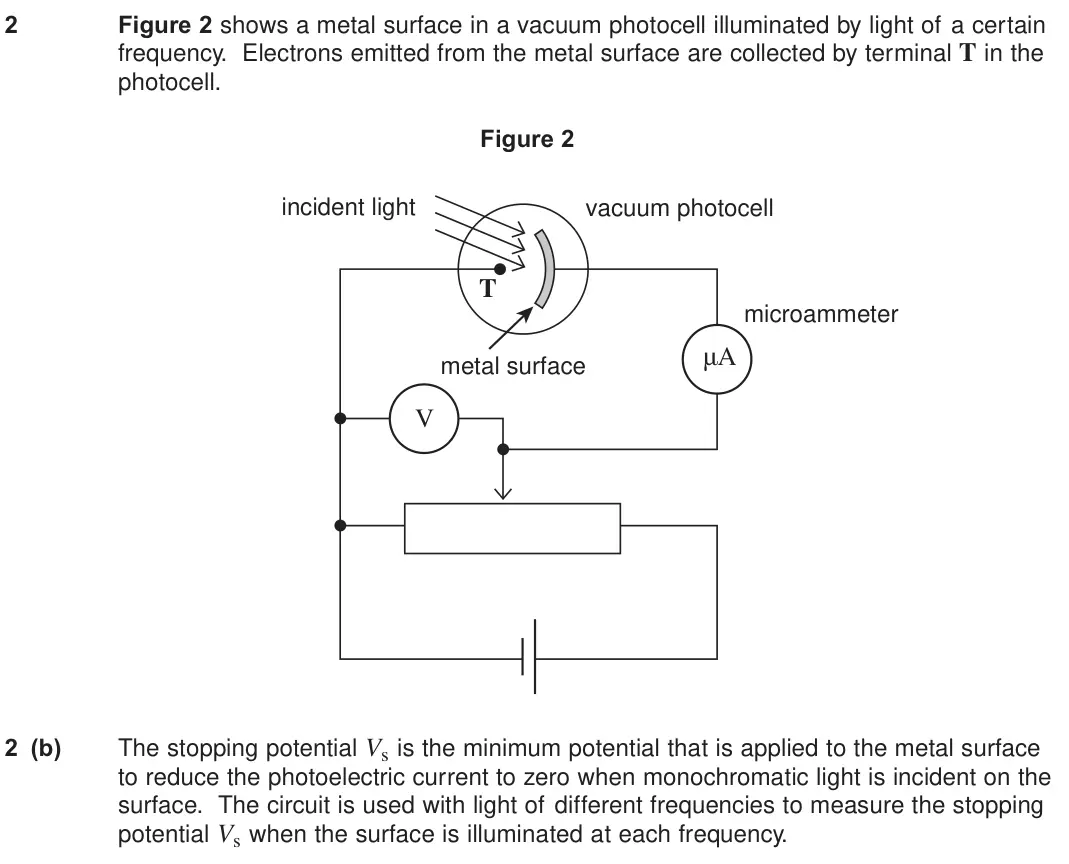
Q2(b)(ii)
The whole paper ↗Q2(b)(ii)
The whole paper ↗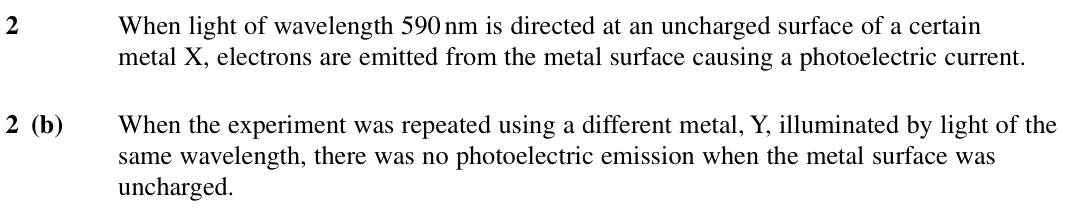
All 14 questions on The discovery of photoelectricity, as a list
- June 2025, Paper 3 Turning points, Q02.1 (3 marks): Compare these experimental results and theoretical predictions. You may sketch and label a graph or graphs on Figure 4 as part of your answer. [3 marks] Figure
- June 2025, Paper 3 Turning points, Q02.2 (1 mark): A proposal was made that allowed a resolution of the contradiction. Outline this proposal. [1 mark]
- November 2020, Paper 3 Turning points, Q02.1 (2 marks): State what is meant by black-body radiation. [2 marks]
- November 2020, Paper 3 Turning points, Q02.2 (2 marks): Describe how the predictions of classical theory compare with Wien and Lummer’s experimental results. Annotate Figure 2 as part of your answer. [2 marks]
- November 2020, Paper 3 Turning points, Q02.3 (2 marks): In 1900 Max Planck suggested a solution to the problems of the classical theory. Outline the main aspects of his suggestion. [2 marks]
- November 2020, Paper 3 Turning points, Q02.4 (6 marks): Planck’s suggestion was developed by Albert Einstein to explain the results of photoelectric effect experiments. Discuss Einstein’s explanation of photoelectric
- June 2018, Paper 3 Turning points, Q03.1 (3 marks): Calculate the wavelength, in nm, of the electromagnetic radiation incident on the metal surface. [3 marks] wavelength = nm
- June 2018, Paper 3 Turning points, Q03.2 (3 marks): The intensity of the electromagnetic radiation is increased. No adjustment is made to the potential divider. The classical wave model and the photon model make
- June 2018, Paper 3 Turning points, Q03.3 (2 marks): The potential divider in Figure 5 is returned to its original position so that a photocurrent is detected by the microammeter. The potential divider is then adj
- June 2018, Paper 3 Turning points, Q03.4 (1 mark): The apparatus shown in Figure 5 is used to investigate three different metal surfaces A, B and C. Table 2 shows, for each of the three surfaces, a voltmeter rea
- June 2016, PHYA5 Turning points (old spec), Q2(a) (6 marks): The arrangement shown in Figure 2 is used by a student in a photoelectric effect experiment. Figure 2 Monochromatic light falls on the photocathode. A current i
- June 2014, PHYA5 Turning points (old spec), Q2(b)(i) (2 marks): Draw a graph on the axes below to show how Vs varies with the frequency f of the incident light. [2 marks] Vs 0 0 f
- June 2014, PHYA5 Turning points (old spec), Q2(b)(ii) (3 marks): Use the photoelectric equation hf = φ + Ek to explain your graph. [3 marks]
- June 2010, PHYA5 Turning points (old spec), Q2(b)(ii) (2 marks): How did this observation contribute to the failure of the wave theory of light?
Questions, mark schemes and examiner’s reports are © AQA, from their published past papers. Plumi isn’t affiliated with any exam board. Want whole papers? AQA A-Level Physics past papers.
The Plumi iPad app also offers exam-style questions with AI feedback on your handwritten working.