 plumi
Wave–particle duality: AQA A‑Level Physics questions
AQA A-Level Physics past-paper questions on 3.12.2.5 Wave–particle duality, 2008–2025, with mark schemes and examiner’s reports where available.
Paper
All papers
Exam
All years
Calculations
Q01.3
The whole paper ↗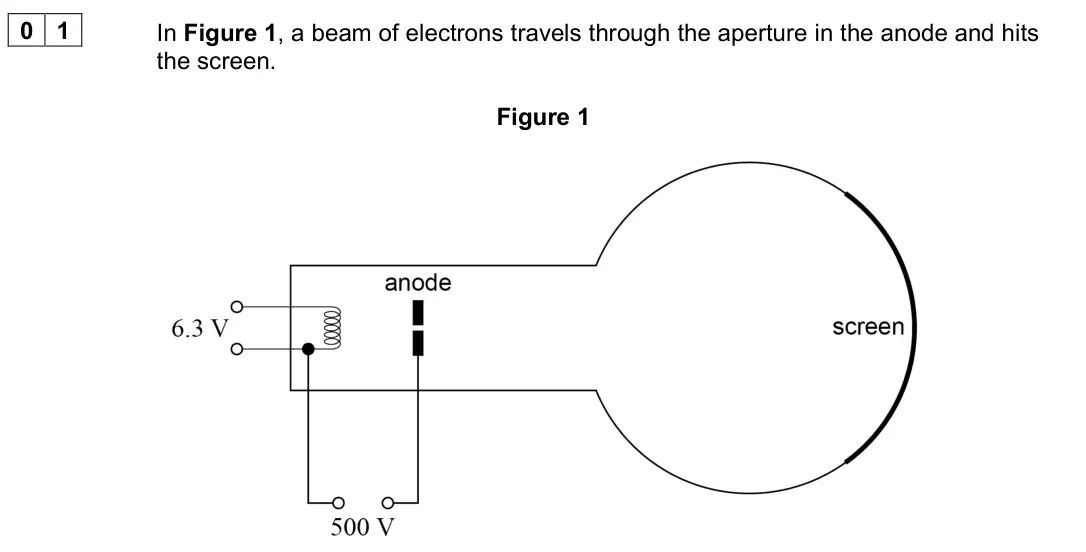
Q01.2
The whole paper ↗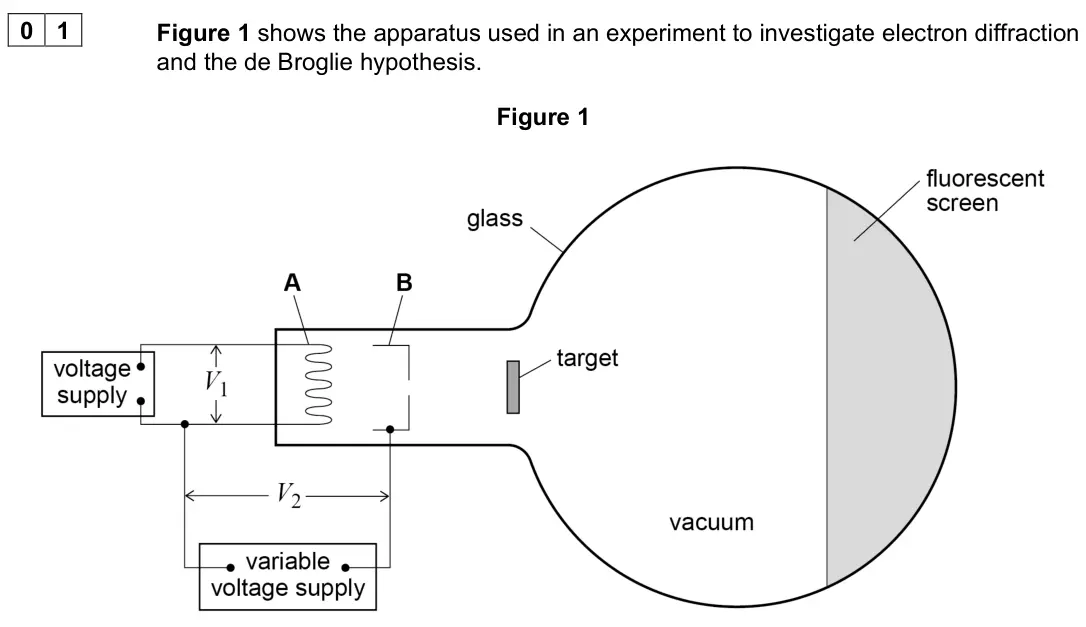
Q01.3
The whole paper ↗Q03.3
The whole paper ↗Q03.1
The whole paper ↗
Q03.2
The whole paper ↗Q03.3
The whole paper ↗Q2(b)
The whole paper ↗Q3(a)(ii)
The whole paper ↗
Q2(a)
The whole paper ↗Q2(b)
The whole paper ↗Q2(c)
The whole paper ↗Q3(a)
The whole paper ↗Q3(b)(i)
The whole paper ↗
Q1(a)(i)
The whole paper ↗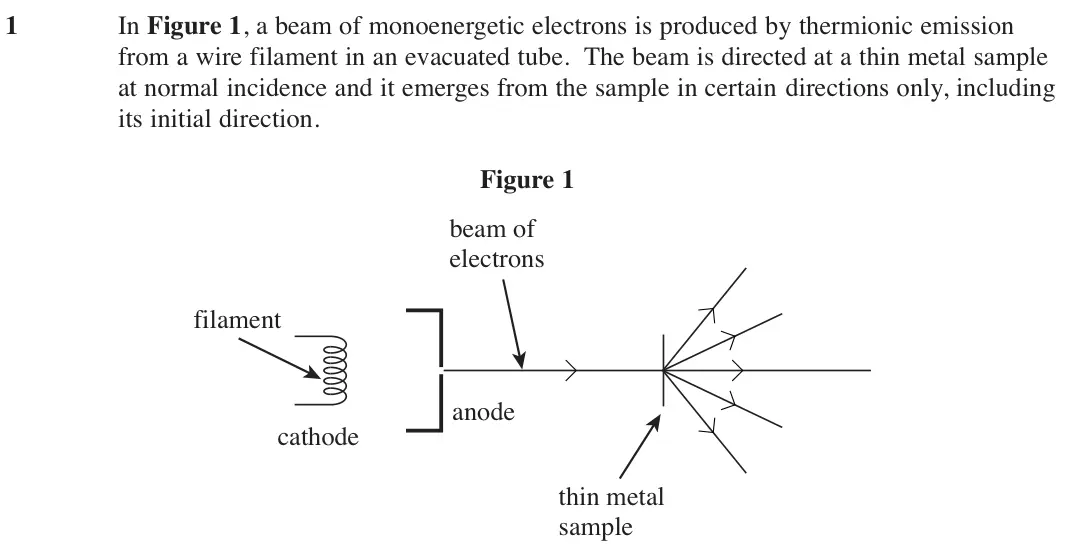
Q1(a)(ii)
The whole paper ↗Q1(b)(i)
The whole paper ↗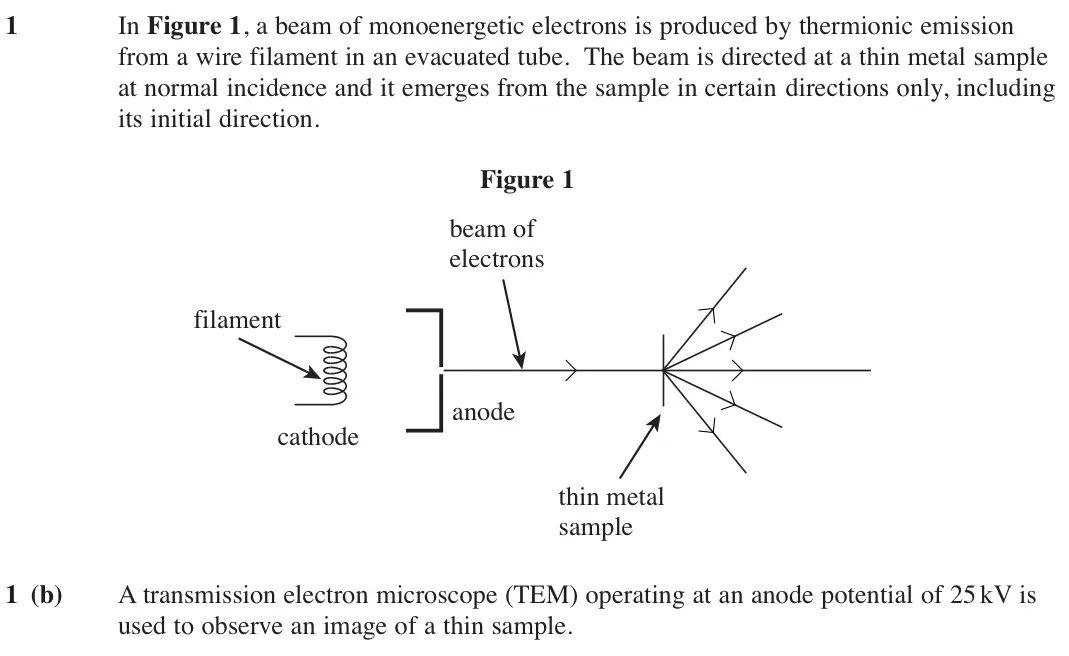
Q5(a)
The whole paper ↗
All 18 questions on Wave–particle duality, as a list
- June 2023, Paper 3 Turning points, Q01.3 (3 marks): A student suggests that the apparatus can be used to demonstrate the wave properties of electrons in the beam, provided that the aperture in the anode has a sui
- November 2021, Paper 3 Turning points, Q01.2 (4 marks): In the experiment, electrons are incident on a target made of a crystalline material. The electron wavelengths need to be about 50% the size of an atom to produ
- November 2021, Paper 3 Turning points, Q01.3 (4 marks): Figure 2 shows a typical diffraction pattern produced on the screen by the electrons. Figure 2 Explain how measurements made with the apparatus in Figure 1 can
- November 2020, Paper 3 Turning points, Q03.3 (3 marks): The smallest size of objects that the STM can resolve is similar to the de Broglie wavelength of the tunnelling electrons. Deduce whether electrons with kinetic
- June 2019, Paper 3 Turning points, Q03.1 (2 marks): State de Broglie’s hypothesis. [2 marks]
- June 2019, Paper 3 Turning points, Q03.2 (2 marks): The voltmeter in Figure 3 shows a reading of 3.5 kV. Determine whether this voltmeter reading is consistent with a de Broglie wavelength for the electrons in th
- June 2019, Paper 3 Turning points, Q03.3 (4 marks): The experiment is repeated using a similar arrangement to that shown in Figure 3. Figure 4 shows the diffraction patterns from the two experiments. Figure 4 fir
- June 2015, PHYA5 Turning points (old spec), Q2(b) (4 marks): Electromagnetic waves and matter are now known to exhibit both particle and wave behaviour. The photons for a particular X-ray wavelength have energy 5.0 keV. C
- June 2014, PHYA5 Turning points (old spec), Q3(a)(ii) (3 marks): Calculate the de Broglie wavelength of the electrons in the beam of a TEM in which the anode potential is 21 kV. Give your answer to an appropriate number of si
- June 2013, PHYA5 Turning points (old spec), Q2(a) (2 marks): State de Broglie’s hypothesis. (2 marks)
- June 2013, PHYA5 Turning points (old spec), Q2(b) (4 marks): Neutrons in a narrow beam can be diffracted by crystals thereby exhibiting wave behaviour. Calculate the de Broglie wavelength of a neutron of kinetic energy 0.
- June 2013, PHYA5 Turning points (old spec), Q2(c) (2 marks): Explain why an electron of the same de Broglie wavelength as the neutron in part (b) has much more kinetic energy than 0.021eV. Assume relativistic effects are
- June 2012, PHYA5 Turning points (old spec), Q3(a) (6 marks): Light has a dual wave-particle nature. State and outline a piece of evidence for the wave nature of light and a piece of evidence for its particle nature. For e
- June 2012, PHYA5 Turning points (old spec), Q3(b)(i) (2 marks): Show that the electron has a de Broglie wavelength of 1.24 × 10⁻¹² m. (2 marks)
- June 2011, PHYA5 Turning points (old spec), Q1(a)(i) (1 mark): Name the physical process occurring at the thin metal sample in Figure 1 which shows the electrons behaving as waves. (1 mark)
- June 2011, PHYA5 Turning points (old spec), Q1(a)(ii) (2 marks): Explain why the electrons need to be monoenergetic in order for them to emerge in certain directions only. (2 marks)
- June 2011, PHYA5 Turning points (old spec), Q1(b)(i) (4 marks): Calculate the momentum of the electrons emerging from the anode, stating an appropriate unit. answer = (4 marks)
- June 2008, PHA8W (2008 spec), Q5(a) (3 marks): 5 (a) Calculate the de Broglie wavelength of a 15 keV electron. (3 marks)
Questions, mark schemes and examiner’s reports are © AQA, from their published past papers. Plumi isn’t affiliated with any exam board. Want whole papers? AQA A-Level Physics past papers.
The Plumi iPad app also offers exam-style questions with AI feedback on your handwritten working.