 plumi
Electron microscopes: AQA A‑Level Physics questions
AQA A-Level Physics past-paper questions on 3.12.2.6 Electron microscopes, 2008–2025, with mark schemes and examiner’s reports where available.
Paper
All papers
Exam
All years
Calculations
Q01.2
The whole paper ↗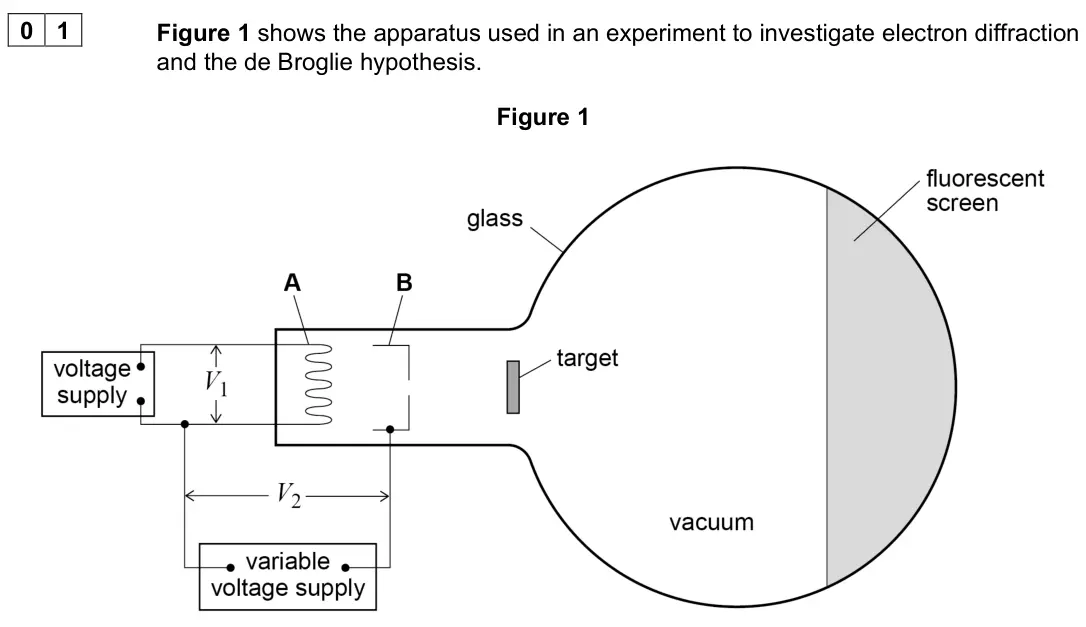
Q01.4
The whole paper ↗Q03.1
The whole paper ↗Q03.2
The whole paper ↗Q03.3
The whole paper ↗Q03.2
The whole paper ↗
Q03.3
The whole paper ↗Q3(a)(i)
The whole paper ↗
Q3(b)
The whole paper ↗Q1(b)(i)
The whole paper ↗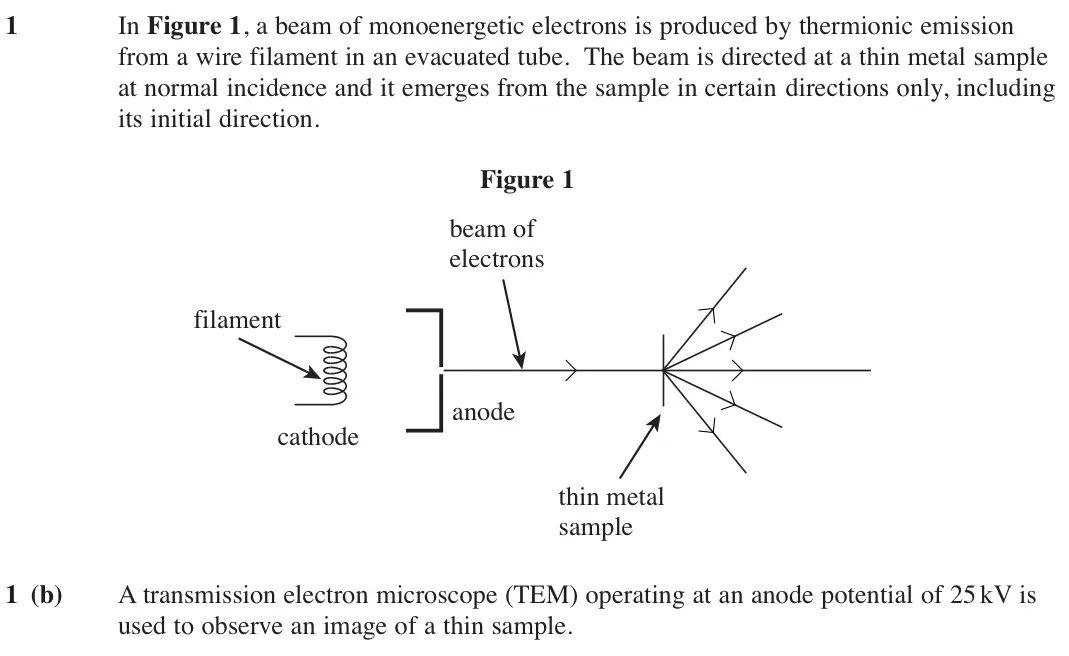
Q1(b)(ii)
The whole paper ↗Q3(a)
The whole paper ↗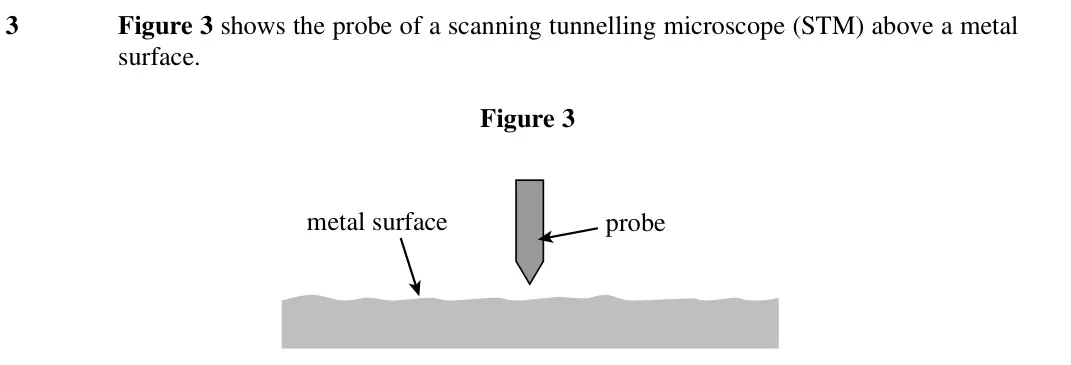
Q3(b)
The whole paper ↗Q5(a)
The whole paper ↗
Q5(b)
The whole paper ↗
All 15 questions on Electron microscopes, as a list
- November 2021, Paper 3 Turning points, Q01.2 (4 marks): In the experiment, electrons are incident on a target made of a crystalline material. The electron wavelengths need to be about 50% the size of an atom to produ
- November 2021, Paper 3 Turning points, Q01.4 (1 mark): STM and TEM are abbreviations for two types of electron microscope. Which row links the type of microscope to a relevant property of moving electrons? Tick ()
- November 2020, Paper 3 Turning points, Q03.1 (2 marks): The scanning tunnelling microscope (STM) uses a process called quantum tunnelling. Explain what is meant by quantum tunnelling of an electron in an STM. You may
- November 2020, Paper 3 Turning points, Q03.2 (3 marks): An STM is used to map the positions of the atoms between points A and B on the surface of a sample. Figure 3 shows some of the features of the operation of an S
- November 2020, Paper 3 Turning points, Q03.3 (3 marks): The smallest size of objects that the STM can resolve is similar to the de Broglie wavelength of the tunnelling electrons. Deduce whether electrons with kinetic
- June 2017, Paper 3 Turning points, Q03.2 (3 marks): The electrons in a particular TEM have a kinetic energy of 4.1 × 10⁻¹⁶ J. Relativistic effects are negligible for this electron energy. Suggest, with a calculat
- June 2017, Paper 3 Turning points, Q03.3 (6 marks): A typical TEM can accelerate electrons to very high speeds and form high resolution images. Explain: • the process of image formation, and • the factors that af
- June 2014, PHYA5 Turning points (old spec), Q3(a)(i) (2 marks): Explain why a magnetic lens deflects the electrons without changing their kinetic energy. [2 marks]
- June 2014, PHYA5 Turning points (old spec), Q3(b) (6 marks): In the operation of a TEM, electrons pass through a thin sample and form a magnified image of the sample on a fluorescent screen. Describe the physical processe
- June 2011, PHYA5 Turning points (old spec), Q1(b)(i) (4 marks): Calculate the momentum of the electrons emerging from the anode, stating an appropriate unit. answer = (4 marks)
- June 2011, PHYA5 Turning points (old spec), Q1(b)(ii) (3 marks): Describe and explain how the resolution of the image would change if the anode potential were increased.
- June 2010, PHYA5 Turning points (old spec), Q3(a) (6 marks): Explain why electrons can cross the gap between the tip of the probe and the surface, provided • the gap is sufficiently narrow • a potential difference is appl
- June 2010, PHYA5 Turning points (old spec), Q3(b) (2 marks): The probe is moved horizontally in a straight line across the surface. As it moves, the current due to the transfer of electrons between the surface and the pro
- June 2008, PHA8W (2008 spec), Q5(a) (3 marks): 5 (a) Calculate the de Broglie wavelength of a 15 keV electron. (3 marks)
- June 2008, PHA8W (2008 spec), Q5(b) (2 marks): 5 (b) State and explain one effect on the image of increasing the operating voltage of the microscope. (2 marks)
Questions, mark schemes and examiner’s reports are © AQA, from their published past papers. Plumi isn’t affiliated with any exam board. Want whole papers? AQA A-Level Physics past papers.
The Plumi iPad app also offers exam-style questions with AI feedback on your handwritten working.