 plumi
Newton’s corpuscular theory of light: AQA A‑Level Physics questions
AQA A-Level Physics past-paper questions on 3.12.2.1 Newton’s corpuscular theory of light, 2008–2025, with mark schemes and examiner’s reports where available.
Paper
All papers
Exam
All years
Calculations
Q03.3
The whole paper ↗
Q01.1
The whole paper ↗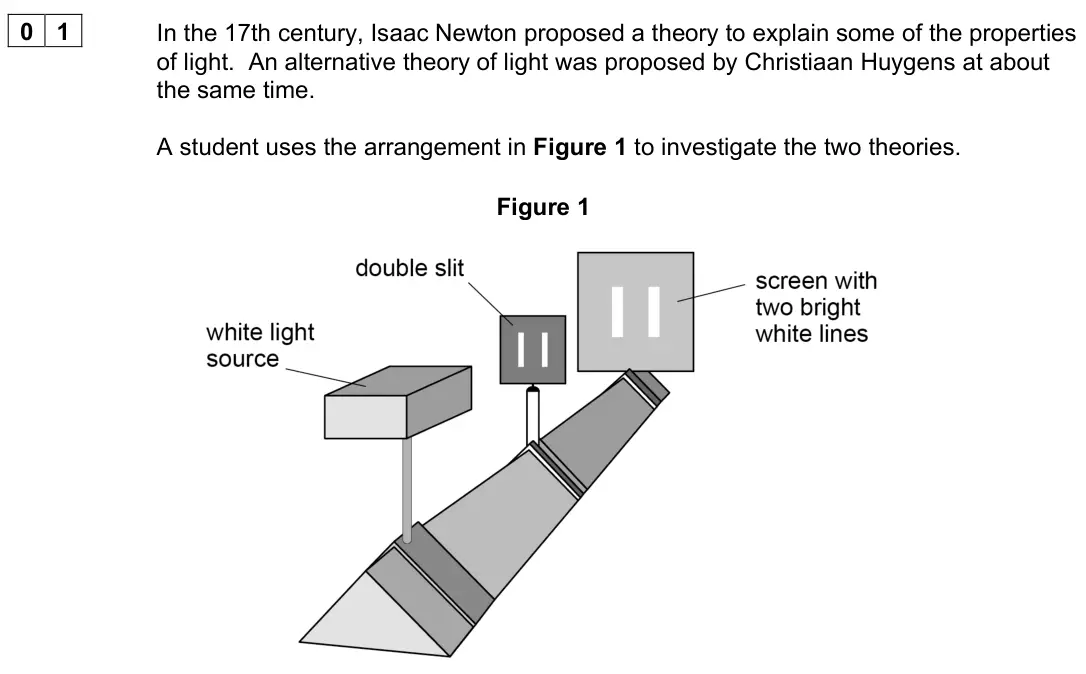
Q01.2
The whole paper ↗Q01.3
The whole paper ↗Q02.1
The whole paper ↗
Q02.2
The whole paper ↗Q2(a)(i)
The whole paper ↗Q2(a)(ii)
The whole paper ↗Q3(a)(i)
The whole paper ↗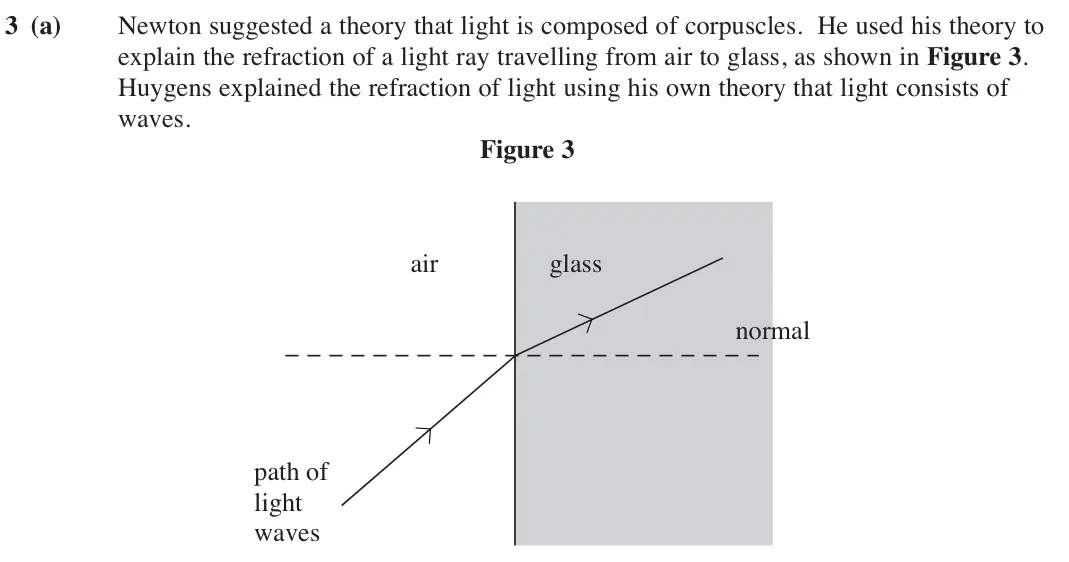
Q3(a)(ii)
The whole paper ↗Q3(a)
The whole paper ↗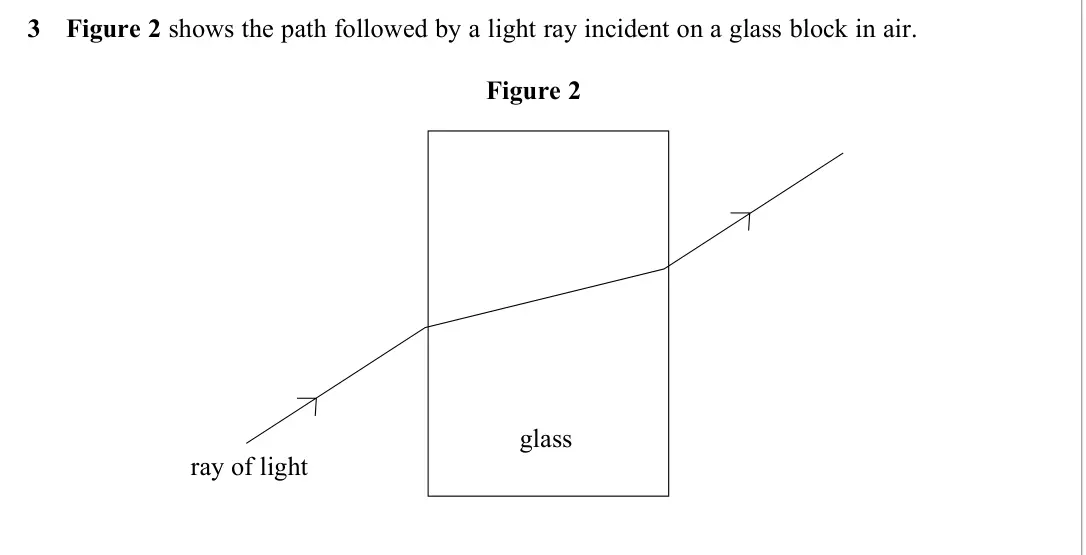
Q3(b)
The whole paper ↗
All 13 questions on Newton’s corpuscular theory of light, as a list
- June 2025, Paper 3 Turning points, Q03 (6 marks): The work of Fizeau, Foucault, Hertz and Maxwell contributed to our understanding of the nature of light. Fizeau measured the speed of light in air. Foucault con
- June 2023, Paper 3 Turning points, Q03.3 (3 marks): Another theory of the nature of light was proposed by Isaac Newton. Describe how Newton’s theory was used to explain the refraction of light as it moves from ai
- June 2022, Paper 3 Turning points, Q01.1 (2 marks): The student observes two bright white lines on the screen. Explain how this observation supports Newton’s theory of light. [2 marks]
- June 2022, Paper 3 Turning points, Q01.2 (6 marks): The student makes alterations to the apparatus in Figure 1. Figure 2 shows the red and dark fringes that the student now observes on the screen. Figure 2 Identi
- June 2022, Paper 3 Turning points, Q01.3 (3 marks): Shortly before the work of Newton and Huygens, Francesco Grimaldi carried out an experiment into the behaviour of light. Figure 3 shows Grimaldi’s arrangement.
- June 2019, Paper 3 Turning points, Q02.1 (1 mark): What happens to the horizontal and vertical components of the velocity of the corpuscles, according to the theory, when they are reflected? Tick () one box. [1
- June 2019, Paper 3 Turning points, Q02.2 (6 marks): Newton used the corpuscular theory to explain the refraction of light at an interface between air and water. Huygens used the wave theory to explain the refract
- June 2015, PHYA5 Turning points (old spec), Q2(a)(i) (3 marks): Describe how Newton used the corpuscular theory to explain the refraction of light as it passes from one substance into a substance of higher optical density. [
- June 2015, PHYA5 Turning points (old spec), Q2(a)(ii) (2 marks): Huygens used a wave theory to explain refraction. Explain why the corpuscular theory was rejected in favour of a wave theory to explain refraction. [2 marks]
- June 2011, PHYA5 Turning points (old spec), Q3(a)(i) (1 mark): State one reason why Huygens’ theory of light was rejected for many years after it was first proposed, in favour of Newton’s corpuscular theory of light. (1 mar
- June 2011, PHYA5 Turning points (old spec), Q3(a)(ii) (2 marks): Explain why the eventual measurement of the speed of light in water led to the definite conclusion that light consists of waves and not corpuscles. (2 marks)
- June 2008, PHA8W (2008 spec), Q3(a) (4 marks): 3 (a) Use Newton’s theory of light to explain the refraction of the light ray on entering the glass block. You may be awarded additional marks to those shown in
- June 2008, PHA8W (2008 spec), Q3(b) (2 marks): 3 (b) Huygens put forward an alternative theory of light. Compare the explanations of refraction suggested by Newton and by Huygens. (2 marks)
Questions, mark schemes and examiner’s reports are © AQA, from their published past papers. Plumi isn’t affiliated with any exam board. Want whole papers? AQA A-Level Physics past papers.
The Plumi iPad app also offers exam-style questions with AI feedback on your handwritten working.