 plumi
Principle of superposition of waves and formation of stationary waves: AQA A‑Level Physics questions
AQA A-Level Physics past-paper questions on 3.3.1.3 Principle of superposition of waves and formation of stationary waves, 2008–2025, with mark schemes and examiner’s reports where available.
Paper
All papers
Exam
All years
Calculations
Q02.2
The whole paper ↗Q02.3
The whole paper ↗Q02.4
The whole paper ↗Q01.1
The whole paper ↗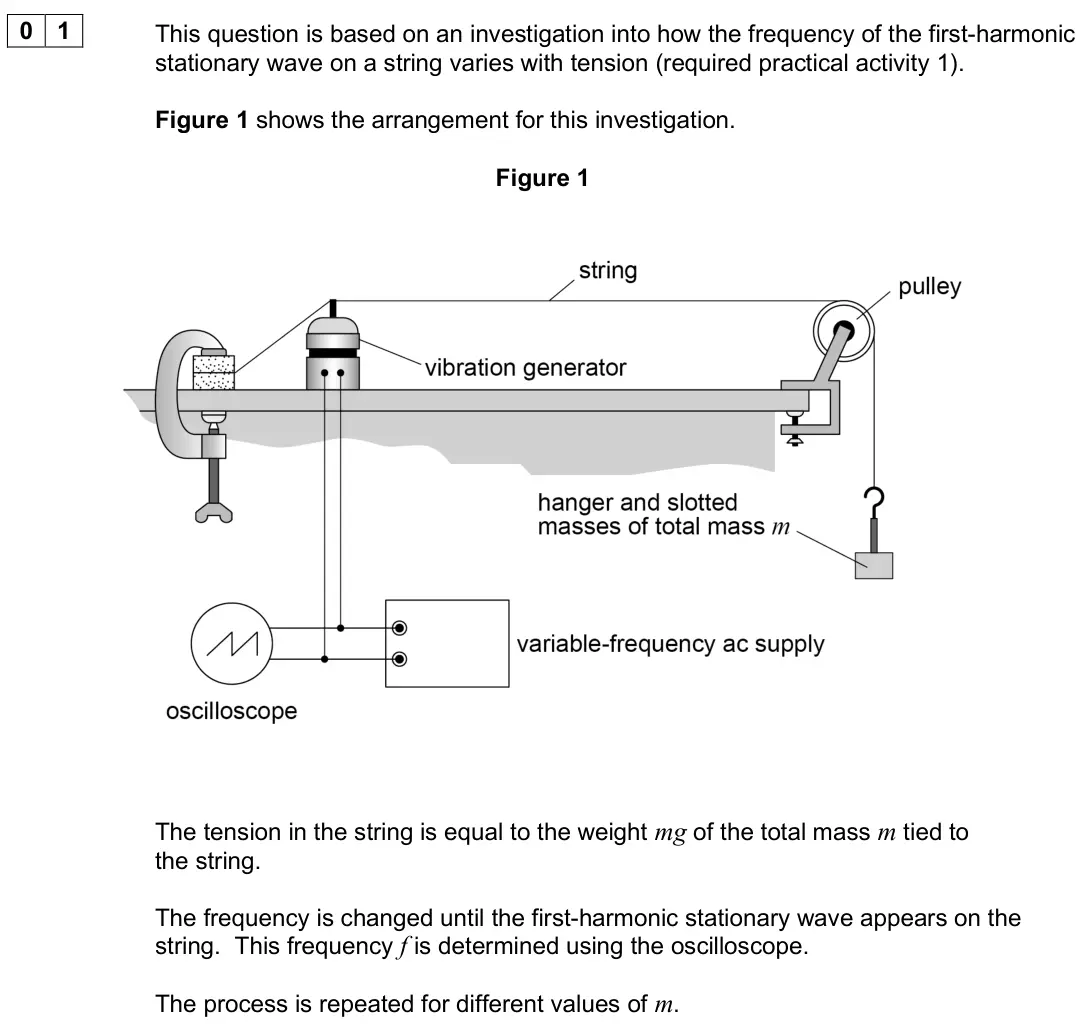
Q01.2
The whole paper ↗Q01.4
The whole paper ↗Q01.5
The whole paper ↗- Your answer
Q07.1
The whole paper ↗
Q07.2
The whole paper ↗Q07.3
The whole paper ↗Q07.4
The whole paper ↗Q03.1
The whole paper ↗
Q03.2
The whole paper ↗Q03.3
The whole paper ↗Q03.4
The whole paper ↗
All 97 questions on Principle of superposition of waves and formation of stationary waves, as a list
- June 2025, Paper 1, Q02.2 (1 mark): Explain how a stationary wave is produced on the wire. [1 mark]
- June 2025, Paper 1, Q02.3 (2 marks): Figure 3 shows a small section of the wire at one instant. Five points on the wire are labelled P1 to P5. The dashed line represents the position of the wire wh
- June 2025, Paper 1, Q02.4 (5 marks): A student investigates stationary waves on a wire using the apparatus in Figure 2. The investigation requires the student to produce the first five harmonics on
- June 2025, Paper 1, Q14 (1 mark): In an investigation of stationary waves on different wires, the frequency f of the first harmonic is measured. Which quantity produces a straight-line graph thr
- June 2025, Paper 3A, Q01.1 (2 marks): Identify two control variables for the arrangement shown in Figure 1. You may annotate Figure 1 as part of your answer. [2 marks] 1 2
- June 2025, Paper 3A, Q01.2 (1 mark): The total mass m is made from a mass hanger and up to three slotted masses. One 20 g, one 50 g and one 100 g slotted mass are provided. The hanger has a mass of
- June 2025, Paper 3A, Q01.4 (1 mark): Determine the period of the waveform on Figure 2 when m = 100 g. [1 mark] period = ms
- June 2025, Paper 3A, Q01.5 (2 marks): Deduce whether Figure 2 shows the expected result of doubling m from 100 g to 200 g. [2 marks]
- June 2025, AS Paper 2, Q05 (1 mark): [multiple choice] A horizontal length of wire vibrates between a fixed point and a frictionless pulley. The tension in the wire is caused by the weight of a mas
- June 2025, AS Paper 2, Q16 (1 mark): A string vibrates at the Nth harmonic. The separation x between adjacent nodes is 0.60 m. The string now vibrates at the (N + 1)th harmonic and x decreases by 0
- June 2024, Paper 1, Q07.1 (1 mark): Deduce the amplitude of one of the progressive waves. [1 mark] amplitude = mm
- June 2024, Paper 1, Q07.2 (2 marks): Determine, in m s−1, the speed of one of the progressive waves. [2 marks] speed = m s−1
- June 2024, Paper 1, Q07.3 (1 mark): State the phase relationship between the two waves when t = 0 [1 mark]
- June 2024, Paper 1, Q07.4 (3 marks): Sketch, on Figure 7, a graph to show how the displacement of S varies with t. [3 marks] Figure 7 END OF SECTION A Section B
- June 2024, Paper 1, Q15 (1 mark): A loudspeaker producing a single-frequency sound is mounted above a tube filled with water. A tap at the bottom of the tube is opened to allow the water to run
- June 2024, AS Paper 1, Q03.1 (2 marks): The frequency of the first harmonic is 147 Hz. Calculate the speed of the wave travelling in the string. [2 marks] speed of wave = m s−1
- June 2024, AS Paper 1, Q03.2 (3 marks): The tension in the string is 71 N. Calculate the mass of the string between X and Y. [3 marks] mass = kg
- June 2024, AS Paper 1, Q03.3 (3 marks): Draw, on Figure 5, the stationary wave that produces the harmonic f3. Label the positions of all nodes N and all antinodes A. [3 marks] Figure 5
- June 2024, AS Paper 1, Q03.4 (3 marks): The string is vibrating freely. The player then touches the string lightly at its midpoint Z as shown in Figure 6. This prevents the string from vibrating at Z.
- June 2024, AS Paper 2, Q30 (1 mark): A stationary wave is formed due to superposition between a progressive wave and its reflection. Both the progressive wave and its reflection are polarised. Whic
- June 2024, AS Paper 2, Q32 (1 mark): Which row is correct for both a progressive wave and a stationary wave? [1 mark] Progressive wave Stationary wave A Some of the particles do not vibrate. All th
- June 2023, Paper 1, Q14 (1 mark): A string with a length of 1.2 m vibrates at its second harmonic. The diagram shows the displacement–time graph for a point on the string. What are the wavelengt
- June 2023, Paper 1, Q15 (1 mark): A standing wave is created on a string. Which statement about the two waves that create the standing wave is not correct? [1 mark] A They have the same frequenc
- June 2023, AS Paper 1, Q02.2 (2 marks): Calculate the resultant of the waves at time P in Figure 3. [2 marks] resultant =
- June 2023, AS Paper 2, Q01.4 (2 marks): The wires used in the experiment are made of the same metal so that ρ is a control variable. State two other control variables in the experiment. [2 marks] 1 2
- June 2023, AS Paper 2, Q01.5 (2 marks): The student suggests that 1 f d ∝ . Deduce, using data points from Figure 3, whether this suggestion is correct. [2 marks]
- June 2023, AS Paper 2, Q01.6 (2 marks): Another student repeats the experiment with the mass of M doubled. Explain how this student’s plotted data compare with Figure 3. [2 marks]
- June 2023, AS Paper 2, Q07 (1 mark): Powder is spread along the inside of an air-filled pipe that is closed at one end. A loudspeaker is placed at the other end. At certain sound frequencies a stat
- June 2023, AS Paper 2, Q24 (1 mark): A stationary wave of wavelength λ is produced on a string. What are the phase difference and the distance between adjacent antinodes? [1 mark] Phase difference
- June 2022, Paper 1, Q19 (1 mark): The frequency of the first harmonic of a standing wave on a string is f. The tension in the string is T. The tension is increased to 4T without changing the len
- June 2022, AS Paper 2, Q17 (1 mark): A stretched wire vibrates between two fixed points. The frequency of the first harmonic of the vibrating wire is 300 Hz. Without making any other change, the te
- June 2022, AS Paper 2, Q18 (1 mark): A stationary wave forms on a uniform string. Which statement is correct? [1 mark] A The amplitude of oscillations is a maximum at the nodes. B The distance betw
- November 2021, Paper 1, Q02.2 (4 marks): Explain what happens to the signal detected by R as M is moved slowly towards X. [4 marks]
- November 2021, Paper 1, Q18 (1 mark): The diagram shows a stationary wave on a string at one instant in time. P, Q and R are three points on the string. Which row is correct? [1 mark] A P is in anti
- November 2021, AS Paper 2, Q01.1 (2 marks): Draw a line of best fit for these data. [2 marks]
- November 2021, AS Paper 2, Q01.2 (1 mark): State a value for the position of P. [1 mark] position of P = cm
- November 2021, AS Paper 2, Q01.4 (3 marks): Deduce the frequency of the microwaves produced by T. [3 marks] frequency = Hz
- November 2021, AS Paper 2, Q17 (1 mark): The diagram shows a string stretched between two fixed points O and R which are 120 cm apart. P and Q are points on the string. OP = 30 cm OQ = 90 cm At a certa
- November 2020, Paper 1, Q18 (1 mark): Stationary waves are set up on a rope of length 1.0 m fixed at both ends. Which statement is not correct? [1 mark] A The first harmonic has a wavelength of 2.0
- November 2020, AS Paper 1, Q06.1 (2 marks): The string is made to vibrate at the second harmonic. Compare the motion of P with that of Q. [2 marks]
- November 2020, AS Paper 1, Q06.2 (2 marks): The frequency of the vibration generator is increased, and a higher harmonic of the stationary wave is formed. Figure 9 shows the string between P and Q at an i
- November 2020, AS Paper 1, Q06.3 (3 marks): The instantaneous position of the string in Figure 9 can be explained by the superposition of two waves. The instantaneous positions of these waves between P an
- November 2020, AS Paper 1, Q06.4 (1 mark): Figure 11 shows the positions of the two waves between P and Q a short time later. Figure 11 Draw, on Figure 12, the appearance of the string between P and Q at
- November 2020, AS Paper 1, Q06.5 (2 marks): Annotate (with an A) the positions of any antinodes on your drawing in Figure 12. [2 marks]
- November 2020, AS Paper 1, Q06.6 (3 marks): The frequency of the vibration generator is reduced until the first harmonic is observed in the string, as shown in Figure 13. Figure 13 The string in Figure 13
- June 2019, Paper 3A, Q03.2 (2 marks): A metre ruler is placed next to the bridges supporting the wire, as shown in Figure 17. Figure 17 Determine the wavelength of the stationary wave shown in Figur
- June 2019, Paper 3A, Q03.3 (1 mark): The stationary wave is formed by two waves of frequency f and wavelength travelling with speed c in opposite directions. Determine c. [1 mark] c = m s−1
- June 2019, Paper 3A, Q03.4 (2 marks): Determine, in kg m−1, the mass per unit length of the wire. [2 marks] mass per unit length = kg m−1
- June 2019, AS Paper 2, Q17 (1 mark): The frequency of the first harmonic of a wire fixed at both ends is 300 Hz. The tension in the wire is now doubled. What is the frequency of the first harmonic
- June 2018, Paper 1, Q03.1 (3 marks): Explain how a stationary wave is produced when a stretched string is plucked. [3 marks]
- June 2018, Paper 1, Q03.2 (2 marks): The vibrating length of one of the strings of a violin is 0.33 m When the tension in the string is 25 N, the string vibrates with a first-harmonic frequency of
- June 2018, Paper 1, Q03.3 (1 mark): Determine the speed at which waves travel along the string in question 03.2 when it vibrates with a first-harmonic frequency of 370 Hz [1 mark] speed of waves =
- June 2018, Paper 1, Q03.4 (4 marks): Figure 6 shows how the tension in the string in question 03.2 varies with the extension of the string. Figure 6 The string with its initial tension of 25 N is v
- June 2018, AS Paper 2, Q17 (1 mark): The fundamental frequency f is the lowest frequency heard when a stretched string is vibrating. The string is now lightly touched one third of the way along its
- June 2017, Paper 1, Q02.1 (2 marks): Show that the data in Table 1 are consistent with the relationship f ∝ √T where T is the tension in the nylon string. [2 marks]
- June 2017, Paper 1, Q02.2 (3 marks): The nylon string used has a density of 1150 kg m–3 and a uniform diameter of 5.0 × 10⁻⁴ m. Determine the length l of the string used. [3 marks] l = m
- June 2017, Paper 1, Q02.3 (2 marks): The student uses the relationship in question 02.1 to predict frequencies for tensions that are much larger than those used in the original experiment. Explain
- June 2017, Paper 1, Q15 (1 mark): A stationary wave is set up on a stretched string of length l and diameter d. Another stationary wave is also set up on a second string made from the same mater
- June 2017, AS Paper 1, Q05.3 (4 marks): When wind blows, stationary waves can be formed on the aerial wire. Explain how stationary waves are produced and why only waves of specific frequencies can for
- June 2017, AS Paper 1, Q05.5 (2 marks): Calculate the frequency of the wave when the third harmonic is formed on the aerial wire. [2 marks] frequency = Hz
- June 2017, AS Paper 1, Q05.6 (1 mark): Sketch, on Figure 7, the standing wave on the wire when the third harmonic is formed. [1 mark] Figure 7
- June 2017, AS Paper 2, Q14 (1 mark): A uniform wire, fixed at both ends, is plucked in the middle so that it vibrates at the first harmonic as shown. What is the phase difference between the oscill
- June 2016, AS Paper 1, Q02.1 (2 marks): Suggest how stationary waves are formed in the microwave oven. [2 marks]
- June 2016, AS Paper 1, Q02.2 (2 marks): The student removes the turntable and places a bar of chocolate on the floor of the oven. He then switches the oven on for about one minute. When the chocolate
- June 2016, AS Paper 1, Q02.3 (5 marks): Calculate, by making suitable measurements on Figure 4, the frequency of the microwaves used by the oven. [5 marks] frequency = ____________________ Hz
- June 2016, AS Paper 1, Q02.4 (1 mark): Explain why most microwave ovens contain a rotating turntable on which the food is placed during cooking. [1 mark]
- June 2016, AS Paper 2, Q13 (1 mark): The frequency of the first harmonic of a standing wave on a wire is 𝑓. The length of the wire and tension in the wire are both doubled. What is the frequency of
- Specimen, Paper 1, Q12 (1 mark): The diagram shows two pulses on a string travelling towards each other. Which of the following diagrams shows the shape of the string when the pulses have passe
- June 2016, PHYA5 Turning points (old spec), Q3(b)(i) (3 marks): Explain why the detected signal strength changes from a maximum to a minimum as the metal reflector is moved. [3 marks] ________________________________________
- June 2016, PHYA5 Turning points (old spec), Q3(b)(ii) (2 marks): Determine the least distance the reflector has to move for the detected signal strength to change from a maximum to a minimum to confirm Hertz’s value for the s
- June 2015, PHYA2 (old spec), Q6 (6 marks): A stationary wave is formed on a stretched string. Discuss the formation of this wave. Your answer should include: an explanation of how the stationary wave is
- June 2014, PHYA2 (old spec), Q7(d) (3 marks): A continuous ultrasound wave of constant frequency is reflected from a solid surface and returns in the direction it came from. Figure 7 Assuming there is no si
- June 2013, PHYA5 Turning points (old spec), Q3(a) (6 marks): Explain why stationary waves are formed in this arrangement and describe how the wavelength of the radio waves can be determined by moving a suitable detector a
- January 2013, PHYA2 (old spec), Q6 (6 marks): Discuss the formation of stationary waves on a string or rope. Your account should include: ● a labelled diagram of a stationary wave ● the conditions necessary
- June 2012, PHYA2 (old spec), Q6(a)(i) (2 marks): Describe the motion of point X. (2 marks)
- June 2012, PHYA2 (old spec), Q6(a)(ii) (2 marks): State the phase relationship between X and Y X and Z (2 marks)
- June 2012, PHYA2 (old spec), Q6(b)(i) (2 marks): Show that the speed of a progressive wave on this string is about 125ms–1 (2 marks)
- June 2012, PHYA2 (old spec), Q6(c)(i) (1 mark): State the name given to the point on the wave midway between C and B. (1 mark)
- June 2012, PHYA2 (old spec), Q6(c)(ii) (2 marks): Calculate the wavelength of this stationary wave. answer = m (2 marks)
- June 2012, PHYA2 (old spec), Q6(c)(iii) (1 mark): Calculate the frequency of this fundamental mode. The speed of the progressive wave remains at 125ms–1. answer = Hz (1 mark)
- January 2012, PHYA2 (old spec), Q7(c) (3 marks): A continuous wave of the same amplitude and frequency moves along the rope from the right and passes through the first wave. The knot becomes motionless. Explai
- January 2011, PHYA4 Section B (old spec), Q5(c) (3 marks): The length of PQ is 0.40m. When the wire is vibrating, transverse waves are propagated along the wire at a speed of 64ms–1. Explain why the wire is set into lar
- January 2011, PHYA2 (old spec), Q4 (6 marks): Figure 4 shows a stationary wave on a string. The string is tied onto a thin metal bar at A and fixed at B. A vibration generator causes the bar to oscillate at
- January 2010, PHYA2 (old spec), Q4(a)(i) (1 mark): On Figure 4, sketch the stationary wave produced when the string is vibrating in its fundamental mode. Figure 4 (1 mark) bridge A (known as the ‘nut’) bridge B
- January 2010, PHYA2 (old spec), Q4(a)(ii) (2 marks): Calculate the wavelength of the fundamental mode of vibration. answer = m (2 marks)
- January 2010, PHYA2 (old spec), Q4(a)(iii) (2 marks): Calculate the speed of a progressive wave on this string. answer = ms–1 (2 marks)
- January 2010, PHYA2 (old spec), Q4(b)(i) (2 marks): On Figure 5, sketch the stationary wave produced and label all nodes that are present. (2 marks) Figure 5 bridge A (known as the ‘nut’) bridge B string 0.64 m 0
- January 2010, PHYA2 (old spec), Q4(b)(ii) (1 mark): Calculate the frequency of the overtone. answer = Hz (1 mark)
- January 2010, PHYA2 (old spec), Q4(c) (1 mark): The guitarist needs to raise the fundamental frequency of vibration of this string. State one way in which this can be achieved. (1 mark)
- January 2009, PHYA2 (old spec), Q5(a) (3 marks): Explain why a stationary wave is formed on the string. (3 marks)
- January 2009, PHYA2 (old spec), Q5(b)(i) (2 marks): The stationary wave in Figure 4 has a frequency of 150 Hz. The string PQ has a length of 1.2 m. Calculate the wave speed of the waves forming the stationary wav
- January 2009, PHYA2 (old spec), Q5(b)(ii) (2 marks): On Figure 5, draw the stationary wave that would be formed on the string at the same tension if it was made to vibrate at a frequency of 450 Hz. Figure 5 P Q (2
- June 2008, PA10 (2008 spec), Q3(a) (3 marks): 3 (a) When plucked at its centre, the wire vibrates in its fundamental mode and produces sound waves of frequency 150 Hz. 3 (a) (i) With the aid of a sketch, de
- June 2008, PA10 (2008 spec), Q3(b) (4 marks): 3 (b) The fundamental frequency of vibration, fo, of the wire is given by fo = 1 2l T µ where l is the length of the wire, µ is the mass per unit length of the
- June 2008, PA10 (2008 spec), Q3(c) (3 marks): 3 (c) The breaking stress of steel is 1.2 × 10 9 Pa. Discuss whether or not the wire is in danger of breaking if its tension is increased to raise the frequency
- January 2008, PA04B (2008 spec), Q1(a) (3 marks): 1 (a) (i) State two conditions which have to be satisfied for the formation of a stationary wave. (ii) When a stationary wave is formed on a string that is stre
- January 2008, PA04B (2008 spec), Q1(b) (4 marks): (b) Figure 1 shows the undisturbed position of a string stretched between the two points, P and Q, which are 3.6 m apart. The string is vibrated transversely at
Questions, mark schemes and examiner’s reports are © AQA, from their published past papers. Plumi isn’t affiliated with any exam board. Want whole papers? AQA A-Level Physics past papers.
The Plumi iPad app also offers exam-style questions with AI feedback on your handwritten working.