 plumi
Collisions of electrons with atoms: AQA A‑Level Physics questions
AQA A-Level Physics past-paper questions on 3.2.2.2 Collisions of electrons with atoms, 2008–2025, with mark schemes and examiner’s reports where available.
Paper
All papers
Exam
All years
Calculations
Q08.2
The whole paper ↗
Q08.3
The whole paper ↗Q03.1
The whole paper ↗
Q02.1
The whole paper ↗
Q02.3
The whole paper ↗Q02.1
The whole paper ↗
Q05.3
The whole paper ↗Q04.1
The whole paper ↗
- Your answer
Q02.4
The whole paper ↗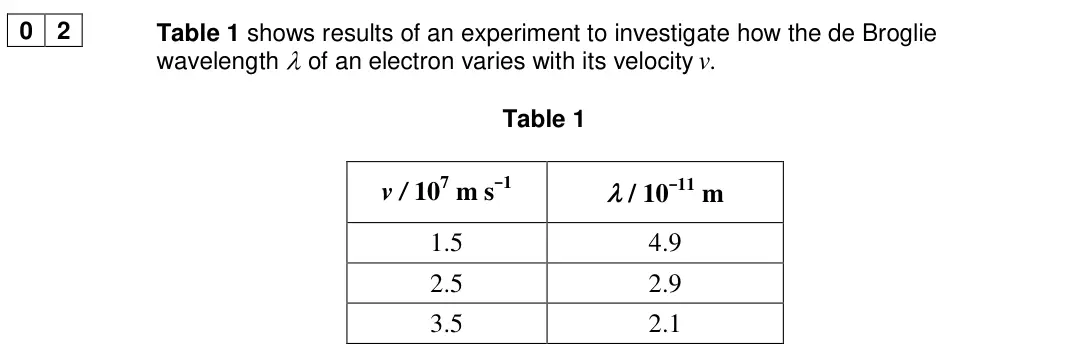
- Your answer
Q03.2
The whole paper ↗
- Your answer
Q07.5
The whole paper ↗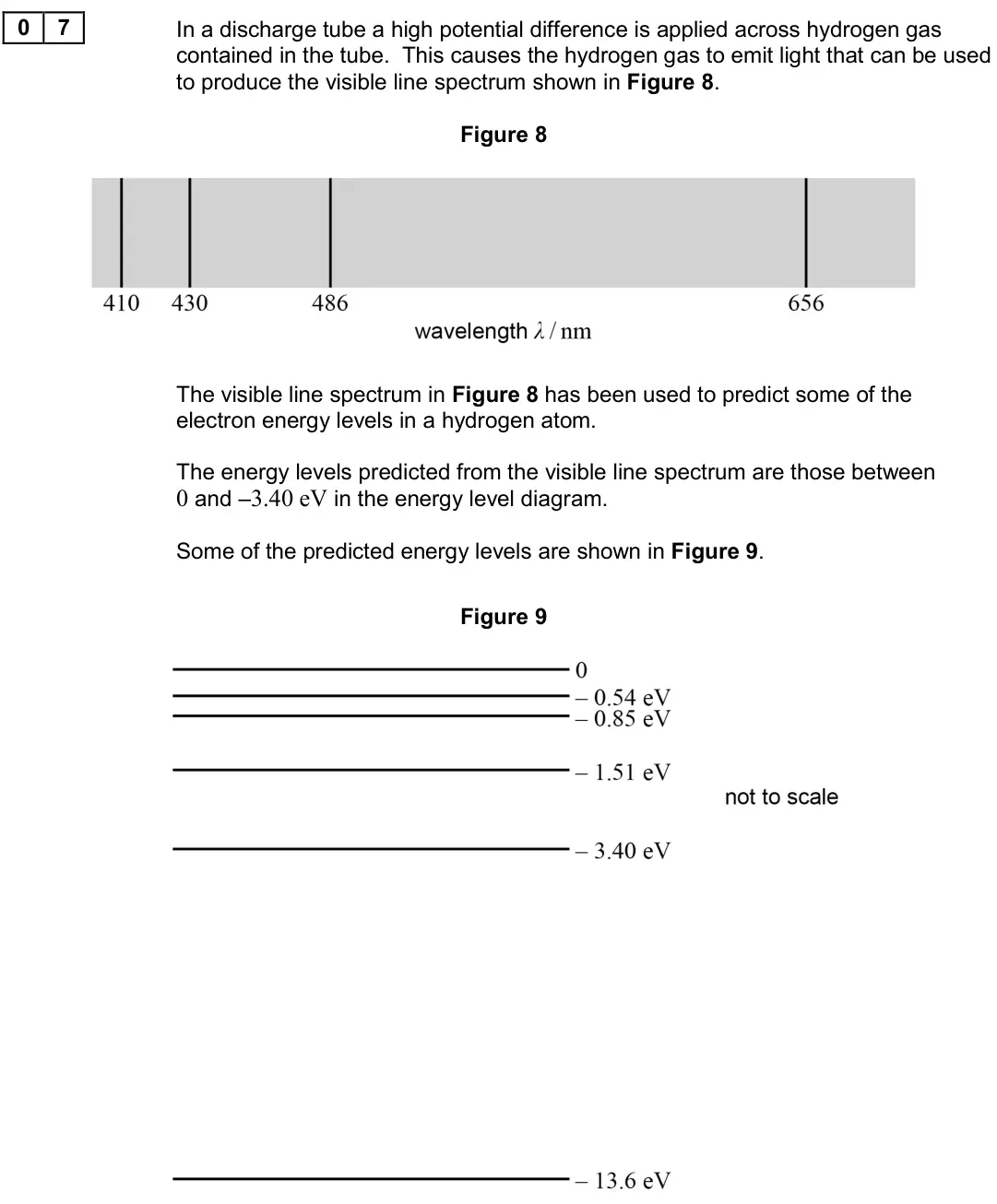
- Your answer
Q4(a)(i)
The whole paper ↗
All 51 questions on Collisions of electrons with atoms, as a list
- June 2025, Paper 1, Q08.2 (1 mark): Explain why the average speed of the electrons in the tube is much less than the maximum speed you calculated in Question 08.1. [1 mark]
- June 2025, Paper 1, Q08.3 (2 marks): Scientists want to replace the mercury in fluorescent tubes with substance X. Figure 12 is an emission spectrum for X. Figure 12 White light consists of the who
- June 2025, AS Paper 1, Q03.1 (4 marks): Calculate the de Broglie wavelength of this electron immediately after the collision. [4 marks] de Broglie wavelength = m
- June 2024, AS Paper 1, Q02.1 (1 mark): Deduce V. [1 mark] V = V
- June 2024, AS Paper 1, Q02.3 (4 marks): The experiment is repeated with a different gas. Figure 2 shows the three lowest energy levels for an atom of the gas. Figure 2 When an electron in the beam col
- June 2022, Paper 1, Q15 (1 mark): A fluorescent tube contains a gas. The coating of the tube [1 mark] A becomes ionised by the gas and emits photons of ultraviolet light. B absorbs photons of ul
- June 2022, AS Paper 1, Q02.1 (2 marks): In the experiment, the gas is ionised by a beam of electrons. Explain how the beam of electrons causes a particle of the gas to have a charge of +1e. [2 marks]
- November 2021, Paper 1, Q14 (1 mark): What is the role of the mercury vapour in a fluorescent tube? [1 mark] A It absorbs photons of UV light and emits visible light. B It absorbs photons of visible
- November 2021, AS Paper 2, Q05.3 (6 marks): The student has paint that fluoresces when light of any wavelength is incident on it. She coats the blue LED and the red LED with the paint. Compare the wavelen
- November 2021, AS Paper 2, Q13 (1 mark): Some energy levels of a lithium atom are shown below. A free electron with kinetic energy 6.0 × 10⁻¹⁹ J collides with a stationary lithium atom in its n = 1 ene
- November 2020, Paper 1, Q12 (1 mark): An electron collides with an isolated atom and raises an atomic electron to a higher energy level. Which statement is correct? [1 mark] A The colliding electron
- November 2020, AS Paper 2, Q04.1 (2 marks): Beta particles collide with atoms in the scintillation material, which emits photons of light as a result. Explain how photons are produced by collisions betwee
- June 2019, Paper 1, Q09 (1 mark): An electron collides with an isolated atom and raises an orbiting electron to a higher energy level. Which statement is correct? [1 mark] A The colliding electr
- June 2018, Paper 1, Q02.4 (3 marks): Explain how the emission of light from the fluorescent screen shows that the electrons incident on it are behaving as particles. [3 marks]
- June 2018, Paper 1, Q13 (1 mark): The diagram shows an energy-level diagram for a hydrogen atom. Electrons, each having a kinetic energy of 2.0 × 10⁻¹⁸ J, collide with atoms of hydrogen in their
- June 2018, AS Paper 1, Q03.2 (3 marks): Two ways to excite a hydrogen atom are by collision with a free electron or by the absorption of a photon. Explain why, for a particular transition, the photon
- June 2017, Paper 1, Q12 (1 mark): The diagram shows an energy level diagram for a hydrogen atom. Electrons with energy 13.0 eV collide with atoms of hydrogen in their ground state. What is the n
- June 2017, AS Paper 1, Q07.5 (6 marks): Discuss how the discharge tube is made to emit electromagnetic radiation of specific frequencies. In your answer you should: • explain why there must be a high
- Specimen, Paper 1, Q18 (1 mark): An electron collides with a neutral atom and ionizes it. Which of the following describes the particles present after the collision? [1 mark] A An electron and
- June 2016, PHYA1 (old spec), Q4(a)(i) (3 marks): Explain how the mercury atoms become excited. [3 marks] ______________________________________________________________________________ _________________________
- June 2016, PHYA1 (old spec), Q4(b) (2 marks): Explain how the ultraviolet photons in the tube are converted into photons in the visible part of the electromagnetic spectrum. [2 marks] ______________________
- June 2015, PHYA1 (old spec), Q4(a)(ii) (2 marks): State what is meant by ionisation energy. [2 marks]
- June 2015, PHYA1 (old spec), Q4(b) (2 marks): Show that the minimum frequency of electromagnetic radiation needed for a photon to ionise an atom of sodium is about 1.2 × 10¹⁵ Hz. [2 marks]
- June 2014, PHYA1 (old spec), Q4(a)(i) (1 mark): In which part of the electromagnetic spectrum are these photons? [1 mark]
- June 2014, PHYA1 (old spec), Q4(a)(ii) (1 mark): What is meant by an excited mercury atom? [1 mark]
- June 2014, PHYA1 (old spec), Q4(a)(iii) (2 marks): How do the mercury atoms in the fluorescent tube become excited? [2 marks]
- June 2014, PHYA1 (old spec), Q4(c) (2 marks): Explain how the coating on the inside of a fluorescent tube emits visible light. [2 marks]
- January 2013, PHYA1 (old spec), Q4(a)(i) (2 marks): Explain why the electron in the ground state becomes excited to the n = 2 energy level. (2 marks)
- January 2013, PHYA1 (old spec), Q4(a)(iii) (2 marks): The initial kinetic energy of the incident electron is 1.70 × 10⁻¹⁸ J. Calculate its kinetic energy after the collision. kinetic energy = J (2 marks)
- January 2013, PHYA1 (old spec), Q4(a)(iv) (2 marks): Show that the incident electron cannot excite the electron in the ground state to the n = 3 energy level. (2 marks)
- January 2012, PHYA1 (old spec), Q4(a)(i) (1 mark): State what is meant by ground state. (1 mark)
- January 2012, PHYA1 (old spec), Q4(a)(ii) (3 marks): Explain the difference between excitation and ionisation.
- January 2012, PHYA1 (old spec), Q4(c) (4 marks): The ionisation energy of hydrogen is 13.6eV. Calculate the minimum frequency necessary for a photon to cause the ionisation of a hydrogen atom. Give your answer
- June 2011, PHYA1 (old spec), Q4(a) (6 marks): Line spectra were observed before they could be explained by theory. We now know that photons of characteristic frequency are emitted when the vapour of an elem
- June 2011, PHYA1 (old spec), Q4(b)(i) (2 marks): State what is meant by the ionisation energy of hydrogen. (2 marks)
- June 2011, PHYA1 (old spec), Q4(b)(ii) (3 marks): Express the ionisation energy of hydrogen in joules, giving your answer to an appropriate number of significant figures. answer = J (3 marks)
- January 2010, PHYA1 (old spec), Q2(a)(i) (1 mark): What is meant by an excited atom? (1 mark)
- January 2010, PHYA1 (old spec), Q2(a)(ii) (3 marks): Describe the process by which mercury atoms become excited in a fluorescent tube. (3 marks)
- January 2010, PHYA1 (old spec), Q2(a)(iii) (3 marks): What is the purpose of the coating on the inside surface of the glass in a fluorescent tube? (3
- June 2009, PHYA1 (old spec), Q2(a) (6 marks): Explain what is meant by the ground state of an atom and describe the process that is taking place in the atoms emitting photons. The quality of your written co
- June 2009, PHYA1 (old spec), Q2(b)(i) (2 marks): Explain why one of the electrons loses energy while the other does not. (2 marks)
- June 2009, PHYA1 (old spec), Q2(b)(ii) (2 marks): Convert the energy of 9.0 eV into joules (2 marks)
- June 2009, PHYA1 (old spec), Q2(b)(iii) (3 marks): Calculate the maximum frequency of the photon emitted when the 9.0 ev electron collides with an atom.
- January 2009, PHYA1 (old spec), Q1(a) (1 mark): The level, n = 1, is the ground state of the atom. State the ionisation energy of the atom in eV. answer = eV (1 mark)
- January 2009, PHYA1 (old spec), Q1(b)(i) (3 marks): On Figure 1 show with arrows the transitions responsible for these photons. (3 marks)
- January 2009, PA01 (2008 spec), Q2(a) (4 marks): 2 (a) Describe and explain the processes which occur involving some of the atoms of mercury in the vapour when the fluorescent tube is in operation. (4 marks)
- January 2009, PA01 (2008 spec), Q2(b) (3 marks): 2 (b) Explain the purpose of the coating on the inside surface of the glass tube. (3 marks)
- June 2008, PA01 (2008 spec), Q4 (7 marks): 4 The tube in a fluorescent lamp contains mercury vapour at low pressure. When connected to a suitable power supply the lamp emits light. You may be awarded add
- June 2008, PA10 (2008 spec), Q5(a) (5 marks): 5 (a) (i) Estimate the mean kinetic energy of an atom of the vapour at a temperature of 3000 K. 5 (a) (ii) Explain why the vapour emits light when its temperatu
- January 2008, PA01 (2008 spec), Q5(a) (3 marks): (a) (i) Explain what is meant by ionisation. (ii) Ionisation may be caused by electron impact. Explain how else might an atom be ionised. (iii) Calculate the gr
- January 2008, PA01 (2008 spec), Q5(b) (3 marks): (b) (i) An electron with kinetic energy 2.6 × 10 –18 J collides inelastically with an electron in the ground state. State which energy levels may be occupied fo
Questions, mark schemes and examiner’s reports are © AQA, from their published past papers. Plumi isn’t affiliated with any exam board. Want whole papers? AQA A-Level Physics past papers.
The Plumi iPad app also offers exam-style questions with AI feedback on your handwritten working.