 plumi
Orbits of planets and satellites: AQA A‑Level Physics questions
AQA A-Level Physics past-paper questions on 3.7.2.4 Orbits of planets and satellites, 2008–2025, with mark schemes and examiner’s reports where available.
Paper
All papers
Exam
All years
Calculations
Q04.1
The whole paper ↗- Your answer
Q05.1
The whole paper ↗
Q05.3
The whole paper ↗Q04.7
The whole paper ↗
Q02.1
The whole paper ↗
Q02.2
The whole paper ↗Q02.3
The whole paper ↗Q02.5
The whole paper ↗Q02.1
The whole paper ↗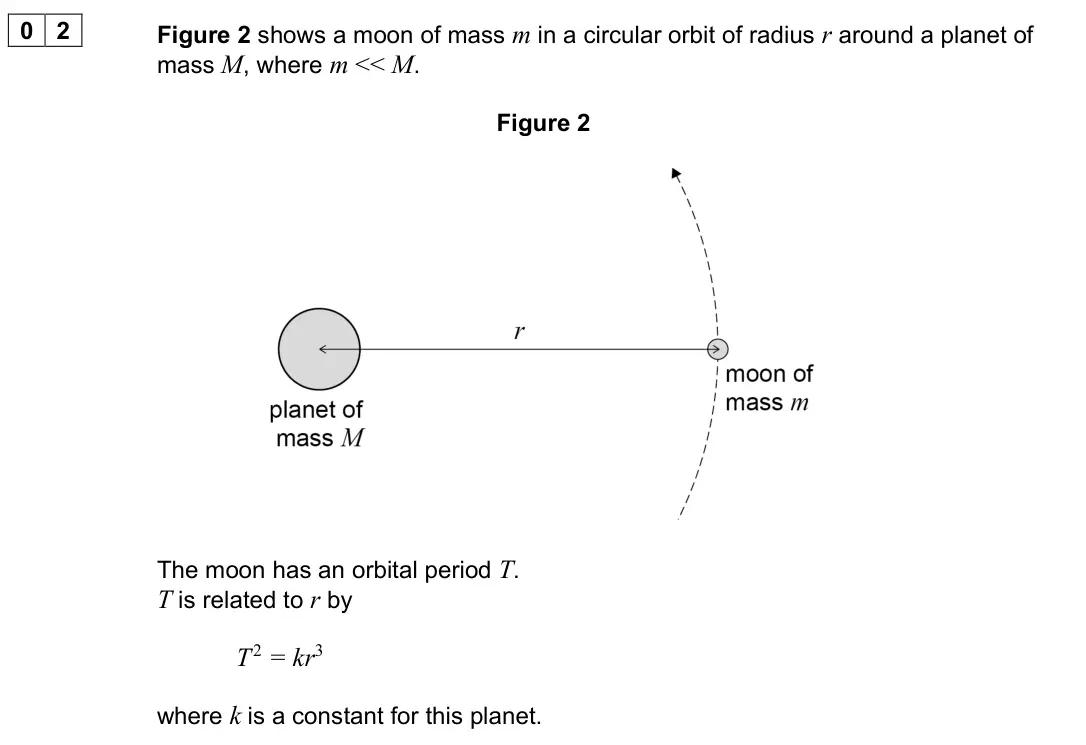
Q02.2
The whole paper ↗
All 53 questions on Orbits of planets and satellites, as a list
- June 2025, Paper 2, Q04.1 (3 marks): Mimas and Enceladus are moons of Saturn. Mimas orbits at a height of 1.28 × 10⁸ m above the surface of Saturn. The orbital period of Mimas is 0.94 Earth days. E
- June 2025, Paper 2, Q07 (1 mark): [multiple choice] An object on the surface of a moon has an escape velocity v. The moon has a density ρ and radius R. Another moon X has a density 2ρ and radius
- June 2024, Paper 2, Q05.1 (3 marks): The resultant force on S1 is due to the gravitational forces from the Earth and the Moon. The magnitude of the Earth’s gravitational field strength at the orbit
- June 2024, Paper 2, Q05.3 (3 marks): Another satellite S2 is placed in a circular orbit between the Earth and the Moon. S2 always views the near side of the Moon. S2 also has the same angular speed
- June 2024, Paper 2, Q21 (1 mark): A synchronous orbit of the Earth has a radius R. A planet has a mass twice the mass of the Earth. A day on the planet is one quarter of an Earth day. What is th
- June 2024, Paper 2, Q22 (1 mark): An asteroid has a mass of 2 × 10¹⁷ kg and an escape velocity of 40 m s−1. What is the order of magnitude of the radius of the asteroid? [1 mark] A 103 m B 104 m
- June 2023, Paper 2, Q11 (1 mark): Data are collected for the mass M, radius R and escape velocity u for each planet in the Solar System. The data show that u is directly proportional to [1 mark]
- June 2023, Paper 2, Q12 (1 mark): A satellite is in a circular orbit at a height h above the surface of a planet of mass M and radius R. What is the linear speed of the satellite? [1 mark] A ( )
- June 2023, Paper 2, Q13 (1 mark): Which statement is not true for a satellite in a geostationary orbit? [1 mark] A The satellite orbits in the plane of the Earth’s equator. B The satellite has t
- June 2022, Paper 2, Q04.7 (1 mark): Explain why P cannot have a circular orbit around H. [1 mark]
- June 2022, Paper 2, Q10 (1 mark): The Moon orbits the Earth in 27 days. What is the angular speed of the Moon’s orbit? [1 mark] A 4.3 × 10⁻⁷ rad s−1 B 2.7 × 10⁻⁶ rad s−1 C 3.7 × 10⁻² rad s−1 D 2
- June 2022, Paper 2, Q11 (1 mark): The radius of the Earth is R and the acceleration due to gravity at the surface of the Earth is g. What is the escape velocity for a mass m at the surface of th
- June 2022, Paper 2, Q12 (1 mark): A planet has a mass M and a radius R. Loose material at the equator only just remains in contact with the surface of the planet. This is because the speed at wh
- June 2022, Paper 2, Q13 (1 mark): Satellites N and F have the same mass and move in circular orbits about the same planet. The orbital radius of N is less than that of F. Which is smaller for N
- November 2021, Paper 2, Q02.1 (2 marks): One GPS satellite is in a circular orbit at a height h above the surface of the Earth. The Earth has mass M and radius R. Show that the angular speed of the sat
- November 2021, Paper 2, Q02.2 (2 marks): Calculate the orbital period of the satellite when h equals 2.02 × 10⁷ m. [2 marks] orbital period = s
- November 2021, Paper 2, Q02.3 (2 marks): Figure 3 shows the orbital plane of the satellite inclined at an angle to the equator. X, Y and Z are locations on the Earth. X is at the North Pole, Y is on a
- November 2021, Paper 2, Q02.5 (2 marks): A different satellite is in a higher circular orbit. Explain how the linear speed of this satellite compares with the linear speed of the satellite in Question
- November 2020, Paper 2, Q02.1 (3 marks): Show that k = 2 4 GM π [3 marks]
- November 2020, Paper 2, Q02.2 (2 marks): Calculate the orbital radius X of Umbriel. [2 marks] orbital radius = m
- November 2020, Paper 2, Q02.3 (3 marks): Calculate the mass of Uranus. [3 marks] mass = kg
- November 2020, Paper 2, Q02.4 (3 marks): Deduce which moon in Table 3 has the greatest escape velocity for an object on its surface. Assume the effect of Uranus is negligible. [3 marks]
- November 2020, Paper 2, Q13 (1 mark): What is the angular speed of a satellite in a geostationary orbit around the Earth? [1 mark] A 1.2 × 10⁻⁵ rad s−1 B 7.3 × 10⁻⁵ rad s−1 C 4.4 × 10⁻³ rad s−1 D 2.
- June 2019, Paper 2, Q03.3 (4 marks): Calculate, using Figure 2, the escape velocity at the surface of the Moon. radius of Moon = 1.74 × 10⁶ m [4 marks] escape velocity = m s−1
- June 2019, Paper 2, Q09 (1 mark): What is the angular speed of a satellite in a geostationary orbit around the Earth? [1 mark] A 1.2 × 10⁻⁵ rad s–1 B 7.3 × 10⁻⁵ rad s–1 C 4.2 × 10⁻³ rad s–1 D 2.
- June 2019, Paper 2, Q10 (1 mark): A planet of mass M and radius R rotates so quickly that material at its equator only just remains on its surface. What is the period of rotation of the planet?
- June 2019, Paper 2, Q11 (1 mark): Satellites N and F have the same mass and are in circular orbits about the same planet. The orbital radius of F is greater than that of N. Which is greater for
- June 2018, Paper 2, Q18 (1 mark): Which graph shows the relationship between the time period T and the orbital radius r of a planet in orbit around the Sun? [1 mark] A B C D A B C D
- June 2017, Paper 2, Q07.1 (2 marks): Derive an expression to show that for satellites in a circular orbit T2 ∝ r3 where T is the period of orbit and r is the radius of the orbit. [2 marks]
- June 2017, Paper 2, Q07.2 (2 marks): Pluto is a dwarf planet. The mean orbital radius of Pluto around the Sun is 5.91 × 10⁹ km compared to a mean orbital radius of 1.50 × 10⁸ km for the Earth. Calc
- June 2017, Paper 2, Q14 (1 mark): A satellite X of mass m is in a concentric circular orbit of radius R about a planet of mass M. What is the kinetic energy of X? [1 mark] A GMm 2R B GMm R C 2GM
- Specimen, Paper 2, Q06.1 (2 marks): Read the following passage and answer the questions that follow Satellites used for telecommunications are usually in geostationary orbits. Using suitable dishe
- Specimen, Paper 2, Q06.2 (1 mark): Read the following passage and answer the questions that follow Satellites used for telecommunications are usually in geostationary orbits. Using suitable dishe
- Specimen, Paper 2, Q06.4 (3 marks): Read the following passage and answer the questions that follow Satellites used for telecommunications are usually in geostationary orbits. Using suitable dishe
- June 2016, PHYA4 Section A (old spec), Q11 (1 mark): A geosynchronous satellite is in a constant radius orbit around the Earth. The Earth has a mass of 6.0 × 1024 kg and a radius of 6.4 × 10⁶ m. What is the height
- June 2015, PHYA4 Section A (old spec), Q13 (1 mark): A satellite X is in a circular orbit of radius r about the centre of a spherical planet of mass M. Which line, A to D, in the table gives correct expressions fo
- June 2015, PHYA4 Section A (old spec), Q14 (1 mark): A satellite orbiting the Earth moves to an orbit which is closer to the Earth. Which line, A to D, in the table shows correctly what happens to the speed of the
- June 2014, PHYA4 Section B (old spec), Q1(b)(ii) (5 marks): The satellite in part (b)(i) is in a circular polar orbit. Show that the satellite would travel around the Earth three times every 24 hours. [5 marks]
- June 2014, PHYA4 Section B (old spec), Q1(c) (2 marks): State and explain one possible use for the satellite travelling in the orbit in part (b)(ii). [2 marks]
- June 2013, PHYA4 Section A (old spec), Q15 (1 mark): Two satellites P and Q, of equal mass, orbit the Earth at radii R and 2R respectively. Which one of the following statements is correct? A P has less kinetic en
- January 2013, PHYA4 Section B (old spec), Q2(a)(i) (4 marks): Calculate the height above the surface of the Earth, in km, of a satellite in a geosynchronous circular orbit. Give your answer to an appropriate number of sign
- January 2013, PHYA4 Section B (old spec), Q2(a)(ii) (2 marks): Calculate the centripetal force acting on the polar orbiting satellite if its mass is 650kg. centripetal force N (2 marks)
- January 2013, PHYA4 Section B (old spec), Q2(b) (6 marks): These geosynchronous and polar satellites have different applications because of their different orbits in relation to the rotation of the Earth. Compare the pr
- June 2012, PHYA4 Section A (old spec), Q14 (1 mark): Two satellites, P and Q, of the same mass, are in circular orbits around the Earth. The radius of the orbit of Q is three times that of P. Which one of the foll
- January 2012, PHYA4 Section A (old spec), Q13 (1 mark): A satellite is in orbit at a height h above the surface of a planet of mass M and radius R. What is the velocity of the satellite? A B C D (R + h) GM √ R GM (R
- June 2011, PHYA4 Section A (old spec), Q13 (1 mark): A satellite of mass m travels in a circular orbit of radius r around a planet of mass M. Which one of the following expressions gives the angular speed of the s
- January 2011, PHYA4 Section B (old spec), Q1(b)(i) (3 marks): Calculate the radius of the orbit of the Hubble telescope. answer = m (3 marks)
- June 2010, PHYA4 Section A (old spec), Q11 (1 mark): An artificial satellite of mass m is in a stable circular orbit of radius r around a planet of mass M. Which one of the following expressions gives the speed of
- January 2010, PHYA4 Section A (old spec), Q10 (1 mark): A planet of mass M and radius R rotates so rapidly that loose material at the equator only just remains on the surface. What is the period of rotation of the pl
- January 2010, PHYA4 Section B (old spec), Q3(b)(iii) (2 marks): Calculate the centripetal acceleration of a satellite in orbit B. answer = ms–2 (2 marks)
- June 2008, PA04B (2008 spec), Q3(b) (5 marks): 3 (b) (i) From the graph, estimate the potential energy lost by the 1000 kg mass as it falls to the surface of the Moon from a very large distance above it. Exp
- January 2008, PA04B (2008 spec), Q5(a) (3 marks): 5 (a) By considering the force equation for a satellite of mass m in an orbit of radius r around a planet of mass M, show that the orbital time period T of the
- January 2008, PA04B (2008 spec), Q5(b) (5 marks): (b) One of the moons of Jupiter, Ganymede, is the largest satellite in the solar system. Its orbital period is equal to 7.15 Earth days and the radius of its or
Questions, mark schemes and examiner’s reports are © AQA, from their published past papers. Plumi isn’t affiliated with any exam board. Want whole papers? AQA A-Level Physics past papers.
The Plumi iPad app also offers exam-style questions with AI feedback on your handwritten working.