 plumi
Gravitational field strength: AQA A‑Level Physics questions
AQA A-Level Physics past-paper questions on 3.7.2.2 Gravitational field strength, 2008–2025, with mark schemes and examiner’s reports where available.
Paper
All papers
Exam
All years
Calculations
Q04.2
The whole paper ↗Q06.1
The whole paper ↗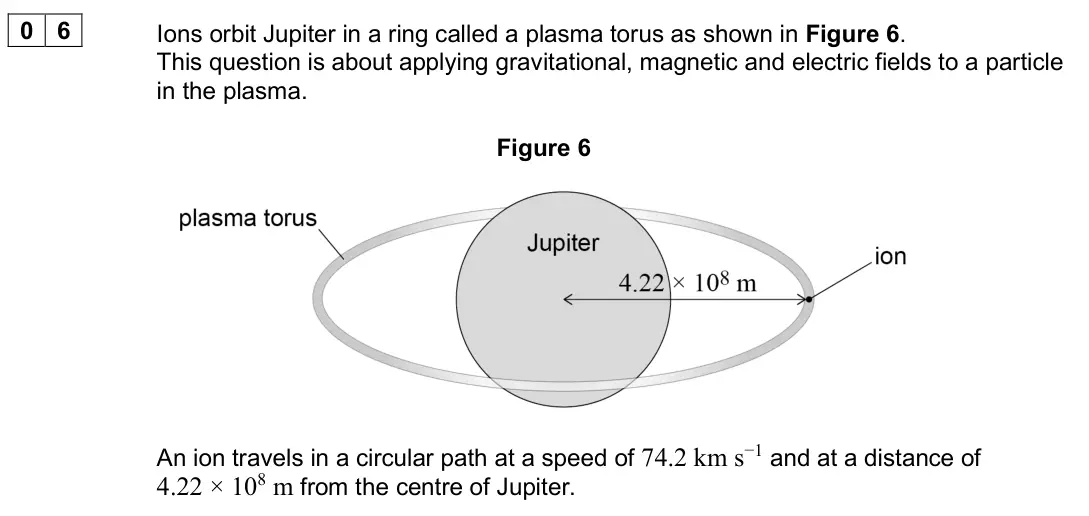
Q05.1
The whole paper ↗
Q05.2
The whole paper ↗Q03.1
The whole paper ↗Q03.3
The whole paper ↗Q03.4
The whole paper ↗Q04.1
The whole paper ↗
Q04.2
The whole paper ↗Q04.3
The whole paper ↗Q04.4
The whole paper ↗Q02.5
The whole paper ↗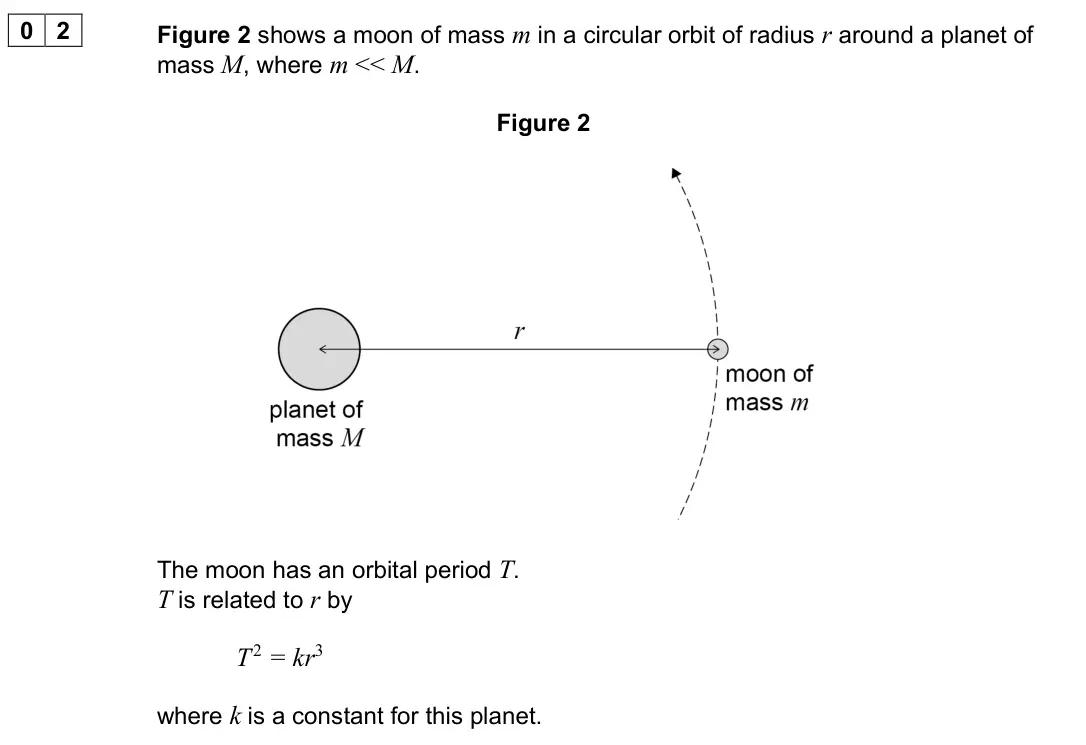
- Your answer
- Your answer
Q06.1
The whole paper ↗Q06.2
The whole paper ↗Q06.3
The whole paper ↗Q07.3
The whole paper ↗
All 50 questions on Gravitational field strength, as a list
- June 2025, Paper 2, Q04.2 (1 mark): A student suggests that, over the range of distances shown in Figure 2, the gravitational field strength due to the mass of Saturn alone is approximately consta
- June 2025, Paper 2, Q06.1 (3 marks): Student A suggests that the gravitational force acting on the ion due to Jupiter provides the centripetal acceleration of the ion. Deduce whether this suggestio
- June 2024, Paper 2, Q05.1 (3 marks): The resultant force on S1 is due to the gravitational forces from the Earth and the Moon. The magnitude of the Earth’s gravitational field strength at the orbit
- June 2024, Paper 2, Q05.2 (2 marks): Calculate the distance from S1 to the centre of the Moon. mass of the Moon = 7.35 × 10²² kg [2 marks] distance = m
- June 2023, Paper 2, Q03.1 (2 marks): Describe two properties of a radial gravitational field. [2 marks] 1 2
- June 2023, Paper 2, Q03.3 (2 marks): Calculate g g S E . distance from the Earth to the Sun = 1.50 × 10¹¹ m [2 marks] g g S E =
- June 2023, Paper 2, Q03.4 (1 mark): Explain why gS is more important than gE in predicting the motion of the space probe as it escapes from the Solar System. [1 mark]
- June 2022, Paper 2, Q04.1 (2 marks): Compare, with reference to Figure 4, the masses of G and H. [2 marks]
- June 2022, Paper 2, Q04.2 (1 mark): X and Y are two points in the field. Annotate Figure 4 to show the field direction at X and the field direction at Y. [1 mark]
- June 2022, Paper 2, Q04.3 (1 mark): A spherical asteroid P has a mass of 2.0 × 10²⁰ kg. The gravitational field strength at its surface is 0.40 N kg−1. Calculate the radius R of P. [1 mark] R = m
- June 2022, Paper 2, Q04.4 (1 mark): Sketch, on Figure 5, the variation of the gravitational field strength g with distance r. The distance r is measured from the centre of P. [1 mark] Figure 5
- June 2022, Paper 2, Q09 (1 mark): A planet of radius R and mass M has a gravitational field strength of g at its surface. Which row describes a planet with a gravitational field strength of 4g a
- November 2021, Paper 2, Q12 (1 mark): A planet has radius R and density ρ. The gravitational field strength at the surface is g. What is the gravitational field strength at the surface of a planet o
- November 2020, Paper 2, Q02.5 (3 marks): A spring mechanism can project an object vertically to a maximum height of 1.0 m from the surface of the Earth. Determine whether the same mechanism could proje
- June 2019, Paper 2, Q12 (1 mark): An object moves freely at 90° to the direction of a gravitational field. The acceleration of the object is [1 mark] A zero. B opposite to the direction of the g
- June 2018, Paper 2, Q19 (1 mark): The Earth can be assumed to be a uniform sphere of radius R. What is the mean density of the Earth? [1 mark] A 3g 4πRG B 3RG 4πg C 3G 4πRg D 3Rg 4πG
- June 2017, Paper 2, Q06.1 (1 mark): State what is represented by gravitational field lines. [1 mark]
- June 2017, Paper 2, Q06.2 (2 marks): Figure 6 shows the gravitational field above a small horizontal region on the surface of the Earth. Figure 6 Suggest why the field lines converge over a small a
- June 2017, Paper 2, Q06.3 (2 marks): A ball travelling at constant speed passes position J moving towards position K in Figure 6. Assume friction is negligible. Explain any change in the speed of t
- June 2017, Paper 2, Q07.3 (3 marks): A small mass released from rest just above the surface of Pluto has an acceleration of 0.617 m s−2. Assume Pluto has no atmosphere that could provide any resist
- June 2017, Paper 2, Q12 (1 mark): Charon is a moon of Pluto that has a mass equal to that of Pluto. The distance between the centre of Pluto and the centre of Charon is d. X is the point at whic
- Specimen, Paper 2, Q08 (1 mark): A planet has a radius half the Earth's radius and a mass a quarter of the Earth's mass. What is the approximate gravitational field strength on the surface of t
- Specimen, Paper 2, Q09 (1 mark): Two stars of mass M and 4M are at a distance d between their centres. The resultant gravitational field strength is zero along the line between their centres at
- June 2016, PHYA4 Section B (old spec), Q2(a)(i) (2 marks): Show that the gravitational field strength gs at the surface of a planet is related to the the density ρ and the radius R of the planet by the expression gs = –
- June 2016, PHYA4 Section B (old spec), Q2(a)(ii) (3 marks): Calculate the radius of Venus. Give your answer to an appropriate number of significant figures. [3 marks] radius = ___________________________ m
- June 2016, PHYA4 Section B (old spec), Q2(b) (3 marks): At a certain time, the positions of Earth and Venus are aligned so that the distance between them is a minimum. Sketch a graph on the axes below to show how the
- June 2015, PHYA4 Section A (old spec), Q10 (1 mark): The following data refer to two planets, P and Q. The gravitational field strength at the surface of P is 13.4 N kg–1. What is the gravitational field strength
- June 2015, PHYA4 Section A (old spec), Q11 (1 mark): The diagram shows an isolated binary star system. The two stars have equal masses, M, and the distance between their centres is r. The point P is half-way betwe
- June 2014, PHYA4 Section B (old spec), Q1(a)(i) (2 marks): Define gravitational field strength and state whether it is a scalar or vector quantity. [2 marks]
- June 2014, PHYA4 Section B (old spec), Q1(a)(ii) (2 marks): A mass m is at a height h above the surface of a planet of mass M and radius R. The gravitational field strength at height h is g. By considering the gravitatio
- June 2013, PHYA4 Section A (old spec), Q12 (1 mark): The gravitational field strengths at the surfaces of the Earth and the Moon are 9.8Nkg–1 and 1.7Nkg–1 respectively. If the mass of the Earth is 81 × the mass of
- June 2013, PHYA4 Section A (old spec), Q13 (1 mark): Two stars of mass M and 4M are at a distance d between their centres. The resultant gravitational field strength is zero along the line between their centres at
- January 2013, PHYA4 Section A (old spec), Q11 (1 mark): Which one of the following gives a correct unit for (––) ? A Nm–2 B Nkg–1 C Nm D N g2 G
- January 2013, PHYA4 Section A (old spec), Q12 (1 mark): The gravitational field strength at the surface of the Earth is 6 times its value at the surface of the Moon. The mean density of the Moon is 0.6 times the mean
- June 2012, PHYA4 Section A (old spec), Q11 (1 mark): Which one of the following statements about gravitational fields is incorrect? A Moving a mass in the direction of the field lines reduces its potential energy.
- June 2012, PHYA4 Section A (old spec), Q12 (1 mark): An object on the surface of a planet of radius R and mass M has weight W. What would be the weight of the same object when on the surface of a planet of radius
- June 2012, PHYA4 Section A (old spec), Q13 (1 mark): The gravitational field strength on the surface of a planet orbiting a star is 8.0Nkg–1. If the planet and star have a similar density but the diameter of the s
- June 2012, PHYA4 Section B (old spec), Q4(c) (6 marks): The amount of energy required to move a manned spacecraft from the Earth to the Moon is much greater than that required to return it to the Earth. By reference
- January 2012, PHYA4 Section A (old spec), Q11 (1 mark): A spherical planet of uniform density ρ has radius R. Which line, A to D, in the table gives correct expressions for the mass of the planet and the gravitationa
- June 2011, PHYA4 Section A (old spec), Q8 (1 mark): The time period of a pendulum on Earth is 1.0s. What would be the period of a pendulum of the same length on a planet with half the density but twice the radius
- June 2011, PHYA4 Section A (old spec), Q11 (1 mark): A planet has a radius half the Earth’s radius and a mass a quarter of the Earth’s mass. What is the approximate gravitational field strength on the surface of t
- June 2011, PHYA4 Section A (old spec), Q12 (1 mark): At the surface of the Earth the gravitational field strength is g, and the gravitational potential is V. The radius of the Earth is R. An object, whose weight o
- January 2011, PHYA4 Section A (old spec), Q9 (1 mark): The diagram shows two point masses each of mass m separated by a distance 2r. What is the value of the gravitational field strength at the mid-point, P, between
- January 2011, PHYA4 Section A (old spec), Q11 (1 mark): What would the period of rotation of the Earth need to be if objects at the equator were to appear weightless? radius of Earth = 6.4 × 10⁶ m A 4.5 × 10⁻² hours
- June 2010, PHYA4 Section A (old spec), Q9 (1 mark): A projectile moves in a gravitational field. Which one of the following is a correct statement about the gravitational force acting on the projectile? A The for
- January 2010, PHYA4 Section A (old spec), Q11 (1 mark): The radius of a certain planet is x times the radius of the Earth and its surface gravitational field strength is y times that of the Earth. mass of the planet
- January 2010, PHYA4 Section B (old spec), Q3(b)(iii) (2 marks): Calculate the centripetal acceleration of a satellite in orbit B. answer = ms–2 (2 marks)
- June 2008, PA04A (2008 spec), Q9 (2 marks): 9 Which one of the following has different units to the other three? A gravitational potential gradient B gravitational Þ eld strength C force per unit mass D g
- June 2008, PA10 (2008 spec), Q4(a) (4 marks): 4 (a) (i) Light takes 43 minutes to travel from the Sun to Jupiter. Calculate the distance from the Sun to Jupiter. 4 (a) (ii) The mass of the Sun is 1040 times
- January 2008, PA04A (2008 spec), Q10 (2 marks): 10 The diagram shows two objects of equal mass m separated by a distance r. Which line, A to D, in the table gives the correct values of the gravitational field
Questions, mark schemes and examiner’s reports are © AQA, from their published past papers. Plumi isn’t affiliated with any exam board. Want whole papers? AQA A-Level Physics past papers.
The Plumi iPad app also offers exam-style questions with AI feedback on your handwritten working.