 plumi
Simple harmonic systems: AQA A‑Level Physics questions
AQA A-Level Physics past-paper questions on 3.6.1.3 Simple harmonic systems, 2008–2025, with mark schemes and examiner’s reports where available.
Paper
All papers
Exam
All years
Calculations
Q04.3
The whole paper ↗
Q04.4
The whole paper ↗Q05.5
The whole paper ↗
Q01.1
The whole paper ↗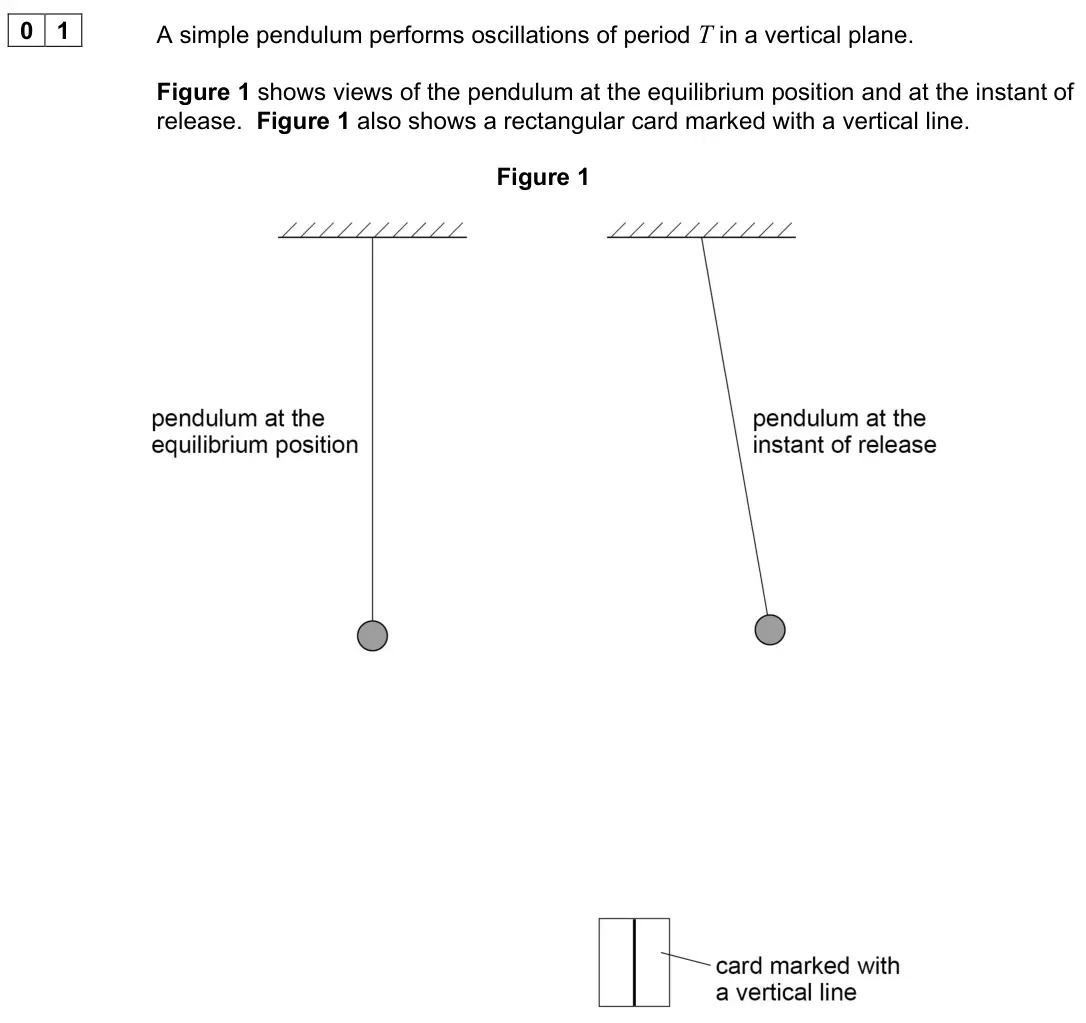
Q01.2
The whole paper ↗Q01.3
The whole paper ↗- Your answer
- Your answer
- Your answer
Q07.1
The whole paper ↗
Q07.2
The whole paper ↗- Your answer
- Your answer
All 54 questions on Simple harmonic systems, as a list
- June 2025, Paper 1, Q31 (1 mark): A spring with a spring constant of 50 N m−1 is attached to a rigid horizontal bar. An object of mass m is attached to the bottom of the spring. When the bar is
- June 2025, Paper 1, Q32 (1 mark): A simple pendulum of length 8.0 cm oscillates on Earth with a frequency f1. An identical pendulum on the Moon oscillates with a frequency f2. The acceleration d
- June 2025, Paper 3A, Q04.3 (2 marks): A horizontal fiducial mark is used to reduce uncertainty in the measurement of T. The fiducial mark is to be placed level with one of the positions A, B, C or D
- June 2025, Paper 3A, Q04.4 (2 marks): When the total mass of the test tube, wire and tape is constant, it can be shown that: 1 T ∝ density of the liquid When the test tube oscillates in the oil, T i
- June 2024, Paper 1, Q31 (1 mark): When a mass M is suspended from a spring, the spring extends by a distance x. M is displaced vertically and, when released, it oscillates with a period T. M is
- June 2024, Paper 1, Q32 (1 mark): A mass–spring system and a simple pendulum have identical periods of oscillation T when at the surface of the Earth. Both are taken to planet X where the accele
- June 2022, Paper 1, Q05.5 (2 marks): The teacher adjusts the angular speed of the turntable so that the block completes one rotation every 2.50 s. She sets up a simple pendulum above the centre of
- November 2021, Paper 1, Q30 (1 mark): A simple pendulum and a mass−spring system each have a time period T on the Earth. They are taken to the surface of a planet where the acceleration due to gravi
- November 2020, Paper 1, Q25 (1 mark): A mass of 0.90 kg is suspended from the lower end of a light spring of stiffness 80 N m−1. When the mass is displaced vertically and released, it undergoes vert
- November 2020, Paper 1, Q30 (1 mark): The period of a simple pendulum is doubled when the pendulum length is increased by 1.8 m. What is the original length of the pendulum? [1 mark] A 0.45 m B 0.60
- November 2020, Paper 3A, Q01.1 (2 marks): The card can be used as a fiducial mark to reduce uncertainty in the measurement of T. Annotate Figure 1 to show a suitable position for the fiducial mark. Expl
- November 2020, Paper 3A, Q01.2 (2 marks): The period of the pendulum is constant for small-amplitude oscillations. Figure 2 shows an arrangement used to determine the maximum amplitude that can be consi
- November 2020, Paper 3A, Q01.3 (3 marks): Figure 3 shows some of the results of the experiment. Figure 3 Estimate, using Figure 3, the expected percentage increase in T when AR increases from 0.35 m to
- June 2019, Paper 1, Q31 (1 mark): The frequency of oscillation of a vertical spring is f when the mass hanging from the spring is m. What is the relationship between f and m? [1 mark] A 1 2 f m
- June 2018, Paper 1, Q30 (1 mark): An object of mass 0.15 kg performs simple harmonic motion. It oscillates with amplitude 55 mm and frequency 0.80 Hz What is the maximum value of its kinetic ene
- June 2018, Paper 1, Q31 (1 mark): Which graph shows how the gravitational potential energy Ep of a simple pendulum varies with displacement s from the equilibrium position? [1 mark] A B C D Copy
- June 2017, Paper 1, Q07.1 (4 marks): Deduce the spring constant k for spring A and the mass m suspended from it. [4 marks] k = N m–1 m = kg
- June 2017, Paper 1, Q07.2 (2 marks): Calculate the frequency at which the mass attached to spring B oscillates with maximum amplitude. [2 marks] frequency = Hz
- June 2017, Paper 1, Q31 (1 mark): Which graph best shows how the kinetic energy of a simple pendulum varies with displacement from the equilibrium position? [1 mark] A B C D
- Specimen, Paper 2, Q21 (1 mark): A simple pendulum and a mass-spring system have the same oscillation frequency f at the surface of the Earth. The pendulum and the mass-spring system are taken
- Specimen, Paper 3A, Q01.2 (1 mark): The student repeats the procedure several times. Data for the experiment is shown in Table 1. Table 1 d / m 0.752 0.758 0.746 0.701 0.772 0.769 Time for bar to
- June 2016, PHYA4 Section B (old spec), Q4(a) (1 mark): State one limitation that applies to the pendulum when this equation is used. [1 mark] _________________________________________________________________________
- June 2016, PHYA4 Section B (old spec), Q4(b) (6 marks): Describe an experiment to determine the value of the Earth’s gravitational field strength g using a simple pendulum and any other appropriate apparatus. In your
- June 2016, PHYA4 Section B (old spec), Q4(c) (3 marks): When carrying out the experiment in part (b), a student measures the time period incorrectly. Mistakenly, the student thinks that the time period is the time ta
- June 2015, PHYA4 Section A (old spec), Q7 (1 mark): A simple pendulum has a time period of 1.42 s on Earth. The gravitational field strength at the surface of Mars is 0.37 times that at the surface of the Earth.
- June 2014, PHYA4 Section B (old spec), Q3(a)(i) (1 mark): Name the two types of potential energy involved when a mass–spring system performs vertical simple harmonic oscillations. [1 mark]
- June 2014, PHYA4 Section B (old spec), Q3(a)(ii) (2 marks): Describe the energy changes which take place during one complete oscillation of a vertical mass-spring system, starting when the mass is at its lowest point. [2
- June 2014, PHYA4 Section B (old spec), Q3(b)(i) (2 marks): State the time period of the simple harmonic oscillations that produces the energy–time graph shown in Figure 3, explaining how you arrive at your answer. [2 ma
- June 2014, PHYA4 Section B (old spec), Q3(c)(i) (3 marks): The mass of the object suspended from the spring in part (b) is 0.35kg. Calculate the spring constant of the spring used to obtain Figure 3. State an appropriat
- June 2014, PHYA4 Section B (old spec), Q3(c)(ii) (4 marks): The maximum kinetic energy of the oscillating object is 2.0 × 10⁻² J. Show that the amplitude of the oscillations of the object is about 40mm. [4 marks]
- June 2013, PHYA4 Section A (old spec), Q8 (1 mark): A particle of mass m oscillates in a straight line with simple harmonic motion of constant amplitude. The total energy of the particle is E. What is the total e
- June 2013, PHYA4 Section A (old spec), Q9 (1 mark): When a mass suspended on a spring is displaced, the system oscillates with simple harmonic motion. Which one of the following statements regarding the energy of
- June 2013, PHYA4 Section A (old spec), Q10 (1 mark): When a mass M attached to a spring X, as shown in Figure 1, is displaced downwards and released it oscillates with time period T. An identical spring is connect
- June 2013, PHYA4 Section B (old spec), Q1(b)(i) (3 marks): Calculate the frequency of the oscillations of a simple pendulum of length 984mm. Give your answer to an appropriate number of significant figures. frequency Hz
- June 2013, PHYA4 Section B (old spec), Q1(c) (3 marks): A simple pendulum of time period 1.90s is set up alongside another pendulum of time period 2.00s. The pendulums are displaced in the same direction and released
- January 2013, PHYA4 Section A (old spec), Q6 (1 mark): A particle of mass 0.20kg moves with simple harmonic motion of amplitude 2.0 × 10⁻²m. If the total energy of the particle is 4.0 × 10⁻⁵J, what is the time perio
- January 2013, PHYA4 Section A (old spec), Q8 (1 mark): A simple pendulum and a mass-spring system are taken to the Moon, where the gravitational field strength is less than on Earth. Which line, A to D, in the table
- January 2013, PHYA4 Section A (old spec), Q9 (1 mark): Two pendulums, P and Q, are set up alongside each other. The period of P is 1.90s and the period of Q is 1.95s. How many oscillations are made by pendulum Q bet
- June 2012, PHYA4 Section A (old spec), Q8 (1 mark): A baby bouncer consisting of a harness and elastic ropes is suspended from a doorway. When a baby of mass 10kg is placed in the harness, the ropes stretch by 0.
- June 2012, PHYA4 Section A (old spec), Q9 (1 mark): A simple pendulum and a mass-spring system both have the same time period T at the surface of the Earth. If taken to another planet where the acceleration due t
- January 2012, PHYA4 Section B (old spec), Q3(b)(i) (2 marks): If the arrangement can be assumed to act as a mass-spring system, calculate the time taken for one half of an oscillation. answer = s (2 marks)
- June 2011, PHYA4 Section A (old spec), Q8 (1 mark): The time period of a pendulum on Earth is 1.0s. What would be the period of a pendulum of the same length on a planet with half the density but twice the radius
- June 2011, PHYA4 Section B (old spec), Q2(b)(ii) (3 marks): The frequency f of oscillation of the trolley is given by f = where m = mass of the trolley k = spring constant of one spring. Calculate the period of oscillati
- June 2011, PHYA4 Section B (old spec), Q2(c)(i) (1 mark): The spring constant of each inter-atomic ‘spring’ is about 200Nm–1. The mass of the copper ion is 1.0 × 10⁻²⁵kg. Show that the frequency of vibration of the cop
- January 2011, PHYA4 Section A (old spec), Q7 (1 mark): The period of vertical oscillation of a mass-spring system is T when the spring carries a mass of 1.00 kg. What mass should be added to the 1.00 kg if the perio
- June 2010, PHYA4 Section A (old spec), Q8 (1 mark): The time period of oscillation of a simple pendulum of length l is the same as the time period of oscillation of a mass M attached to a vertical spring. The len
- June 2010, PHYA4 Section B (old spec), Q2(b)(ii) (3 marks): With reference to the forces acting on the sphere, explain why it starts to move with simple harmonic motion.
- January 2010, PHYA4 Section A (old spec), Q7 (1 mark): A mass M hangs in equilibrium on a spring. M is made to oscillate about the equilibrium position by pulling it down 10cm and releasing it. The time for M to tra
- January 2010, PHYA4 Section B (old spec), Q1(b)(i) (4 marks): Calculate the distance from the top of the chains to the centre of mass of the girl and seat. Express your answer to an appropriate number of significant figure
- June 2008, PA04A (2008 spec), Q2 (2 marks): 2 When the length of a simple pendulum is decreased by 600 mm, the period of oscillation is halved. What was the original length of the pendulum? A 800 mm B 100
- June 2008, PA04B (2008 spec), Q1(a) (2 marks): 1 (a) The mass of the block is 1600 kg, and tests have shown that vertical oscillations of the block have a frequency of 0.92 Hz. Calculate the spring constant
- June 2008, PA10 (2008 spec), Q6(a) (3 marks): 6 (a) Outline how you would use a stopwatch to measure the time period of the oscillations as accurately as possible. You may be awarded additional marks to tho
- June 2008, PA10 (2008 spec), Q6(b) (3 marks): 6 (b) The time period, T, of a simple pendulum at height h above the floor is given by T = 2! where H is the height of the point of suspension of the pendulum a
- June 2008, PA10 (2008 spec), Q6(c) (9 marks): 6 (c) The following measurements of T and h were made. height h / mm time period T / s (time period) 2 T 2 / s 2 50 3.60 253 3.48 445 3.35 656 3.24 860 3.12 104
Questions, mark schemes and examiner’s reports are © AQA, from their published past papers. Plumi isn’t affiliated with any exam board. Want whole papers? AQA A-Level Physics past papers.
The Plumi iPad app also offers exam-style questions with AI feedback on your handwritten working.