 plumi
Forced vibrations and resonance: AQA A‑Level Physics questions
AQA A-Level Physics past-paper questions on 3.6.1.4 Forced vibrations and resonance, 2008–2025, with mark schemes and examiner’s reports where available.
Paper
All papers
Exam
All years
Calculations
Q04.5
The whole paper ↗
Q06.3
The whole paper ↗
Q06.4
The whole paper ↗Q05.6
The whole paper ↗
Q01.5
The whole paper ↗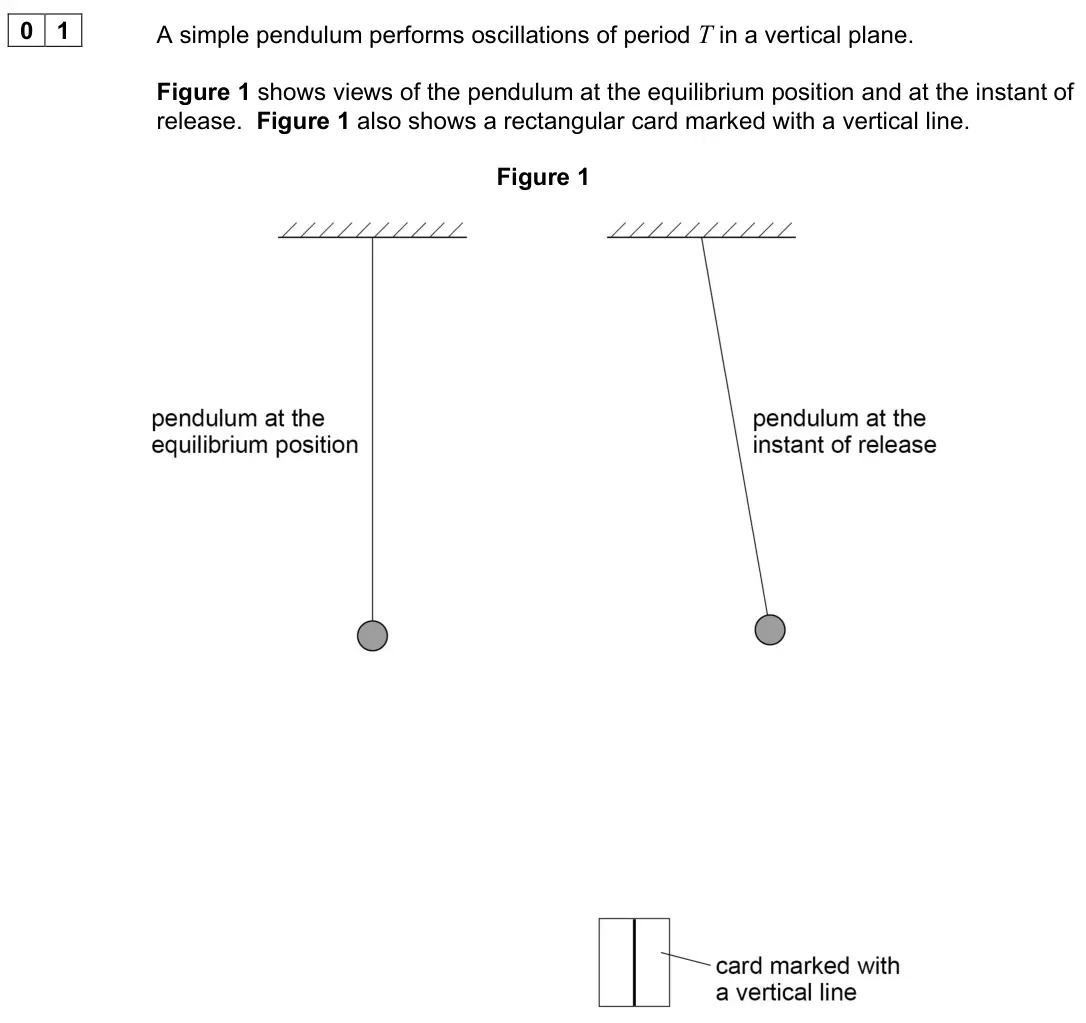
Q01.6
The whole paper ↗Q01.7
The whole paper ↗- Your answer
Q07.2
The whole paper ↗
Q07.3
The whole paper ↗- Your answer
Q1(a)
The whole paper ↗Q1(b)(i)
The whole paper ↗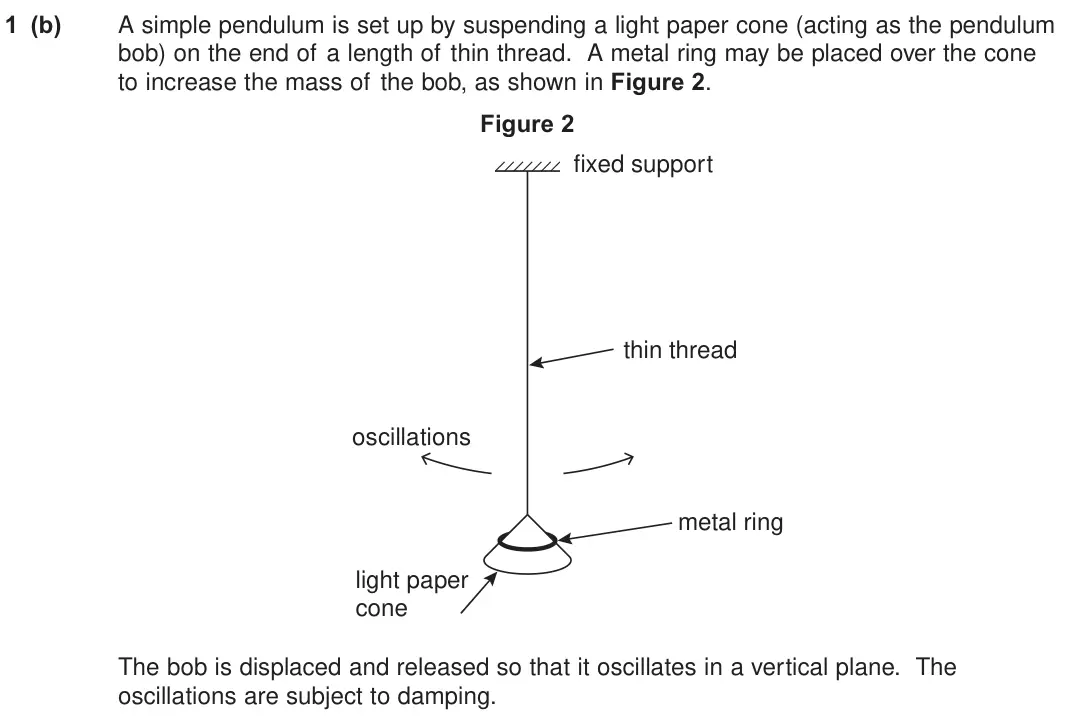
Q1(b)(ii)
The whole paper ↗- Your answer
- Your answer
- Your answer
- Your answer
Q5(c)
The whole paper ↗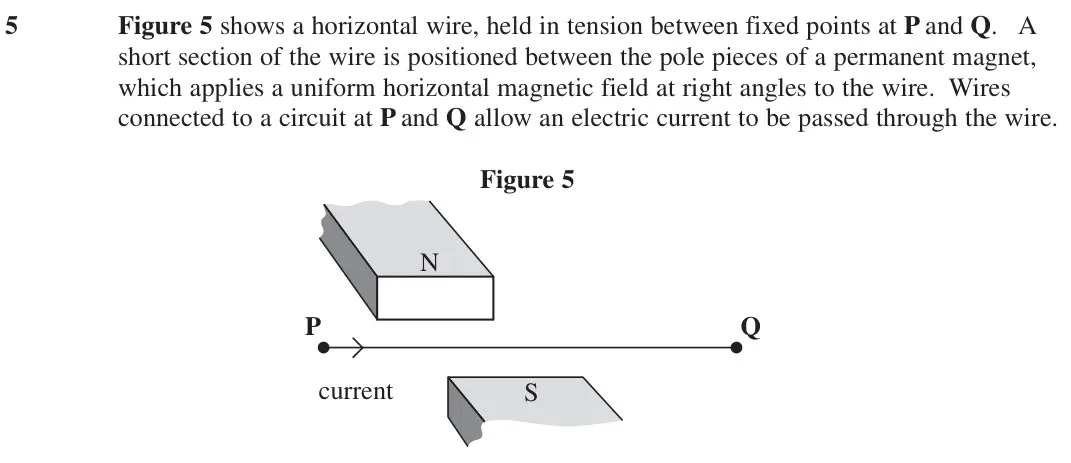
All 23 questions on Forced vibrations and resonance, as a list
- June 2025, Paper 1, Q31 (1 mark): A spring with a spring constant of 50 N m−1 is attached to a rigid horizontal bar. An object of mass m is attached to the bottom of the spring. When the bar is
- June 2025, Paper 3A, Q04.5 (3 marks): Due to damping, only a small number of oscillations occurs after the test tube is released. The student wants to produce a greater number of oscillations for a
- June 2023, Paper 1, Q06.3 (2 marks): Explain what is meant by resonance. [2 marks]
- June 2023, Paper 1, Q06.4 (3 marks): Figure 16 shows a ship moving through continuous waves of wavelength 118 m and velocity 14.2 m s−1. The ship is moving steadily at 8.0 m s−1 relative to the sea
- June 2022, Paper 1, Q05.6 (2 marks): A lamp is used to project shadow images of the block and pendulum bob on a screen. Both shadows appear to move with SHM across the screen. Figure 11 shows the i
- November 2020, Paper 3A, Q01.5 (1 mark): Table 2 shows results for An and the corresponding value of ln(An / m) for certain values of n. Table 2 n An / m ln(An / m) 2 0.238 −1.435 4 0.225 7 0.212 −1.55
- November 2020, Paper 3A, Q01.6 (2 marks): Plot on Figure 4 a graph of ln(An / m) against n. [2 marks] Figure 4
- November 2020, Paper 3A, Q01.7 (2 marks): It can be shown that An = A0 δ −n where A0 is the amplitude of release of the pendulum δ is a constant called the damping factor. Explain how to find δ from you
- June 2019, Paper 1, Q32 (1 mark): A metal panel is driven to vibrate at different frequencies. The amplitude a of the vibration is measured at each frequency. The graph shows the variation of am
- June 2017, Paper 1, Q07.2 (2 marks): Calculate the frequency at which the mass attached to spring B oscillates with maximum amplitude. [2 marks] frequency = Hz
- June 2017, Paper 1, Q07.3 (4 marks): Figure 11 shows how the amplitude of the oscillations of the mass varies with frequency for spring A. Figure 11 The investigation is repeated with the mass atta
- June 2016, PHYA4 Section A (old spec), Q8 (1 mark): The diagram shows a string XY supporting a heavy pendulum P and four pendulums A, B, C and D of smaller mass. Pendulum P is set in oscillation perpendicular to
- June 2015, PHYA4 Section B (old spec), Q1(a) (4 marks): A mass is attached to one end of a spring and the other end of the spring is suspended from a support rod, as shown in Figure 1. Figure 1 The support rod oscill
- June 2015, PHYA4 Section B (old spec), Q1(b)(i) (1 mark): Are the oscillations of the pendulum more heavily damped when the cone oscillates with the metal ring on it, when it oscillates without the ring, or does the pr
- June 2015, PHYA4 Section B (old spec), Q1(b)(ii) (3 marks): Explain your answer to part (b)(i). [3 marks]
- June 2014, PHYA4 Section A (old spec), Q9 (1 mark): A periodic force is applied to a lightly-damped object causing the object to oscillate. The graph shows how the amplitude A of the oscillations varies with the
- June 2012, PHYA4 Section A (old spec), Q10 (1 mark): An oscillatory system, subject to damping, is set into vibration by a periodic driving force of frequency f. The graphs, A to D, which are to the same scale, sh
- January 2012, PHYA4 Section A (old spec), Q8 (1 mark): A mechanical system is oscillating at resonance with a constant amplitude. Which one of the following statements is not correct? A The applied force prevents th
- June 2011, PHYA4 Section A (old spec), Q9 (1 mark): Which one of the following statements always applies to a damping force acting on a vibrating system? A It is in the same direction as the acceleration. B It is
- January 2011, PHYA4 Section B (old spec), Q5(c) (3 marks): The length of PQ is 0.40m. When the wire is vibrating, transverse waves are propagated along the wire at a speed of 64ms–1. Explain why the wire is set into lar
- January 2010, PHYA4 Section A (old spec), Q8 (1 mark): Which one of the following statements concerning forced vibrations and resonance is correct? A An oscillating body that is not resonating will return to its nat
- June 2008, PA04B (2008 spec), Q1(c) (2 marks): 1 (c) In practice, the vertical oscillations of a car are greatly reduced by fitting dampers (known as shock absorbers) to the suspension system. Figure 2 shows
- June 2008, PA04B (2008 spec), Q1(d) (2 marks): 1 (d) An experiment is carried out to investigate the rattling of internal components of a car at certain engine speeds. When a loudspeaker connected to an ac s
Questions, mark schemes and examiner’s reports are © AQA, from their published past papers. Plumi isn’t affiliated with any exam board. Want whole papers? AQA A-Level Physics past papers.
The Plumi iPad app also offers exam-style questions with AI feedback on your handwritten working.