 plumi
Preparation: AQA A‑Level Chemistry questions
AQA A-Level Chemistry past-paper questions on 3.3.11.1 Preparation, 2008–2025, with mark schemes and examiner’s reports where available.
Paper
All papers
Exam
All years
Calculations
Q09.2
The whole paper ↗
Q09.3
The whole paper ↗Q10.4
The whole paper ↗
Q10.5
The whole paper ↗Q04.4
The whole paper ↗
Q10.1
The whole paper ↗
Q10.4
The whole paper ↗Q07.2
The whole paper ↗
Q05.2
The whole paper ↗
Q01.1
The whole paper ↗
Q01.2
The whole paper ↗Q01.3
The whole paper ↗Q08.2
The whole paper ↗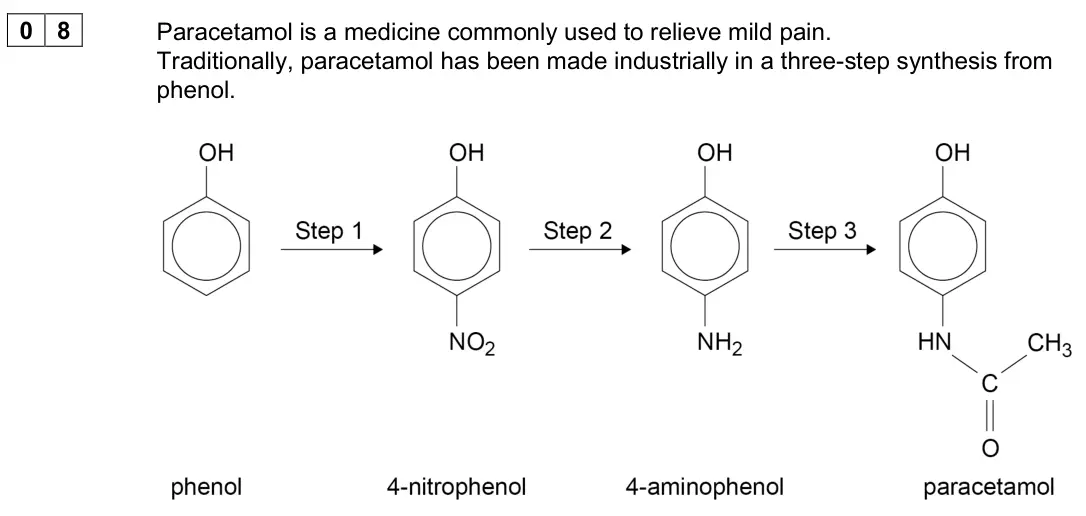
Q10.3
The whole paper ↗
Q10.4
The whole paper ↗Q10.6
The whole paper ↗Q01.2
The whole paper ↗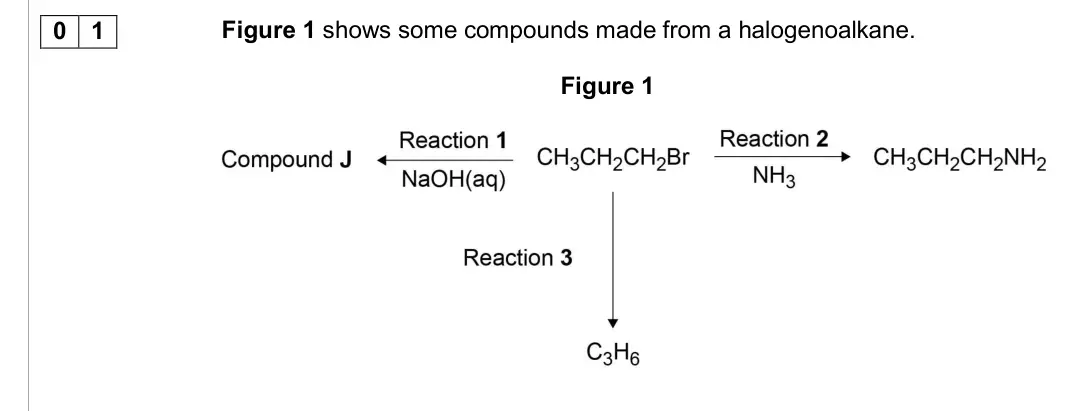
Q11.2
The whole paper ↗
Q09.8
The whole paper ↗
All 44 questions on Preparation, as a list
- June 2024, Paper 2, Q09.2 (2 marks): CH3CHBrCH2CH3 reacts with NH3 Draw the skeletal formula of the major organic product formed when • an excess of NH3 is used • an excess of CH3CHBrCH2CH3 is used
- June 2024, Paper 2, Q09.3 (3 marks): Figure 3 shows a two-step synthesis to make amine G. Figure 3 Complete Figure 3 by drawing the mechanism for Step 1 and the displayed formula of amine G. [3 mar
- June 2024, Paper 2, Q10.4 (1 mark): State the reagent(s) needed for Step 2. [1 mark]
- June 2024, Paper 2, Q10.5 (1 mark): State a possible use for the amine formed in Step 2. [1 mark]
- June 2023, Paper 2, Q04.4 (2 marks): State the reagent and reaction conditions needed for reaction 3. Give an equation for reaction 3. [2 marks] Reagent and conditions Equation
- June 2022, Paper 2, Q10.1 (3 marks): State the reagents needed for step 1 and the reagents needed for step 2. [3 marks] step 1 step 2
- June 2022, Paper 2, Q10.4 (2 marks): Amine A is formed in step 2 and amine B is formed in step 5. Explain why the yield of B in step 5 is less than the yield of A in step 2. [2 marks]
- November 2021, Paper 2, Q07.2 (3 marks): Compound L has molecular formula C4H7NO Figure 6 shows the infrared spectrum of L. Figure 6 L reacts with H2 in the presence of a nickel catalyst to give compou
- November 2021, Paper 3, Q30 (1 mark): A two-step preparation of propylamine is shown. bromoethane → X → propylamine What is X? [1 mark] A CH3CH2CH2NH2 B CH3CH2CN C CH3CH2CH2Br D CH3CH2NH2
- November 2020, Paper 2, Q05.2 (4 marks): Outline the mechanism for the reaction of 2-bromopropane with an excess of ammonia. [4 marks]
- June 2019, Paper 2, Q01.1 (2 marks): Give an equation for the preparation of 1,6-diaminohexane by the reaction of 1,6-dibromohexane with an excess of ammonia. [2 marks]
- June 2019, Paper 2, Q01.2 (4 marks): Complete the mechanism for the reaction of ammonia with 6-bromohexylamine to form 1,6-diaminohexane. Suggest the structure of a cyclic secondary amine that can
- June 2019, Paper 2, Q01.3 (3 marks): 1,6-Diaminohexane can also be formed in a two-stage synthesis starting from 1,4-dibromobutane. Suggest the reagent and a condition for each stage in this altern
- June 2019, Paper 2, Q08.2 (1 mark): Complete the equation for the reaction in Step 2. [1 mark]
- June 2018, Paper 2, Q10.3 (2 marks): Primary amines can be prepared by the reaction of halogenoalkanes with ammonia or by the reduction of nitriles. Justify the statement that it is better to prepa
- June 2018, Paper 2, Q10.4 (1 mark): Draw the structure of a primary amine with four carbon atoms that cannot be formed from a nitrile. [1 mark]
- June 2018, Paper 2, Q10.6 (2 marks): Phenylamine can be prepared by a process involving the reduction of nitrobenzene using tin and an excess of hydrochloric acid. Give an equation for the reductio
- June 2017, Paper 2, Q01.2 (2 marks): Name the mechanism for Reaction 2 and give an essential condition used to ensure that CH3CH2CH2NH2 is the major product. [2 marks Name of mechanism Condition
- June 2017, Paper 2, Q11.2 (5 marks): Amine F can be prepared in a three-step synthesis starting from methylbenzene. Suggest the structures of the two intermediate compounds. For each step, give rea
- Specimen, Paper 2, Q09.8 (1 mark): 6
- Specimen, Paper 3, Q31 (1 mark): How many secondary amines have the molecular formula C4H11N? [1 mark] A 2 B 3 C 4 D 5 3 1
- June 2016, CHEM4 (old spec), Q3(e) (1 mark): Give the name, including the classification, of the functional group that contains the nitrogen atom labelled b. [1 mark]
- June 2016, CHEM4 (old spec), Q8(b) (5 marks): Draw the structure of compound S. For each of Steps 3 and 4, give a reagent and one condition, other than heat. [5 marks]
- June 2015, CHEM4 (old spec), Q5(b)(i) (1 mark): Give a reducing agent for this reaction. [1 mark]
- June 2015, CHEM4 (old spec), Q5(b)(ii) (1 mark): Write an equation for this reaction. Use [H] to represent the reducing agent. [1 mark]
- June 2015, CHEM4 (old spec), Q5(b)(iii) (1 mark): Give a use for J. [1 mark]
- June 2014, CHEM4 (old spec), Q4(b)(ii) (1 mark): Suggest a combination of reagents for the reaction in Stage 2. [1 mark]
- June 2013, CHEM4 (old spec), Q8(c)(i) (7 marks): Identify the intermediate compound in Route A. Give the reagents and conditions for both stages in Route A and the single stage in Route B.
- June 2013, CHEM4 (old spec), Q8(c)(ii) (2 marks): Give one disadvantage of Route A and one disadvantage of Route B.
- June 2013, CHEM2 (old spec), Q8(d) (1 mark): Draw the structure of the organic product with Mr = 73, made from the reaction between 2-bromobutane and ammonia. (1 mark)
- January 2013, CHEM4 (old spec), Q7(a) (5 marks): Consider the following conversion. Identify a reducing agent for this conversion. Write a balanced equation for the reaction using molecular formulae for the ni
- June 2012, CHEM4 (old spec), Q5(c) (3 marks): For Step 3, give the reagent, give a necessary condition and name the mechanism. Reagent Condition Name of mechanism (3 marks)
- January 2012, CHEM4 (old spec), Q10(b) (6 marks): For the reaction of CH3CH2CH2Cl with an excess of ammonia, name and outline the mechanism and name the organic product.
- June 2011, CHEM4 (old spec), Q8(b) (6 marks): Benzene can be converted into amine U by the two-step synthesis shown below. The mechanism of Reaction 1 involves attack by an electrophile. Give the reagents u
- January 2011, CHEM4 (old spec), Q7(a) (1 mark): Name the compound (CH3CH2)2NH (1 mark)
- January 2011, CHEM4 (old spec), Q7(d) (2 marks): Identify one organic impurity in the product of Step 3 and give a reason for its formation. (2 marks)
- June 2010, CHEM4 (old spec), Q3(d)(i) (4 marks): Outline a mechanism for Reaction 3. (4 marks)
- June 2010, CHEM4 (old spec), Q3(d)(ii) (1 mark): State the conditions used in Reaction 3 to form the maximum amount of the primary amine, D. (1 mark)
- June 2010, CHEM4 (old spec), Q3(d)(iii) (1 mark): Draw the structure of the secondary amine formed as a by-product in Reaction 3. (1 mark) 13
- January 2010, CHEM4 (old spec), Q8(c)(i) (2 marks): Identify a suitable reagent or mixture of reagents for the reduction of Y to form this diamine. Write an equation for this reaction using [H] to represent the r
- June 2009, CHEM2 (old spec), Q8(c) (1 mark): 8 (c) Explain why an excess of ammonia is needed in Reaction 2 to produce a high yield of ethylamine. (1 mark)
- June 2008, CHM4 (2008 spec), Q5(b) (5 marks): 5 (b) Name and outline a mechanism for Reaction 2. Name of mechanism Mechanism (5 marks)
- June 2008, CHM4 (2008 spec), Q5(c) (4 marks): 5 (c) Compound G is a primary amine with molecular formula C4H11N In Reaction 2, the percentage conversion of F into G is 53.4%. 5 (c) (i) Calculate the mass of
- January 2008, CHM3W (2008 spec), Q5(c) (2 marks): (c) Complete and balance the following equation for the reaction of ammonia with bromomethane. Give the name of the organic product of this reaction. CH3Br + ……
Questions, mark schemes and examiner’s reports are © AQA, from their published past papers. Plumi isn’t affiliated with any exam board. Want whole papers? AQA A-Level Chemistry past papers.
The Plumi iPad app also offers exam-style questions with AI feedback on your handwritten working.