 plumi
Nucleophilic properties: AQA A‑Level Chemistry questions
AQA A-Level Chemistry past-paper questions on 3.3.11.3 Nucleophilic properties, 2008–2025, with mark schemes and examiner’s reports where available.
Paper
All papers
Exam
All years
Calculations
Q09.1
The whole paper ↗
Q09.2
The whole paper ↗Q10.4
The whole paper ↗
Q05.3
The whole paper ↗
Q01.2
The whole paper ↗
Q01.4
The whole paper ↗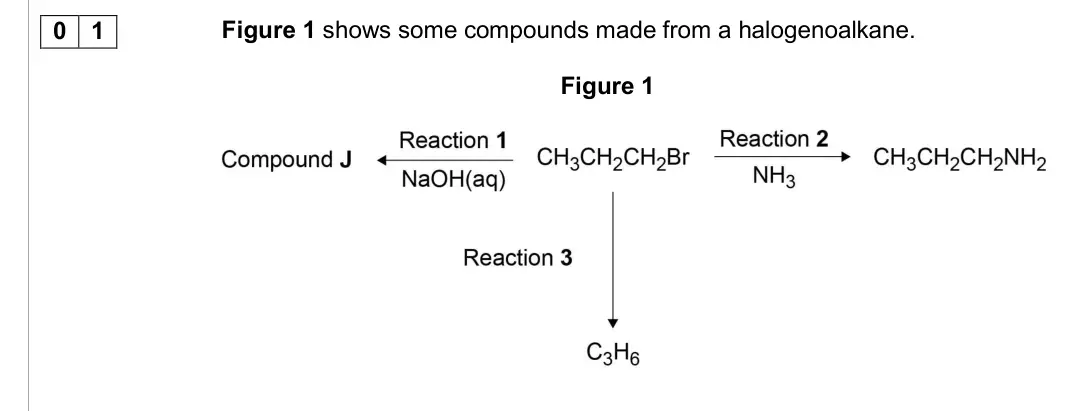
Q06.3
The whole paper ↗Q3(b)
The whole paper ↗
Q5(c)
The whole paper ↗
Q7(b)
The whole paper ↗Q8(a)
The whole paper ↗
Q5(f)
The whole paper ↗
Q8(a)(iii)
The whole paper ↗
Q4(d)(iv)
The whole paper ↗
Q6(b)(i)
The whole paper ↗- Your answer
All 21 questions on Nucleophilic properties, as a list
- June 2025, Paper 3, Q07 (1 mark): The reaction between methylamine (CH3NH2) and excess bromoethane (C2H5Br) produces a quaternary ammonium salt. What is the formula for the cation in this salt?
- June 2025, Paper 3, Q35 (1 mark): Which compound can be used as a cationic surfactant? [1 mark] A [C16H33N(CH3)3]Br B C16H33N(CH3)2 C C17H35COONa D C17H35COOH
- June 2024, Paper 2, Q09.1 (2 marks): An incomplete equation for Step 1 in the reaction between bromoethane and an amine is shown. Complete the equation. In Step 2 of this reaction, the product of S
- June 2024, Paper 2, Q09.2 (2 marks): CH3CHBrCH2CH3 reacts with NH3 Draw the skeletal formula of the major organic product formed when • an excess of NH3 is used • an excess of CH3CHBrCH2CH3 is used
- June 2022, Paper 2, Q10.4 (2 marks): Amine A is formed in step 2 and amine B is formed in step 5. Explain why the yield of B in step 5 is less than the yield of A in step 2. [2 marks]
- November 2021, Paper 3, Q32 (1 mark): Methylamine reacts with bromoethane by nucleophilic substitution to produce a mixture of products. Which is not a possible product of this reaction? [1 mark] A
- November 2020, Paper 2, Q05.3 (2 marks): Draw the skeletal formula of the main organic species formed in the reaction between a large excess of 2-bromopropane and ammonia. Give a use for the organic pr
- June 2019, Paper 2, Q01.2 (4 marks): Complete the mechanism for the reaction of ammonia with 6-bromohexylamine to form 1,6-diaminohexane. Suggest the structure of a cyclic secondary amine that can
- June 2019, Paper 3, Q27 (1 mark): Methylamine reacts with bromoethane by substitution to produce a mixture of products. Which compound is not a possible product of this reaction? [1 mark] A C2H5
- June 2017, Paper 2, Q01.4 (2 marks): When Reaction 2 is carried out under different conditions, a compound with molecular formula C9H21N is produced. Draw the skeletal formula of the compound. Iden
- Specimen, Paper 2, Q06.3 (1 mark): Draw the structure of the species formed when glycine reacts with an excess of bromomethane. [1 mark] 0 6 . 3
- June 2016, CHEM4 (old spec), Q3(b) (1 mark): Name the mechanism for Step 2. [1 mark]
- June 2015, CHEM4 (old spec), Q5(c) (4 marks): Outline a mechanism for the reaction of bromomethane with an excess of compound J. You should represent J as RNH2 in the mechanism. [4 marks]
- June 2014, CHEM4 (old spec), Q7(b) (4 marks): Cetrimide is used as an antiseptic. [CH3(CH2)15N(CH3)3]+ Br– cetrimide Name this type of compound. Give the reagent that must be added to CH3(CH2)15NH2 to make
- June 2013, CHEM4 (old spec), Q8(a) (6 marks): The amine CH3CH2CH2NH2 reacts with CH3COCl Name and outline a mechanism for this reaction. Give the IUPAC name of the organic product. (6 marks)
- June 2012, CHEM4 (old spec), Q5(f) (1 mark): Draw the structure of the tertiary amine formed when X reacts with bromomethane. (1 mark) Section B Answer all questions in the spaces provided.
- January 2012, CHEM4 (old spec), Q8(a)(iii) (1 mark): [C16H33N(CH3)3]+ Br – (1 mark)
- June 2011, CHEM4 (old spec), Q4(d)(iv) (1 mark): Draw the structure of the species formed when serine reacts with an excess of bromomethane. (1 mark)
- June 2010, CHEM4 (old spec), Q6(b)(i) (1 mark): Draw the structure of the product formed when serine reacts with an excess of CH3Br (1 mark)
- June 2008, CHM6W (2008 spec), Q13 (1 mark): 13 Which one of the following is formed when an excess of bromomethane reacts with diethylamine? A B N CH2CH3 CH2CH3 CH3CH2 N CH3 CH3 CH3CH2 CH3 N CH2CH3 CH3 CH
- January 2008, CHM4 (2008 spec), Q7(b) (6 marks): (b) Name and outline a mechanism for this reaction and name the product shown. (6 marks) CH3CH2Cl NHCH2CH3 NH2
Questions, mark schemes and examiner’s reports are © AQA, from their published past papers. Plumi isn’t affiliated with any exam board. Want whole papers? AQA A-Level Chemistry past papers.
The Plumi iPad app also offers exam-style questions with AI feedback on your handwritten working.