 plumi
Addition reactions of alkenes: AQA A‑Level Chemistry questions
AQA A-Level Chemistry past-paper questions on 3.3.4.2 Addition reactions of alkenes, 2008–2025, with mark schemes and examiner’s reports where available.
Paper
All papers
Exam
All years
Calculations
Q01.5
The whole paper ↗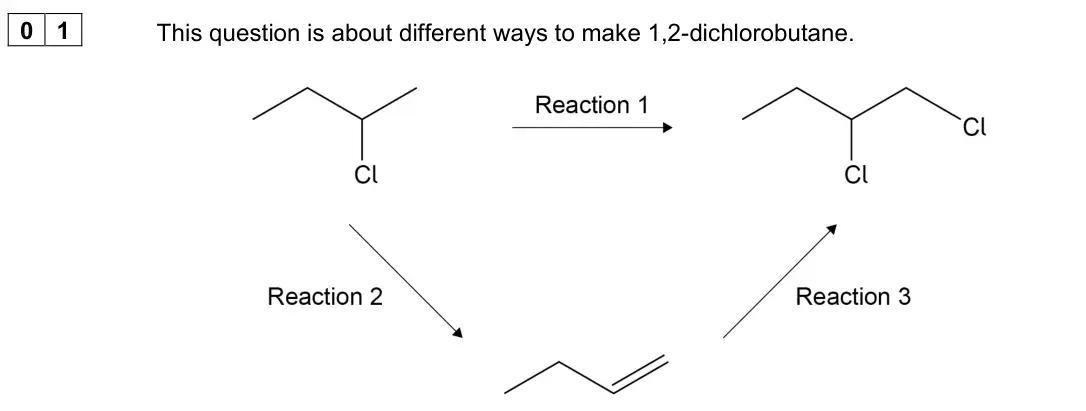
Q01.6
The whole paper ↗Q02.3
The whole paper ↗
Q06.2
The whole paper ↗
Q08.1
The whole paper ↗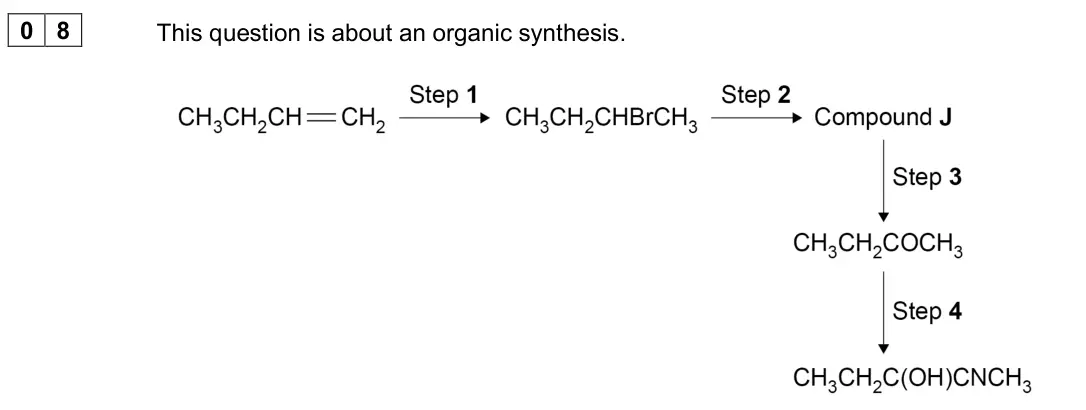
Q09.3
The whole paper ↗
Q04.2
The whole paper ↗Q04.3
The whole paper ↗Q04.2
The whole paper ↗
Q04.1
The whole paper ↗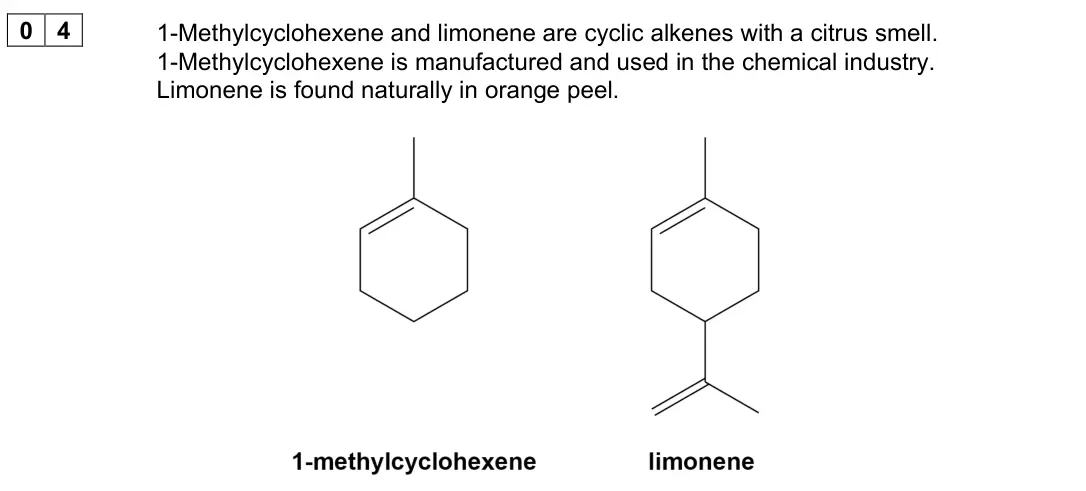
Q04.2
The whole paper ↗Q04.3
The whole paper ↗Q03.1
The whole paper ↗
Q03.2
The whole paper ↗Q05.5
The whole paper ↗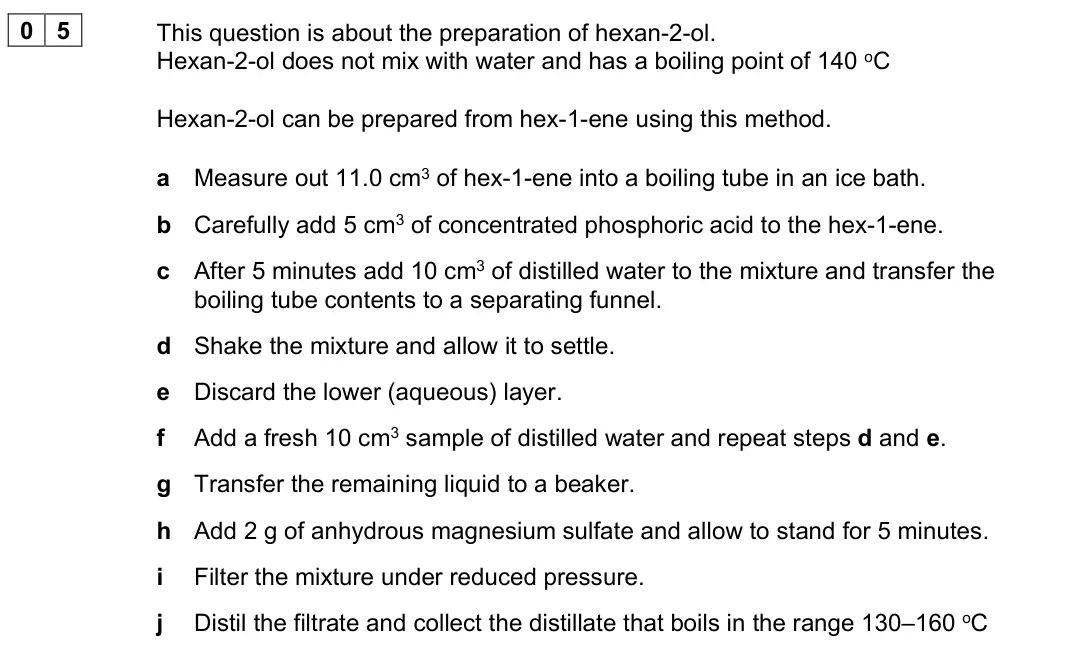
Q07.6
The whole paper ↗
Q07.7
The whole paper ↗
All 90 questions on Addition reactions of alkenes, as a list
- June 2025, Paper 2, Q01.5 (2 marks): Identify the reagent and name the mechanism for reaction 3. [2 marks] Reagent Name of mechanism
- June 2025, Paper 2, Q01.6 (1 mark): Use of the reagent for reaction 2 followed by the reagent for reaction 3 gives another organic product. Give the structure of the other organic product. [1 mark
- June 2025, Paper 2, Q02.3 (2 marks): Figure 1 shows part of the mechanism when L reacts with hydrogen bromide. Figure 1 Complete Figure 1 to show the next step in the mechanism that gives the major
- June 2025, Paper 3, Q13 (1 mark): Compound X reacts with concentrated sulfuric acid to produce compound Y. Compound Y reacts with an excess of water to produce an alcohol. Which compound could b
- June 2025, Paper 3, Q36 (1 mark): The hydration of 1-methylcyclopent-1-ene uses a catalyst of sulfuric acid and produces a mixture of products. Which ion is formed during the mechanism for this
- June 2025, AS Paper 2, Q06.2 (3 marks): Complete the mechanism for this reaction by adding curly arrows in the relevant places. [3 marks]
- June 2024, Paper 2, Q08.1 (2 marks): Name the mechanism in Step 1. State the reagent(s) used for Step 1. [2 marks] Name of mechanism Reagent(s)
- June 2024, Paper 2, Q09.3 (3 marks): Figure 3 shows a two-step synthesis to make amine G. Figure 3 Complete Figure 3 by drawing the mechanism for Step 1 and the displayed formula of amine G. [3 mar
- June 2024, AS Paper 2, Q04.2 (5 marks): Compound J reacts with hydrogen bromide to form compounds K and L. K is the major product. Name and outline the mechanism for the formation of K. [5 marks] Name
- June 2024, AS Paper 2, Q04.3 (3 marks): Explain why compound K is the major product in the reaction in Question 04.2. [3 marks]
- June 2023, Paper 2, Q04.2 (6 marks): Reaction 1 produces a mixture of W and two other isomers. Draw the structures of the two other isomers. Explain, by considering the mechanism of this reaction,
- June 2023, Paper 3, Q31 (1 mark): Compound X can be converted into an alcohol in a two-stage process. What is the name of compound X? [1 mark] A propene B propanal C methylbenzene D ethanamide
- June 2023, AS Paper 2, Q04.1 (5 marks): 1-Methylcyclohexene reacts with HBr to form two structural isomers. The major product is 1-bromo-1-methylcyclohexane. Name and outline the mechanism for the for
- June 2023, AS Paper 2, Q04.2 (4 marks): Draw the skeletal formula of the minor product formed in the reaction in Question 04.1. Explain why the products are formed in different amounts. [4 marks] Skel
- June 2023, AS Paper 2, Q04.3 (1 mark): Draw the structure of the major product when an excess of HBr reacts with limonene. [1 mark]
- June 2022, Paper 2, Q03.1 (5 marks): Name the mechanism for the reaction of 2-methylbut-1-ene with concentrated sulfuric acid. Outline the mechanism for this reaction to form the major product. [5
- June 2022, Paper 2, Q03.2 (3 marks): Draw the structure of the minor product formed in the reaction in Question 03.1 Explain why this is the minor product. [3 marks] Structure of minor product Expl
- June 2022, Paper 2, Q05.5 (2 marks): Identify the most likely organic impurity, other than hex-1-ene, in the distillate collected in step j. Suggest one reason why it could be difficult to remove t
- June 2022, AS Paper 2, Q07.6 (5 marks): Name and outline a mechanism to show the conversion of but-1-ene into compound W in the first part of this process. [5 marks] Name of mechanism Outline of mecha
- June 2022, AS Paper 2, Q07.7 (2 marks): There is a very low yield of butan-1-ol from but-1-ene in this manufacturing process. Explain why. [2 marks] Section B Answer all questions in this section. Onl
- November 2021, Paper 2, Q08.2 (4 marks): State the reagents needed and give equations for step 2 and step 3. Show the structure of Compound G in your equations. [4 marks] Step 2 reagent Step 2 equation
- November 2021, AS Paper 2, Q02.1 (5 marks): Name and outline the mechanism for the reaction of cyclohexene with Br2 [5 marks] Name of mechanism Outline of mechanism
- November 2021, AS Paper 2, Q02.2 (3 marks): Explain why there is an attraction between a C=C double bond and Br2 [3 marks]
- November 2021, AS Paper 2, Q02.3 (1 mark): Draw the skeletal formula of the halogenoalkane formed when buta-1,3-diene (CH2=CHCH=CH2) reacts with an excess of Br2 [1 mark]
- November 2021, AS Paper 2, Q18 (1 mark): Which compound reacts with hydrogen bromide to give 2-bromo-3-methylbutane as the major product? [1 mark] A (CH3)2C=CHCH3 B (CH3)2C=CH2 C CH2=C(CH3)CH2CH3 D (CH
- November 2020, Paper 3, Q24 (1 mark): Which compound decolourises bromine water in the absence of sunlight? [1 mark] A CH3CH2CH2Br B C D CH3CH2CHCH2
- November 2020, Paper 3, Q28 (1 mark): Which compound reacts with hydrogen bromide to give 2-bromo-3-methylbutane as the major product? [1 mark] A (CH3)2C=CHCH3 B CH3(CH2)2CH=CH2 C CH3CH2C(CH3)=CH2 D
- November 2020, AS Paper 2, Q12 (1 mark): What is the IUPAC name of the major product of the reaction between 2-ethylbut-1-ene and hydrogen bromide? [1 mark] A 1-bromo-2-ethylbutane B 2-bromo-2-ethylbut
- November 2020, AS Paper 2, Q15 (1 mark): In which reaction does the inorganic reagent act initially as an electrophile? [1 mark] A bromoethane with ethanolic potassium hydroxide B chloroethane with aqu
- June 2019, Paper 2, Q02.5 (3 marks): Cyclohexene reacts with bromine. Complete the mechanism for this reaction. [3 marks]
- June 2019, Paper 3, Q33 (1 mark): Which alkene reacts with hydrogen bromide to give 2-bromo-3-methylbutane as the major product? [1 mark] A (CH3)2C=CHCH3 B CH3CH2CH=CHCH3 C CH3CH2C(CH3)=CH2 D (C
- June 2019, AS Paper 2, Q06.1 (5 marks): Name and outline the mechanism for the formation of E in this reaction. [5 marks] Name of mechanism Mechanism
- June 2019, AS Paper 2, Q06.2 (1 mark): Draw the structure of F. [1 mark]
- June 2019, AS Paper 2, Q06.3 (2 marks): Explain why more of isomer E than isomer F is formed in this reaction. [2 marks]
- June 2018, Paper 3, Q03.2 (2 marks): Describe a test-tube reaction, on the product, to show that the cyclohexanol had been dehydrated. State what you would observe. [2 marks]
- June 2018, AS Paper 2, Q05.1 (6 marks): A hydrocarbon contains 87.8% by mass of carbon and has a relative molecular mass (Mr) of 82.0 The hydrocarbon decolourises bromine water. Determine the empirica
- June 2018, AS Paper 2, Q11 (1 mark): Which is the major product of the reaction between 2-methylbut-2-ene and iodine monochloride (ICl)? [1 mark] A B C D
- June 2017, Paper 3, Q02.1 (1 mark): Name the mechanism for the reaction of concentrated sulfuric acid with an alkene. [1 mark]
- June 2017, Paper 3, Q02.2 (4 marks): Outline the mechanism for the reaction of concentrated sulfuric acid with propene to show the formation of the major product. [4 marks]
- June 2017, Paper 3, Q02.3 (1 mark): Draw the structure of the minor product of the reaction between concentrated sulfuric acid and propene. [1 mark] 7
- June 2017, Paper 3, Q02.4 (2 marks): Explain why the product shown in your answer to Question 2.2 is the major product. [2 marks]
- June 2017, AS Paper 2, Q08.2 (1 mark): Draw the displayed formula of C5H11Br that is the major product of the reaction of 2-methylbut-2-ene with hydrogen bromide. [1 mark]
- June 2016, AS Paper 2, Q03.7 (2 marks): Oleic acid (C18H34O2) is a straight-chain fatty acid obtained from plant oils. Isooctane can be made from oleic acid. The skeletal formula of oleic acid is show
- June 2016, AS Paper 2, Q07.2 (7 marks): Name and outline the mechanism for the formation of 3-bromo-3-methylpentane from this reaction of 3-methylpent-2-ene with hydrogen bromide. Explain why more 3-b
- Specimen, Paper 2, Q12.1 (1 mark): 12 But-1-ene reacts with a reagent of the form HY to form a saturated compound. Suggest a reagent of the form HY which reacts with but-1-ene. [1 mark] 1 2 . 1
- Specimen, Paper 2, Q12.2 (5 marks): Name of mechanism Mechanism
- Specimen, Paper 2, Q12.3 (3 marks): 12 But-1-ene reacts with a reagent of the form HY to form a saturated compound. Explain how three isomeric products are formed when HY reacts with but-1-ene. [3
- Specimen, Paper 3, Q27 (1 mark): What is the major product of the reaction between but-1-ene and DBr? (D is deuterium and represents 2H) [1 mark] A CH2DCH2CH2CH2Br B CH2DCH2CHBrCH3 C CH3CH2CHBr
- June 2016, CHEM2 (old spec), Q9(a) (7 marks): On a laboratory scale, a mixture of propan-1-ol and propan-2-ol can be prepared from propene in two steps. In step 1, propene reacts with cold, concentrated sul
- June 2015, CHEM2 (old spec), Q2(b) (3 marks): Propane and propene [3 marks] Reagent Observation with propane Observation with propene
- June 2015, CHEM2 (old spec), Q8(b) (5 marks): The conversion of P into Q in Reaction 1 uses HCl Name and outline a mechanism for this reaction. [5 marks]
- June 2014, CHEM4 (old spec), Q7(c) (3 marks): Give a reagent that could be used in a test-tube reaction to distinguish between benzene and cyclohexene. Describe what you would see when the reagent is added
- June 2014, CHEM2 (old spec), Q7(b) (3 marks): A chemical test can be used to distinguish between separate samples of Isomer 1 and Isomer 2. Identify a suitable reagent for the test. State what you would obs
- June 2014, CHEM2 (old spec), Q7(e)(i) (5 marks): Name and outline a mechanism for the reaction of Isomer 4 with hydrogen bromide to give 2-bromo-2-methylbutane as the major product. [5 marks] (CH3)2C CHCH3 + H
- June 2014, CHEM2 (old spec), Q7(e)(ii) (2 marks): The minor product in this reaction mixture is 2-bromo-3-methylbutane. Explain why this bromoalkane is formed as a minor product. [2 marks]
- June 2013, CHEM2 (old spec), Q1(d)(i) (5 marks): Name and outline a mechanism for Stage 1 of this conversion. Name of mechanism Mechanism (5 marks)
- June 2013, CHEM2 (old spec), Q1(d)(ii) (1 mark): Deduce the type of reaction in Stage 2 of this conversion. (1 mark)
- June 2013, CHEM2 (old spec), Q1(d)(iii) (1 mark): State the overall role of sulfuric acid in this conversion. (1 mark)
- June 2013, CHEM2 (old spec), Q2(c) (3 marks): Cyclohexane and cyclohexene Reagent Observation with cyclohexane Observation with cyclohexene
- June 2013, CHEM2 (old spec), Q8(a) (1 mark): Draw the structure of the alkene that would form 1,2-dibromo-3-methylbutane when reacted with bromine. (1 mark)
- January 2013, CHEM2 (old spec), Q8(a) (5 marks): Name and outline a mechanism for Reaction 1. Name of mechanism Mechanism (5 marks)
- June 2012, CHEM1 (old spec), Q2(d)(i) (1 mark): Suggest the formula of a reagent that could be added to X in order to convert it into Y. (1 mark)
- June 2012, CHEM2 (old spec), Q3(d)(iii) (2 marks): Write an equation for the hydration of propene to form isopropyl alcohol. Give the IUPAC name for isopropyl alcohol. Equation IUPAC name (2 marks)
- June 2012, CHEM2 (old spec), Q7(b) (4 marks): The equation for the first reaction in the conversion of hex-3-ene into hexan-3-ol is shown below. CH3CH2CH CHCH2CH3 + H2SO4 CH3CH2CH2CH(OSO2OH)CH2CH3 Outline a
- January 2012, CHEM2 (old spec), Q8(b) (4 marks): The first stage in this conversion involves the reaction of hydrogen bromide with but-1-ene. CH3CH2CH CH2 + HBr CH3CH2CHBrCH3 Outline a mechanism for this react
- January 2012, CHEM2 (old spec), Q10(b) (3 marks): A simple chemical test can be used to distinguish between cyclohexane (A) and cyclohexene (D). Give a reagent for this test and state what you would observe wit
- June 2011, CHEM4 (old spec), Q8(c) (6 marks): Cyclohexene can be converted into amine W by the two-step synthesis shown below. Suggest an identity for compound V. For Reaction 3, give the reagent used and n
- June 2011, CHEM2 (old spec), Q9(b) (5 marks): Name and outline a mechanism for the following conversion. CH3 CH3 CH3 C CH2 CH3 C CH2Br Br (5 marks) Br2
- January 2011, CHEM2 (old spec), Q7(b)(ii) (1 mark): Name the type of mechanism involved in this reaction. (1 mark)
- January 2011, CHEM2 (old spec), Q7(b)(iii) (1 mark): Draw the structure of the compound with Mr = 387.6 formed when penta-1,4-diene (H2C=CHCH2CH=CH2) reacts with an excess of bromine. (1 mark)
- January 2011, CHEM2 (old spec), Q7(c) (2 marks): Two products are formed when propene reacts with hydrogen bromide. Draw the structure of the intermediate that leads to the formation of the major product in th
- June 2010, CHEM2 (old spec), Q2(d)(ii) (1 mark): Suggest one reason why this reaction occurs by a mechanism involving a carbocation, but the reaction in part (c) (ii) does not. (1 mark)
- June 2010, CHEM2 (old spec), Q5(c)(ii) (4 marks): Outline a mechanism for Stage 1 of this reaction. (4 marks)
- June 2010, CHEM2 (old spec), Q6(a)(i) (1 mark): Name the major product P. (1 mark)
- June 2010, CHEM2 (old spec), Q6(a)(ii) (1 mark): Name the mechanism for these reactions. (1 mark)
- June 2010, CHEM2 (old spec), Q6(a)(iii) (2 marks): Draw the displayed formula for the minor product Q and state the type of structural isomerism shown by P and Q. Displayed formula for Q Type of structural isome
- January 2010, CHEM2 (old spec), Q1(b)(i) (1 mark): Use your knowledge of the chemistry of alkenes to deduce the type of reaction that has occurred in this conversion. (1 mark)
- January 2010, CHEM2 (old spec), Q10(d) (5 marks): The reaction of chlorine with ethene is similar to that of bromine with ethene. Name and outline a mechanism for the reaction of chlorine with ethene to form 1,
- June 2009, CHEM2 (old spec), Q7(b) (5 marks): 7 (b) Name and outline a mechanism for the reaction of bromine with but-2-ene. Name of mechanism Mechanism (5 marks)
- June 2008, CHM3W (2008 spec), Q2(f)(iii) (1 mark): 2 (f) (iii) Draw the structure of the product formed when prop-2-en-l-ol reacts with bromine. (1 mark)
- June 2008, CHM3W (2008 spec), Q5(c)(i) (1 mark): 5 (c) (i) Identify compound R. (1 mark)
- June 2008, CHM3W (2008 spec), Q5(c)(ii) (1 mark): 5 (c) (ii) Name the type of mechanism for the conversion of Q into R. (1 mark)
- June 2008, CHM4 (2008 spec), Q5(a) (2 marks): 5 (a) (i) Name the mechanism for Reaction 1. 5 (a) (ii) Compound F is the only product formed in Reaction 1. Deduce the structure of compound E. (2 marks)
- June 2008, CHM6W (2008 spec), Q36 (1 mark): 36 The drug tamoxifen, which is used in the treatment of cancer, has the structure Correct statements about tamoxifen include 1 it can undergo electrophilic add
- June 2008, CHM6W (2008 spec), Q37 (1 mark): 37 Ionone, shown below, is a compound responsible for the smell of raspberries. Mechanisms involved in reactions of ionone include 1 electrophilic addition. 2 e
- January 2008, CHM3W (2008 spec), Q2(e)(ii) (1 mark): (ii) Name the type of mechanism involved in this reaction. (1 mark)
- January 2008, CHM3W (2008 spec), Q2(e)(iii) (1 mark): (iii) Draw the structure of the compound with Mr = 373.6, formed when buta-1,3-diene reacts with an excess of bromine. (1 mark)
- January 2008, CHM3W (2008 spec), Q3(b)(i) (1 mark): (i) State the type of reaction. (1 mark)
- January 2008, CHM3W (2008 spec), Q3(b)(ii) (2 marks): (ii) Give a reagent and a catalyst for this reaction. Reagent Catalyst (2 marks)
- January 2008, CHM3W (2008 spec), Q6(c) (5 marks): (c) Name and outline a mechanism for the conversion of B into C (Reaction 2). (5 marks)
Questions, mark schemes and examiner’s reports are © AQA, from their published past papers. Plumi isn’t affiliated with any exam board. Want whole papers? AQA A-Level Chemistry past papers.
The Plumi iPad app also offers exam-style questions with AI feedback on your handwritten working.