 plumi
Infrared spectroscopy: AQA A‑Level Chemistry questions
AQA A-Level Chemistry past-paper questions on 3.3.6.3 Infrared spectroscopy, 2008–2025, with mark schemes and examiner’s reports where available.
Paper
All papers
Exam
All years
Calculations
Q04.2
The whole paper ↗
Q02.1
The whole paper ↗
Q02.2
The whole paper ↗Q02.3
The whole paper ↗Q05.1
The whole paper ↗
Q02.5
The whole paper ↗
Q03.3
The whole paper ↗
Q03.4
The whole paper ↗Q02.3
The whole paper ↗
Q07.1
The whole paper ↗
Q07.2
The whole paper ↗Q04.6
The whole paper ↗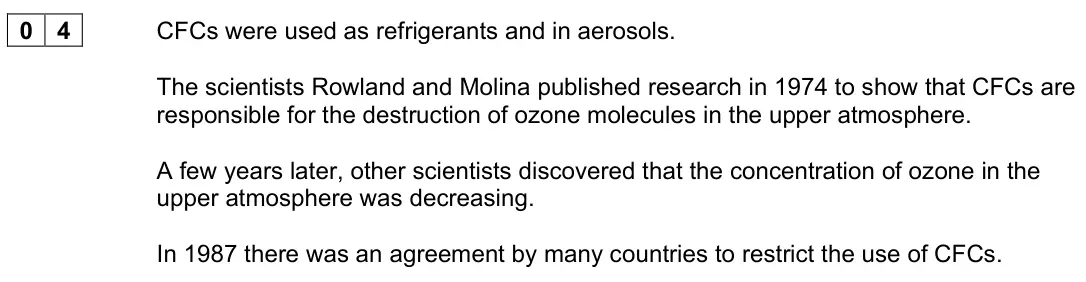
Q07.4
The whole paper ↗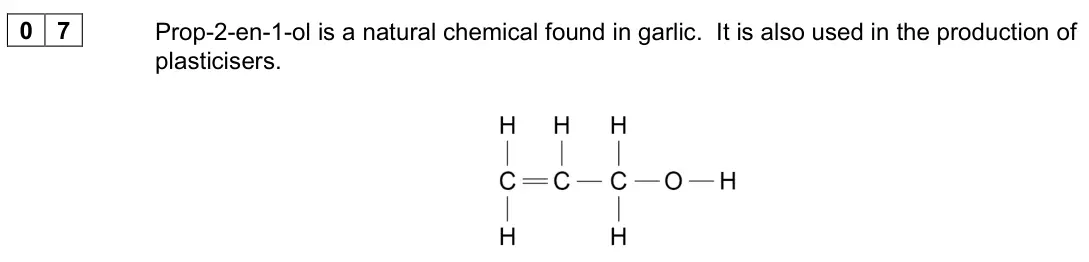
Q03.5
The whole paper ↗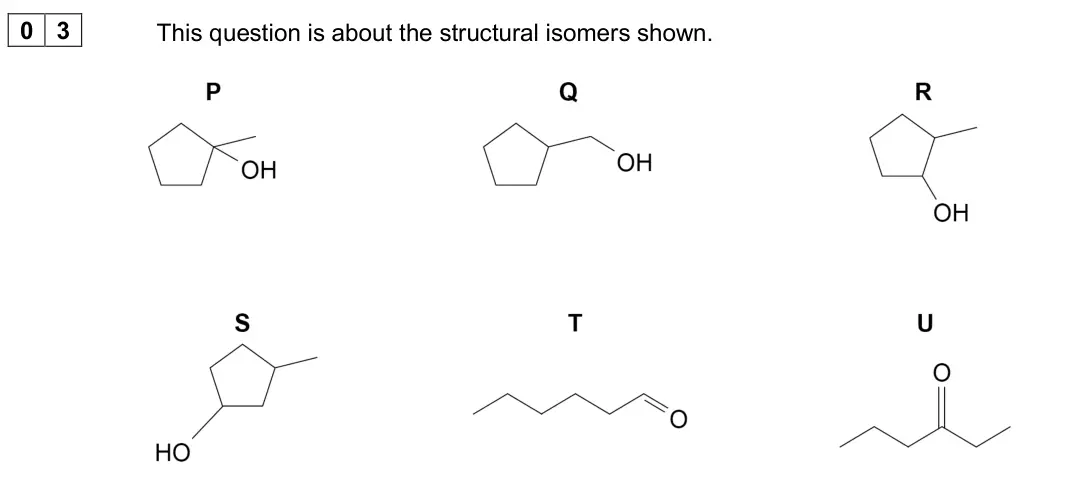
All 75 questions on Infrared spectroscopy, as a list
- June 2025, AS Paper 2, Q04.2 (1 mark): Compound C has the molecular formula C4H6O2 In the infrared spectrum of C, there is • absorption in the range 3230–3550 cm–1 • absorption in the range 1620–1680
- June 2025, AS Paper 2, Q17 (1 mark): Which of these gases is not linked to global warming caused by the absorption of infrared radiation? [1 mark] A CO2 B C3H8 C H2O D N2
- June 2024, AS Paper 2, Q02.1 (2 marks): Compounds A and B both have the molecular formula C4H8O2 Figure 1 shows the infrared spectra of compounds A and B. Use the infrared spectra to deduce a possible
- June 2024, AS Paper 2, Q02.2 (2 marks): Figure 2 shows the infrared spectrum of either pent-1-ene or 2-methylbut-2-ene. Figure 2 Outline how to use the infrared spectrum to determine whether the compo
- June 2024, AS Paper 2, Q02.3 (1 mark): Figure 3 shows the infrared spectrum of methane. Figure 3 Use information from Figure 3 to explain why methane acts as a greenhouse gas. [1 mark]
- June 2023, Paper 2, Q05.1 (1 mark): Identify the bond that causes the absorption at 1725 cm–1 [1 mark]
- June 2023, Paper 3, Q33 (1 mark): The skeletal formulas of two compounds are shown. Which method would distinguish between samples of these compounds? [1 mark] A comparing fingerprint regions of
- June 2023, AS Paper 2, Q02.5 (1 mark): Carbon dioxide is a product from the combustion of petrol in cars. Carbon dioxide acts as a greenhouse gas when it absorbs infrared radiation. Give one reason w
- June 2023, AS Paper 2, Q14 (1 mark): The infrared spectrum of an organic compound is shown. Which compound could produce this spectrum? [1 mark] A but-1-ene B but-2-en-1-ol C butanoic acid D butan-
- June 2022, Paper 2, Q06 (6 marks): This question is about compound X with the empirical formula C2H4O Figure 2 shows the infrared spectrum of X. Figure 3 shows the 13C NMR spectrum of X. The 1H N
- June 2022, AS Paper 2, Q02 (6 marks): A student has samples of these four compounds but does not know which is which: • butanoic acid • 2-methylpropanal • 2-methylpropanoic acid • 2-methylpropan-1-o
- June 2022, AS Paper 2, Q03.3 (1 mark): Draw the skeletal formula of a functional group isomer of butanal that has an absorption in the range 1680–1750 cm–1 in its infrared spectrum. [1 mark]
- June 2022, AS Paper 2, Q03.4 (1 mark): Draw the skeletal formula of a structural isomer of butanal that has an absorption in the range 3230–3550 cm–1 in its infrared spectrum. [1 mark]
- November 2021, Paper 2, Q02.3 (1 mark): Carbon dioxide is formed when petrol is burned. Carbon dioxide acts as a greenhouse gas when it absorbs infrared radiation. Give a reason why carbon dioxide abs
- November 2021, Paper 2, Q07.1 (1 mark): Compound K has molecular formula C4H8O Figure 5 shows the infrared spectrum of K. Figure 5 Which functional group does K contain? Tick () one box. [1 mark] Fun
- November 2021, Paper 2, Q07.2 (3 marks): Compound L has molecular formula C4H7NO Figure 6 shows the infrared spectrum of L. Figure 6 L reacts with H2 in the presence of a nickel catalyst to give compou
- November 2021, Paper 3, Q11 (1 mark): Which statement does not support the suggestion that an unknown organic compound is [1 mark] A Its 1H NMR spectrum has 3 peaks with an integration ratio of 2:3:
- November 2021, AS Paper 2, Q04.6 (2 marks): CFC-11 is a greenhouse gas that can contribute to global warming. State and explain how CFC-11 is able to contribute to global warming. [2 marks]
- November 2021, AS Paper 2, Q07.4 (1 mark): Figure 3 shows the infrared spectrum of a functional group isomer of prop-2-en-1-ol. Figure 3 This isomer reacts with acidified potassium dichromate(VI) to form
- November 2020, Paper 2, Q03.5 (4 marks): Describe fully how infrared spectra can be used to distinguish between isomers R, S and T. Use data from Table A in the Data Booklet in your answer. [4 marks]
- November 2020, AS Paper 2, Q13 (1 mark): Which can be used to distinguish between these two compounds? (CH3)2CHCH2CHO and (CH3)3CCHO [1 mark] A Acidified potassium dichromate(VI) B Fingerprint region o
- June 2019, Paper 2, Q06.4 (1 mark): Compounds E, F, and G are isomers. Figure 1 shows the infrared spectra of these isomers, but not necessarily in the same order. Label each spectrum with the cor
- June 2019, Paper 2, Q07.2 (6 marks): Explain how and why isomers X and Y can be distinguished by comparing each of their • boiling points • 13C NMR spectra • infrared spectra. Use data from Tables
- June 2019, Paper 2, Q11.5 (1 mark): Combustion of biodiesel produces greenhouse gases such as carbon dioxide that cause global warming. Part of the infrared spectrum of carbon dioxide is shown in
- June 2019, Paper 2, Q11.6 (2 marks): Explain how carbon dioxide causes global warming. [2 marks]
- June 2019, AS Paper 2, Q23 (1 mark): The infrared spectrum of an organic compound is shown. Which compound produces this spectrum? [1 mark] A ethanoic acid B 4-hydroxybutanone C propan-1-ol D prop-
- June 2018, Paper 2, Q02.3 (1 mark): The infrared spectrum of Compound Y shows a significant absorption in the range 1680–1750 cm–1 Draw the displayed formula of Compound Y. [1 mark]
- June 2018, Paper 2, Q10.1 (1 mark): The infrared spectra A, B and C are those of a primary amine, a tertiary amine and a nitrile, but not necessarily in that order. Give the letter of each compoun
- June 2018, Paper 3, Q03.8 (1 mark): Explain how an infrared spectrum would confirm that the cyclohexene obtained from the chromatography column did not contain any cyclohexanol. [1 mark]
- June 2018, AS Paper 2, Q06.5 (1 mark): The infrared spectrum in Figure 4 is that of either alcohol B or alkene C. Figure 4 Tick the box that shows the correct compound. Explain your answer with refer
- June 2018, AS Paper 2, Q07.1 (6 marks): Four compounds, all colourless liquids, are • butan-2-ol • butanal • butanone • 2-methylpropan-2-ol Two of these compounds can be identified using different tes
- June 2017, Paper 2, Q10.3 (3 marks): Isomer Q (C6H10O2) is a cyclic compound. The infrared spectrum of Q is shown in Figure 4 and the 13C NMR spectrum of Q is shown in Figure 5. Use these spectra a
- June 2017, Paper 3, Q12 (1 mark): Which compound gives this infrared spectrum? [1 mark] A 1-bromobutane B butan-1-ol C butanal D butanoic acid 19
- June 2017, AS Paper 2, Q12 (1 mark): The infrared spectrum of an organic compound is shown. Which compound produces this spectrum? [1 mark] A butanone B ethanol C pent-2-ene D propanoic acid
- June 2016, AS Paper 2, Q04.2 (2 marks): The infrared spectrum of one of these three compounds is shown in Figure 4. Figure 4 Use the spectrum to identify the compound. State the bond that you used to
- June 2016, AS Paper 2, Q05.6 (1 mark): There are growing concerns about the use of 1,1,1-trifluoroethane as a refrigerant as it is a greenhouse gas that absorbs some of Earth’s infrared radiation. Gi
- June 2016, CHEM4 (old spec), Q9(b) (9 marks): The infrared spectrum of R (C6H14O2) is shown in Figure 1. Figure 1 The proton n.m.r. spectrum of R contains five peaks. The chemical shift values, integration
- June 2016, CHEM2 (old spec), Q4(a) (1 mark): Use Table A on the data sheet to identify the bond and the functional group present responsible for this absorption. [1 mark]
- June 2016, CHEM2 (old spec), Q4(c) (4 marks): Isomer C is resistant to oxidation. Isomer C reacts to form compound R that has an absorption in its infrared spectrum in the range 1620–1680 cm–1. State the bo
- June 2016, CHEM2 (old spec), Q4(d)(ii) (2 marks): A student claims to have oxidised compound D. Figure 1 shows the infrared spectrum of the product obtained by the student. Figure 1 Suggest two ways in which th
- June 2015, CHEM2 (old spec), Q6(c)(iii) (2 marks): There are two functional groups in prop-2-en-1-ol. Each of these functional groups contains a bond with a characteristic absorption range in the infrared spectr
- June 2015, CHEM2 (old spec), Q6(d)(i) (1 mark): Draw the structure of X. [1 mark]
- June 2014, CHEM2 (old spec), Q7(c)(i) (1 mark): State the infrared absorption range that shows that Isomer 3 and Isomer 4 contain the same functional group. [1 mark]
- June 2014, CHEM2 (old spec), Q7(c)(ii) (1 mark): State one way that the infrared spectrum of Isomer 3 is different from the infrared spectrum of Isomer 4. [1 mark]
- June 2014, CHEM2 (old spec), Q8(b) (3 marks): Reaction 3 is an acid-catalysed reaction in which water is used to break chemical bonds when the CN functional group is converted into the COOH functional group
- June 2013, CHEM4 (old spec), Q8(b)(ii) (2 marks): Use Table 1 on the Data Sheet to explain how you could use infrared spectra in the range outside the fingerprint region to distinguish between the secondary ami
- June 2013, CHEM2 (old spec), Q5(b)(iv) (1 mark): Identify one feature of this infrared spectrum of a pure sample of X that may be used to confirm that X is an alcohol. You may find it helpful to refer to Table
- June 2013, CHEM2 (old spec), Q9(c) (2 marks): Consider the infrared spectrum of (E)-but-2-enenitrile. Identify two features of the infrared spectrum that support the fact that this is the infrared spectrum
- January 2013, CHEM4 (old spec), Q5(c)(iii) (1 mark): Draw the structure of a cyclic compound that has only two peaks in its 13C n.m.r. spectrum and has no absorption for C= O in its infrared spectrum. (1 mark)
- January 2013, CHEM2 (old spec), Q5(a)(ii) (1 mark): Consider the infrared spectrum of solid glucose. State why it is possible to suggest that in the solid state very few molecules have the structure shown. You ma
- June 2012, CHEM2 (old spec), Q6(b)(ii) (2 marks): The following infrared spectrum was obtained for a sample of X produced in this reaction. Use this infrared spectrum to explain why it is possible to deduce tha
- June 2012, CHEM2 (old spec), Q8(b)(ii) (3 marks): The infrared spectra shown are those of three compounds. Compound A 1,4-dibromobutane Compound B butane-1,4-diol Compound C butanedioic acid Identify the compou
- January 2012, CHEM4 (old spec), Q6(a) (1 mark): The infrared spectrum of X is shown below. Use Table 1 on the Data Sheet to help you answer the question. Identify the functional group that causes the absorpti
- January 2012, CHEM2 (old spec), Q10(a)(i) (1 mark): (1 mark) 4000 3000 2000 Wavenumber / cm–1 1500 1000 500 Transmittance / % 100 50 0
- January 2012, CHEM2 (old spec), Q10(a)(ii) (1 mark): (1 mark) 4000 3000 2000 Wavenumber / cm–1 1500 1000 500 Transmittance / % 100 50 0
- January 2012, CHEM2 (old spec), Q10(a)(iii) (1 mark): (1 mark) 4000 3000 2000 Wavenumber / cm–1 1500 1000 500 Transmittance / % 100 50 0
- January 2012, CHEM2 (old spec), Q10(a)(iv) (1 mark): (1 mark) 4000 3000 2000 Wavenumber / cm–1 1500 1000 500 Transmittance / % 100 50 0
- June 2011, CHEM2 (old spec), Q6(e)(i) (1 mark): Deduce which of the isomers (1, 2 or 3) would give this infrared spectrum. You may find it helpful to refer to Table 1 on the Data Sheet. (1 mark)
- June 2011, CHEM2 (old spec), Q6(e)(ii) (2 marks): Identify two features of the infrared spectrum that support your deduction. In each case, identify the functional group responsible. Feature 1 and functional gr
- January 2011, CHEM4 (old spec), Q4(c)(i) (1 mark): Identify the bond that causes the absorption at 1637 cm–1 in its infrared spectrum. (1 mark)
- January 2011, CHEM2 (old spec), Q6(a)(i) (1 mark): Use information from the infrared spectra to deduce one reason why the student concluded that water vapour is a more effective greenhouse gas than carbon dioxid
- January 2011, CHEM2 (old spec), Q6(a)(ii) (2 marks): Use your knowledge of the bonds in CO2 to state why the infrared spectrum of carbon dioxide is not as might be predicted from the data provided in Table 1 on th
- January 2011, CHEM2 (old spec), Q8(c)(ii) (2 marks): A student obtained the following infrared spectrum for the product from this elimination reaction. Use information from the infrared spectrum to state and expla
- June 2010, CHEM4 (old spec), Q3(b)(i): 4000 3000 2000 Wavenumber / cm–1 1500 1000 500 Transmittance / % 100 50 0 100
- June 2010, CHEM4 (old spec), Q3(b)(ii): 4000 3000 2000 Wavenumber / cm–1 1500 1000 500 100 50 0 100 Transmittance / %
- June 2010, CHEM4 (old spec), Q3(b)(iii): 4000 3000 2000 Wavenumber / cm–1 1500 1000 500 100 50 0 Transmittance / %
- June 2010, CHEM4 (old spec), Q3(b)(iv) (4 marks): (4 marks) Wavenumber / cm–1 4000 3000 2000 1500 1000 500 100 50 0 Transmittance / %
- June 2010, CHEM2 (old spec), Q6(b)(i) (2 marks): Identify the infrared Spectrum 1 or 2 that represents compound R. Use information from the infrared spectra to give one reason for your answer. You may find it
- January 2010, CHEM4 (old spec), Q7(a) (2 marks): Compounds A and B have the molecular formula C3H6O A has an absorption at 1715cm–1 in its infrared spectrum and has only one peak in its 1H n.m.r. spectrum. B h
- January 2010, CHEM4 (old spec), Q7(d) (2 marks): Compounds G and H have the molecular formula C6H12O Each exists as a pair of optical isomers and each has an absorption at about 1700cm–1 in its infrared spectr
- January 2010, CHEM2 (old spec), Q6(c) (1 mark): State the structural feature of propanal and propanone which can be identified from their infrared spectra by absorptions at approximately 1720cm–1. You may fin
- January 2010, CHEM2 (old spec), Q9(b) (3 marks): The infrared spectrum of one of these isomeric alcohols is given below. Identify one feature of the infrared spectrum which supports the fact that this is an al
- June 2009, CHEM2 (old spec), Q9(b) (3 marks): 9 (b) The infrared spectrum shown below is either that of butan-2-ol or that of butanone. Identify the compound to which this infrared spectrum refers. Explain
- June 2008, CHM6W (2008 spec), Q35 (1 mark): 35 Compound X has the following characteristics • it has an infra-red spectrum with a strong absorption at around 1700 cm–1 • it has a proton n.m.r. spectrum wi
- January 2008, CHM4 (2008 spec), Q8(d) (2 marks): (d) (i) Infra-red spectroscopy can be used to distinguish between esters and carboxylic acids. Identify an absorption that would enable you to distinguish betwe
Questions, mark schemes and examiner’s reports are © AQA, from their published past papers. Plumi isn’t affiliated with any exam board. Want whole papers? AQA A-Level Chemistry past papers.
The Plumi iPad app also offers exam-style questions with AI feedback on your handwritten working.