 plumi
Nucleophilic substitution: AQA A‑Level Chemistry questions
AQA A-Level Chemistry past-paper questions on 3.3.3.1 Nucleophilic substitution, 2008–2025, with mark schemes and examiner’s reports where available.
Paper
All papers
Exam
All years
Calculations
Q09.5
The whole paper ↗
Q09.6
The whole paper ↗Q01.1
The whole paper ↗
Q01.2
The whole paper ↗Q01.3
The whole paper ↗Q05.1
The whole paper ↗
Q08.2
The whole paper ↗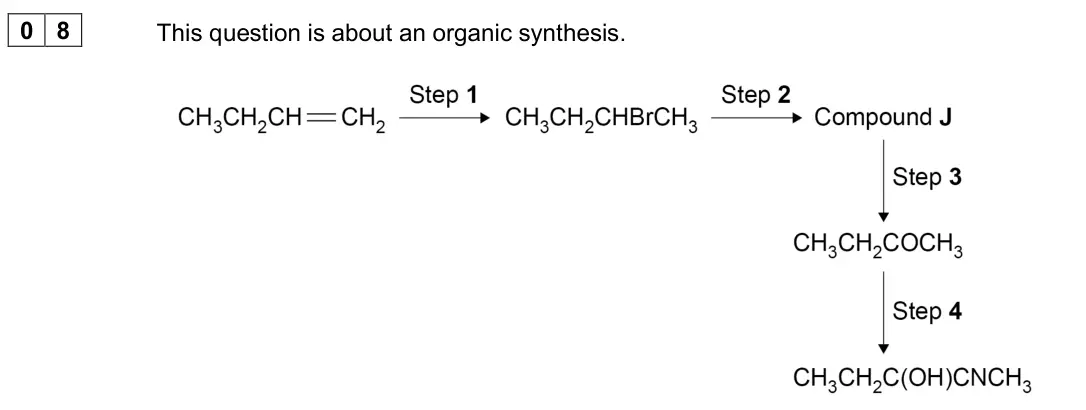
Q06.1
The whole paper ↗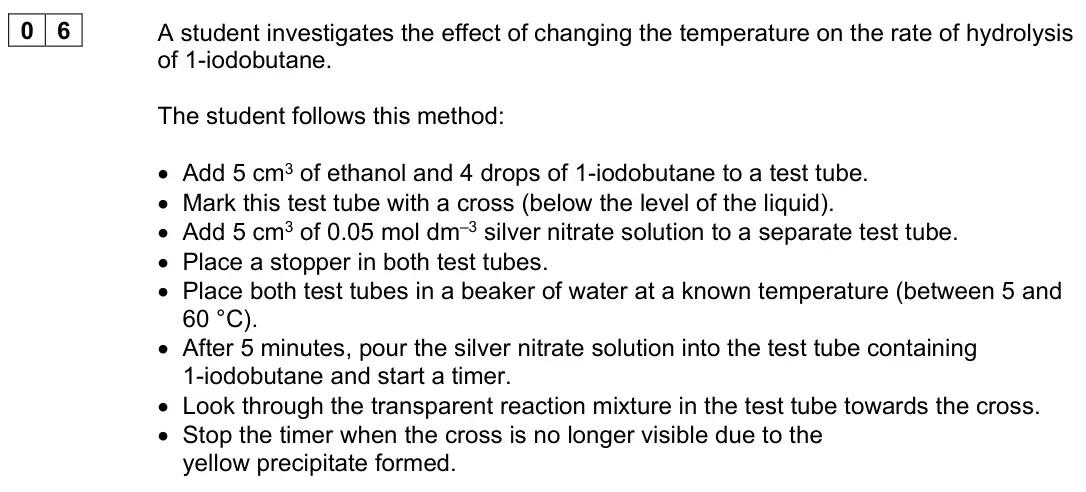
Q06.3
The whole paper ↗Q07.4
The whole paper ↗
Q07.5
The whole paper ↗Q04.3
The whole paper ↗
Q03.1
The whole paper ↗
Q03.2
The whole paper ↗Q03.7
The whole paper ↗
All 92 questions on Nucleophilic substitution, as a list
- June 2025, Paper 2, Q09.5 (1 mark): The rate equation for the reaction between a different bromoalkane (R2CHBr) and an aqueous solution of KOH is rate = k [R2CHBr] Which of these is a correct mech
- June 2025, Paper 2, Q09.6 (2 marks): Explain, in terms of bond polarity, why R2CHBr and KOH react together. [2 marks]
- June 2025, Paper 3, Q08 (1 mark): Each of the conversions shown uses KOH as a reactant. In which conversion does KOH not act as a base? [1 mark] A (CH3)2NH2+Br – to (CH3)2NH B CH3COOH to CH3COO–
- June 2025, AS Paper 2, Q01.1 (2 marks): Halogenoalkanes undergo substitution reactions with nucleophiles such as CN–, NH3 and OH– Explain why halogenoalkanes react with nucleophiles. [2 marks]
- June 2025, AS Paper 2, Q01.2 (3 marks): 2-Bromobutane reacts with ammonia to form CH3CH(NH2)CH2CH3 Complete the mechanism for this reaction. [3 marks] 2-Bromobutane reacts with KOH to give a mixture o
- June 2025, AS Paper 2, Q01.3 (1 mark): Identify the solvent that should be used to ensure that butan-2-ol is the main organic product when 2-brombutane reacts with KOH [1 mark]
- June 2024, Paper 2, Q05.1 (2 marks): Silver nitrate solution can be used to distinguish between propanoyl chloride and 1-chloropropane. Give the observations you would expect when a few drops of si
- June 2024, Paper 2, Q08.2 (2 marks): Identify compound J. State the reagent(s) and conditions needed for Step 2. [2 marks] Compound J Reagent(s) and conditions
- June 2024, AS Paper 2, Q06.1 (1 mark): Identify the yellow precipitate formed in the reaction. [1 mark]
- June 2024, AS Paper 2, Q06.3 (3 marks): The student repeats the investigation using 1-bromobutane instead of 1-iodobutane. State and explain how the rate of reaction for 1-bromobutane compares with th
- June 2024, AS Paper 2, Q07.4 (3 marks): Name and outline the mechanism for Step 1. [3 marks] Name of mechanism Outline of mechanism
- June 2024, AS Paper 2, Q07.5 (1 mark): Suggest one reason why water is not a suitable solvent for Step 1. [1 mark]
- June 2024, AS Paper 2, Q11 (1 mark): Which labelled curly arrow shows an incorrect movement of an electron pair? [1 mark] A B C D
- June 2023, Paper 2, Q04.3 (2 marks): Identify the reagent that is warmed with isomer W in reaction 2. State the other reaction condition needed. [2 marks] Reagent Condition
- June 2023, Paper 3, Q29 (1 mark): Which is not a possible product of a reaction between KOH and ? [1 mark] A B C D
- June 2023, AS Paper 2, Q03.1 (2 marks): Outline the mechanism for the nucleophilic substitution reaction of 1-bromobutane with sodium hydroxide. [2 marks]
- June 2023, AS Paper 2, Q03.2 (2 marks): State how Figure 1 shows that the rate of reaction of 1-iodobutane is faster than the rate of reaction of 1-bromobutane. State why the rates are different. [2 m
- June 2023, AS Paper 2, Q13 (1 mark): Which is not a possible product of the reaction of this compound with potassium hydroxide? [1 mark] A B C D
- June 2022, Paper 3, Q03.7 (2 marks): A student compares the rates of hydrolysis of 1-chlorobutane, 1-bromobutane and 1-iodobutane. The suggested method is: • add equal volumes of the three halogeno
- June 2022, Paper 3, Q23 (1 mark): Which compound is formed from bromoethane in a nucleophilic substitution reaction? [1 mark] A CH3CN B CH3CH2NH2 C CH2=CH2 D CH3CH2OSO2OH
- June 2022, AS Paper 2, Q05.1 (5 marks): Name and outline the mechanism for this reaction. [5 marks] Name of mechanism Outline of mechanism
- June 2022, AS Paper 2, Q16 (1 mark): Which reaction does not result in a change in the shape around a carbon atom? [1 mark] A chloromethane with aqueous sodium hydroxide B ethene with bromine C pro
- June 2022, AS Paper 2, Q21 (1 mark): Which of these compounds is not produced? [1 mark] A butan-1-ol B butan-2-ol C but-1-ene D E-but-2-ene
- November 2021, Paper 2, Q08.2 (4 marks): State the reagents needed and give equations for step 2 and step 3. Show the structure of Compound G in your equations. [4 marks] Step 2 reagent Step 2 equation
- November 2021, AS Paper 2, Q07.1 (1 mark): Prop-2-en-1-ol can be prepared by reacting 3-chloroprop-1-ene with dilute aqueous sodium hydroxide. Name the mechanism for this reaction. [1 mark]
- November 2021, AS Paper 2, Q14 (1 mark): What is the organic product of this reaction? [1 mark] A propylamine B butylamine C propanenitrile D butanenitrile
- November 2021, AS Paper 2, Q15 (1 mark): Which is the correct mechanism for the reaction? [1 mark] A B C D
- November 2021, AS Paper 2, Q16 (1 mark): The reactions of 1-bromopropane and 1-chloropropane with potassium cyanide in aqueous ethanol occur at different rates under the same conditions. Which row corr
- November 2020, Paper 2, Q05.2 (4 marks): Outline the mechanism for the reaction of 2-bromopropane with an excess of ammonia. [4 marks]
- November 2020, AS Paper 2, Q01.5 (5 marks): Ammonia reacts with 1-chloropropane to form propylamine. Name and outline the mechanism for this reaction. [5 marks] Name of mechanism Outline of mechanism
- June 2019, Paper 2, Q01.3 (3 marks): 1,6-Diaminohexane can also be formed in a two-stage synthesis starting from 1,4-dibromobutane. Suggest the reagent and a condition for each stage in this altern
- June 2019, AS Paper 2, Q02.1 (2 marks): Outline the mechanism for this reaction. [2 marks]
- June 2019, AS Paper 2, Q16 (1 mark): Which compound can react with ammonia to produce propylamine? [1 mark] A CH3CH═CH2 B CH3CH2CH2OH C CH3CH2CH2Br D CH3CH2CH3
- June 2019, AS Paper 2, Q19 (1 mark): Which species can act as a nucleophile? [1 mark] A NH4 + B CH3OH C CH4 D H+
- June 2019, AS Paper 2, Q22 (1 mark): Which compound could not be produced by reacting 2-bromo-3-methylbutane with sodium hydroxide? [1 mark] A 2-methylbut-1-ene B 3-methylbut-1-ene C 2-methylbut-2-
- June 2018, Paper 2, Q02.2 (3 marks): Reaction 1 occurs via a nucleophilic substitution mechanism. Explain why the halogenoalkane is attacked by the nucleophile in this reaction. [3 marks]
- June 2018, Paper 3, Q10 (1 mark): Which statement is correct about the molecule shown? [1 mark] A It reacts with HBr in an electrophilic substitution reaction. B It reacts with NaBH4 in a nucleo
- June 2018, AS Paper 2, Q06.3 (4 marks): Reaction of A with warm, dilute aqueous sodium hydroxide forms alcohol B. Name the mechanism for this reaction. Outline the mechanism using the structure of A s
- June 2018, AS Paper 2, Q06.6 (1 mark): Compound D reacts with dilute aqueous sodium hydroxide in a similar way to A to form alcohol B. Compound A Compound D Explain why D reacts more quickly than A w
- June 2018, AS Paper 2, Q18 (1 mark): Which species could act as a nucleophile? [1 mark] A BH3 B NH4 + C PH3 D SiH4
- June 2017, Paper 2, Q01.1 (1 mark): Draw the displayed formula of compound J. [1 mark
- June 2017, Paper 2, Q01.2 (2 marks): Name the mechanism for Reaction 2 and give an essential condition used to ensure that CH3CH2CH2NH2 is the major product. [2 marks Name of mechanism Condition
- June 2017, Paper 3, Q14 (1 mark): The reaction sequence shows how CH3CH3 can be converted into BrCH2CH2Br Which step occurs by nucleophilic substitution? [1 mark] A Step A B Step B C Step C D St
- June 2017, AS Paper 2, Q06.1 (3 marks): Name and outline the mechanism for this reaction. [3 marks] Name of mechanism Mechanism
- June 2017, AS Paper 2, Q16 (1 mark): Which compound has the fastest rate of reaction with potassium cyanide to form pentanenitrile? [1 mark] A 1-bromobutane B 1-chlorobutane C 1-fluorobutane D 1-io
- June 2016, AS Paper 2, Q10 (1 mark): Pentanenitrile can be made by reaction of 1-bromobutane with potassium cyanide. Which of these is the correct name for the mechanism of this reaction? [1 mark]
- Specimen, Paper 3, Q28 (1 mark): Why are fluoroalkanes unreactive? [1 mark] A Fluorine is highly electronegative. B The F– ion is very stable. C They are polar molecules. D The C F bond is very
- June 2016, CHEM4 (old spec), Q3(b) (1 mark): Name the mechanism for Step 2. [1 mark]
- June 2016, CHEM4 (old spec), Q8(a) (3 marks): Give the reagent and conditions for Step 1. State how you could obtain a sample of the alcohol from the reaction mixture formed in Step 1. [3 marks]
- June 2016, CHEM4 (old spec), Q8(b) (5 marks): Draw the structure of compound S. For each of Steps 3 and 4, give a reagent and one condition, other than heat. [5 marks]
- June 2016, CHEM2 (old spec), Q8(a) (8 marks): The same reagent is used in both reactions. The product is determined by the choice of conditions. State the reagent and the conditions for each of reaction 1 a
- June 2016, CHEM2 (old spec), Q8(c) (4 marks): The rates of hydrolysis of two chloroalkanes can be investigated by adding aqueous silver nitrate to the chloroalkanes. During the hydrolysis reactions, chlorid
- June 2015, CHEM2 (old spec), Q8(c) (5 marks): The conversion of Q into R in Reaction 2 uses NH3 Name and outline a mechanism for this reaction. [5 marks]
- June 2014, CHEM2 (old spec), Q8(a)(i) (2 marks): Use your knowledge of organic reaction mechanisms to complete the mechanism for this step by drawing two curly arrows on the following equation. [2 marks] Br- H
- June 2014, CHEM2 (old spec), Q8(a)(ii) (2 marks): Deduce the name of the mechanism in Question 8 (a) (i). Give the IUPAC name of (CH3)2CHCH2Br [2 marks]
- June 2013, CHEM2 (old spec), Q5(b)(i) (1 mark): Draw the displayed formula for X. (1 mark)
- June 2013, CHEM2 (old spec), Q5(b)(ii) (1 mark): Suggest one change to the reaction conditions that would increase the yield of X. (1 mark)
- June 2013, CHEM2 (old spec), Q5(b)(iii) (1 mark): State the type of mechanism for the conversion of 2-bromo-3-methylbutane into X. (1 mark)
- June 2013, CHEM2 (old spec), Q8(d) (1 mark): Draw the structure of the organic product with Mr = 73, made from the reaction between 2-bromobutane and ammonia. (1 mark)
- January 2013, CHEM4 (old spec), Q1(c)(ii) (1 mark): Outline a mechanism for this step using a curly arrow. (1 mark)
- January 2013, CHEM2 (old spec), Q8(b) (5 marks): Name and outline a mechanism for Reaction 2. Name of mechanism Mechanism (5 marks)
- June 2012, CHEM4 (old spec), Q5(c) (3 marks): For Step 3, give the reagent, give a necessary condition and name the mechanism. Reagent Condition Name of mechanism (3 marks)
- June 2012, CHEM2 (old spec), Q8(b)(i) (3 marks): Name and outline a mechanism for the following reaction that occurs in Process 1. BrCH2CH2CH2CH2Br + NaOH BrCH2CH2CH2CH2OH + NaBr (3 marks)
- January 2012, CHEM4 (old spec), Q10(b) (6 marks): For the reaction of CH3CH2CH2Cl with an excess of ammonia, name and outline the mechanism and name the organic product.
- January 2012, CHEM2 (old spec), Q9(b) (6 marks): Give a reagent and conditions for Reaction 2. Reaction 2 CH3CH2Br CH3CH2OH Name and outline a mechanism for Reaction 2. Suggest one reason, other than safety, w
- June 2011, CHEM4 (old spec), Q8(c) (6 marks): Cyclohexene can be converted into amine W by the two-step synthesis shown below. Suggest an identity for compound V. For Reaction 3, give the reagent used and n
- June 2011, CHEM2 (old spec), Q3(f)(iv) (1 mark): The bromoalkane that reacts with sodium cyanide to produce propanenitrile. (1 mark)
- June 2011, CHEM2 (old spec), Q9(c) (5 marks): Name and outline a mechanism for the following conversion. NH3 CH3CH2CH2Br CH3CH2CH2NH2 (5 marks)
- January 2011, CHEM2 (old spec), Q8(a)(i) (1 mark): nucleophile (1 mark)
- January 2011, CHEM2 (old spec), Q8(a)(ii) (1 mark): substitution, as applied to nucleophilic substitution in a haloalkane (1 mark)
- January 2011, CHEM2 (old spec), Q8(a)(iii) (1 mark): hydrolysis (1 mark)
- January 2011, CHEM2 (old spec), Q8(b) (2 marks): Outline a mechanism for the nucleophilic substitution reaction in which 2-bromopropane (CH3CHBrCH3) reacts with potassium hydroxide to form propan-2-ol. (2 mark
- June 2010, CHEM4 (old spec), Q3(d)(i) (4 marks): Outline a mechanism for Reaction 3. (4 marks)
- June 2010, CHEM2 (old spec), Q2(a)(i) (1 mark): State the meaning of the term hydrolysis. (1 mark)
- June 2010, CHEM2 (old spec), Q2(b) (1 mark): The student used the following enthalpy data to try to account for the different initial rates of hydrolysis of the haloalkanes used in part (a). The student de
- June 2010, CHEM2 (old spec), Q2(c)(i) (1 mark): State the meaning of the term nucleophile. (1 mark)
- June 2010, CHEM2 (old spec), Q2(c)(ii) (2 marks): When a hydroxide ion collides with a molecule of 1-bromobutane, the following reaction occurs. CH3CH2CH2CH2Br + OH– CH3CH2CH2CH2OH + Br– Outline the nucleophili
- June 2010, CHEM2 (old spec), Q2(d)(i) (1 mark): Complete the following equation by drawing the structure of the carbocation formed when the C–Br bond in 2-bromo-2-methylpropane is broken. (1 mark) CH3 CH3 C B
- June 2010, CHEM2 (old spec), Q2(d)(ii) (1 mark): Suggest one reason why this reaction occurs by a mechanism involving a carbocation, but the reaction in part (c) (ii) does not. (1 mark)
- January 2010, CHEM2 (old spec), Q7(a)(i) (3 marks): Name and outline a mechanism for this reaction. Name of mechanism Mechanism (3 marks)
- January 2010, CHEM2 (old spec), Q7(a)(iii) (1 mark): Identify the characteristic of the haloalkane molecule that enables it to undergo this type of reaction. (1 mark)
- June 2009, CHEM2 (old spec), Q8(a) (1 mark): 8 (a) State what is meant by the term nucleophile. (1 mark)
- June 2009, CHEM2 (old spec), Q8(b) (2 marks): 8 (b) Outline a mechanism for the reaction of potassium cyanide with bromoethane (Reaction 1). (2 marks)
- June 2008, CHM3W (2008 spec), Q4(a)(i) (1 mark): 4 (a) (i) What feature of the bromoethane molecule makes it susceptible to attack by an ammonia molecule? (1 mark)
- June 2008, CHM3W (2008 spec), Q4(a)(ii) (4 marks): 4 (a) (ii) Outline a mechanism for this reaction. (4 marks)
- June 2008, CHM3W (2008 spec), Q4(b) (2 marks): 4 (b) Bromoethane is converted into compound B by reaction with reagent A. Identify reagent A and give the name of compound B. Identity of reagent A Name of com
- June 2008, CHM3W (2008 spec), Q4(c)(i) (1 mark): 4 (c) (i) State what is meant by the term nucleophile. (1 mark)
- June 2008, CHM3W (2008 spec), Q4(c)(ii) (1 mark): 4 (c) (ii) Identify the nucleophile in the reaction of potassium hydroxide with bromoethane. (1 mark)
- June 2008, CHM5 (2008 spec), Q1(c) (1 mark): 1 (c) Define the term nucleophile. (1 mark)
- June 2008, CHM6W (2008 spec), Q21 (1 mark): 21 A substitution reaction occurs when ammonia reacts with 1 [Cu(H2O)6]2+ 2 BF3 3 CH3Br 4 HBr
- January 2008, CHM3W (2008 spec), Q5(c) (2 marks): (c) Complete and balance the following equation for the reaction of ammonia with bromomethane. Give the name of the organic product of this reaction. CH3Br + ……
- January 2008, CHM3W (2008 spec), Q6(d) (3 marks): (d) Name and outline a mechanism for the conversion of A into D (Reaction 3). (3 marks)
Questions, mark schemes and examiner’s reports are © AQA, from their published past papers. Plumi isn’t affiliated with any exam board. Want whole papers? AQA A-Level Chemistry past papers.
The Plumi iPad app also offers exam-style questions with AI feedback on your handwritten working.