 plumi
Identification of functional groups by test-tube reactions: AQA A‑Level Chemistry questions
AQA A-Level Chemistry past-paper questions on 3.3.6.1 Identification of functional groups by test-tube reactions, 2008–2025, with mark schemes and examiner’s reports where available.
Paper
All papers
Exam
All years
Calculations
Q05.2
The whole paper ↗
Q01.1
The whole paper ↗
Q06.1
The whole paper ↗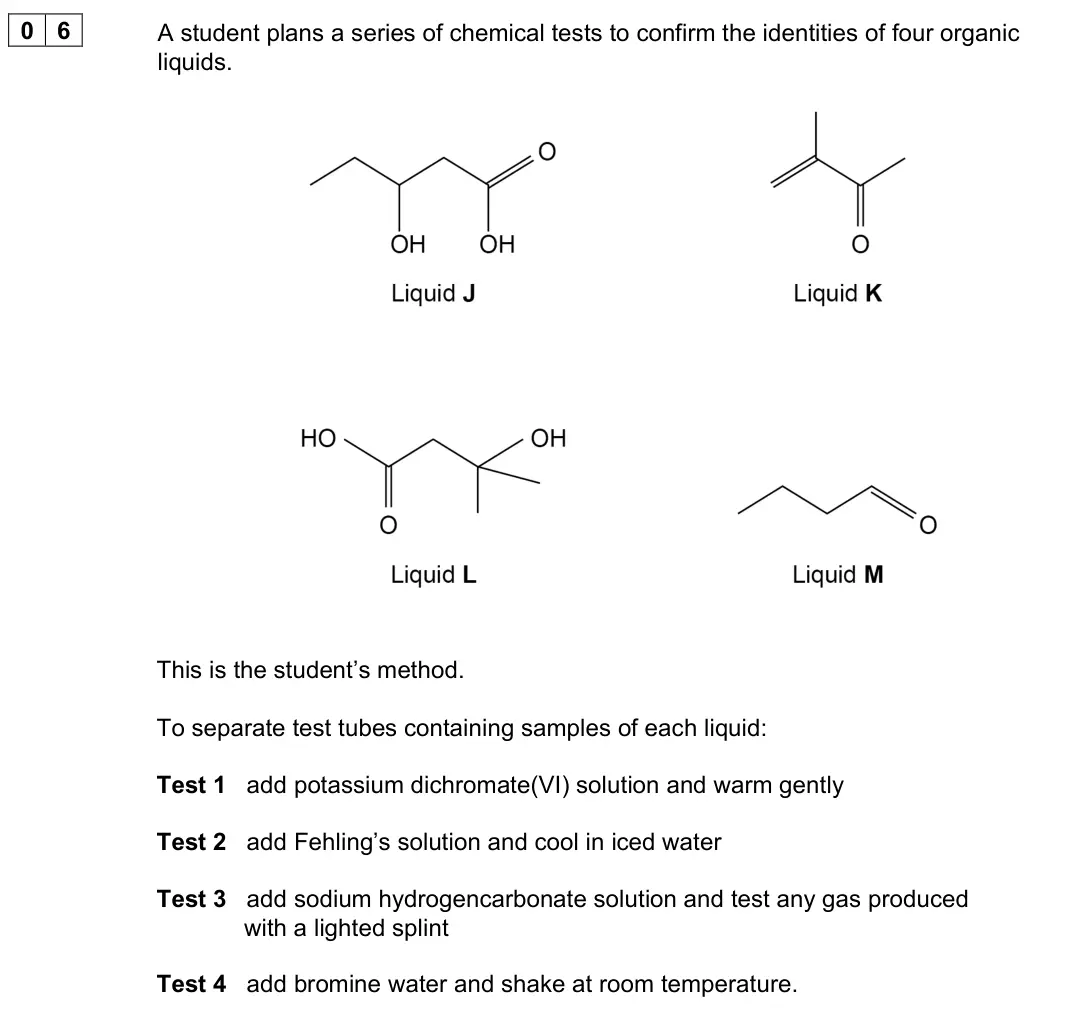
Q06.2
The whole paper ↗Q06.3
The whole paper ↗Q01.1
The whole paper ↗
Q01.2
The whole paper ↗Q06.6
The whole paper ↗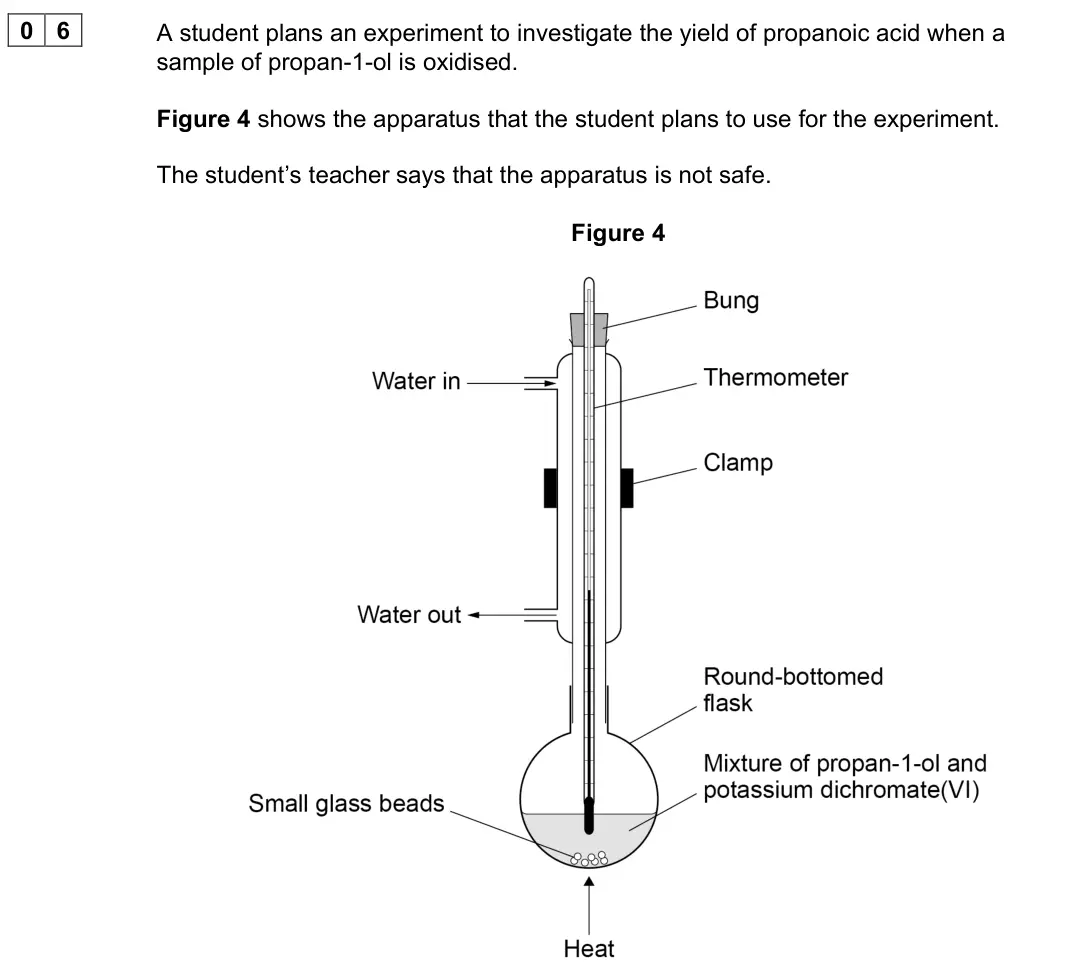
Q07.4
The whole paper ↗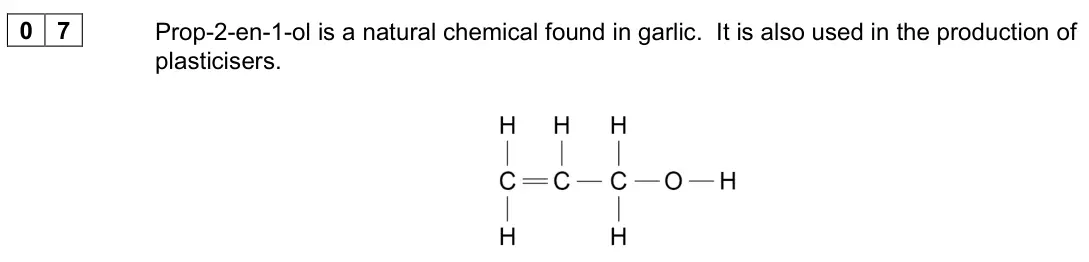
Q03.2
The whole paper ↗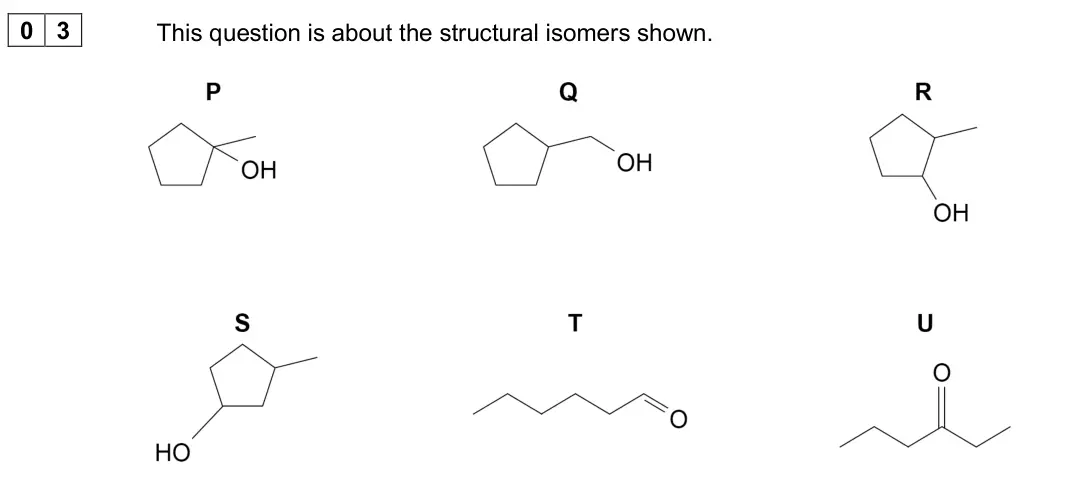
Q06.2
The whole paper ↗
Q06.1
The whole paper ↗
Q13.2
The whole paper ↗
Q01.1
The whole paper ↗
Q01.2
The whole paper ↗Q03.3
The whole paper ↗
Q03.2
The whole paper ↗
All 46 questions on Identification of functional groups by test-tube reactions, as a list
- June 2024, Paper 2, Q05.2 (3 marks): Three unlabelled bottles are known to contain either propan-1-ol, propanal, or propanone. A sample of each liquid is warmed with a few drops of Fehling’s soluti
- June 2024, AS Paper 2, Q01.1 (3 marks): Table 1 shows the results of chemical tests on three organic compounds. Complete the empty boxes in the table. Table 1 Chemical test Add bromine water orange to
- June 2023, Paper 2, Q06.1 (1 mark): Identify the missing reagent needed in Test 1. [1 mark]
- June 2023, Paper 2, Q06.2 (2 marks): In addition to the missing reagent in Test 1, there is a mistake in the method for two of the other tests. State the two mistakes. Suggest how each of the mista
- June 2023, Paper 2, Q06.3 (8 marks): The missing reagent is added and the mistakes are corrected. Identify the liquid(s), J, K, L and M, that would react in each test. State the expected observatio
- June 2023, AS Paper 2, Q01.1 (3 marks): and 01.2, give a reagent (or combination of reagents) that could be added separately to each compound in a single reaction to distinguish between them. State wh
- June 2023, AS Paper 2, Q01.2 (3 marks): Cyclohexane and cyclohexene [3 marks] Reagent(s) Observation with cyclohexane Observation with cyclohexene
- June 2022, AS Paper 2, Q02 (6 marks): A student has samples of these four compounds but does not know which is which: • butanoic acid • 2-methylpropanal • 2-methylpropanoic acid • 2-methylpropan-1-o
- November 2021, Paper 3, Q06.6 (3 marks): State a simple chemical test that distinguishes the propanoic acid from the propan-1-ol. Give one observation for the test with each substance. [3 marks] Test P
- November 2021, AS Paper 2, Q07.4 (1 mark): Figure 3 shows the infrared spectrum of a functional group isomer of prop-2-en-1-ol. Figure 3 This isomer reacts with acidified potassium dichromate(VI) to form
- November 2020, Paper 2, Q03.2 (2 marks): Identify the isomer(s) that would react with Tollens’ reagent. State the expected observation when Tollens’ reagent reacts. [2 marks] Isomer(s) Expected observa
- November 2020, Paper 3, Q24 (1 mark): Which compound decolourises bromine water in the absence of sunlight? [1 mark] A CH3CH2CH2Br B C D CH3CH2CHCH2
- November 2020, AS Paper 2, Q06.2 (2 marks): State what you would observe if bromine water was added to poly(chloroethene). Explain this observation. [2 marks] Observation Explanation
- June 2019, Paper 2, Q06.1 (3 marks): Give a reagent and observations for a test-tube reaction to distinguish between 2-methylbutan-1-ol and 2-methylbutan-2-ol. [3 marks] Reagent Observation with 2-
- June 2019, Paper 2, Q13.2 (2 marks): A student attempted to reduce a sample of 2-methylbutanal but added insufficient NaBH4 The student confirmed that the reduction was incomplete by using a chemic
- June 2019, Paper 3, Q23 (1 mark): Three reagents are added separately to four organic compounds. Which row shows the correct observations? [1 mark] Sodium hydrogen carbonate Acidified potassium
- June 2019, AS Paper 2, Q01.1 (3 marks): and 01.2, give a reagent (or combination of reagents) that could be added separately to each compound to distinguish between them. State what is observed in eac
- June 2019, AS Paper 2, Q01.2 (3 marks): Compounds A and C [3 marks] Reagent Observation with A Observation with C
- June 2018, Paper 2, Q03.3 (2 marks): Describe how you would carry out a simple test-tube reaction to confirm that the sample of propanal obtained by distillation does not contain any propanoic acid
- June 2018, Paper 3, Q03.2 (2 marks): Describe a test-tube reaction, on the product, to show that the cyclohexanol had been dehydrated. State what you would observe. [2 marks]
- June 2018, AS Paper 2, Q07.1 (6 marks): Four compounds, all colourless liquids, are • butan-2-ol • butanal • butanone • 2-methylpropan-2-ol Two of these compounds can be identified using different tes
- June 2017, Paper 2, Q07.1 (6 marks): You are provided with samples of each of the four compounds. Describe how you could distinguish between all four compounds using the minimum number of tests on
- June 2016, AS Paper 2, Q03.7 (2 marks): Oleic acid (C18H34O2) is a straight-chain fatty acid obtained from plant oils. Isooctane can be made from oleic acid. The skeletal formula of oleic acid is show
- June 2016, AS Paper 2, Q09 (1 mark): Which of the following compounds would form an orange-red precipitate when heated with Fehling’s solution? [1 mark] A CH3CH2CN B CH3CH2COOH C CH3CHO D CH3COCH3
- Specimen, Paper 3, Q01.5 (5 marks): 5
- June 2016, CHEM4 (old spec), Q4(c) (3 marks): Compound Q is an alternative product that could be formed when X reacts with benzene. Describe how you could distinguish between P and Q by a test-tube reaction
- June 2016, CHEM2 (old spec), Q4(b) (3 marks): Compounds A and B are both straight-chain compounds. A can be oxidised to form P. B can be oxidised to form Q. P and Q are isomers with molecular formula C4H8O
- June 2015, CHEM4 (old spec), Q10(a) (3 marks): A simple test-tube reaction can be used to distinguish between isomers P and S. Identify a reagent (or combination of reagents) you could use. State what you wo
- June 2015, CHEM4 (old spec), Q10(b) (2 marks): A simple test-tube reaction can be used to distinguish between isomer Q and all the other isomers. Identify a reagent (or combination of reagents) you could use
- June 2015, CHEM2 (old spec), Q2(a) (3 marks): Butan-2-ol and 2-methylpropan-2-ol [3 marks] Reagent Observation with butan-2-ol Observation with 2-methylpropan-2-ol
- June 2015, CHEM2 (old spec), Q2(b) (3 marks): Propane and propene [3 marks] Reagent Observation with propane Observation with propene
- June 2014, CHEM4 (old spec), Q8(b) (5 marks): State how you could distinguish between compounds J and K by a simple test-tube reaction. State how you could distinguish between J and K by giving the number o
- June 2014, CHEM2 (old spec), Q7(b) (3 marks): A chemical test can be used to distinguish between separate samples of Isomer 1 and Isomer 2. Identify a suitable reagent for the test. State what you would obs
- June 2013, CHEM2 (old spec), Q2(c) (3 marks): Cyclohexane and cyclohexene Reagent Observation with cyclohexane Observation with cyclohexene
- June 2013, CHEM2 (old spec), Q2(d) (3 marks): Butanal and butanone Reagent Observation with butanal Observation with butanone
- January 2013, CHEM4 (old spec), Q6(a) (3 marks): Reagent Observation with R Observation with S
- January 2013, CHEM4 (old spec), Q6(b) (3 marks): Reagent Observation with T Observation with U
- January 2013, CHEM4 (old spec), Q6(c) (3 marks): Reagent Observation with V Observation with W
- January 2013, CHEM2 (old spec), Q10(d) (3 marks): State how you could test a sample of water to show that it contains chloride ions. In your answer, give a reagent, one observation and the simplest ionic equati
- June 2012, CHEM4 (old spec), Q7(a) (8 marks): A chemist discovered four unlabelled bottles of liquid, each of which contained a different pure organic compound. The compounds were known to be propan-1-ol, p
- January 2012, CHEM2 (old spec), Q6(b) (2 marks): A simple chemical test, using either Fehling’s solution or Tollens’ reagent, can be used to distinguish between compound 1 and compound 3. Choose one of these t
- January 2012, CHEM2 (old spec), Q10(b) (3 marks): A simple chemical test can be used to distinguish between cyclohexane (A) and cyclohexene (D). Give a reagent for this test and state what you would observe wit
- June 2011, CHEM4 (old spec), Q7(a)(i) (3 marks):
- June 2011, CHEM4 (old spec), Q7(a)(ii) (3 marks):
- June 2011, CHEM4 (old spec), Q7(a)(iii) (3 marks):
- June 2008, CHM4 (2008 spec), Q7(a) (9 marks): 7 (a) Describe, by giving reagents and stating observations, how you could distinguish between the compounds in the following pairs. Use one simple test-tube re
Questions, mark schemes and examiner’s reports are © AQA, from their published past papers. Plumi isn’t affiliated with any exam board. Want whole papers? AQA A-Level Chemistry past papers.
The Plumi iPad app also offers exam-style questions with AI feedback on your handwritten working.