 plumi
Oxidation of alcohols: AQA A‑Level Chemistry questions
AQA A-Level Chemistry past-paper questions on 3.3.5.2 Oxidation of alcohols, 2008–2025, with mark schemes and examiner’s reports where available.
Paper
All papers
Exam
All years
Calculations
Q04.2
The whole paper ↗
Q05.1
The whole paper ↗
Q05.2
The whole paper ↗Q05.3
The whole paper ↗Q07.1
The whole paper ↗
Q07.2
The whole paper ↗Q06.4
The whole paper ↗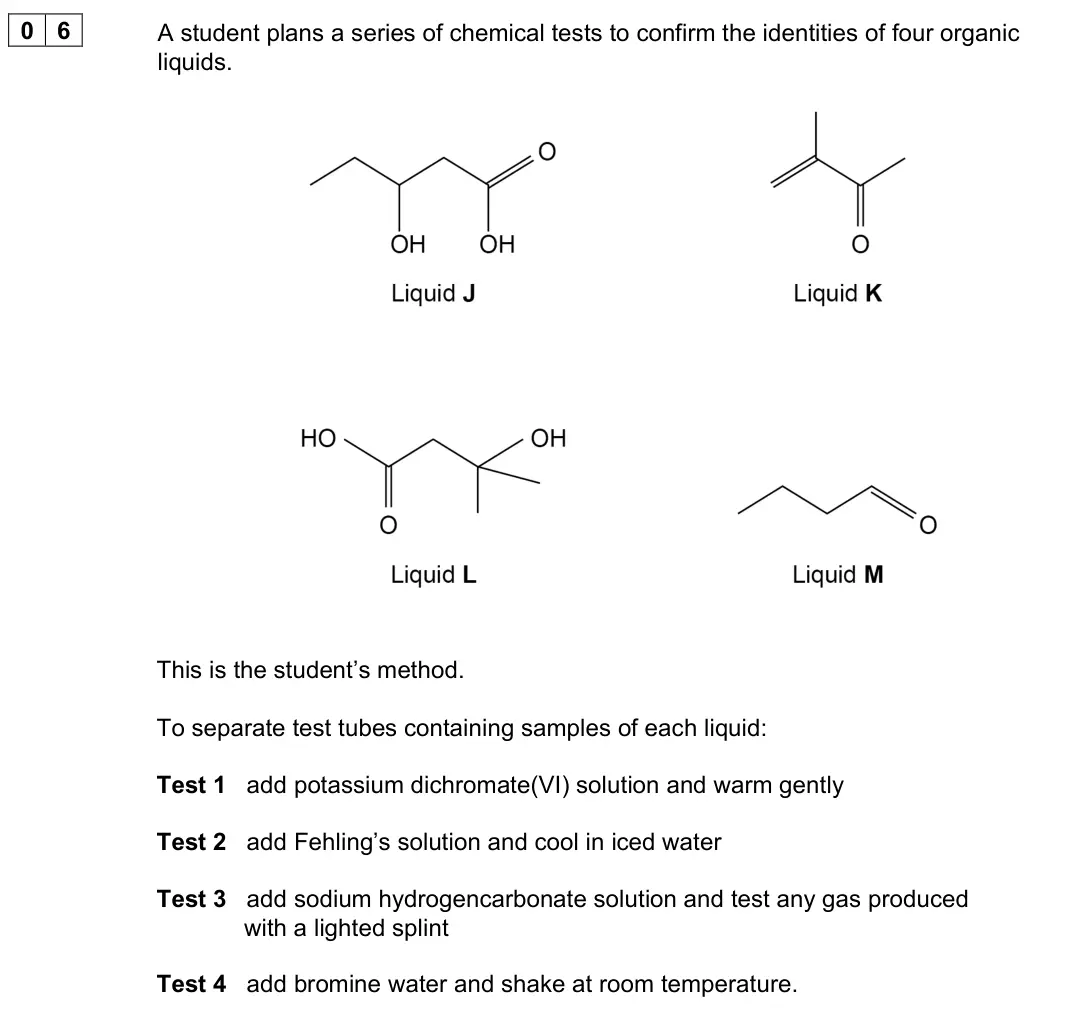
Q06.1
The whole paper ↗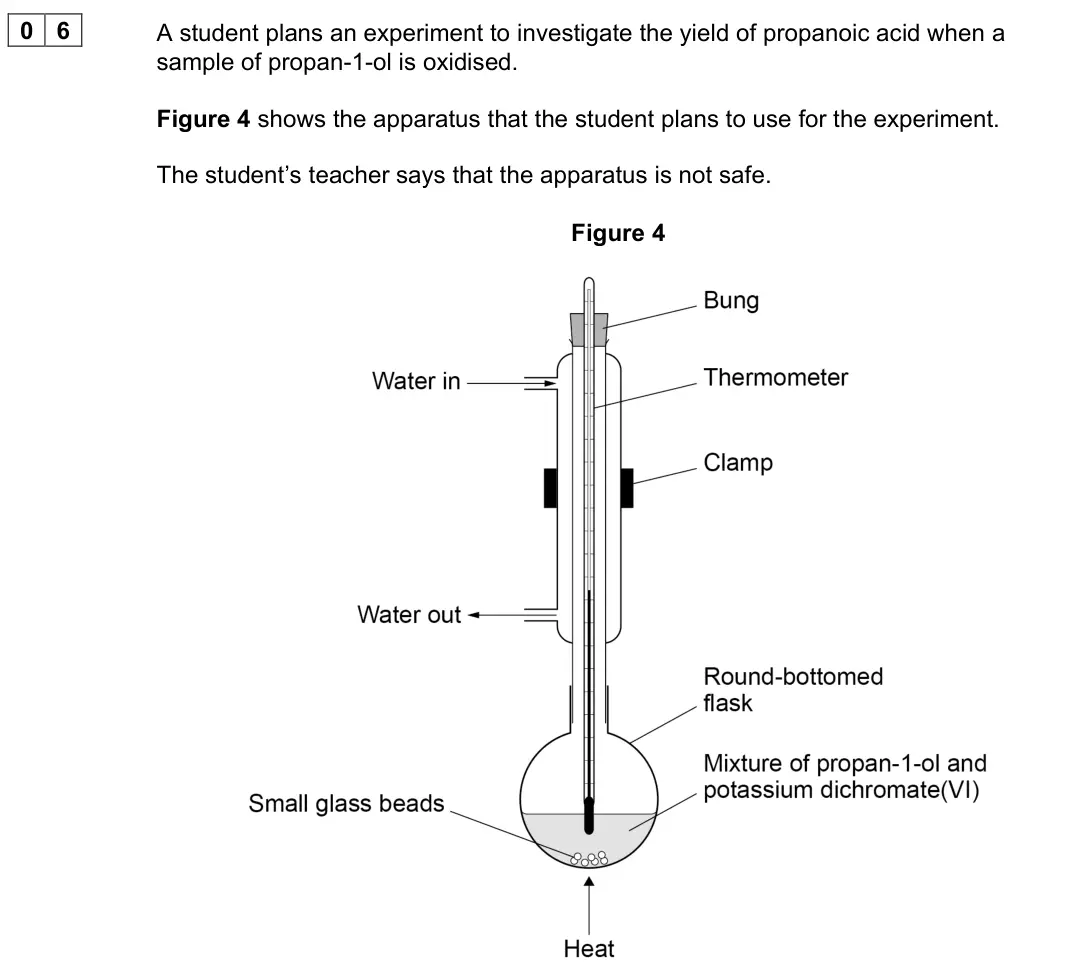
Q06.2
The whole paper ↗Q06.3
The whole paper ↗Q06.4
The whole paper ↗Q06.5
The whole paper ↗
All 73 questions on Oxidation of alcohols, as a list
- June 2025, Paper 2, Q04.2 (1 mark): Deduce the role of the concentrated nitric acid in the reaction. [1 mark]
- June 2025, Paper 3, Q05.1 (6 marks): A student has separate unlabelled samples of propan-1-ol and propan-2-ol but does not know which sample is which alcohol. The student plans a series of steps to
- June 2025, Paper 3, Q05.2 (3 marks): A primary alcohol can be oxidised to form a carboxylic acid using an excess of the oxidising agent in Question 05.1. Give the condition needed for this reaction
- June 2025, Paper 3, Q05.3 (1 mark): During oxidation reactions, anti-bumping granules are often added to the pear-shaped flask containing the reactants. State why anti-bumping granules are used. [
- June 2025, AS Paper 2, Q11 (1 mark): Which compound produces (CH3)2CHCOCH3 on oxidation? [1 mark] A 2-methylpropan-1-ol B 2,2-dimethylpropan-1-ol C 2-methylbutan-2-ol D 3-methylbutan-2-ol
- June 2025, AS Paper 2, Q13 (1 mark): 2-Methylpentane-1,2,4-triol is refluxed with an excess of acidified potassium dichromate(VI). What is the molecular formula of the main organic product? [1 mark
- June 2024, AS Paper 2, Q07.1 (1 mark): Acidified potassium dichromate(VI) is used as the oxidising agent. State the colour change in this reaction. [1 mark]
- June 2024, AS Paper 2, Q07.2 (1 mark): A second organic product, X, is formed in small quantities. The boiling point of X is 49 °C Identify X. [1 mark]
- June 2024, AS Paper 2, Q13 (1 mark): Which diagram shows the correct apparatus for the conversion of hexan-1-ol to hexanal? [1 mark] A B C D
- June 2023, Paper 2, Q06.4 (3 marks): Figure 10 shows the apparatus that is used to separate a mixture of liquids K and M using fractional distillation. Suggest labels that should be added to positi
- June 2023, Paper 3, Q32 (1 mark): Which is a correct equation for the oxidation of 1-phenylethanol? [O] represents oxygen from an oxidising agent. [1 mark] A C6H5CH2CH2OH + 2 [O] → C6H5CH2COOH +
- June 2023, AS Paper 2, Q22 (1 mark): The alcohol CH3CH2CH2OH can be oxidised. Which compound cannot be produced by oxidation of this alcohol? [1 mark] A CO2 B CH3COCH3 C CH3CH2CHO D CH3CH2COOH
- June 2022, Paper 3, Q24 (1 mark): Which statement is not correct for both primary and secondary alcohols? [1 mark] A They are easily oxidised to carboxylic acids by acidified K2Cr2O7 solution. B
- June 2022, AS Paper 2, Q15 (1 mark): Which compound produces (CH3)2CHCOCH3 when oxidised? [1 mark] A 2-methylpropan-1-ol B 2,2-dimethylpropanol C 2-methylbutan-2-ol D 3-methylbutan-2-ol
- November 2021, Paper 3, Q06.1 (2 marks): Give two reasons why the apparatus shown in Figure 4 is not safe. [2 marks] 1 2
- November 2021, Paper 3, Q06.2 (1 mark): Give one additional reagent that is needed to form any propanoic acid. [1 mark]
- November 2021, Paper 3, Q06.3 (2 marks): State two more mistakes in the way the apparatus is set up in Figure 4. [2 marks] 1 2
- November 2021, Paper 3, Q06.4 (1 mark): State the purpose of the small glass beads in the flask in Figure 4. [1 mark]
- November 2021, Paper 3, Q06.5 (4 marks): After correcting the mistakes, the student heats a reaction mixture containing 6.50 g of propan-1-ol with an excess of the oxidising agent. The propanoic acid s
- November 2021, Paper 3, Q26 (1 mark): Which compound is produced when 1-phenylethanol reacts with acidified potassium dichromate(VI)? [1 mark] A C6H5CH2CH2OH B C6H5CH2CHO C C6H5COCH3 D C6H5CH(OH)CH3
- November 2021, AS Paper 2, Q03.1 (6 marks): Figure 2 shows the apparatus set up by a student to make propanone by this method. Suitable clamps are used to hold all the apparatus firmly in place. Figure 2
- November 2020, Paper 2, Q03.1 (2 marks): Identify the isomer(s) that would react when warmed with acidified potassium dichromate(VI). State the expected observation when acidified potassium dichromate(
- November 2020, Paper 2, Q03.2 (2 marks): Identify the isomer(s) that would react with Tollens’ reagent. State the expected observation when Tollens’ reagent reacts. [2 marks] Isomer(s) Expected observa
- November 2020, Paper 3, Q25 (1 mark): Which compound reacts to form a ketone when warmed with an acidified solution of potassium dichromate(VI)? [1 mark] A CH3CH2CH2OH B (CH3)2CHOH C CH3CH2CHO D (CH
- November 2020, AS Paper 2, Q07.2 (2 marks): Ethanedioic acid is formed by the oxidation of ethane-1,2-diol (HOCH2CH2OH). State suitable reagent(s) and a condition for this reaction. [2 marks] Reagent(s) C
- June 2019, Paper 2, Q06.1 (3 marks): Give a reagent and observations for a test-tube reaction to distinguish between 2-methylbutan-1-ol and 2-methylbutan-2-ol. [3 marks] Reagent Observation with 2-
- June 2019, Paper 2, Q13.2 (2 marks): A student attempted to reduce a sample of 2-methylbutanal but added insufficient NaBH4 The student confirmed that the reduction was incomplete by using a chemic
- June 2019, Paper 3, Q22 (1 mark): Which compound is formed when 1-phenylethanol reacts with acidified potassium dichromate(VI)? [1 mark] A C6H5CH2CH2OH B C6H5CH2CHO C C6H5COCH3 D C6H5CH2COOH
- June 2019, AS Paper 2, Q08.1 (3 marks): Calculate the minimum volume, in cm3, of 0.40 mol dm–3 potassium dichromate(VI) solution needed to oxidise 6.0 cm3 of propan-1-ol to propanal. Mr of propan-1-ol
- June 2019, AS Paper 2, Q08.2 (3 marks): The reaction is done in a pear-shaped flask. Complete the diagram to show the assembled apparatus needed to prepare propanal from propan-1-ol in this way. Label
- June 2019, AS Paper 2, Q18 (1 mark): Which compound can be oxidised to form (CH3)2CHCOCH3? [1 mark] A 2-methylpropan-1-ol B 2,2-dimethylpropanol C 2-methylbutan-2-ol D 3-methylbutan-2-ol
- June 2018, Paper 2, Q03.1 (3 marks): Explain, with reference to intermolecular forces, why distillation allows propanal to be separated from the other organic compounds in this reaction mixture. [3
- June 2018, Paper 2, Q03.2 (2 marks): Give two ways of maximising the yield of propanal obtained by distillation of the reaction mixture. [2 marks] 1 2
- June 2018, Paper 3, Q11 (1 mark): Which statement is correct about both 2-methylbutan-1-ol and 2-methylbutan-2-ol? [1 mark] A They can be formed by alkaline hydrolysis of esters. B They can be o
- June 2017, Paper 3, Q02.6 (3 marks): A by-product of the reaction of butan-2-ol with concentrated sulfuric acid has the molecular formula C4H8O Name this by-product, identify the role of the sulfur
- June 2017, AS Paper 2, Q17 (1 mark): Which alcohol can be oxidised by acidified potassium dichromate(VI) but cannot be dehydrated by heating with concentrated sulfuric acid? [1 mark] A 2,3-dimethyl
- June 2016, AS Paper 2, Q06.2 (2 marks): Write an equation for this oxidation reaction of propane-1,2-diol under reflux, using [O] to represent the oxidizing agent. Show the displayed formula of the or
- June 2016, AS Paper 2, Q06.3 (2 marks): Draw a labelled diagram to show how you would set up apparatus for refluxing. [2 marks]
- June 2016, AS Paper 2, Q06.4 (1 mark): Anti-bumping granules are placed in the flask when refluxing. Suggest why these granules prevent bumping. [1 mark]
- June 2016, AS Paper 2, Q06.5 (1 mark): Draw the structure of a different organic product formed when the acidified potassium dichromate(VI) is not in excess. [1 mark]
- June 2016, AS Paper 2, Q09 (1 mark): Which of the following compounds would form an orange-red precipitate when heated with Fehling’s solution? [1 mark] A CH3CH2CN B CH3CH2COOH C CH3CHO D CH3COCH3
- Specimen, Paper 2, Q04.2 (1 mark): Draw the structure of the organic product, B, formed when A is oxidised in the reaction with acidified potassium dichromate(VI). [1 mark] 0 4 . 2
- Specimen, Paper 2, Q04.7 (1 mark): Draw the structure of the isomer of A that is not oxidised by acidified potassium dichromate(VI). [1 mark] 0 4 . 7
- Specimen, Paper 3, Q01.1 (3 marks): In order to ensure that the oxidation to ethanoic acid is complete, the reaction is carried out under reflux. Describe what happens when a reaction mixture is r
- Specimen, Paper 3, Q01.2 (1 mark): Write a half-equation for the overall oxidation of ethanol into ethanoic acid. [1 mark] 0 1 . 2 3
- Specimen, Paper 3, Q01.3 (5 marks): The boiling points of the organic compounds in a reaction mixture are shown in Table 1. Table 1 Compound ethanol ethanal ethanoic acid Boiling point / °C 78 21
- June 2016, CHEM2 (old spec), Q4(b) (3 marks): Compounds A and B are both straight-chain compounds. A can be oxidised to form P. B can be oxidised to form Q. P and Q are isomers with molecular formula C4H8O
- June 2016, CHEM2 (old spec), Q4(d)(i) (3 marks): Compound S is obtained by distilling it off as it forms during the oxidation. Compound T is formed when the oxidation takes place under reflux. Identify the fun
- June 2015, CHEM2 (old spec), Q2(a) (3 marks): Butan-2-ol and 2-methylpropan-2-ol [3 marks] Reagent Observation with butan-2-ol Observation with 2-methylpropan-2-ol
- June 2015, CHEM2 (old spec), Q7(b)(i) (1 mark): Write an equation for this reaction using [O] to represent the oxidising agent. [1 mark]
- June 2015, CHEM2 (old spec), Q7(b)(ii) (1 mark): State the class of alcohols to which propan-2-ol belongs. [1 mark]
- June 2014, CHEM2 (old spec), Q7(d) (1 mark): Two alcohols are formed by the hydration of Isomer 4. Draw the displayed formula for the alcohol formed that is oxidised readily by acidified potassium dichroma
- June 2013, CHEM2 (old spec), Q2(d) (3 marks): Butanal and butanone Reagent Observation with butanal Observation with butanone
- June 2013, CHEM2 (old spec), Q8(b) (1 mark): Draw the structure of the alcohol with molecular formula C4H10O that is resistant to oxidation by acidified potassium dichromate(VI). (1 mark)
- June 2013, CHEM2 (old spec), Q10(d)(ii) (1 mark): Draw the structure of the organic compound with Mr = 60 that is produced in this reaction. (1 mark)
- January 2013, CHEM4 (old spec), Q6(a) (3 marks): Reagent Observation with R Observation with S
- January 2013, CHEM4 (old spec), Q6(c) (3 marks): Reagent Observation with V Observation with W
- January 2013, CHEM2 (old spec), Q5(c)(iv) (2 marks): The earliest breathalysers used laboratory chemicals to oxidise the ethanol to ethanoic acid. Detection was by a colour change. Identify a reagent or combinatio
- June 2012, CHEM2 (old spec), Q8(d) (3 marks): State the class of alcohols to which the diol butane-1,4-diol belongs. Identify a suitable reagent or combination of reagents for the conversion of butane-1,4-d
- January 2012, CHEM2 (old spec), Q6(b) (2 marks): A simple chemical test, using either Fehling’s solution or Tollens’ reagent, can be used to distinguish between compound 1 and compound 3. Choose one of these t
- January 2012, CHEM2 (old spec), Q10(c) (3 marks): Cyclohexanol (B) can be converted into cyclohexanone (C). Give a reagent or combination of reagents that can be used for this reaction and state the type of rea
- January 2011, CHEM2 (old spec), Q3(d) (3 marks): Butan-2-ol(l) and 2-methylpropan-2-ol(l) Reagent Observation with butan-2-ol(l) Observation with 2-methylpropan-2-ol(l) (3 marks)
- January 2011, CHEM2 (old spec), Q9(a)(iv) (1 mark): Using [O] to represent the oxidising agent, write an equation for the oxidation of butan-1-ol to form an aldehyde. (1 mark)
- June 2010, CHEM2 (old spec), Q5(c)(iii) (1 mark): State the class of alcohols to which ethanol belongs. (1 mark)
- June 2010, CHEM2 (old spec), Q5(c)(iv) (1 mark): Draw the displayed formula of the carboxylic acid formed when ethanol is oxidised by an excess of acidified potassium dichromate(VI) solution. (1 mark)
- January 2010, CHEM2 (old spec), Q9(a) (3 marks): Two of these are butan-l-ol (CH3CH2CH2CH2OH) and butan-2-ol. The other two isomers are alcohol X and alcohol Y. Draw the displayed formula for butan-2-ol. Alcoh
- January 2010, CHEM2 (old spec), Q9(d) (5 marks): Butan-l-ol reacts with acidified potassium dichromate(VI) solution to produce two organic compounds. State the class of alcohols to which butan-l-ol belongs. Dr
- June 2009, CHEM2 (old spec), Q9(a) (1 mark): 9 (a) State the class of alcohol to which butan-2-ol belongs. (1 mark)
- June 2009, CHEM2 (old spec), Q9(c) (1 mark): 9 (c) Draw the displayed formula of the alcohol C4H9OH which is resistant to oxidation by acidified potassium dichromate(VI). (1 mark) Section B Answer both que
- June 2008, CHM3W (2008 spec), Q2(e)(i) (1 mark): 2 (e) (i) State the type of reaction. (1 mark)
- June 2008, CHM3W (2008 spec), Q2(f)(ii) (1 mark): 2 (f) (ii) Identify the class of alcohol to which prop-2-en-l-ol belongs. (1 mark)
- January 2008, CHM3W (2008 spec), Q3(c) (1 mark): (c) State the class of alcohols to which citronellol belongs. (1 mark)
- January 2008, CHM3W (2008 spec), Q3(d) (2 marks): (d) Citronellol can be converted into the aldehyde citronellal, which has the following structure. State the type of reaction and a reagent or combination of re
Questions, mark schemes and examiner’s reports are © AQA, from their published past papers. Plumi isn’t affiliated with any exam board. Want whole papers? AQA A-Level Chemistry past papers.
The Plumi iPad app also offers exam-style questions with AI feedback on your handwritten working.