 plumi
Mass spectrometry: AQA A‑Level Chemistry questions
AQA A-Level Chemistry past-paper questions on 3.3.6.2 Mass spectrometry, 2008–2025, with mark schemes and examiner’s reports where available.
Paper
All papers
Exam
All years
Calculations
Q07.1
The whole paper ↗
Q05.1
The whole paper ↗
Q01.3
The whole paper ↗
Q09.5
The whole paper ↗
Q03.6
The whole paper ↗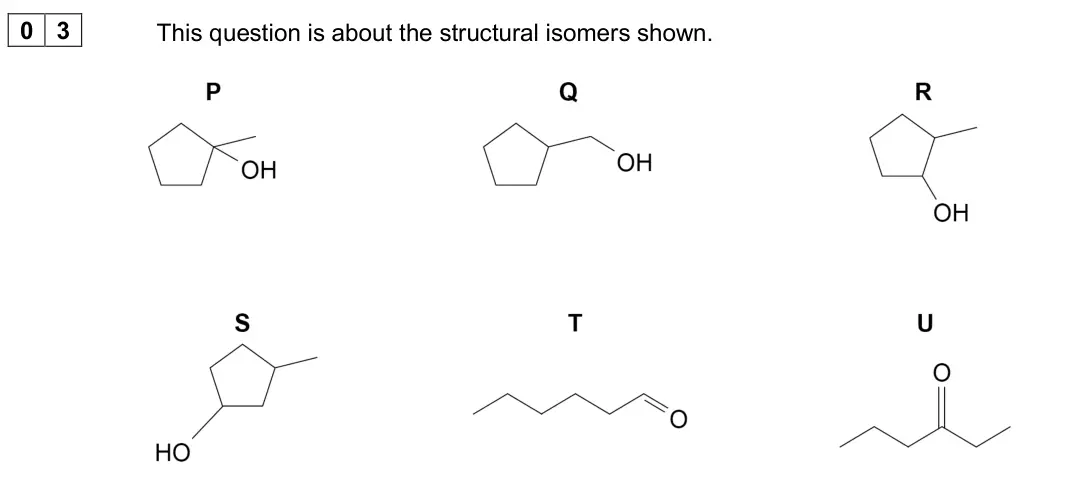
Q10.5
The whole paper ↗
Q06.2
The whole paper ↗
Q04.1
The whole paper ↗Q05.1
The whole paper ↗Q05.2
The whole paper ↗Q4(a)(i)
The whole paper ↗
Q4(a)(ii)
The whole paper ↗Q4(a)(iii)
The whole paper ↗Q6(a)(i)
The whole paper ↗
Q6(c)
The whole paper ↗
Q4(a)
The whole paper ↗
Q8(c)
The whole paper ↗
Q6(b)
The whole paper ↗
All 41 questions on Mass spectrometry, as a list
- June 2025, Paper 2, Q07.1 (5 marks): Compound P is a hydrocarbon with only one peak (a singlet) in its 1H NMR spectrum. P has a precise Mr of 84.09396 Carbon has a precise Ar of 12.00000 Hydrogen h
- June 2025, AS Paper 2, Q05.1 (2 marks): The Mr of a compound can be determined by mass spectrometry. Propanone, prop-2-en-1-ol and butane each have Mr = 58.0 Give the reason why high resolution mass s
- June 2024, AS Paper 2, Q18 (1 mark): High resolution mass spectrometry can be used to determine the precise relative molecular mass of compounds. Which compound has a precise relative molecular mas
- June 2023, AS Paper 2, Q01.3 (3 marks): Table 1 gives the precise relative molecular masses (Mr) of some organic compounds measured using high resolution mass spectrometry. Table 1 Molecular formula C
- June 2022, Paper 2, Q09.5 (2 marks): A sample of the olive oil was dissolved in methanol and placed in a mass spectrometer. The sample was ionised using electrospray ionisation. Each molecule gaine
- November 2020, Paper 2, Q03.6 (1 mark): State why mass spectrometry using electrospray ionisation is not a suitable method to distinguish between the isomers. [1 mark]
- June 2019, Paper 2, Q10.5 (1 mark): The dicarboxylic acid in question 10.1 and the isomers of C6H14O2 in Questions 10.3 and 10.4 all have a relative molecular mass of 118 State why the dicarboxyli
- June 2018, AS Paper 2, Q06.2 (2 marks): Compound A has a relative molecular mass (Mr) of 134.5 The main isotope of hydrogen is 1H The main isotope of carbon is 12C Chlorine consists of two common isot
- June 2017, AS Paper 2, Q20 (1 mark): Which compound forms a molecular ion with a different precise molecular mass from the other three? [1 mark] A butanone B cyclobutanol C dimethylpropane D methyl
- June 2016, AS Paper 2, Q04.1 (2 marks): Explain why determining the precise relative molecular mass of propanal and prop-2-en-1-ol by mass spectrometry could not be used to distinguish between samples
- Specimen, Paper 3, Q05.1 (2 marks): 5 A sample of ethanedioic acid was treated with an excess of an unknown alcohol in the presence of a strong acid catalyst. The products of the reaction were sep
- Specimen, Paper 3, Q05.2 (4 marks): Section B Answer all questions in this section. Only one answer per question is allowed. For each answer completely fill in the circle alongside the appropriate
- June 2016, CHEM4 (old spec), Q4(a)(i) (1 mark): Chlorine exists as the isotopes 35Cl and 37Cl in a 3:1 ratio. Calculate the m/z value of the most abundant molecular ion peak in the mass spectrum of X. [1 mark
- June 2016, CHEM4 (old spec), Q4(a)(ii) (1 mark): The most abundant fragment ion in the mass spectrum of X has m/z = 77. Draw the displayed formula of this fragment ion. [1 mark]
- June 2016, CHEM4 (old spec), Q4(a)(iii) (2 marks): A molecular ion of X that contains one 35Cl atom and one 37Cl atom undergoes fragmentation to form an ion with m/z = 65 and one other species. Write an equation
- June 2015, CHEM2 (old spec), Q6(a)(i) (1 mark): Use data from Table 1 to show that, to 3 significant figures, a more accurate value for the Mr of butane is 58.1 [1 mark]
- June 2014, CHEM4 (old spec), Q6(c) (2 marks): The mass spectrum of alanine gives a major peak at m/z = 44 Write an equation for the fragmentation of the molecular ion of alanine to give an ion that produces
- June 2013, CHEM4 (old spec), Q4(a) (2 marks): The acylium ion H3C C O is formed in a mass spectrometer by fragmentation of the molecular ion of methyl ethanoate. Write an equation for this fragmentation. In
- June 2013, CHEM2 (old spec), Q8(c) (1 mark): Draw the structure of the alkene that has a peak, due to its molecular ion, at m/z = 42 in its mass spectrum. (1 mark)
- June 2012, CHEM4 (old spec), Q6(b) (1 mark): The product of the substitution reaction (C6H5COCH3) was analysed by mass spectrometry. The most abundant fragment ion gave a peak in the mass spectrum with m/z
- June 2012, CHEM2 (old spec), Q3(c) (1 mark): Fertiliser grade phosphoric acid is manufactured from sulfuric acid and calcium phosphate. Use the following precise relative atomic mass data to show how mass
- January 2012, CHEM4 (old spec), Q5(a) (1 mark): Two of the molecular ions fragmented to form an ion with m/z = 133 by losing a radical. Identify the radical that was lost. (1 mark)
- January 2012, CHEM4 (old spec), Q5(b) (1 mark): Two of the molecular ions fragmented to form an ion with m/z = 119 by losing a radical. Identify the radical that was lost. (1 mark)
- January 2012, CHEM4 (old spec), Q5(c) (2 marks): Three of the molecular ions fragmented to form ions with m/z = 105 by losing a radical with Mr = 29 Identify two different radicals with Mr = 29 that could have
- January 2012, CHEM4 (old spec), Q5(d) (4 marks): Consider the structures of the four isomers and the fragmentations indicated in parts (a) to (c). Write the letter A, B, C or D, in the appropriate box below, t
- January 2012, CHEM2 (old spec), Q6(a) (2 marks): Explain why Mr values, measured to five decimal places, cannot distinguish between compounds 1 and 3 but can distinguish between compounds 1 and 2.
- June 2011, CHEM4 (old spec), Q5(d) (2 marks): The mass spectrum of DEP includes major peaks at m/z = 222 (the molecular ion) and at m/z = 177 Write an equation to show the fragmentation of the molecular ion
- June 2011, CHEM2 (old spec), Q3(f)(iii) (1 mark): The hydrocarbon that has a peak, due to its molecular ion, at m/z = 44 in its mass spectrum. (1 mark)
- June 2011, CHEM2 (old spec), Q8(c) (5 marks): The scientists also analysed the exhaust gases from an incinerator used to destroy waste poly(ethene). Mass spectrometry showed that there was a trace gas with
- June 2010, CHEM4 (old spec), Q4(b) (2 marks): The molecular formula of TCDD is C12H4O2Cl4 Chlorine exists as two isotopes 35Cl (75%) and 37Cl (25%). Deduce the number of molecular ion peaks in the mass spec
- June 2010, CHEM2 (old spec), Q4(a) (1 mark): State the meaning of the term molecular ion. (1 mark)
- June 2010, CHEM2 (old spec), Q4(b)(i) (1 mark): Use the following data to show that the trace gas was dinitrogen oxide (N2O). Show your working. (1 mark) Atom Precise relative atomic mass 12C 12.00000 14N 14.
- June 2010, CHEM2 (old spec), Q4(b)(ii) (1 mark): Propane is used as a fuel in the fertiliser factory. State why both propane and its combustion product, carbon dioxide, might have been identified as the trace
- January 2010, CHEM4 (old spec), Q4(c)(i) (1 mark): Identify the isomer that has a major peak at m/z = 57 in its mass spectrum. (1 mark)
- January 2010, CHEM4 (old spec), Q4(c)(ii) (2 marks): Write an equation for the fragmentation of the molecular ion of this isomer to form the species that produces the peak at m/z = 57. (2 marks)
- January 2010, CHEM4 (old spec), Q4(c)(iii) (1 mark): Predict the m/z value of a major peak in the mass spectrum of the other isomer. (1 mark)
- January 2010, CHEM2 (old spec), Q6(e) (2 marks): High resolution mass spectrometry of a sample of propane indicated that it was contaminated with traces of carbon dioxide. Use the data in the table to show how
- June 2008, CHM4 (2008 spec), Q7(b) (3 marks): 7 (b) Compound T in part (a)(iii) has a mass spectrum with a peak at m/z = 57 Draw the structure of the ion responsible for this peak and write an equation for
- June 2008, CHM6W (2008 spec), Q35 (1 mark): 35 Compound X has the following characteristics • it has an infra-red spectrum with a strong absorption at around 1700 cm–1 • it has a proton n.m.r. spectrum wi
- January 2008, CHM4 (2008 spec), Q8(b) (4 marks): (b) The mass spectrum of methyl benzenecarboxylate is shown below. Suggest structures for the fragment ions which produce peaks at m/z = 105 and m/z = 77 in the
- January 2008, CHM4 (2008 spec), Q8(c) (4 marks): (c) Esters V and W are isomers of methyl benzenecarboxylate and both contain a benzene ring. V has a major peak at m/z = 43 in its mass spectrum. Suggest a stru
Questions, mark schemes and examiner’s reports are © AQA, from their published past papers. Plumi isn’t affiliated with any exam board. Want whole papers? AQA A-Level Chemistry past papers.
The Plumi iPad app also offers exam-style questions with AI feedback on your handwritten working.