 plumi
Addition polymers: AQA A‑Level Chemistry questions
AQA A-Level Chemistry past-paper questions on 3.3.4.3 Addition polymers, 2008–2025, with mark schemes and examiner’s reports where available.
Paper
All papers
Exam
All years
Calculations
Q03.1
The whole paper ↗
Q03.2
The whole paper ↗Q03.3
The whole paper ↗Q04.3
The whole paper ↗
- Your answer
Q03.4
The whole paper ↗
Q05.1
The whole paper ↗
Q05.2
The whole paper ↗Q05.3
The whole paper ↗Q07.3
The whole paper ↗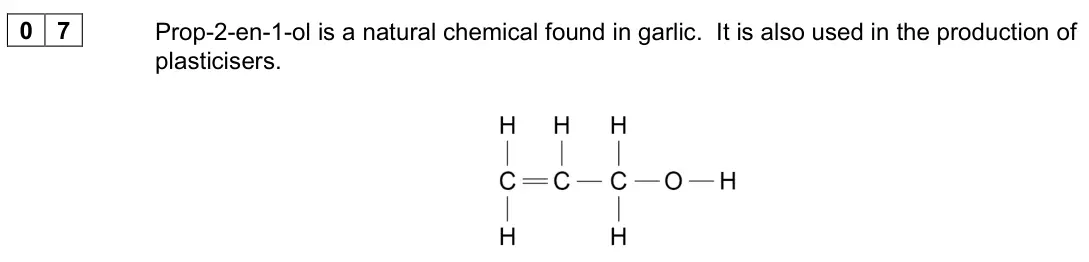
Q06.4
The whole paper ↗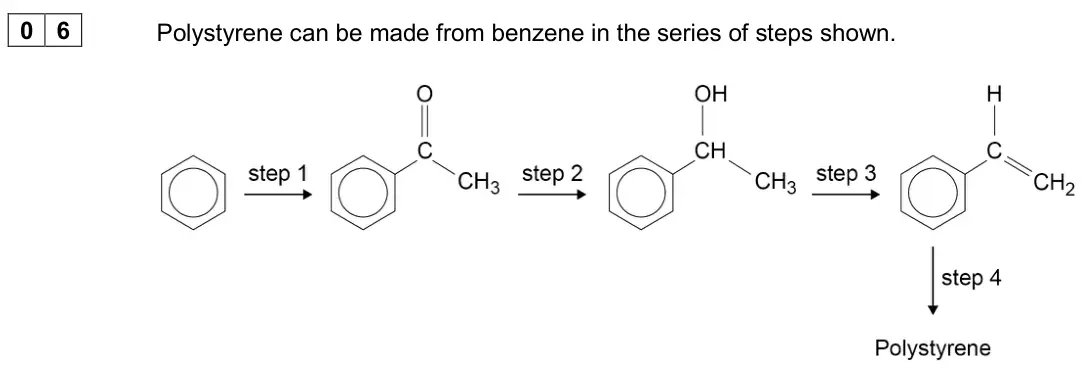
Q06.1
The whole paper ↗
Q06.2
The whole paper ↗Q06.3
The whole paper ↗Q03.2
The whole paper ↗
Q03.3
The whole paper ↗
All 53 questions on Addition polymers, as a list
- June 2025, Paper 2, Q03.1 (2 marks): A section of the polymer PVC is shown. Name the monomer used to make PVC. Draw the structure of the monomer used to make PVC. [2 marks] Monomer name Structure
- June 2025, Paper 2, Q03.2 (1 mark): State why PVC is not biodegradable. [1 mark]
- June 2025, Paper 2, Q03.3 (1 mark): Diisobutyl phthalate (DIBP) is a plasticiser added to PVC to modify its properties. State how the properties of PVC are modified by the addition of DIBP. [1 mar
- June 2025, AS Paper 2, Q04.3 (1 mark): Vinyl acetate (VA) has the molecular formula C4H6O2 The structure of vinyl acetate is shown. PVA is an addition polymer of vinyl acetate. Draw the repeating uni
- June 2024, AS Paper 2, Q15 (1 mark): Which is the structure of poly(1-chloropropene)? [1 mark] A B C D
- June 2023, AS Paper 2, Q09 (1 mark): Which monomer forms this polymer? [1 mark] A but-1-ene B E-but-2-ene C Z-but-2-ene D methylpropene
- June 2023, AS Paper 2, Q15 (1 mark): Which reaction results in an overall change in shape around a carbon atom? [1 mark] A oxidation of propanal with acidified potassium dichromate(VI) B polymerisa
- June 2022, Paper 2, Q03.4 (2 marks): 2-methylbut-1-ene can form a polymer. State the type of polymerisation. Draw the repeating unit for the polymer formed. [2 marks] Type of polymerisation Repeati
- June 2022, AS Paper 2, Q10 (1 mark): Which statement about poly(ethene) is correct? [1 mark] A It has a lower relative molecular mass than ethene. B It has a lower density than ethene at standard t
- June 2022, AS Paper 2, Q11 (1 mark): A polymer is formed from the monomer CH2=CHCN Which statement is not correct? [1 mark] A The monomer is propanenitrile. B The monomer is unsaturated. C The poly
- November 2021, AS Paper 2, Q05.1 (6 marks): The three key steps in the manufacture of poly(propene) from crude oil are shown. Naphtha is a mixture of alkanes with 6 to 12 carbon atoms per molecule. For ea
- November 2021, AS Paper 2, Q05.2 (1 mark): Poly(propene) is not biodegradable because it is unreactive. Explain why poly(propene) is unreactive. [1 mark]
- November 2021, AS Paper 2, Q05.3 (1 mark): Scientists are developing new polymers, including some that are biodegradable. Suggest why it is beneficial for some polymers to be biodegradable. [1 mark]
- November 2021, AS Paper 2, Q07.3 (1 mark): Prop-2-en-1-ol forms an addition polymer. Draw the repeating unit of poly(prop-2-en-1-ol). [1 mark]
- November 2020, Paper 2, Q06.4 (1 mark): Draw the repeating unit of polystyrene. [1 mark]
- November 2020, AS Paper 2, Q06.1 (3 marks): Give an equation, showing structural formulas, for the conversion of chloroethene into poly(chloroethene). [3 marks]
- November 2020, AS Paper 2, Q06.2 (2 marks): State what you would observe if bromine water was added to poly(chloroethene). Explain this observation. [2 marks] Observation Explanation
- November 2020, AS Paper 2, Q06.3 (2 marks): Plasticisers are often added during the manufacture of PVC. The structure of the plasticiser DEHP is shown. Deduce the molecular formula of DEHP and state why a
- June 2019, Paper 2, Q03.2 (2 marks): The insides of some golf balls are made from a mixture of three other polymers. The repeating unit for one of these polymers is shown. Draw the skeletal formula
- June 2019, Paper 2, Q03.3 (2 marks): A second polymer in the mixture has a repeating unit with the structure shown. The third polymer in the mixture is a stereoisomer of this polymer. Draw the stru
- June 2019, Paper 2, Q03.4 (1 mark): Golf balls recovered from lakes and ponds can be used again even after being in water for several years. Explain why these golf balls do not biodegrade. [1 mark
- June 2019, Paper 3, Q04.4 (1 mark): Draw a section of the polymer polyacrylonitrile, showing three repeating units. [1 mark]
- June 2018, AS Paper 2, Q04.6 (1 mark): The main use of propene, formed from cracking, is to make poly(propene). Draw the repeating unit of poly(propene). [1 mark]
- June 2018, AS Paper 2, Q19 (1 mark): Which statement is correct about poly(chloroethene)? [1 mark] A It has the empirical formula CHCl B It decolourises bromine water. C Its brittleness is reduced
- June 2017, Paper 3, Q18 (1 mark): This structure shows a section of a polymer chain formed from the random polymerisation of two different monomers. Which pair of monomers could produce this pol
- June 2017, AS Paper 2, Q09.1 (2 marks): Chloroethene has a melting point of −154 ºC All types of PVC melt at temperatures over 100 ºC Explain why PVC melts at a higher temperature than chloroethene. [
- June 2017, AS Paper 2, Q09.2 (1 mark): This structure shows a molecule that has been used as a plasticiser in PVC. Deduce the number of hydrogen atoms in this molecule. [1 mark]
- June 2017, AS Paper 2, Q09.3 (1 mark): Use your understanding of the properties of PVC to explain whether you would expect to find a plasticiser in the PVC used to insulate electrical cables. [1 mark
- June 2017, AS Paper 2, Q09.4 (1 mark): A section of the polymer poly(chloroprene), a synthetic rubber, is shown. Draw the displayed formula for the repeating unit of poly(chloroprene). [1 mark] Secti
- June 2016, AS Paper 2, Q15 (1 mark): The repeating unit of a polymer is Which of the following molecules would form a polymer containing this repeating unit? [1 mark] A But-1-ene B E-but-2-ene C Z-
- Specimen, Paper 2, Q07.1 (2 marks): Monomer Type of polymerisation
- June 2016, CHEM4 (old spec), Q4(e)(i) (1 mark): Draw the repeating unit of poly(propene). [1 mark]
- June 2015, CHEM4 (old spec), Q7(b)(i) (1 mark): Give the IUPAC name of a monomer that forms polymer L. [1 mark]
- June 2015, CHEM1 (old spec), Q6(d)(ii) (1 mark): Suggest one important substance manufactured on a large scale from propene. [1 mark]
- June 2015, CHEM2 (old spec), Q6(c)(ii) (1 mark): Deduce the type of polymerisation that results in the formation of this polymer from prop-2-en-1-ol. [1 mark]
- June 2014, CHEM4 (old spec), Q5(e)(ii) (1 mark): The term copolymer is used to describe the product obtained when two or more different monomers form a polymer. Draw the repeating unit of the acrylic copolymer
- June 2014, CHEM4 (old spec), Q5(e)(iii) (1 mark): Name the type of polymerisation involved in Question 5 (e) (ii). [1 mark]
- June 2013, CHEM4 (old spec), Q5(d)(iv) (1 mark): Traditional non-biodegradable plastic cups can be made from poly(phenylethene), commonly known as polystyrene. Draw the repeating unit of poly(phenylethene). (1
- June 2013, CHEM2 (old spec), Q9(b) (1 mark): Draw the repeating unit of the polyalkene formed by addition polymerisation of (E)-but-2-enenitrile. (1 mark)
- June 2013, CHEM2 (old spec), Q10(a)(iii) (2 marks): At pressures higher than 7 MPa, some of the ethene reacts to form a solid with a relative molecular mass greater than 5000 Deduce the identity of this solid. Gi
- January 2013, CHEM4 (old spec), Q4(c)(i) (1 mark): Name the type of polymerisation occurring in the formation of this co-polymer. (1 mark)
- January 2013, CHEM4 (old spec), Q4(c)(ii) (2 marks): Draw the structure of each alkene monomer. Alkene monomer 1 Alkene monomer 2 (2 marks)
- January 2013, CHEM4 (old spec), Q4(d) (2 marks): One of the three compounds shown in parts (a), (b) and (c) cannot be broken down by hydrolysis. Write the letter (a), (b) or (c) to identify this compound and e
- January 2013, CHEM2 (old spec), Q8(c) (2 marks): State the type of reaction in Reaction 3. Give the name of substance X. (2 marks)
- June 2011, CHEM4 (old spec), Q5(b) (1 mark): Draw the displayed formula of the repeating unit of poly(chloroethene). (1 mark)
- January 2011, CHEM4 (old spec), Q4(c)(iii) (1 mark): The organic product from part 4 (c) (ii) can also be polymerised. Draw the repeating unit of the polymer formed from this organic product. (1 mark)
- January 2011, CHEM1 (old spec), Q4(d)(iii) (1 mark): State one type of useful solid material that could be formed from alkenes. (1 mark) Section B Answer all questions in the spaces provided.
- June 2010, CHEM4 (old spec), Q3(c) (2 marks): Draw the repeating unit of the polymer formed by B and name the type of polymerisation involved. Repeating unit Type of polymerisation (2 marks)
- January 2010, CHEM2 (old spec), Q7(d)(i) (1 mark): State the type of polymerisation that alkenes undergo. (1 mark)
- January 2010, CHEM2 (old spec), Q7(d)(ii) (1 mark): Name the alkene that gives a polymer with the repeating unit shown below. Name of alkene (1 mark) C CH3 H C H CH3
- June 2008, CHM4 (2008 spec), Q4(b) (2 marks): 4 (b) The repeating unit shown below represents the polymer commonly known as poly(vinyl acetate) or PVA. CH2 CH O C O CH3 4 (b) (i) Draw the structure of the m
- June 2008, CHM6W (2008 spec), Q11 (1 mark): 11 Which one of the following reactions produces a compound that could be used as a monomer in the formation of an addition polymer that contains chlorine atoms
- January 2008, CHM4 (2008 spec), Q5(b) (2 marks): (b) Polymer R is formed from an alkene monomer. (i) Name the type of polymerisation involved in the formation of polymer R. (ii) Name the alkene monomer. (2 mar
Questions, mark schemes and examiner’s reports are © AQA, from their published past papers. Plumi isn’t affiliated with any exam board. Want whole papers? AQA A-Level Chemistry past papers.
The Plumi iPad app also offers exam-style questions with AI feedback on your handwritten working.