 plumi
Elimination: AQA A‑Level Chemistry questions
AQA A-Level Chemistry past-paper questions on 3.3.3.2 Elimination, 2008–2025, with mark schemes and examiner’s reports where available.
Paper
All papers
Exam
All years
Calculations
Q01.4
The whole paper ↗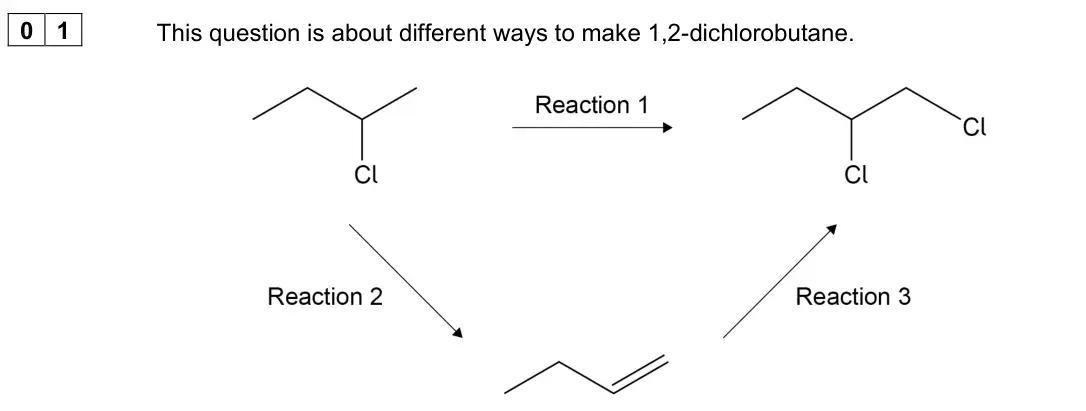
Q01.6
The whole paper ↗Q01.3
The whole paper ↗
Q01.4
The whole paper ↗Q03.1
The whole paper ↗
Q03.4
The whole paper ↗Q06.4
The whole paper ↗
Q01.5
The whole paper ↗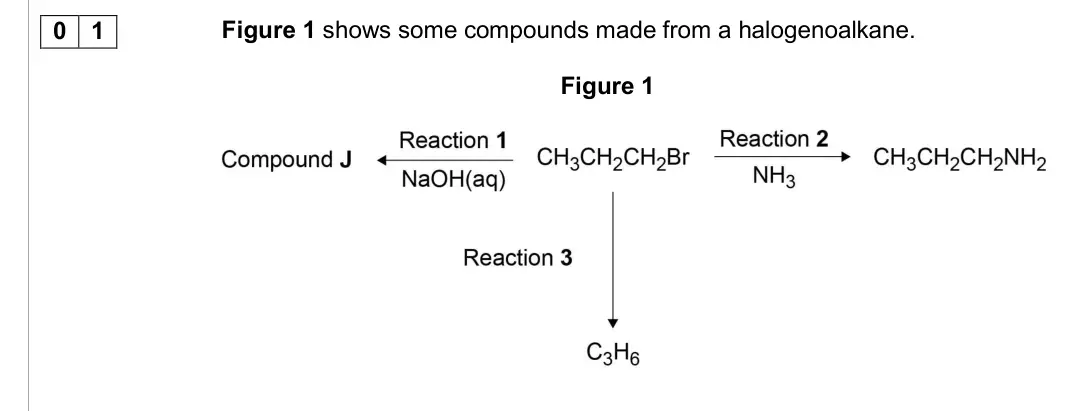
Q01.6
The whole paper ↗Q06.3
The whole paper ↗
All 38 questions on Elimination, as a list
- June 2025, Paper 2, Q01.4 (2 marks): Give a suitable reagent and conditions needed for reaction 2. [2 marks] Reagent Conditions
- June 2025, Paper 2, Q01.6 (1 mark): Use of the reagent for reaction 2 followed by the reagent for reaction 3 gives another organic product. Give the structure of the other organic product. [1 mark
- June 2025, Paper 3, Q08 (1 mark): Each of the conversions shown uses KOH as a reactant. In which conversion does KOH not act as a base? [1 mark] A (CH3)2NH2+Br – to (CH3)2NH B CH3COOH to CH3COO–
- June 2025, Paper 3, Q10 (1 mark): Which diagram shows a correct step in the mechanism for an elimination reaction of bromoethane? [1 mark] A B C D
- June 2025, AS Paper 2, Q01.3 (1 mark): Identify the solvent that should be used to ensure that butan-2-ol is the main organic product when 2-brombutane reacts with KOH [1 mark]
- June 2025, AS Paper 2, Q01.4 (5 marks): Under different conditions, 2-bromobutane reacts with KOH to form but-1-ene and two other alkenes. Name and complete the mechanism to form but-1-ene from 2-brom
- June 2024, AS Paper 2, Q12 (1 mark): A halogenoalkane reacts with ethanolic potassium hydroxide to form these alkenes by elimination: • 2-ethylpent-1-ene • E-3-methylhex-2-ene • Z-3-methylhex-2-ene
- June 2023, Paper 3, Q29 (1 mark): Which is not a possible product of a reaction between KOH and ? [1 mark] A B C D
- June 2023, AS Paper 2, Q13 (1 mark): Which is not a possible product of the reaction of this compound with potassium hydroxide? [1 mark] A B C D
- June 2022, Paper 3, Q03.1 (2 marks): Give the names of the two concurrent mechanisms responsible for the formation of the alkenes and the alcohols. [2 marks] Mechanism to form alkenes Mechanism to
- June 2022, Paper 3, Q03.4 (3 marks): Outline the mechanism for the reaction of 2-bromobutane with sodium hydroxide to form alkene A. [3 marks]
- June 2022, AS Paper 2, Q21 (1 mark): Which of these compounds is not produced? [1 mark] A butan-1-ol B butan-2-ol C but-1-ene D E-but-2-ene
- June 2022, AS Paper 2, Q22 (1 mark): What is the role of the hydroxide ions in the elimination reaction? [1 mark] A base B catalyst C electrophile D nucleophile
- November 2021, AS Paper 2, Q13 (1 mark): Which compound is not formed by reacting 3-bromo-3-methylhexane with warm, ethanolic potassium hydroxide? [1 mark] A 2-ethylpent-1-ene B 3-methylhex-1-ene C 3-m
- June 2019, AS Paper 2, Q22 (1 mark): Which compound could not be produced by reacting 2-bromo-3-methylbutane with sodium hydroxide? [1 mark] A 2-methylbut-1-ene B 3-methylbut-1-ene C 2-methylbut-2-
- June 2018, AS Paper 2, Q06.4 (6 marks): Reaction of A with hot, ethanolic potassium hydroxide gives alkene C. Name the mechanism for this reaction. State the role of the hydroxide ions. Outline the me
- June 2017, Paper 2, Q01.5 (1 mark): Identify the reagent and conditions used in Reaction 3. [1 mark
- June 2017, Paper 2, Q01.6 (4 marks): Name and outline a mechanism for Reaction 3. [4 marks Name of mechanism Mechanism
- June 2017, AS Paper 2, Q06.3 (2 marks): When 1-bromo-2-methylpropane reacts with hot, concentrated ethanolic potassium hydroxide rather than dilute aqueous sodium hydroxide, a different product is for
- June 2016, AS Paper 2, Q13 (1 mark): Which of the following is a correct mechanism for the formation of 2-methylbut-2-ene from 2-bromo-3-methylbutane? [1 mark] A B C D
- June 2016, CHEM2 (old spec), Q8(a) (8 marks): The same reagent is used in both reactions. The product is determined by the choice of conditions. State the reagent and the conditions for each of reaction 1 a
- June 2015, CHEM2 (old spec), Q8(d) (3 marks): State the type of reaction shown by Reaction 3. Identify a reagent for this reaction. Give one condition necessary for a high yield of product when Q is convert
- June 2014, CHEM2 (old spec), Q7(f) (5 marks): Name and outline a mechanism for the following reaction to form Isomer 5. State the role of the hydroxide ion in this reaction. [5 marks] (CH3)2CBrCH2CH3 + KOH
- June 2013, CHEM2 (old spec), Q5(a)(i) (4 marks): Name and outline a mechanism for the conversion of 2-bromo-3-methylbutane into 2-methylbut-2-ene according to the equation. (CH3)2CHCHBrCH3 + KOH (CH3)2C CHCH3
- June 2013, CHEM2 (old spec), Q5(a)(ii) (1 mark): Draw the displayed formula for the other isomer that is formed. (1 mark)
- June 2013, CHEM2 (old spec), Q5(b)(ii) (1 mark): Suggest one change to the reaction conditions that would increase the yield of X. (1 mark)
- January 2013, CHEM2 (old spec), Q8(d) (3 marks): The haloalkane produced in Reaction 1 can be converted back into propene in an elimination reaction using ethanolic potassium hydroxide. KOH CH3CHBrCH3 H2C CHCH
- June 2012, CHEM2 (old spec), Q7(a)(i) (3 marks): Complete the elimination mechanism by drawing appropriate curly arrows. HO H H H CH3 C C C CH2CH3 CH3CH2CH CHCH2CH3 + H2O + Br H H Br 3-bromohexane hex-3-ene (3
- January 2012, CHEM2 (old spec), Q8(c) (3 marks): The second stage is to convert 2-bromobutane into but-2-ene. CH3CH2CHBrCH3 + KOH CH3CH CHCH3 + KBr + H2O Outline a mechanism for this reaction. (3 marks) Sectio
- June 2011, CHEM2 (old spec), Q9(a)(i) (4 marks): Name and outline a mechanism for the conversion of 2-bromopentane into pent-2-ene as shown below. ethanolic KOH CH3CH2CH2CHBrCH3 CH3CH2CH CHCH3 (4 marks)
- June 2011, CHEM2 (old spec), Q9(a)(ii) (1 mark): Draw the structure of the other structurally isomeric alkene produced when 2-bromopentane reacts with ethanolic KOH. (1 mark)
- January 2011, CHEM2 (old spec), Q8(c)(i) (3 marks): Outline a mechanism for the elimination reaction in which 2-bromopropane reacts with potassium hydroxide to form propene. (3 marks)
- June 2010, CHEM4 (old spec), Q3(a)(ii) (1 mark): Name the type of mechanism in Reaction 1. (1 mark)
- January 2010, CHEM2 (old spec), Q7(b) (4 marks): An alternative reaction can occur between this haloalkane and potassium hydroxide as shown by the following equation. Name and outline a mechanism for this reac
- January 2010, CHEM2 (old spec), Q7(c) (1 mark): Give one condition needed to favour the reaction shown in part (b) rather than that shown in part (a). (1 mark)
- June 2009, CHEM2 (old spec), Q8(d) (4 marks): 8 (d) When potassium hydroxide reacts with bromoethane, ethene can also be formed. Name and outline a mechanism for this reaction. Name of mechanism Mechanism (
- June 2008, CHM3W (2008 spec), Q5(b) (4 marks): 5 (b) Name and outline a mechanism for the conversion of P into Q. Name of mechanism Mechanism (4 marks)
- January 2008, CHM3W (2008 spec), Q6(b) (4 marks): (b) Name and outline a mechanism for the conversion of A into B (Reaction 1). (4 marks)
Questions, mark schemes and examiner’s reports are © AQA, from their published past papers. Plumi isn’t affiliated with any exam board. Want whole papers? AQA A-Level Chemistry past papers.
The Plumi iPad app also offers exam-style questions with AI feedback on your handwritten working.