 plumi
Alcohol production: AQA A‑Level Chemistry questions
AQA A-Level Chemistry past-paper questions on 3.3.5.1 Alcohol production, 2008–2025, with mark schemes and examiner’s reports where available.
Paper
All papers
Exam
All years
Calculations
Q06.1
The whole paper ↗
Q06.2
The whole paper ↗Q06.4
The whole paper ↗Q06.5
The whole paper ↗Q06.6
The whole paper ↗Q06.7
The whole paper ↗Q06.9
The whole paper ↗Q06.10
The whole paper ↗Q02.7
The whole paper ↗
Q05.1
The whole paper ↗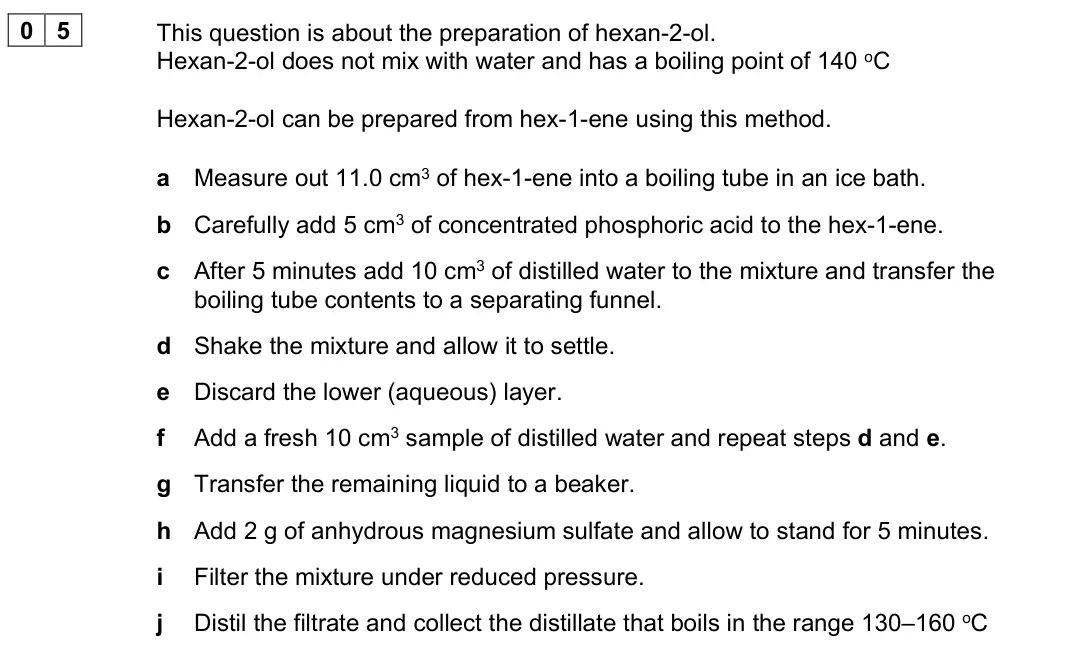
Q05.2
The whole paper ↗Q05.3
The whole paper ↗Q05.4
The whole paper ↗Q05.5
The whole paper ↗Q07.1
The whole paper ↗
All 62 questions on Alcohol production, as a list
- June 2025, Paper 3, Q13 (1 mark): Compound X reacts with concentrated sulfuric acid to produce compound Y. Compound Y reacts with an excess of water to produce an alcohol. Which compound could b
- June 2025, Paper 3, Q24 (1 mark): Ethanol biofuel can be produced by fermentation. Which statement about this process is correct? [1 mark] A It is aerobic and the ethanol is separated by filtrat
- June 2025, Paper 3, Q36 (1 mark): The hydration of 1-methylcyclopent-1-ene uses a catalyst of sulfuric acid and produces a mixture of products. Which ion is formed during the mechanism for this
- June 2025, AS Paper 2, Q06.1 (1 mark): Complete the equation for the conversion of cyclohexene to cyclohexanol in this reaction. [1 mark]
- June 2025, AS Paper 2, Q06.2 (3 marks): Complete the mechanism for this reaction by adding curly arrows in the relevant places. [3 marks]
- June 2025, AS Paper 2, Q06.4 (2 marks): Explain why the condenser in Figure 2 is connected so that water enters at the bottom and not at the top. [2 marks]
- June 2025, AS Paper 2, Q06.5 (1 mark): The flask heated in Figure 2 contains anti-bumping granules. State why these are used. [1 mark]
- June 2025, AS Paper 2, Q06.6 (1 mark): Suggest why the flask in Figure 2 is heated with an electric heater, rather than a Bunsen burner. [1 mark]
- June 2025, AS Paper 2, Q06.7 (2 marks): State why the apparatus set up in Figure 2 is dangerous. State how this problem could be solved. [2 marks] Why the apparatus is dangerous How to solve the probl
- June 2025, AS Paper 2, Q06.9 (1 mark): Give an equation for the complete combustion of cyclohexanol (C6H11OH). [1 mark]
- June 2025, AS Paper 2, Q06.10 (2 marks): The use of cyclohexanol biofuel mixed with diesel in cars is not carbon-neutral. State the meaning of the term carbon-neutral. Give a reason why the use of this
- June 2024, Paper 3, Q29 (1 mark): Which statement about the industrial production of ethanol from ethene at 300 °C is correct? C2H4(g) + H2O(g) ⇌ C2H5OH(g) ΔH = –46 kJ mol–1 [1 mark] A The use o
- June 2023, Paper 3, Q31 (1 mark): Compound X can be converted into an alcohol in a two-stage process. What is the name of compound X? [1 mark] A propene B propanal C methylbenzene D ethanamide
- June 2023, AS Paper 2, Q02.7 (1 mark): Petrol sold in the UK contains 10% bioethanol. Bioethanol is ethanol made from crops by fermentation and is considered to be carbon-neutral. State what is meant
- June 2022, Paper 2, Q05.1 (2 marks): It is important to wear eye protection and a lab coat when completing this experiment. Suggest, with a reason, one other appropriate safety precaution for this
- June 2022, Paper 2, Q05.2 (1 mark): Give a reason for adding the distilled water in steps c and f. [1 mark]
- June 2022, Paper 2, Q05.3 (1 mark): Give a reason for adding anhydrous magnesium sulfate in step h. [1 mark]
- June 2022, Paper 2, Q05.4 (2 marks): Complete and label the diagram of the apparatus used to filter the mixture under reduced pressure in step i. [2 marks]
- June 2022, Paper 2, Q05.5 (2 marks): Identify the most likely organic impurity, other than hex-1-ene, in the distillate collected in step j. Suggest one reason why it could be difficult to remove t
- June 2022, AS Paper 2, Q07.1 (4 marks): The ethanol produced by fermentation of glucose may be regarded as a carbon-neutral fuel. Justify this statement. Include the relevant chemical equations in you
- June 2022, AS Paper 2, Q07.2 (1 mark): Suggest why ethanol produced in Europe using silverskin from South America is less likely to be carbon-neutral than ethanol produced from crops grown in Europe.
- November 2021, Paper 2, Q02.6 (6 marks): Bioethanol is used as an alternative to fossil fuels. This statement appeared on a website. “The fact that bioethanol is a carbon-neutral fuel outweighs the env
- November 2021, AS Paper 2, Q19 (1 mark): Which statement is not correct about the industrial production of ethanol from ethene at 300 °C? C2H4(g) + H2O(g) ⇌ C2H5OH(g) ΔH = −46 kJ mol–1 [1 mark] A The r
- November 2020, AS Paper 2, Q18 (1 mark): Which statement is correct about the production and use of ethanol as a biofuel? [1 mark] A Biofuel ethanol is produced by the fermentation of glucose in the pr
- June 2019, Paper 3, Q32 (1 mark): In the UK industrial ethanol is now produced by the direct hydration of ethene. This process has largely replaced the fermentation method. Which is a likely rea
- June 2018, AS Paper 2, Q12 (1 mark): Which statement is not correct about the industrial preparation of ethanol by the hydration of ethene at 300 °C? C2H4(g) + H2O(g) ⇌ C2H5OH(g) ∆H = – 46 kJ mol–1
- Specimen, Paper 1, Q04.3 (1 mark): Suggest one environmental advantage of manufacturing methanol fuel by this reaction. [1 mark] 0 4 . 3
- June 2016, CHEM2 (old spec), Q9(b) (6 marks): On an industrial scale ethanol can be produced from ethene by direct hydration or from glucose by fermentation. State the conditions for the direct hydration re
- June 2014, CHEM2 (old spec), Q7(d) (1 mark): Two alcohols are formed by the hydration of Isomer 4. Draw the displayed formula for the alcohol formed that is oxidised readily by acidified potassium dichroma
- June 2014, CHEM2 (old spec), Q9(a) (5 marks): A dilute aqueous solution of ethanol can be produced by the fermentation of an aqueous solution of glucose. It is claimed that the ethanol obtained from this so
- June 2013, CHEM2 (old spec), Q1(d)(ii) (1 mark): Deduce the type of reaction in Stage 2 of this conversion. (1 mark)
- June 2013, CHEM2 (old spec), Q1(d)(iii) (1 mark): State the overall role of sulfuric acid in this conversion. (1 mark)
- June 2013, CHEM2 (old spec), Q10(a)(i) (2 marks): Identify the catalyst used in this process. Deduce how an overall yield of 95% is achieved in this process without changing the operating conditions.
- June 2013, CHEM2 (old spec), Q10(a)(ii) (3 marks): Use your knowledge of equilibrium reactions to explain why a manufacturer might consider using an excess of steam in this process, under the same operating cond
- June 2013, CHEM2 (old spec), Q10(a)(iii) (2 marks): At pressures higher than 7 MPa, some of the ethene reacts to form a solid with a relative molecular mass greater than 5000 Deduce the identity of this solid. Gi
- January 2013, CHEM2 (old spec), Q5(b) (3 marks): In the absence of oxygen, an aqueous solution of glucose can be fermented to produce ethanol for use in alcoholic drinks. Write an equation for this fermentatio
- January 2013, CHEM2 (old spec), Q5(d)(i) (1 mark): State the meaning of the term carbon-neutral. (1 mark)
- January 2013, CHEM2 (old spec), Q5(d)(ii) (1 mark): Other than carbon-neutrality, state the main advantage of the use of glucose from crops as the raw material for the production of ethanol. (1 mark)
- January 2013, CHEM2 (old spec), Q5(d)(iii) (1 mark): Give one disadvantage of the use of crops for the production of ethanol. (1 mark)
- June 2012, CHEM5 (old spec), Q5(e)(iv) (2 marks): Suggest why ethanol can be considered to be a carbon-neutral fuel.
- June 2012, CHEM2 (old spec), Q2(d)(i) (1 mark): State the meaning of the term carbon-neutral.
- June 2012, CHEM2 (old spec), Q3(d)(ii) (1 mark): State the meaning of the term hydration. (1 mark)
- June 2012, CHEM2 (old spec), Q3(d)(iii) (2 marks): Write an equation for the hydration of propene to form isopropyl alcohol. Give the IUPAC name for isopropyl alcohol. Equation IUPAC name (2 marks)
- June 2012, CHEM2 (old spec), Q8(a) (2 marks): Deduce one safety reason and one environmental reason why Process 2 is preferred to Process 1.
- June 2012, CHEM2 (old spec), Q8(c) (4 marks): In the production of bioethanol, glucose (C6H12O6) is converted into a dilute aqueous solution of ethanol and carbon dioxide. Give the name of this process and
- January 2012, CHEM2 (old spec), Q9(a) (5 marks): Reaction 1 produces a 15% aqueous solution of ethanol. It is claimed that the ethanol produced in this way is a carbon-neutral biofuel. Write an equation for Re
- January 2012, CHEM2 (old spec), Q9(c) (4 marks): Reaction 3 is used in industry. Reaction 3 H2C CH2 CH3CH2OH Identify a suitable catalyst for Reaction 3. Identify the type of reaction. Give two conditions, in
- June 2011, CHEM2 (old spec), Q1(d)(i) (2 marks): The fermentation of an aqueous solution of glucose. Catalyst Name of organic product (2 marks)
- June 2011, CHEM2 (old spec), Q1(d)(ii) (2 marks): The hydration of but-2-ene. Catalyst Name of organic product (2 marks)
- January 2011, CHEM2 (old spec), Q6(b)(i) (1 mark): Give the meaning of the term carbon-neutral, as applied to a fuel. (1 mark)
- June 2010, CHEM5 (old spec), Q6(e) (1 mark): Give one reason why methanol, synthesised from carbon dioxide and hydrogen, may not be a carbon-neutral fuel. (1 mark)
- June 2010, CHEM2 (old spec), Q5(c)(i) (1 mark): State the overall role of sulfuric acid in Reaction 3. (1 mark)
- June 2010, CHEM2 (old spec), Q8(a) (4 marks): State three essential conditions for the fermentation of aqueous glucose in Process 2. Write an equation for the reaction that takes place during this fermentat
- June 2010, CHEM2 (old spec), Q8(b) (3 marks): It has been claimed that there is no net carbon (greenhouse gas) emission to the atmosphere when ethanol made by Process 2 is used as a fuel. State the term tha
- January 2010, CHEM2 (old spec), Q9(c) (4 marks): British scientists have used bacteria to ferment glucose and produce the biofuel butan-l-ol. Write an equation for the fermentation of glucose (C6H12O6) to form
- June 2009, CHEM1 (old spec), Q3(c)(i) (1 mark): 3 (c) (i) Write an equation which shows how ethanol burns completely in air to form carbon dioxide and water as the only products. (1 mark)
- June 2009, CHEM2 (old spec), Q4(d)(i) (1 mark): 4 (d) (i) State what is meant by the term carbon neutral. (1 mark)
- June 2008, CHM3W (2008 spec), Q6(c) (3 marks): 6 (c) State what must be added to an aqueous solution of glucose to convert it into ethanol. Name the process and write an equation for this reaction. (3 marks)
- June 2008, CHM3W (2008 spec), Q6(d) (3 marks): 6 (d) The reaction of aqueous glucose to form ethanol produces a dilute aqueous solution. Name the process used to separate ethanol from this dilute aqueous sol
- January 2008, CHM3W (2008 spec), Q1(d)(i) (1 mark): (i) Write an equation for the complete combustion of methanol, CH3OH (1 mark)
- January 2008, CHM3W (2008 spec), Q1(d)(ii) (1 mark): (ii) It may be desirable to increase the use of ethanol as a fuel in the future. Give one reason for this, other than the production of smaller amounts of pollu
- January 2008, CHM3W (2008 spec), Q4(d) (2 marks): (d) Write an equation for the fermentation of glucose (C6H12O6) and identify a catalyst for this process. Equation Catalyst (2 marks)
Questions, mark schemes and examiner’s reports are © AQA, from their published past papers. Plumi isn’t affiliated with any exam board. Want whole papers? AQA A-Level Chemistry past papers.
The Plumi iPad app also offers exam-style questions with AI feedback on your handwritten working.