 plumi
Structure, bonding and reactivity: AQA A‑Level Chemistry questions
AQA A-Level Chemistry past-paper questions on 3.3.4.1 Structure, bonding and reactivity, 2008–2025, with mark schemes and examiner’s reports where available.
Paper
All papers
Exam
All years
Calculations
Q02.2
The whole paper ↗
How many marks did you get?
Q08.3
The whole paper ↗
Q7(b)(i)
The whole paper ↗Q7(a)
The whole paper ↗
Q2(f)(i)
The whole paper ↗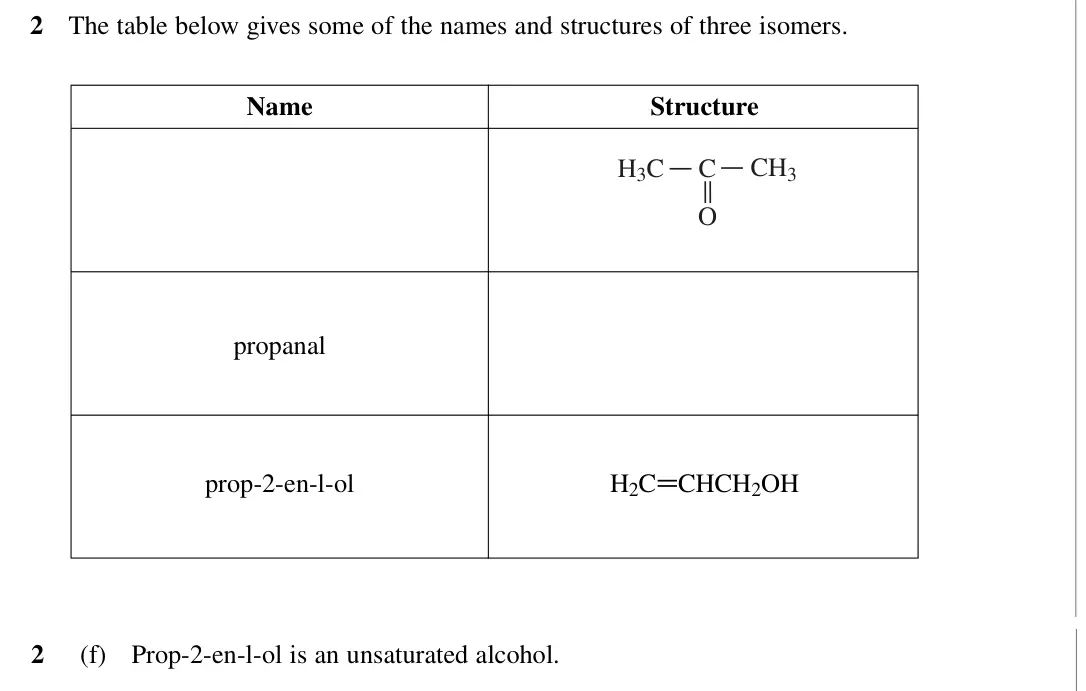
Q2(e)(i)
The whole paper ↗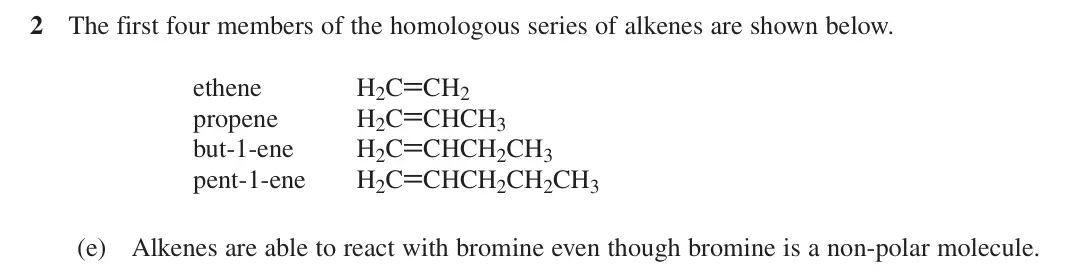
All 8 questions on Structure, bonding and reactivity, as a list
- November 2021, AS Paper 2, Q02.2 (3 marks): Explain why there is an attraction between a C=C double bond and Br2 [3 marks]
- June 2019, AS Paper 2, Q17 (1 mark): Which statement is not correct about CH2═C(CH3)CH2Br? [1 mark] A It displays E-Z isomerism. B It forms an addition polymer. C It reacts with electrophiles. D It
- June 2017, AS Paper 2, Q03.1 (6 marks): Compounds A, B and C all have the molecular formula C5H10 A and B decolourise bromine water but C does not. B exists as two stereoisomers but A does not show st
- June 2017, AS Paper 2, Q08.3 (1 mark): Thermal cracking of hydrocarbons produces molecules that are attacked by electrophiles because they have a region of high electron density. Draw the structure o
- January 2011, CHEM2 (old spec), Q7(b)(i) (2 marks): Explain why bromine molecules react with the double bonds in alkenes.
- June 2009, CHEM2 (old spec), Q7(a) (1 mark): 7 (a) State what is meant by the term unsaturated as applied to an alkene. (1 mark)
- June 2008, CHM3W (2008 spec), Q2(f)(i) (1 mark): 2 (f) (i) State what is meant by the term unsaturated. (1 mark)
- January 2008, CHM3W (2008 spec), Q2(e)(i) (2 marks): (i) Explain why non-polar bromine molecules are able to react with the double bonds in alkenes. (2 marks)
Questions, mark schemes and examiner’s reports are © AQA, from their published past papers. Plumi isn’t affiliated with any exam board. Want whole papers? AQA A-Level Chemistry past papers.
The Plumi iPad app also offers exam-style questions with AI feedback on your handwritten working.