 plumi
Nomenclature: AQA A‑Level Chemistry questions
AQA A-Level Chemistry past-paper questions on 3.3.1.1 Nomenclature, 2008–2025, with mark schemes and examiner’s reports where available.
Paper
All papers
Exam
All years
Calculations
Q02.1
The whole paper ↗
Q06.2
The whole paper ↗
Q03.1
The whole paper ↗
Q04.1
The whole paper ↗
Q09.1
The whole paper ↗
Q02.3
The whole paper ↗
Q01.1
The whole paper ↗
Q03.3
The whole paper ↗
Q03.5
The whole paper ↗
Q02.4
The whole paper ↗
Q04.1
The whole paper ↗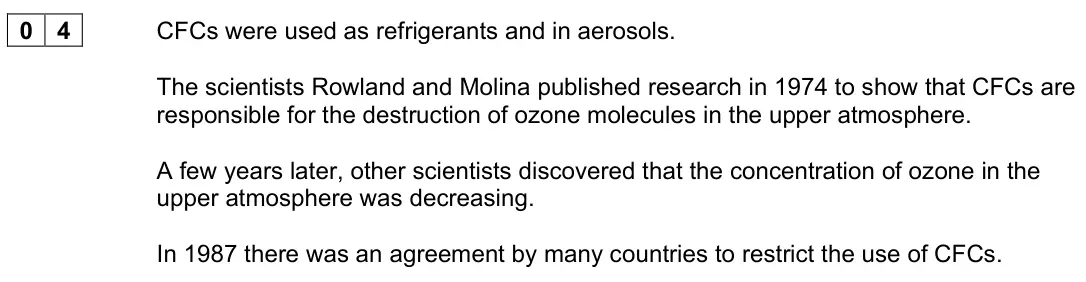
Q02.2
The whole paper ↗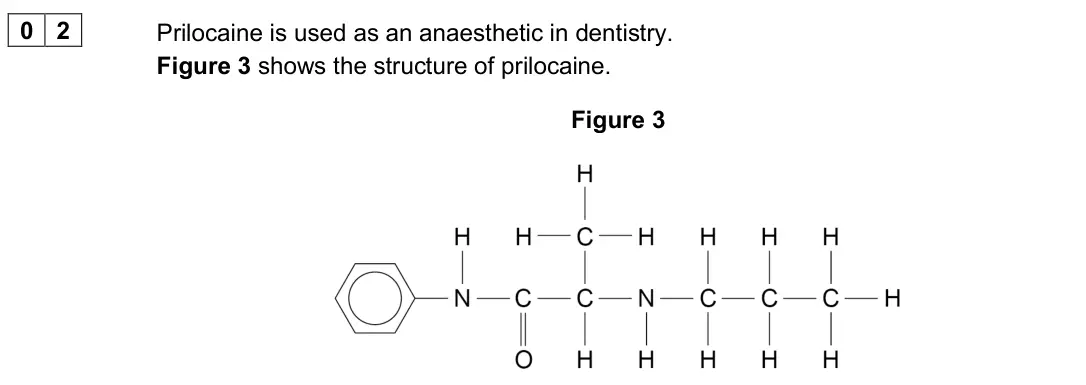
All 111 questions on Nomenclature, as a list
- June 2025, Paper 2, Q02.1 (3 marks): Use IUPAC rules to name L. Explain why L exists as stereoisomers. [3 marks] Name Explanation
- June 2025, Paper 3, Q06.2 (3 marks): Q can be reacted with methanol to form three different esters. State the number used to identify the position of the C=C bond in the name of the ester formed fr
- June 2025, Paper 3, Q18 (1 mark): What is the correct structural formula for 4-chloro-2-methylpent-2-enoic acid? [1 mark] A CH3CCl=CHCH(CH3)COOH B (CH3)2C=CHCHClCOOH C CH3CHClCH=C(CH3)COOH D (CH
- June 2025, AS Paper 2, Q08 (1 mark): What is the name of this compound according to IUPAC rules? [1 mark] A 2-methylbutanal B 3-methylbutanal C 2-methylbutan-1-one D 3-methylbutan-1-one
- June 2025, AS Paper 2, Q12 (1 mark): What is the name of this compound according to IUPAC rules? [1 mark] A E–3-fluoro-2-methylpent-3-ene B Z–3-fluoro-2-methylpent-4-ene C E–3-fluoro-4-methylpent-2
- June 2024, Paper 3, Q23 (1 mark): What is the correct structural formula for 4-chloro-2-methylpent-2-enoic acid? [1 mark] A CH3CCl=CHCH(CH3)COOH B (CH3)2C=CHCHClCOOH C CH3CHClCH=C(CH3)COOH D (CH
- June 2024, AS Paper 2, Q03.1 (1 mark): Use IUPAC rules to name CFCl3 [1 mark]
- June 2023, Paper 2, Q04.1 (1 mark): Use IUPAC rules to name isomer W. [1 mark]
- June 2023, Paper 2, Q09.1 (1 mark): Ethenone is the simplest member of the ketene homologous series. Ketenes all contain one C=C double bond and one C=O double bond. Deduce the general formula for
- June 2023, AS Paper 2, Q02.3 (1 mark): 3-Ethyl-4-methylhexane is a branched alkane in petrol. Draw the skeletal formula of this alkane. [1 mark]
- June 2023, AS Paper 2, Q18 (1 mark): Which is the IUPAC name for this compound? [1 mark] A E-3-fluorohex-3-ene B E-4-fluorohex-3-ene C Z-3-fluorohex-3-ene D Z-4-fluorohex-3-ene
- June 2022, Paper 2, Q01.1 (2 marks): Draw the displayed formula for CH3CH2COCH2I Give the name of CH3CH2COCH2I [2 marks] Displayed formula Name
- June 2022, Paper 3, Q03.3 (2 marks): Deduce the name of isomer A. Explain why A does not exhibit stereoisomerism. [2 marks] Name Explanation
- June 2022, AS Paper 2, Q03.5 (4 marks): Several saturated halogenoalkanes contain 17.8% carbon, 3.0% hydrogen and 79.2% bromine by mass. Calculate the empirical formula of these compounds. Give the IU
- June 2022, AS Paper 2, Q11 (1 mark): A polymer is formed from the monomer CH2=CHCN Which statement is not correct? [1 mark] A The monomer is propanenitrile. B The monomer is unsaturated. C The poly
- November 2021, Paper 2, Q02.4 (4 marks): Compound Z (HOCH2CH2NH2) can be used to remove carbon dioxide from the mixture of waste gases produced in some power stations. Figure 1 shows part of a suggeste
- November 2021, Paper 3, Q27 (1 mark): Which is the correct general formula for non-cyclic compounds in the homologous series? [1 mark] A alcohols CnH2n+2O B aldehydes CnH2n+1O C esters CnH2n+1O2 D p
- November 2021, AS Paper 2, Q04.1 (1 mark): The molecule CFC-11 was commonly used as a refrigerant. Use IUPAC rules to name CFC-11 [1 mark]
- November 2021, AS Paper 2, Q17 (1 mark): Which compound has a molecular formula that is different from the others? [1 mark] A B C D
- November 2020, Paper 2, Q02.2 (1 mark): Identify the functional group(s) in the prilocaine molecule. [1 mark]
- November 2020, Paper 2, Q08.3 (1 mark): Complete this IUPAC name for H3Y [1 mark] propane-1, 2, 3-tricarboxylic acid
- November 2020, AS Paper 2, Q07.1 (1 mark): Draw the skeletal formula of ethanedioic acid. [1 mark]
- November 2020, AS Paper 2, Q11 (1 mark): What is the IUPAC name for this compound? [1 mark] A 2-dimethyl-3-fluoropentane B 2,2-dimethyl-3-fluoropentane C 3-fluoro-2,2-dimethylpentane D 3-fluoro-2-dimet
- June 2019, Paper 2, Q03.1 (4 marks): Deduce the molecular formula of isoprene and suggest a possible structure. [4 marks] Molecular formula Structure
- June 2019, Paper 2, Q03.2 (2 marks): The insides of some golf balls are made from a mixture of three other polymers. The repeating unit for one of these polymers is shown. Draw the skeletal formula
- June 2019, Paper 2, Q07.1 (1 mark): Give the IUPAC name for isomer X. [1 mark]
- June 2019, Paper 2, Q11.1 (3 marks): An ester is formed by the reaction of an acid anhydride with CH3CH2OH Complete the equation. In your answer show clearly the structure of the ester. Give the IU
- June 2019, AS Paper 2, Q02.2 (1 mark): Give the IUPAC name of D. [1 mark]
- June 2019, AS Paper 2, Q07.1 (1 mark): Draw the skeletal formula of propanedioic acid. [1 mark]
- June 2018, Paper 2, Q02.1 (1 mark): Give the IUPAC name for CH2(OH)CH(CH3)CH2Br [1 mark]
- June 2018, Paper 2, Q07.2 (3 marks): The organic product in Question 07.1 can be converted into the alcohol shown. Give the IUPAC name of the alcohol. Give the reagent needed for this reaction and
- June 2018, AS Paper 2, Q04.1 (2 marks): State the general formula of an alkane containing n carbon atoms. Deduce an expression for the relative molecular mass (Mr) of an alkane in terms of n. [2 marks
- June 2018, AS Paper 2, Q06.1 (1 mark): Name Compound A. [1 mark]
- June 2017, Paper 2, Q04.1 (1 mark): Give the IUPAC name of CH3CH2CH2CH2CH(OH)CN [1 mark
- June 2017, Paper 2, Q10.1 (1 mark): Give the full IUPAC name of isomer P. [1 mark
- June 2017, AS Paper 2, Q08.1 (1 mark): Draw the skeletal formula of 3-methylbutanal. [1 mark]
- June 2016, AS Paper 2, Q03.1 (1 mark): Give the IUPAC name for isooctane. [1 mark]
- June 2016, AS Paper 2, Q05.2 (1 mark): Chloropentafluoroethane is a CFC that has been used as a refrigerant. Draw its displayed formula. [1 mark]
- June 2016, AS Paper 2, Q06.1 (1 mark): Draw the skeletal formula of propane-1,2-diol. [1 mark]
- June 2016, AS Paper 2, Q18 (1 mark): The structure of cyclohexene is shown. Which of the following is the general formula of cyclic alkenes such as cyclohexene? [1 mark] A CnH2n-4 B CnH2n-2 C CnH2n
- Specimen, Paper 2, Q03.1 (1 mark): 3 Isooctane (C8H18) is the common name for the branched-chain hydrocarbon that burns smoothly in car engines. The skeletal formula of isooctane is shown in Figu
- Specimen, Paper 2, Q04.1 (1 mark): 4 Alcohol A (CH3)2CHCH(OH)CH3 undergoes reactions separately with acidified potassium dichromate(VI) and with concentrated sulfuric acid. Deduce the IUPAC name
- Specimen, Paper 2, Q06.4 (1 mark): Deduce the IUPAC name of threonine. [1 mark] 0 6 . 4
- June 2016, CHEM4 (old spec), Q3(a)(i) (1 mark): Give the IUPAC name of reagent X in Step 1. [1 mark]
- June 2016, CHEM4 (old spec), Q5(b)(i) (1 mark): Give the IUPAC name of leucine. [1 mark]
- June 2016, CHEM1 (old spec), Q4(a)(i) (1 mark): Identify the homologous series to which octane belongs. [1 mark]
- June 2016, CHEM1 (old spec), Q4(a)(iii) (1 mark): An isomer of octane used to improve the performance of car engines is shown. Give the IUPAC name of this isomer. [1 mark] CH2 H3C C CH3 CH3 H C CH3 CH3
- June 2016, CHEM1 (old spec), Q4(b)(i) (1 mark): Give the IUPAC name for compound X. [1 mark]
- June 2015, CHEM4 (old spec), Q7(b)(i) (1 mark): Give the IUPAC name of a monomer that forms polymer L. [1 mark]
- June 2015, CHEM1 (old spec), Q6(e) (1 mark): There are many structural isomers with the molecular formula C8H18 Draw the structure of 2,3,3-trimethylpentane. [1 mark]
- June 2015, CHEM1 (old spec), Q6(f) (1 mark): A compound C8H18 reacts with chlorine to give several haloalkanes. Give the IUPAC name of the following haloalkane. [1 mark] Cl H3C C C C CH3 H H CH2 CH3 Cl CH3
- June 2015, CHEM2 (old spec), Q6(c)(i) (1 mark): Draw the structure of prop-2-en-1-ol. [1 mark]
- June 2015, CHEM2 (old spec), Q8(a) (2 marks): Give the IUPAC name for compound P and that for compound Q. [2 marks] P Q
- June 2014, CHEM4 (old spec), Q5(c) (1 mark): Give the IUPAC name of the product of the reaction in Question 5 (a). [1 mark]
- June 2014, CHEM4 (old spec), Q6(a) (1 mark): Give the IUPAC name of lysine. [1 mark]
- June 2014, CHEM1 (old spec), Q5(d)(i) (1 mark): Give the general formula for the homologous series that contains dodecane. [1 mark]
- June 2014, CHEM1 (old spec), Q5(e) (2 marks): Give the IUPAC name for the following compound and state the type of structural isomerism shown by this compound and dodecane. [2 marks] IUPAC name Type of stru
- June 2014, CHEM2 (old spec), Q8(a)(ii) (2 marks): Deduce the name of the mechanism in Question 8 (a) (i). Give the IUPAC name of (CH3)2CHCH2Br [2 marks]
- June 2013, CHEM4 (old spec), Q5(a)(i) (1 mark): Give the IUPAC name for lactic acid. (1 mark)
- June 2013, CHEM4 (old spec), Q7(a)(iv) (1 mark): Give the IUPAC name of J. (1 mark)
- June 2013, CHEM4 (old spec), Q7(b)(iii) (1 mark): Give the IUPAC name of K. (1 mark) Section B Answer all questions in the spaces provided.
- June 2013, CHEM1 (old spec), Q2(a)(ii) (1 mark): Give the IUPAC name of the position isomer of but-1-ene. (1 mark)
- June 2013, CHEM1 (old spec), Q2(a)(iii) (1 mark): Give the IUPAC name of the chain isomer of but-1-ene. (1 mark)
- June 2013, CHEM1 (old spec), Q8(a) (3 marks): The structure of the bromoalkane Z is Give the IUPAC name for Z. Give the general formula of the homologous series of straight-chain bromoalkanes that contains
- June 2013, CHEM1 (old spec), Q8(b) (2 marks): Draw the displayed formula of 1,2-dichloro-2-methylpropane. State its empirical formula. (2 marks)
- January 2013, CHEM1 (old spec), Q4(g)(i) (1 mark): Give the IUPAC name of X. (1 mark)
- January 2013, CHEM2 (old spec), Q5(c)(i) (1 mark): Draw the displayed formula for ethanoic acid. (1 mark)
- January 2013, CHEM2 (old spec), Q7(b) (1 mark): The refrigerant R112A (CCl3CF2Cl) has been banned because of concerns about ozone depletion. Give the IUPAC name for CCl3CF2Cl (1 mark)
- June 2012, CHEM4 (old spec), Q5(b) (1 mark): Give the IUPAC name of the product of Step 2. (1 mark)
- June 2012, CHEM1 (old spec), Q2(a)(i) (1 mark): Deduce the general formula of the homologous series that contains X. (1 mark)
- June 2012, CHEM2 (old spec), Q6(d)(i) (1 mark): Draw the displayed formula for 2,3,3,3-tetrafluoropropene. (1 mark)
- January 2012, CHEM1 (old spec), Q3(e) (2 marks): A different chlorinated compound is shown below. Name this compound and state its empirical formula. Name Empirical formula (2 marks) H H H C C C CH3 CH3 CH3 Cl
- June 2011, CHEM4 (old spec), Q5(a) (1 mark): Give the IUPAC name for phthalic acid. (1 mark)
- June 2011, CHEM1 (old spec), Q7(a) (1 mark): Give the general formula for the homologous series of alkanes. (1 mark)
- June 2011, CHEM1 (old spec), Q7(f) (2 marks): Consider the following compound. Name this compound. Deduce the empirical formula of this compound.
- June 2011, CHEM2 (old spec), Q6(a) (1 mark): Complete the table by naming Isomer 3. (1 mark)
- June 2011, CHEM2 (old spec), Q7(b)(i) (1 mark): An example of a CFC is 1,1,1-trichloro-2,2-difluoroethane. Draw the displayed formula of this CFC. (1 mark)
- January 2011, CHEM4 (old spec), Q1(a)(i) (1 mark): Name ester X. (1 mark)
- January 2011, CHEM4 (old spec), Q4(a) (1 mark): Name compound Y, HOCH2CH2COOH (1 mark)
- January 2011, CHEM4 (old spec), Q5(a) (2 marks): Give the name of each of the circled functional groups labelled J and K on the structure of atenolol shown above. Functional group labelled J Functional group l
- January 2011, CHEM4 (old spec), Q7(a) (1 mark): Name the compound (CH3CH2)2NH (1 mark)
- January 2011, CHEM1 (old spec), Q6(a) (2 marks): State two characteristics of a homologous series.
- January 2011, CHEM1 (old spec), Q6(c) (4 marks): The structure shown below is one of several structural isomers of octane. Give the meaning of the term structural isomerism. Name this isomer and state its empi
- January 2011, CHEM2 (old spec), Q1(a)(i) (1 mark): Give the IUPAC name of CF3Cl (1 mark)
- January 2011, CHEM2 (old spec), Q9(a)(i) (1 mark): Name alcohol X. (1 mark)
- January 2011, CHEM2 (old spec), Q9(a)(ii) (1 mark): State the general name of the type of series shown by these primary alcohols. (1 mark)
- June 2010, CHEM4 (old spec), Q1(a) (1 mark): Give the IUPAC name of compound X. (1 mark) 3 3 1
- June 2010, CHEM4 (old spec), Q3(a)(iii) (1 mark): Give the full IUPAC name of compound B. (1 mark)
- June 2010, CHEM1 (old spec), Q6(b)(ii) (1 mark): Name the branched chain isomer of pent-1-ene shown below. (1 mark) H H H CH3 H CH3 C C C
- June 2010, CHEM2 (old spec), Q6(a)(i) (1 mark): Name the major product P. (1 mark)
- June 2010, CHEM2 (old spec), Q6(b)(iii) (1 mark): Name one possible compound which could be S. (1 mark)
- January 2010, CHEM4 (old spec), Q5(a)(i) (1 mark): Give the IUPAC name for glycerol. (1 mark)
- January 2010, CHEM1 (old spec), Q4(a)(i) (2 marks): State the meaning of the term saturated and of the term hydrocarbon as applied to alkanes. Saturated Hydrocarbon
- January 2010, CHEM1 (old spec), Q4(a)(ii) (1 mark): Give the general formula for the alkanes. (1 mark)
- January 2010, CHEM1 (old spec), Q4(e)(i) (1 mark): Name Q. (1 mark)
- January 2010, CHEM2 (old spec), Q7(a)(ii) (1 mark): Name the haloalkane in this reaction. (1 mark)
- June 2009, CHEM1 (old spec), Q4(a) (2 marks): 4 (a) State two characteristics of a homologous series. Characteristic 1 Characteristic 2 (2 marks)
- June 2009, CHEM1 (old spec), Q4(b)(i) (2 marks): 4 (b) (i) Hexane can be converted into 2,2-dichlorohexane. Draw the displayed formula of 2,2-dichlorohexane and deduce its empirical formula. Displayed formula
- January 2009, CHEM1 (old spec), Q6(a) (3 marks): 6 (a) State the meaning of both the words saturated and hydrocarbon as applied to the term saturated hydrocarbon. Name the homologous series to which C8H18 belo
- January 2009, CHEM1 (old spec), Q6(f) (3 marks): H3C C H H CH3 CH3 C H C CH3 CH3 6 (f) The molecular formula C8H18 represents several structural isomers. State what is meant by the term structural isomers. Nam
- June 2008, CHM3W (2008 spec), Q1(a)(i) (1 mark): 1 (a) (i) State what is meant by the term hydrocarbon. (1 mark)
- June 2008, CHM3W (2008 spec), Q2(a) (2 marks): 2 (a) Complete the table. (2 marks)
- June 2008, CHM3W (2008 spec), Q2(c) (1 mark): 2 (c) State what is meant by the term molecular formula. (1 mark)
- June 2008, CHM3W (2008 spec), Q2(d) (1 mark): 2 (d) Give the molecular formula for these isomers. (1 mark)
- June 2008, CHM3W (2008 spec), Q3(b)(i) (1 mark): 3 (b) (i) Give the name of CF2Cl2 (1 mark)
- June 2008, CHM3W (2008 spec), Q5(a) (1 mark): 5 (a) Give the name of compound Q. (1 mark)
- January 2008, CHM3W (2008 spec), Q1(b) (1 mark): (b) State what is meant by the term saturated hydrocarbon. (1 mark)
- January 2008, CHM3W (2008 spec), Q2(a)(i) (1 mark): (i) Give the general formula for these alkenes. (1 mark)
- January 2008, CHM3W (2008 spec), Q2(a)(ii) (2 marks): (ii) State two other characteristics of an homologous series. Characteristic 1 Characteristic 2 (2 marks)
- January 2008, CHM3W (2008 spec), Q2(b) (1 mark): (b) Give the molecular formula for the next member of this homologous series. (1 mark)
- January 2008, CHM3W (2008 spec), Q6(a) (3 marks): (a) Name compounds A, B and D. (3 marks)
Questions, mark schemes and examiner’s reports are © AQA, from their published past papers. Plumi isn’t affiliated with any exam board. Want whole papers? AQA A-Level Chemistry past papers.
The Plumi iPad app also offers exam-style questions with AI feedback on your handwritten working.