 plumi
Modification of alkanes by cracking: AQA A‑Level Chemistry questions
AQA A-Level Chemistry past-paper questions on 3.3.2.2 Modification of alkanes by cracking, 2008–2025, with mark schemes and examiner’s reports where available.
Paper
All papers
Exam
All years
Calculations
Q03.1
The whole paper ↗
Q03.3
The whole paper ↗Q02.2
The whole paper ↗
Q05.1
The whole paper ↗
- Your answer
Q02.2
The whole paper ↗
Q05.1
The whole paper ↗
- Your answer
Q01.2
The whole paper ↗
Q04.5
The whole paper ↗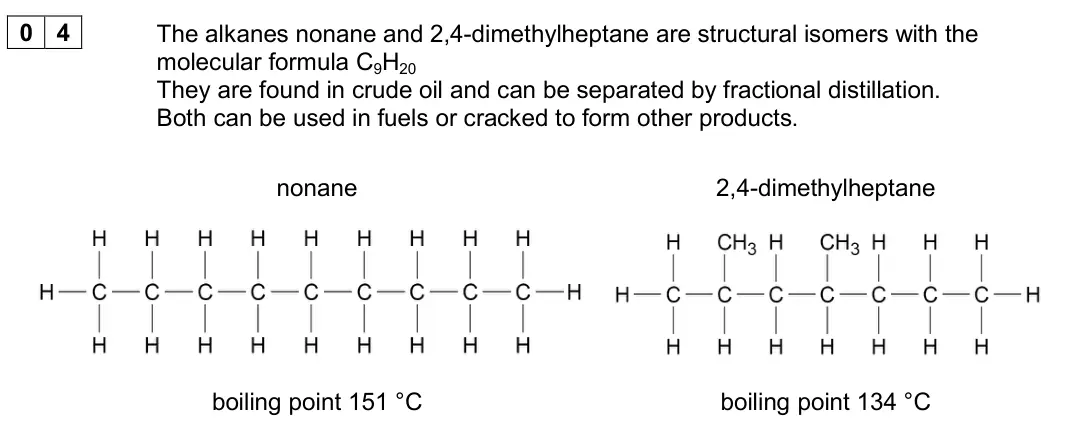
- Your answer
Q03.3
The whole paper ↗Q03.4
The whole paper ↗Q4(b)(ii)
The whole paper ↗Q4(b)(iii)
The whole paper ↗Q6(d)(i)
The whole paper ↗
All 40 questions on Modification of alkanes by cracking, as a list
- June 2025, Paper 3, Q28 (1 mark): Alkanes are obtained from crude oil by fractional distillation. Which statement is correct? [1 mark] A Alkanes obtained are converted to alkenes by thermal crac
- June 2025, AS Paper 2, Q10 (1 mark): Which statement about catalytic cracking is correct? [1 mark] A A high percentage of alkenes is formed. B A pressure of about 70 MPa is used. C C–C bonds are br
- June 2024, Paper 2, Q03.1 (2 marks): Eicosane (C20H42) can be cracked by heating to 700 K in the presence of a catalyst. The products are • an aromatic hydrocarbon C8H10 • an alkane C6H14 • another
- June 2024, Paper 2, Q03.3 (1 mark): Cracking can also be done without a catalyst, using a temperature of 1200 K and a pressure of 7000 kPa State the type of product that is formed in high percenta
- June 2024, AS Paper 2, Q16 (1 mark): Octadecane is a straight-chain alkane containing 18 carbon atoms per molecule. It is cracked to produce oct-1-ene and two other compounds. Which equation repres
- June 2023, AS Paper 2, Q02.2 (1 mark): Petrol for cars contains branched and cyclic alkanes produced by catalytic cracking. Identify the catalyst used in this process. [1 mark]
- June 2022, Paper 3, Q05.1 (2 marks): Zeolites are used as heterogeneous catalysts in the catalytic cracking of alkanes. Tetradecane (C14H30) can be cracked to form octane and a cycloalkane. Give an
- June 2022, AS Paper 2, Q08 (1 mark): When hexadecane (C16H34) is heated to a high temperature, one molecule of hexadecane decomposes to form an alkane containing eight carbon atoms and two differen
- November 2021, Paper 2, Q02.2 (3 marks): Hexadecane (C16H34) can be cracked at high temperature to form petrol. Complete the equation to show the cracking of one molecule of hexadecane to form hexane a
- November 2021, AS Paper 2, Q05.1 (6 marks): The three key steps in the manufacture of poly(propene) from crude oil are shown. Naphtha is a mixture of alkanes with 6 to 12 carbon atoms per molecule. For ea
- November 2020, AS Paper 2, Q09 (1 mark): Which statement is correct about thermal cracking? [1 mark] A A pressure between 100 and 200 kPa is used. B Aromatic hydrocarbons are the major products. C C–C
- June 2018, Paper 2, Q01.2 (3 marks): Heptane can be obtained from the catalytic cracking of hexadecane (C16H34) at a high temperature. Identify a suitable catalyst for this process. Give one condit
- June 2018, AS Paper 2, Q04.5 (1 mark): Nonane can be cracked to form large quantities of propene. Name the type of cracking used. [1 mark]
- June 2017, Paper 3, Q08 (1 mark): The table shows possible conditions and products for the cracking of alkanes. Which row is correct? [1 mark] Type of cracking Conditions Products A Thermal High
- June 2016, AS Paper 2, Q17 (1 mark): Tetradecane (C14H30) is an alkane found in crude oil. When tetradecane is heated to a high temperature, one molecule of tetradecane decomposes to form one molec
- Specimen, Paper 2, Q03.3 (1 mark): Isooctane can be formed, together with propene and ethene, in a reaction in which one molecule of an alkane that contains 20 carbon atoms is cracked. Using mole
- Specimen, Paper 2, Q03.4 (1 mark): How do the products of the reaction in Question 3.3 show that the reaction is an example of thermal cracking? [1 mark] 0 3 . 4
- June 2016, CHEM1 (old spec), Q4(b)(ii) (1 mark): One molecule of an alkane is cracked to produce one molecule of compound X, one molecule of octane and one molecule of ethene. Deduce the molecular formula of t
- June 2016, CHEM1 (old spec), Q4(b)(iii) (2 marks): Name the type of cracking that produces a high yield of compound X. Give two conditions required for this process. [2 marks] Type of cracking Conditions
- June 2015, CHEM1 (old spec), Q6(d)(i) (1 mark): Write an equation to show this cracking reaction. [1 mark]
- June 2014, CHEM1 (old spec), Q5(d)(ii) (3 marks): Write an equation for the cracking of one molecule of dodecane into equal amounts of two different molecules each containing the same number of carbon atoms. St
- June 2013, CHEM1 (old spec), Q2(c)(i) (1 mark): Deduce the molecular formula of Y. (1 mark)
- January 2013, CHEM1 (old spec), Q4(h)(i) (1 mark): Deduce the molecular formula of Z. (1 mark)
- January 2013, CHEM1 (old spec), Q4(h)(ii) (2 marks): State the type of cracking that produces a high proportion of ethene and propene. Give the two conditions for this cracking process. Type of cracking Conditions
- June 2012, CHEM1 (old spec), Q2(c)(i) (1 mark): Write an equation for this reaction. (1 mark)
- June 2012, CHEM1 (old spec), Q2(c)(ii) (2 marks): State the name of the process used to obtain a high yield of X from C15H32 Give one reason why this process is used in industry. Name Reason (2 marks)
- June 2012, CHEM1 (old spec), Q2(c)(iii) (1 mark): State why high temperatures are needed for this process. (1 mark)
- January 2012, CHEM1 (old spec), Q3(c)(i) (1 mark): Deduce the molecular formula of X. (1 mark)
- January 2012, CHEM1 (old spec), Q3(c)(ii) (2 marks): State the type of cracking that produces a high percentage of alkenes. State the conditions needed for this type of cracking. Type of cracking Conditions (2 mar
- January 2012, CHEM1 (old spec), Q3(c)(iii) (1 mark): Explain the main economic reason why alkanes are cracked. (1 mark)
- June 2011, CHEM1 (old spec), Q7(c) (3 marks): A molecule of hydrocarbon Y can be thermally cracked to form one molecule of pentane and two molecules of ethene only. Deduce the molecular formula of Y. State
- January 2011, CHEM1 (old spec), Q4(d)(i) (1 mark): State one condition that is used in this cracking reaction. (1 mark)
- January 2011, CHEM1 (old spec), Q4(d)(ii) (1 mark): Write an equation to show how one molecule of cetane can be cracked to form hexane, butene and ethene. (1 mark)
- June 2010, CHEM1 (old spec), Q6(c) (2 marks): The cracking of one molecule of compound X produces pent-1-ene, ethene and butane in a 1:2:1 mol ratio. Deduce the molecular formula of X and state a use for th
- January 2010, CHEM1 (old spec), Q4(d)(i) (1 mark): Write an equation for this cracking reaction. (1 mark)
- January 2010, CHEM1 (old spec), Q4(d)(ii) (1 mark): Suggest a type of compound that can be manufactured from the other product of this cracking reaction. (1 mark)
- January 2010, CHEM1 (old spec), Q4(d)(iii) (1 mark): State why a high temperature is needed for cracking reactions to occur. (1 mark)
- January 2009, CHEM1 (old spec), Q6(c) (4 marks): 6 (c) C8H18 is obtained by the catalytic cracking of suitable heavy fractions. State what is meant by the term cracking and name the catalyst used in catalytic
- June 2008, CHM3W (2008 spec), Q6(b) (3 marks): 6 (b) Give the name of the process by which ethene is produced from the naphtha fraction. Give one essential condition for this process and name the type of rea
- January 2008, CHM3W (2008 spec), Q4(c) (2 marks): (c) Write an equation for the catalytic cracking of dodecane (C12H26) to form cyclohexane and one other alkane. Identify the catalyst used in this reaction. Equ
Questions, mark schemes and examiner’s reports are © AQA, from their published past papers. Plumi isn’t affiliated with any exam board. Want whole papers? AQA A-Level Chemistry past papers.
The Plumi iPad app also offers exam-style questions with AI feedback on your handwritten working.