 plumi
Thermal physics: OxfordAQA International A Level Physics questions
OxfordAQA International A Level Physics past-paper questions on 3.11 Thermal physics, Official specimen papers for Units 1–5, with mark schemes and examiner’s reports where available.
Past paper difficulty
Paper
All papers
Exam
All years
Calculations
Loading the full question list…
Q01.1
The whole paper ↗Q01.2
The whole paper ↗Q01.3
The whole paper ↗Q01.4
The whole paper ↗Q01.5
The whole paper ↗Q04.1
The whole paper ↗Q04.2
The whole paper ↗Q04.3
The whole paper ↗Q06.1
The whole paper ↗Q06.2
The whole paper ↗Q07.1
The whole paper ↗Q07.2
The whole paper ↗Q07.3
The whole paper ↗Q07.4
The whole paper ↗Q08.1
The whole paper ↗Q08.2
The whole paper ↗



All 26 questions on Thermal physics, as a list
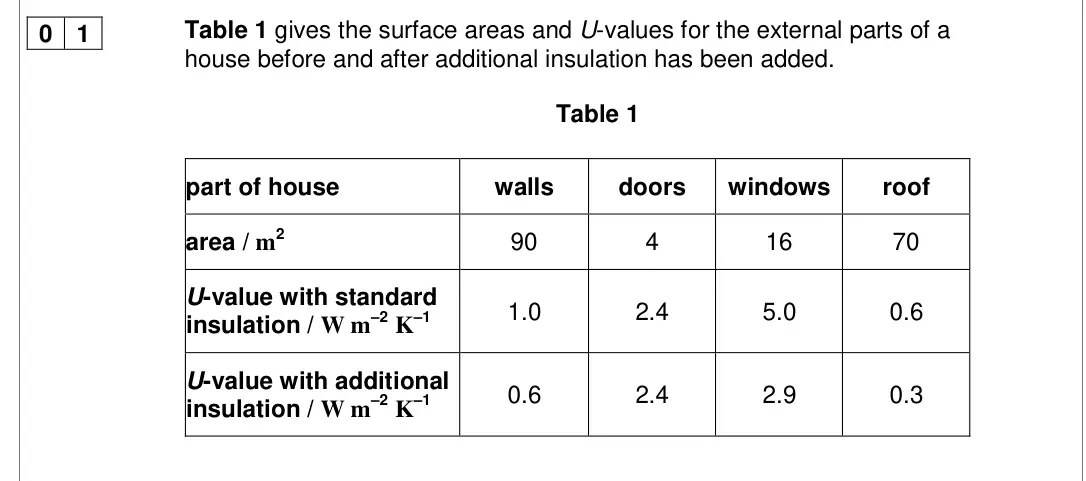
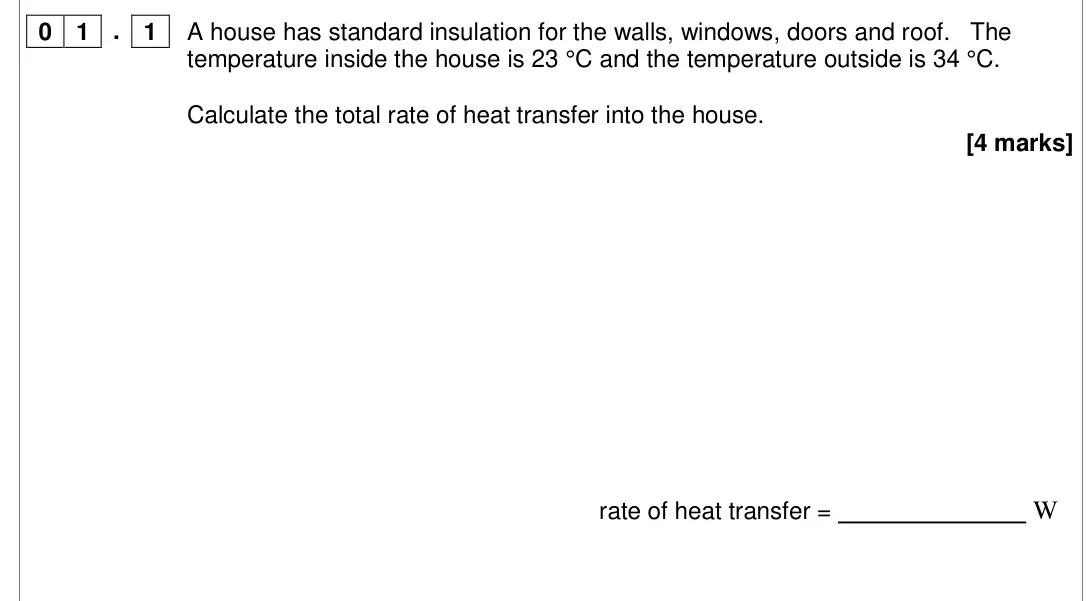
- Specimen, Unit 4, Q01.1 (4 marks): Table 1 gives the surface areas and U-values for the external parts of a house before and after additional insulation has been added. Table 1 part of house walls doors windows roof
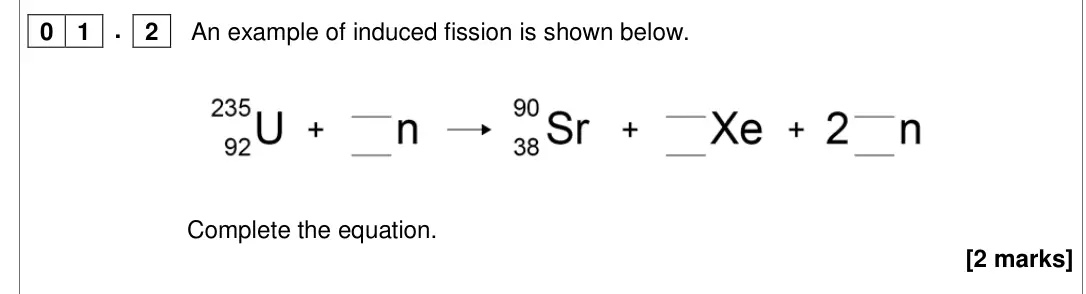
- Specimen, Unit 4, Q01.2 (2 marks): Table 1 gives the surface areas and U-values for the external parts of a house before and after additional insulation has been added. Table 1 part of house walls doors windows roof
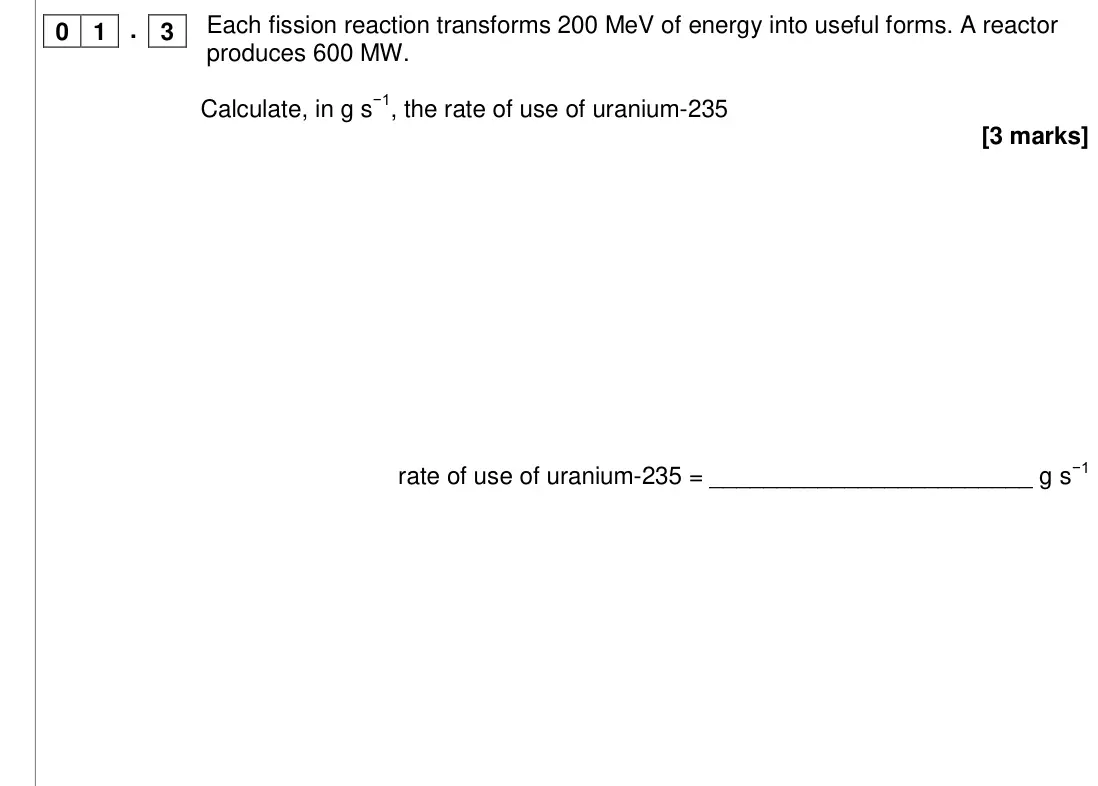
- Specimen, Unit 4, Q01.3 (3 marks): Table 1 gives the surface areas and U-values for the external parts of a house before and after additional insulation has been added. Table 1 part of house walls doors windows roof
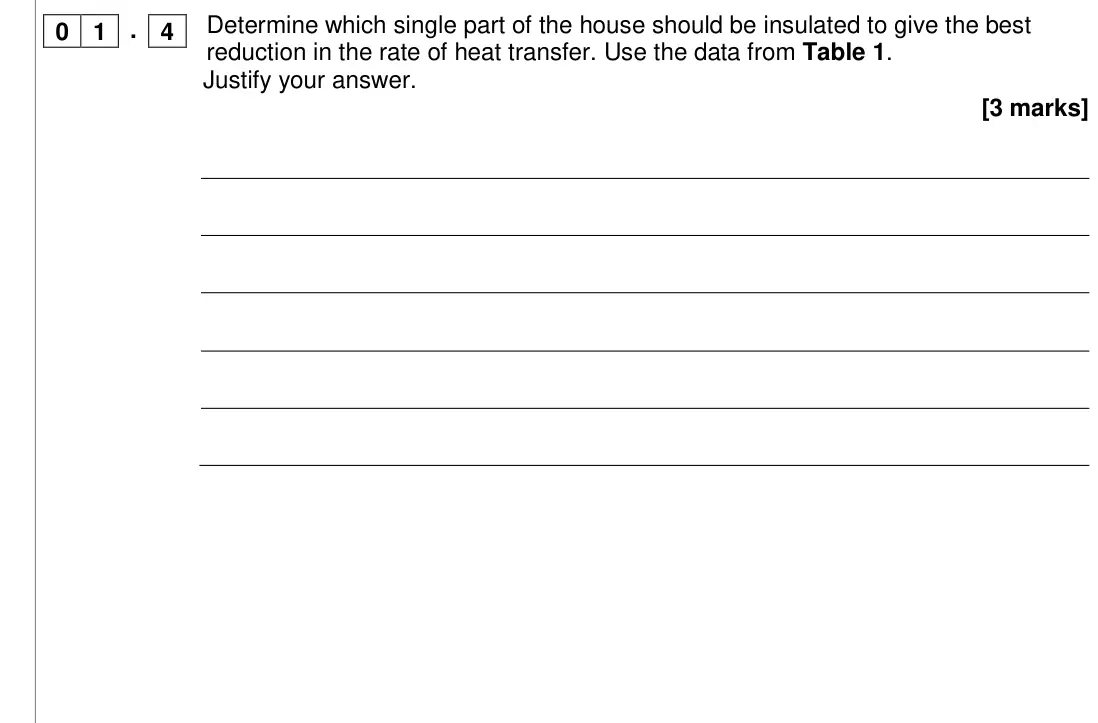
- Specimen, Unit 4, Q01.4 (3 marks): Table 1 gives the surface areas and U-values for the external parts of a house before and after additional insulation has been added. Table 1 part of house walls doors windows roof
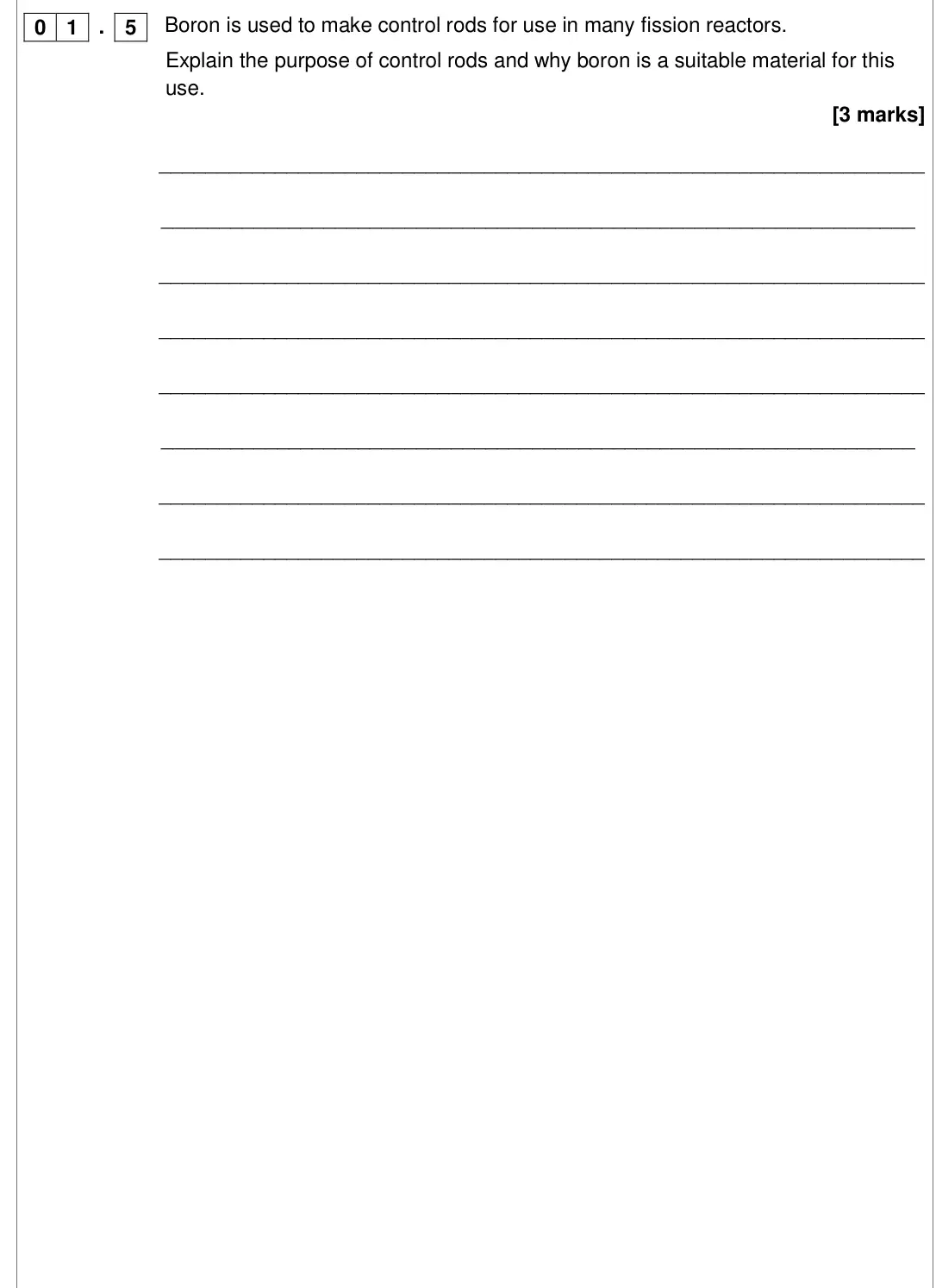
- Specimen, Unit 4, Q01.5 (3 marks): Table 1 gives the surface areas and U-values for the external parts of a house before and after additional insulation has been added. Table 1 part of house walls doors windows roof
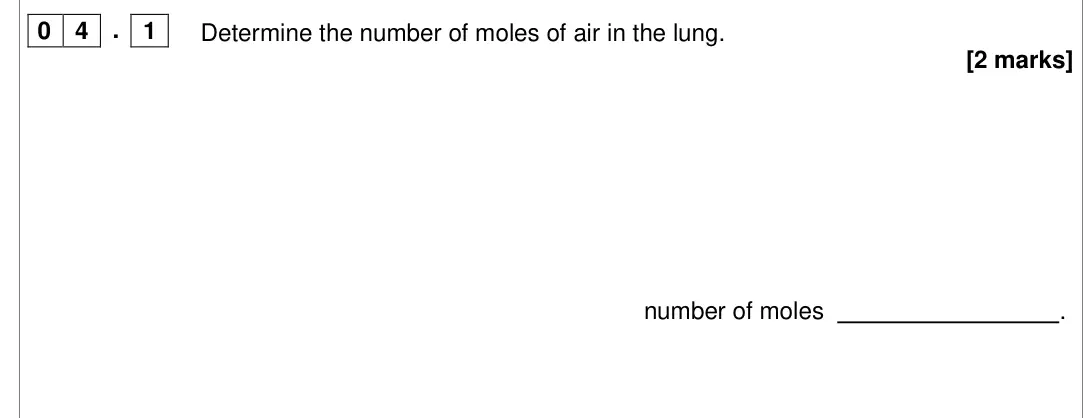
- Specimen, Unit 4, Q04.1 (2 marks): The volume of air in a fully expanded human lung is 2.5 × 10⁻³ m3. The pressure of the air in the lung is 1.0 × 10⁵ Pa and its temperature is 37 °C. 0 4 Determine the number of mol
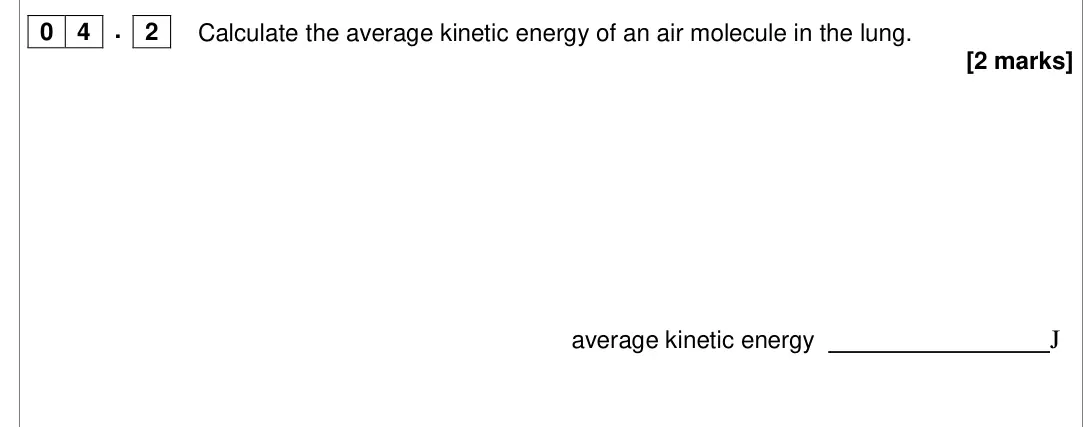
- Specimen, Unit 4, Q04.2 (2 marks): The volume of air in a fully expanded human lung is 2.5 × 10⁻³ m3. The pressure of the air in the lung is 1.0 × 10⁵ Pa and its temperature is 37 °C. 0 4 Calculate the average kinet
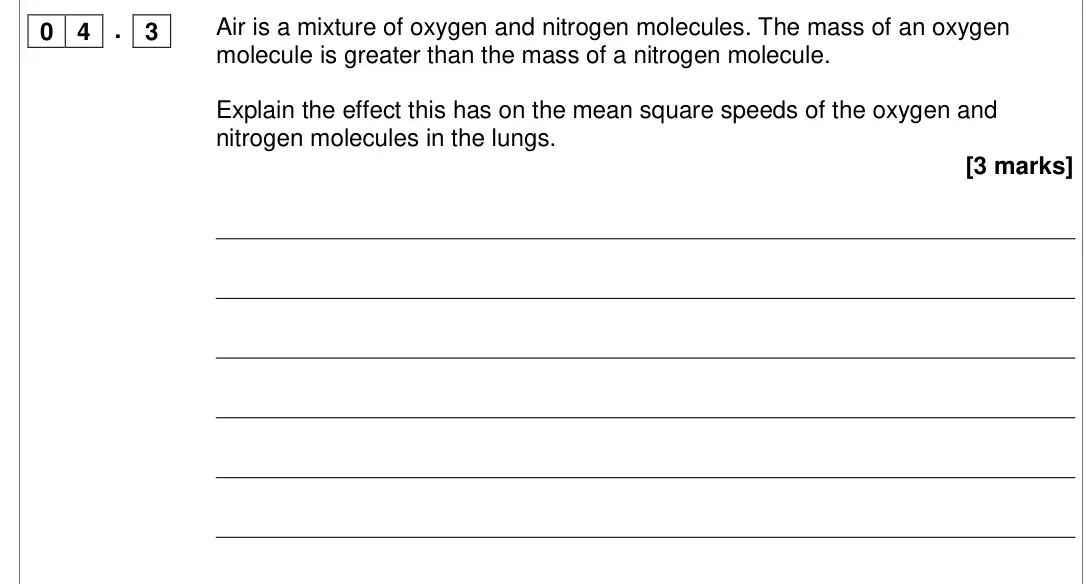
- Specimen, Unit 4, Q04.3 (3 marks): The volume of air in a fully expanded human lung is 2.5 × 10⁻³ m3. The pressure of the air in the lung is 1.0 × 10⁵ Pa and its temperature is 37 °C. 0 4 Air is a mixture of oxygen
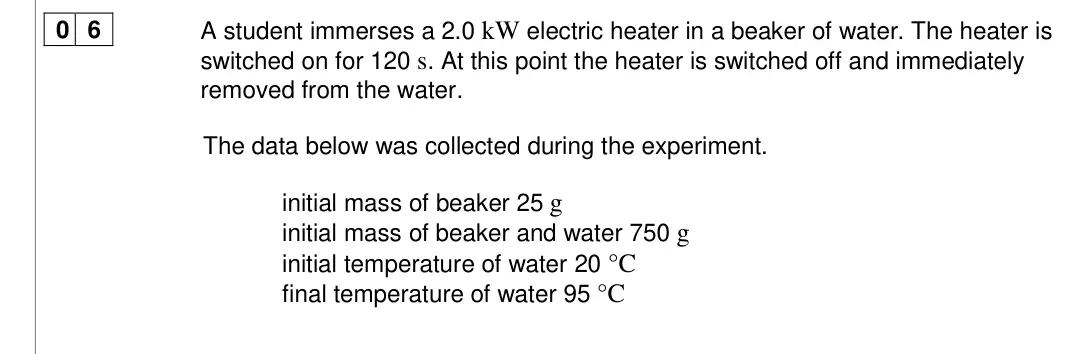
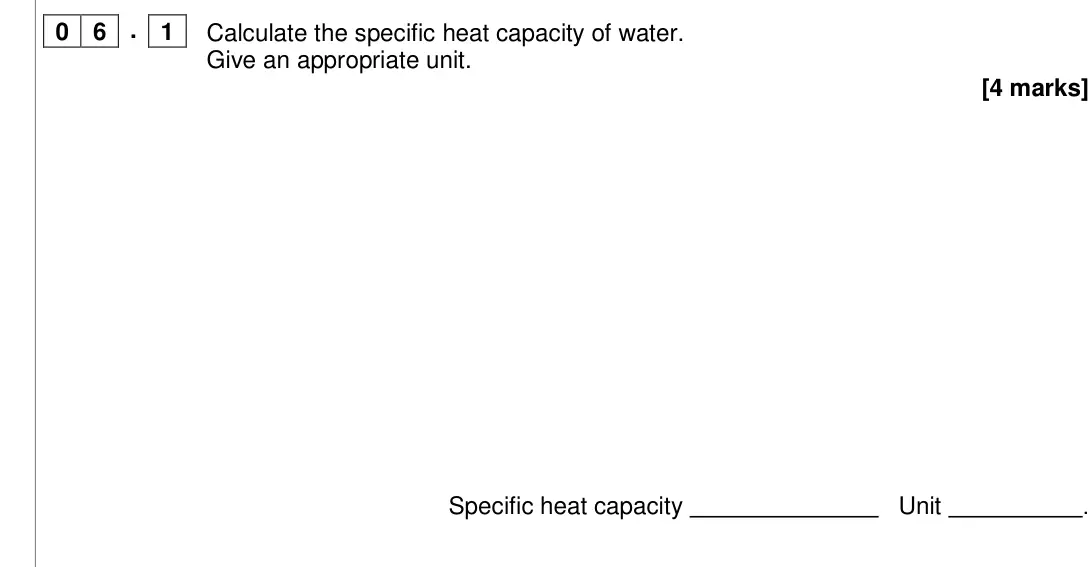
- Specimen, Unit 4, Q06.1 (4 marks): A student immerses a 2.0 kW electric heater in a beaker of water. The heater is switched on for 120 s. At this point the heater is switched off and immediately removed from the wat
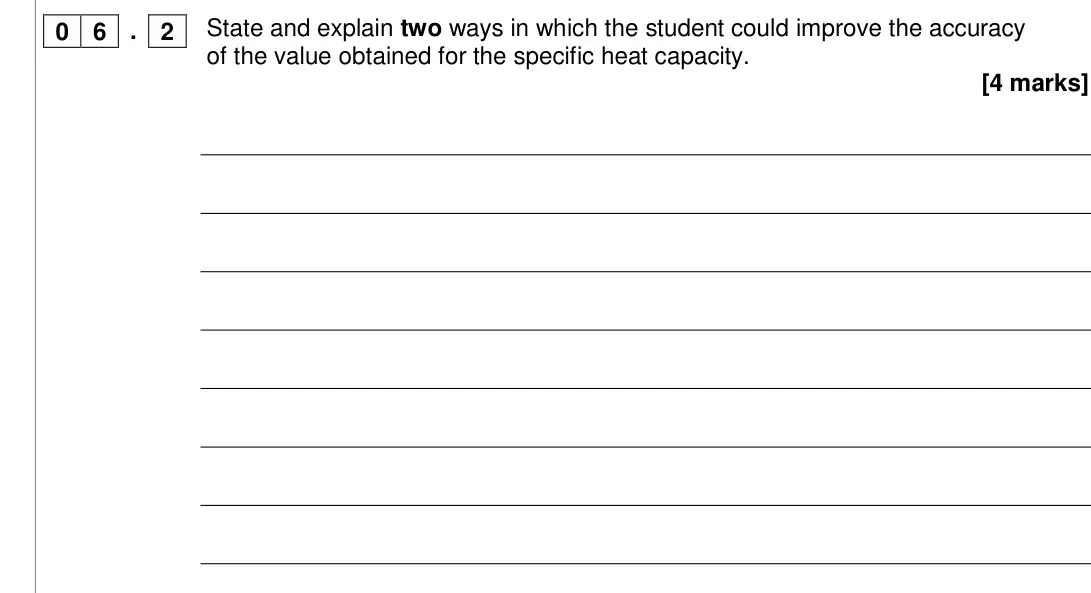
- Specimen, Unit 4, Q06.2 (4 marks): A student immerses a 2.0 kW electric heater in a beaker of water. The heater is switched on for 120 s. At this point the heater is switched off and immediately removed from the wat
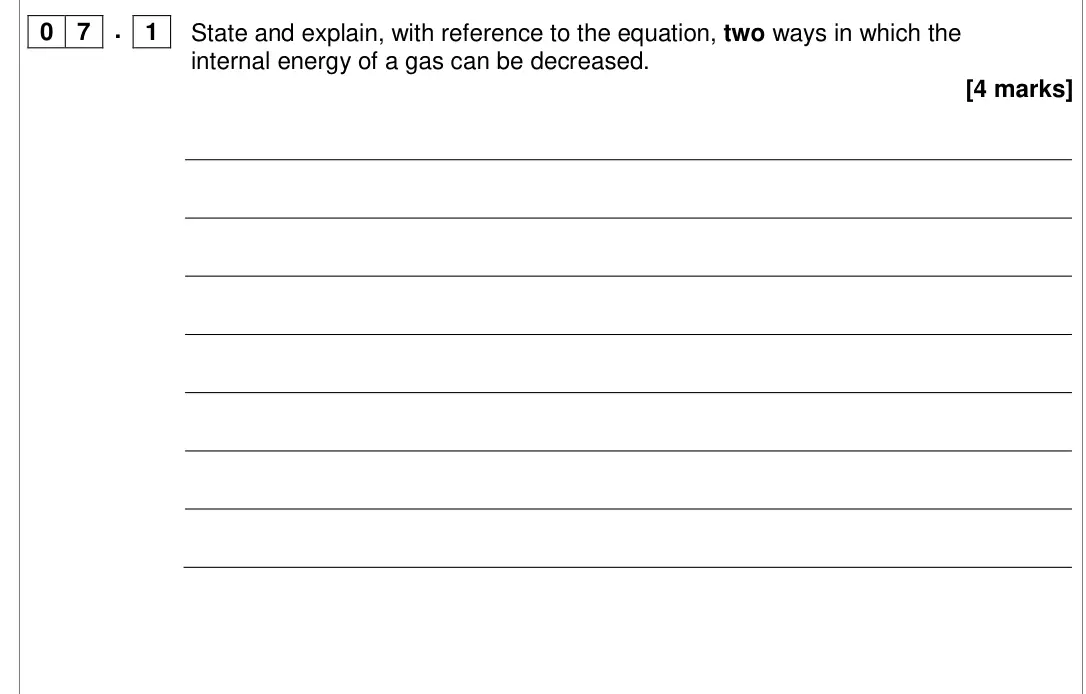
- Specimen, Unit 4, Q07.1 (4 marks): The first law of thermodynamics can be represented by ΔU = Q + W. 0 7 State and explain, with reference to the equation, two ways in which the internal energy of a gas can be decre
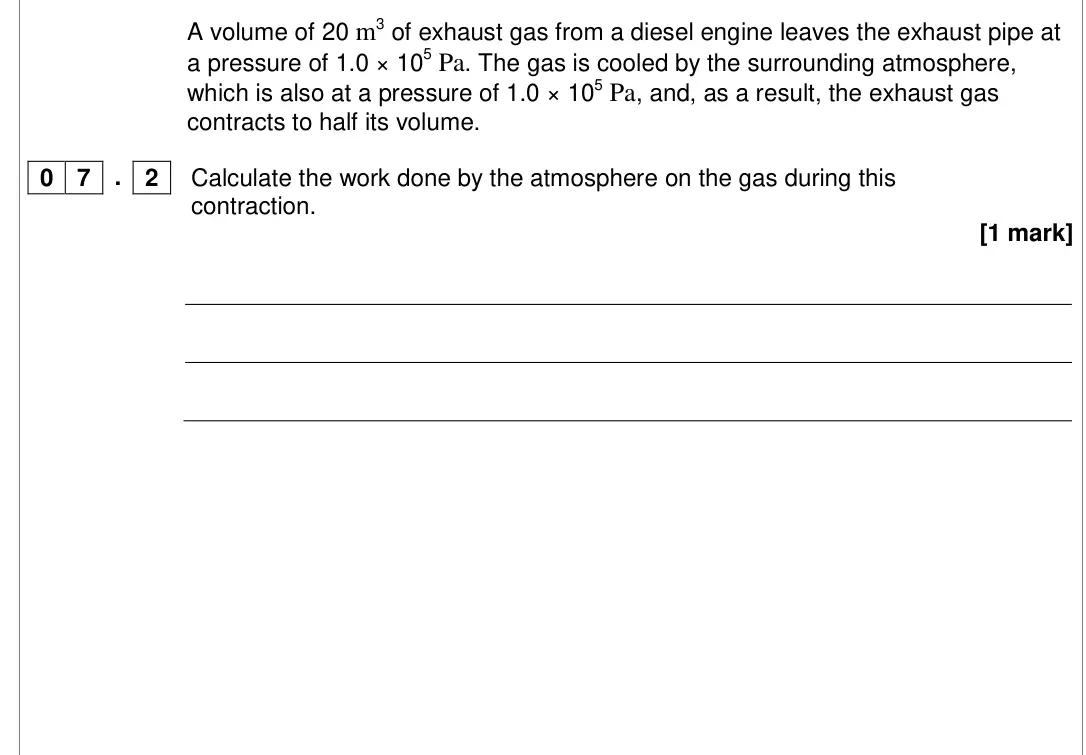
- Specimen, Unit 4, Q07.2 (1 mark): The first law of thermodynamics can be represented by ΔU = Q + W. 0 7 A volume of 20 m3 of exhaust gas from a diesel engine leaves the exhaust pipe at a pressure of 1.0 × 10⁵ Pa. T
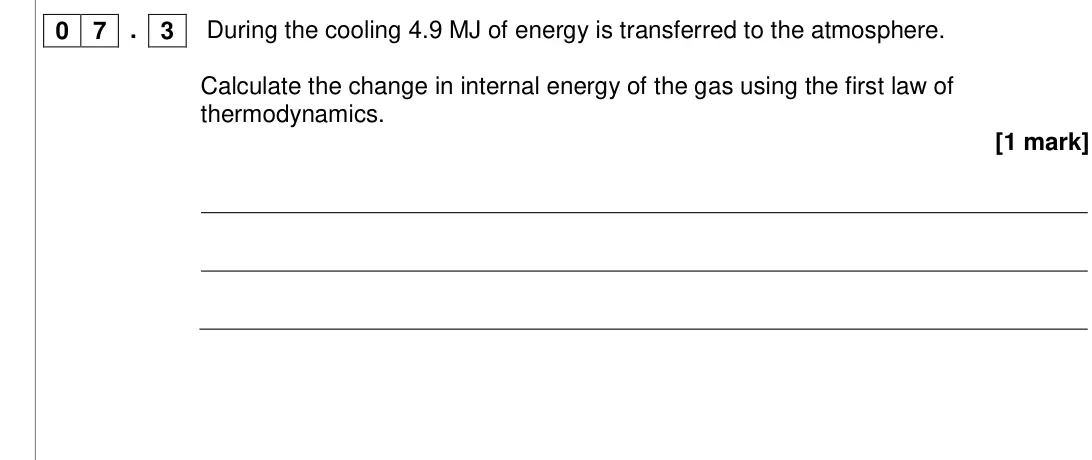
- Specimen, Unit 4, Q07.3 (1 mark): The first law of thermodynamics can be represented by ΔU = Q + W. 0 7 During the cooling 4.9 MJ of energy is transferred to the atmosphere. Calculate the change in internal energy
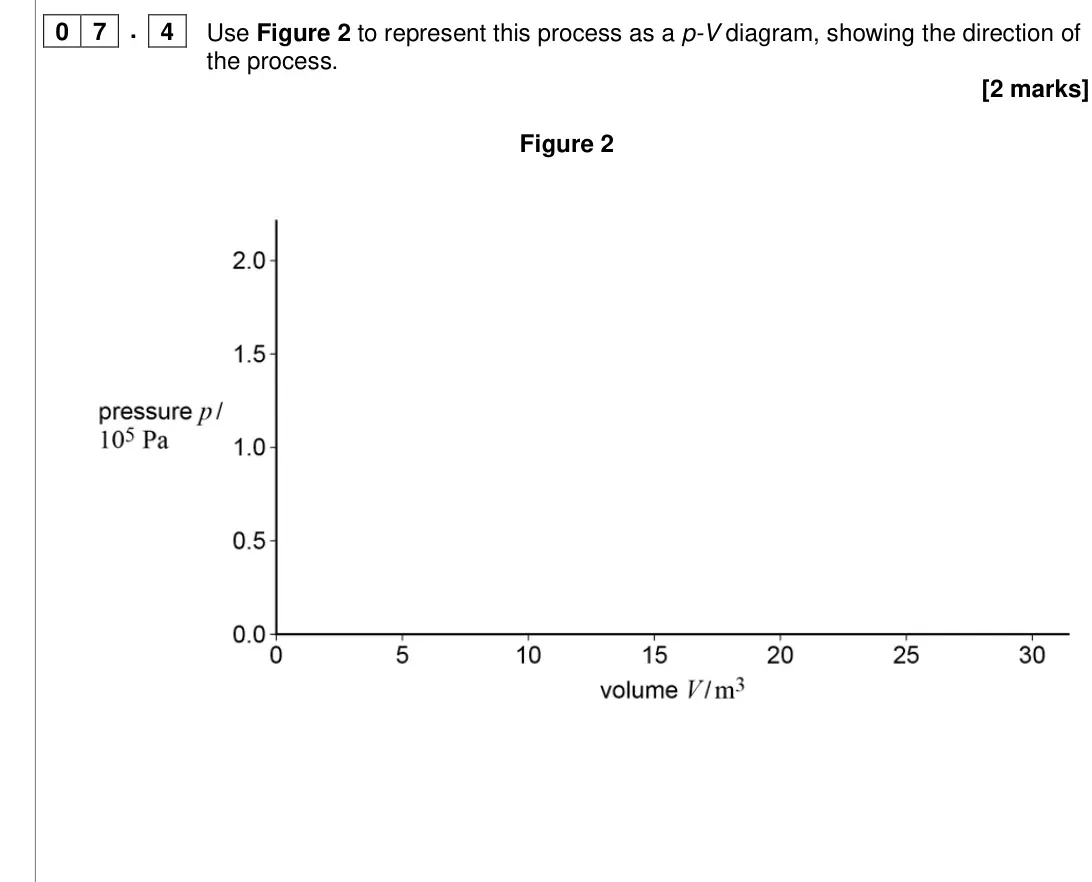
- Specimen, Unit 4, Q07.4 (2 marks): The first law of thermodynamics can be represented by ΔU = Q + W. 0 7 Use Figure 2 to represent this process as a p-V diagram, showing the direction of the process. [2 marks] Figur
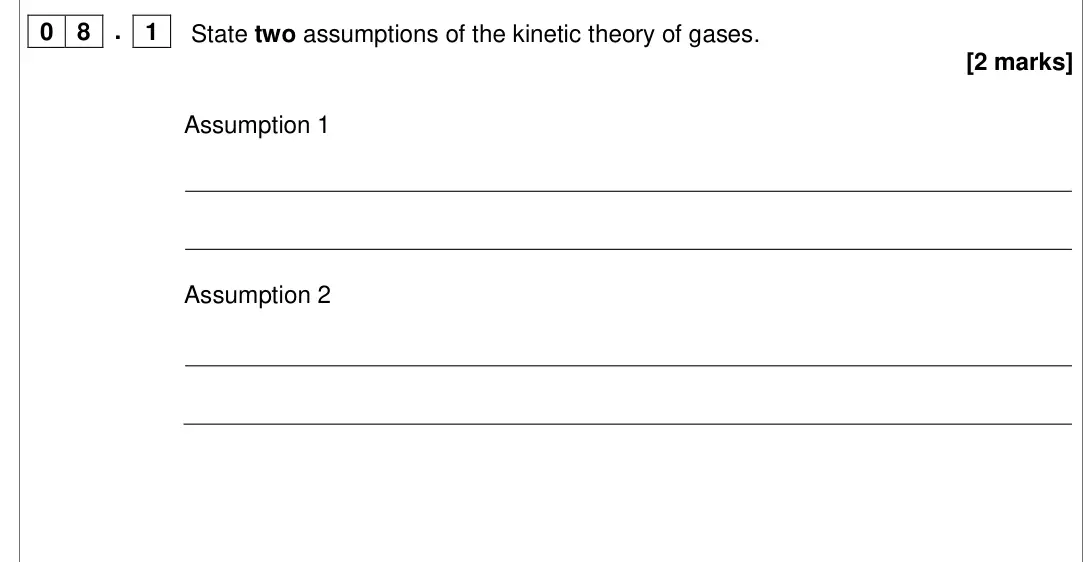
- Specimen, Unit 4, Q08.1 (2 marks): This question is about the kinetic theory of gases. 0 8 State two assumptions of the kinetic theory of gases. [2 marks] 0 8 . 1 Assumption 1 Assumption 2
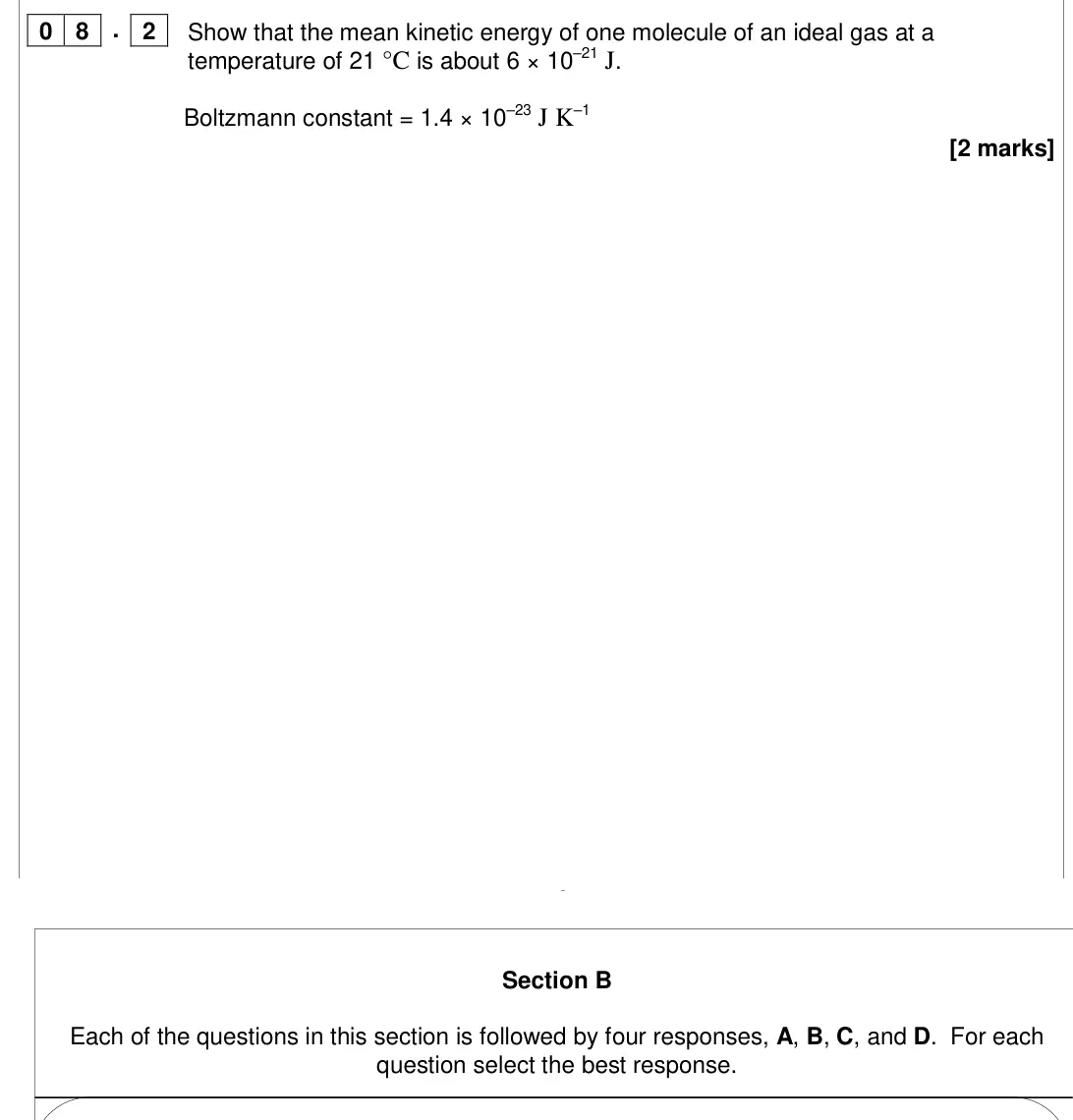
- Specimen, Unit 4, Q08.2 (2 marks): This question is about the kinetic theory of gases. 0 8 Show that the mean kinetic energy of one molecule of an ideal gas at a temperature of 21 °C is about 6 × 10–21 J. Boltzmann
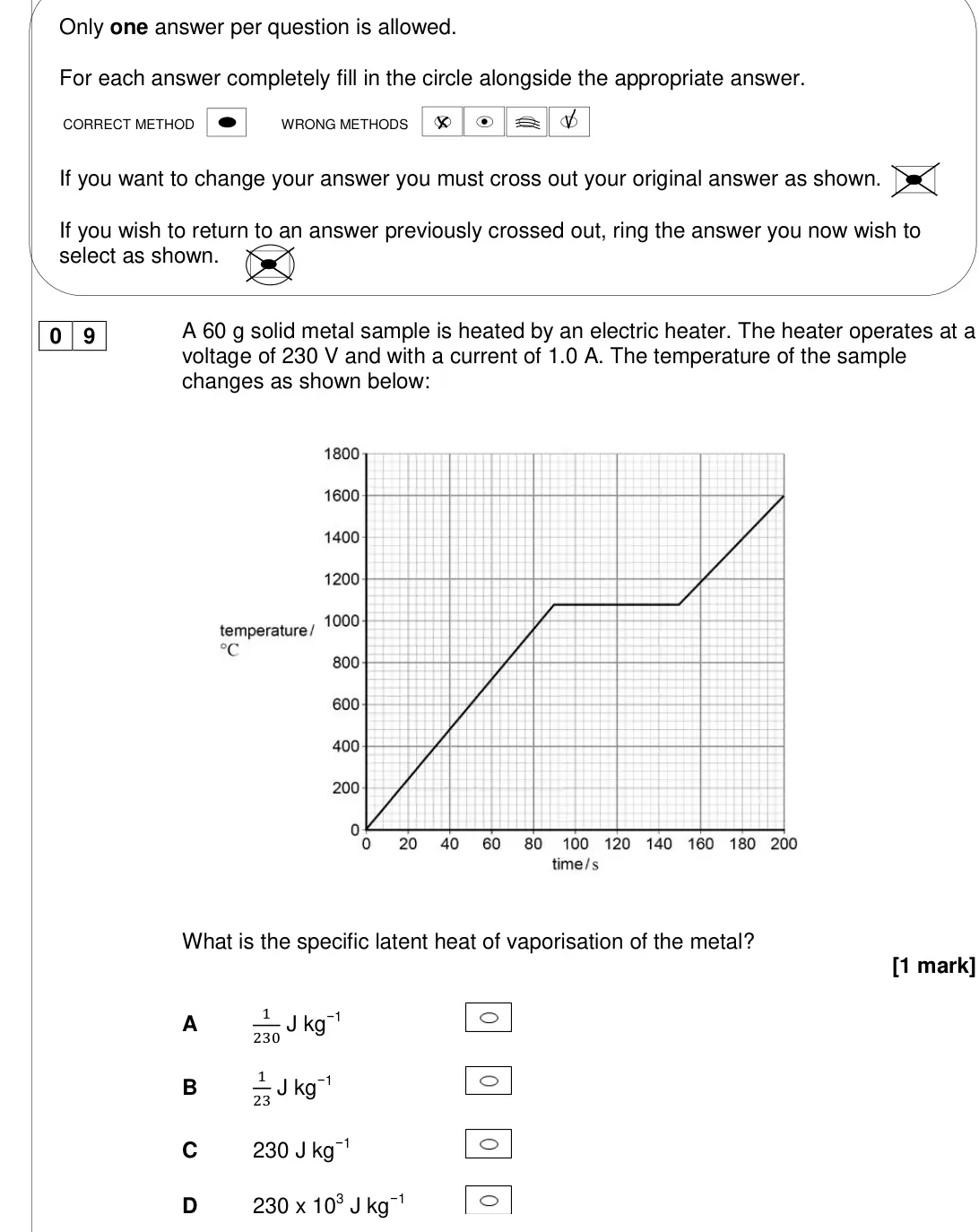
- Specimen, Unit 4, Q09 (1 mark): Only one answer per question is allowed. For each answer completely fill in the circle alongside the appropriate answer. If you want to change your answer you must cross out your o
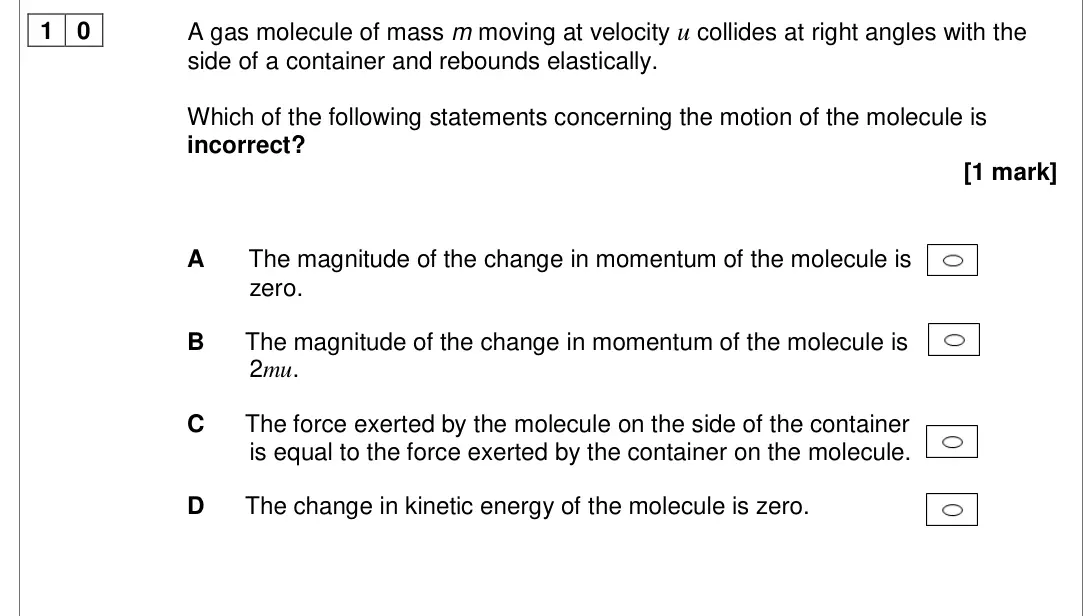
- Specimen, Unit 4, Q10 (1 mark): A gas molecule of mass m moving at velocity u collides at right angles with the side of a container and rebounds elastically. Which of the following statements concerning the motio
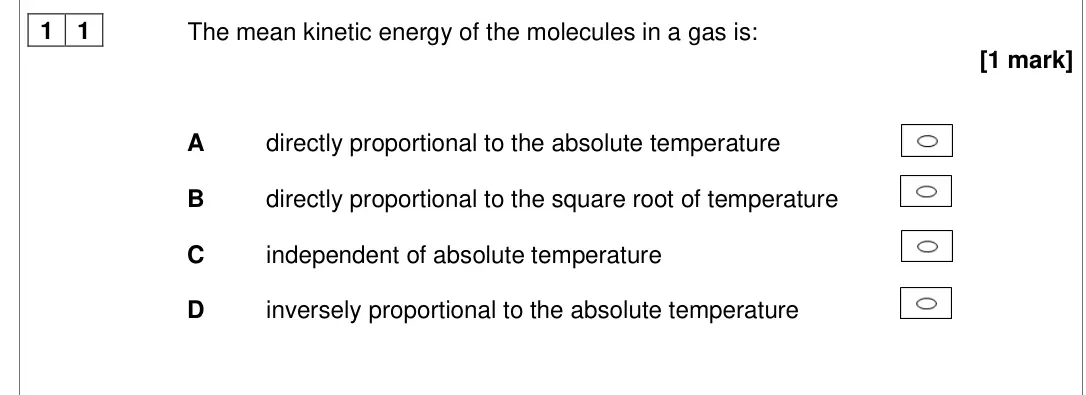
- Specimen, Unit 4, Q11 (1 mark): The mean kinetic energy of the molecules in a gas is: [1 mark] A directly proportional to the absolute temperature B directly proportional to the square root of temperature C indep
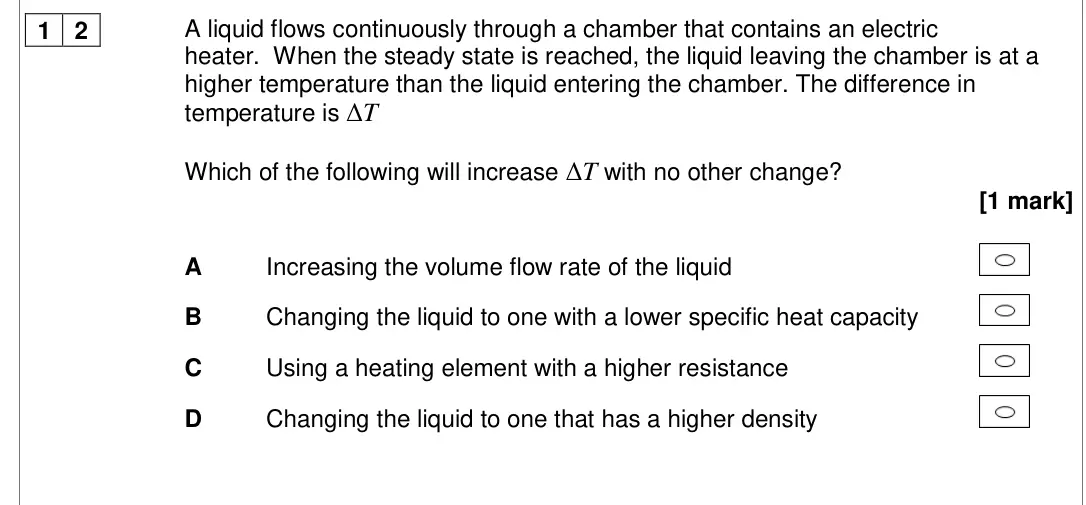
- Specimen, Unit 4, Q12 (1 mark): A liquid flows continuously through a chamber that contains an electric heater. When the steady state is reached, the liquid leaving the chamber is at a higher temperature than the
- Specimen, Unit 4, Q13 (1 mark): The temperature of a hot liquid in a container falls at a rate of 2 K per minute just before it begins to solidify. The temperature then remains steady for 20 minutes by which time
- Specimen, Unit 4, Q14 (1 mark): A fixed mass of gas occupies a volume V. The temperature of the gas increases so that the root mean square velocity of the gas molecules is doubled. What will the new volume be if
- Specimen, Unit 4, Q17 (1 mark): A perfect gas at 27 °C is heated at constant pressure so as to double its volume. What is the increase in temperature of the gas? [1 mark] A 54 °C B 300 °C C 327 °C D 600 °C 1 7
- Specimen, Unit 4, Q18 (1 mark): n moles of an ideal gas is at pressure P. What is the pressure of 4n moles of the same gas at three times the temperature and half the volume? [1 mark] A P/6 B 6P C 12P D 24P 1 8
- Specimen, Unit 4, Q19 (1 mark): X and Y are two gas bottles that are connected by a tube that has negligible volume compared with the volume of each bottle. Initially the valve W is closed. X has a volume 2V and
- Specimen, Unit 4, Q20 (1 mark): A spherical balloon, of radius 12 cm, is filled with helium at a pressure of 14 kPa. The balloon is released from the surface of the earth and travels to a height of 1500 m. The gr
Questions, mark schemes and examiner’s reports are © OxfordAQA, from their published past papers. Plumi isn’t affiliated with any exam board. Want whole papers? OxfordAQA International A Level Physics past papers.
The Plumi iPad app also offers exam-style questions with AI feedback on your handwritten working.