 plumi
Percentage yield and atom economy: OCR A‑Level Chemistry A questions
OCR A-Level Chemistry A past-paper questions on 2.1.3.6 Percentage yield and atom economy, 2016–2025, with mark schemes and examiner’s reports where available.
Paper
All papers
Exam
All years
Calculations
- Your answer
Q5(a)(ii)
The whole paper ↗
- Your answer
Q5(c)
The whole paper ↗
- Your answer
Q23(c)
The whole paper ↗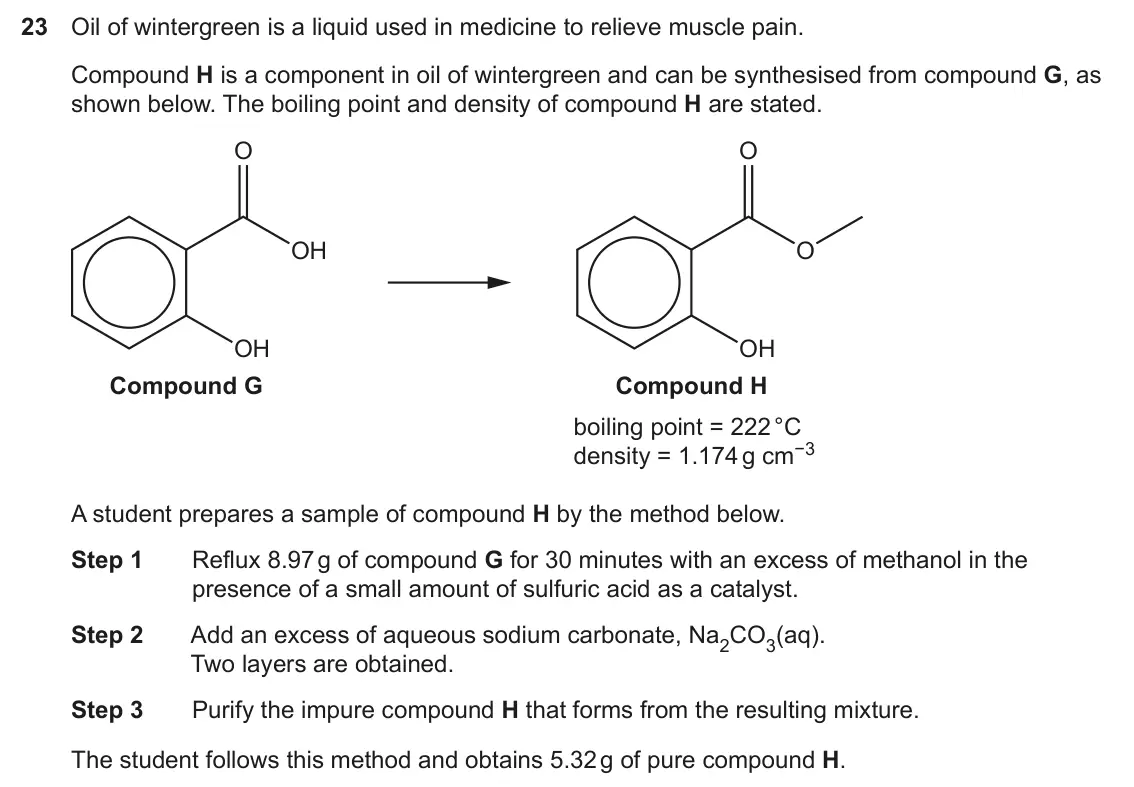
Q18(b)
The whole paper ↗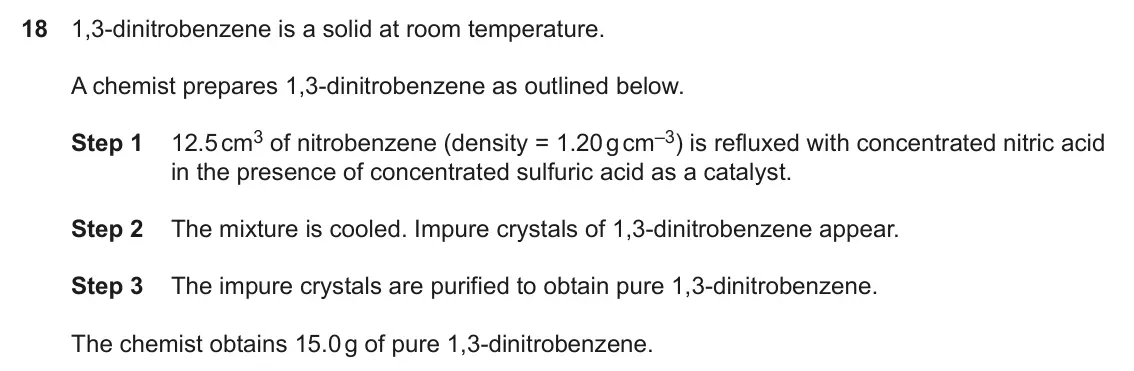
- Your answer
Q1(b)(ii)
The whole paper ↗
- Your answer
Q3(a)
The whole paper ↗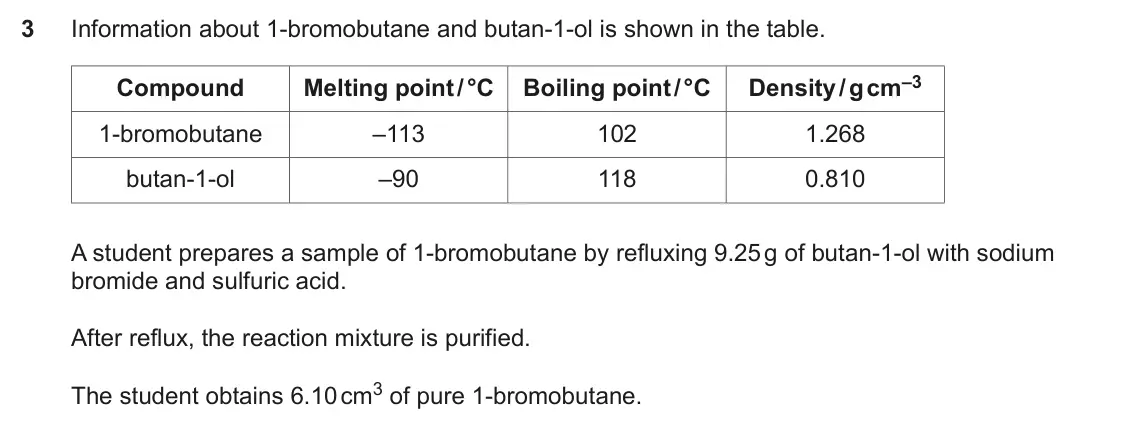
Q5(b)
The whole paper ↗
Q5(c)(i)
The whole paper ↗Q7(b)
The whole paper ↗
Q20(a)
The whole paper ↗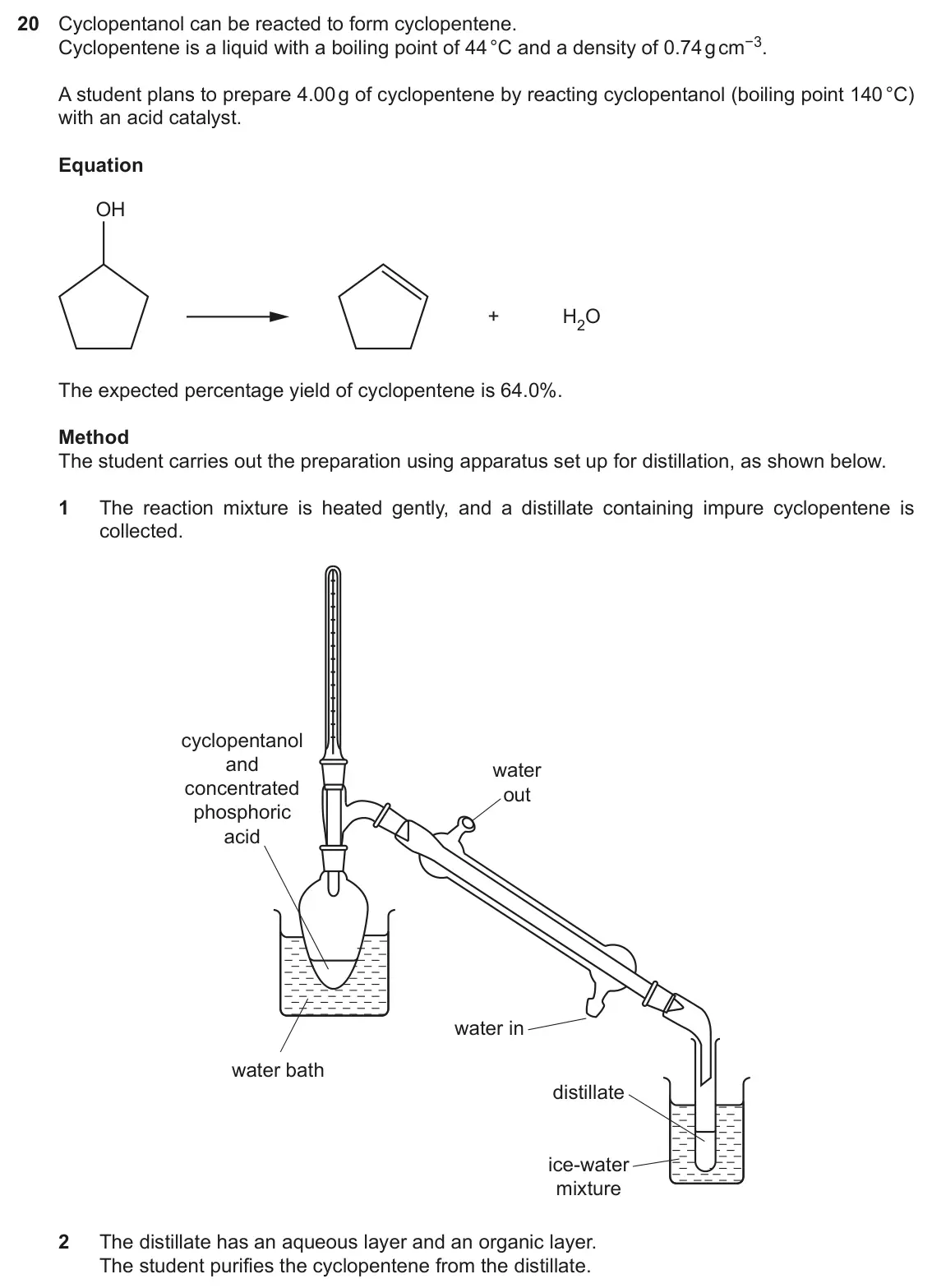
- Your answer
Q5(d)(i)
The whole paper ↗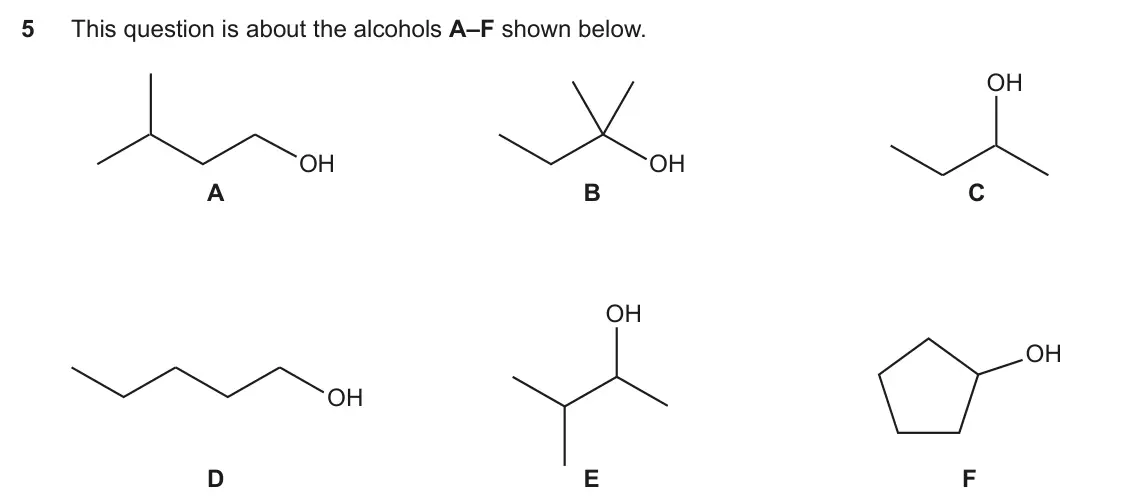
- Your answer
Q18(e)(i)
The whole paper ↗
Q2(d)
The whole paper ↗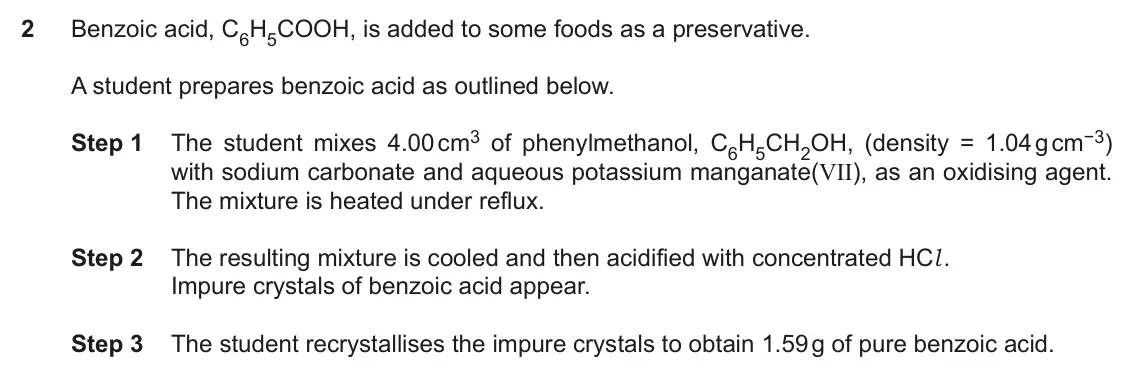
All 30 questions on Percentage yield and atom economy, as a list
- June 2025, Paper 2, Q6 (1 mark): Propene can be prepared using the reactions shown. Which reaction has the lowest atom economy? A C3H7Br C3H6 + HBr B C12H26 2C3H6 + C6H14 C C8H18 C3H6 + C5H12 D
- June 2025, Paper 3, Q5(a)(ii) (4 marks): Calculate the mass of LiAl H4 that the student should use in Step 2 and the percentage yield of pure C6H5CH2OH obtained in Step 4. Give the mass of LiAl H4 and
- June 2025, AS Paper 1, Q4 (1 mark): Which reaction to extract iron (Fe) has the highest atom economy? A 2Al + Fe2O3 2Fe + Al 2O3 B FeO + CO Fe + CO2 C Fe2O3 + 3CO 2Fe + 3CO2 D 2Fe2O3 + 3C 4Fe + 3C
- June 2025, AS Paper 2, Q5(c) (6 marks): This question is about haloalkanes. (c)* 2-Chlorobutane, CH3CH2CHCl CH3, is an organic liquid with a boiling point of 70 °C. A student prepares 2-chlorobutane f
- June 2024, Paper 1, Q3 (1 mark): Which chemical process is the most sustainable in terms of the atom economy of the iron produced? A Fe2O3 + 3CO 2Fe + 3CO2 B Fe2O3 + 3H2 2Fe + 3H2O C 2Fe2O3 4Fe
- June 2024, Paper 2, Q23(c) (3 marks): Calculate the percentage yield of compound H. Give your answer to three significant figures. percentage yield = % [3]
- June 2023, Paper 2, Q18(b) (3 marks): Determine the percentage yield of 1,3-dinitrobenzene. Give your answer to 3 significant figures. percentage yield = % [3]
- June 2023, AS Paper 1, Q3 (1 mark): Hydrogen can be prepared industrially by the reaction of methane with steam. The equation is shown below. CH4(g) + 2H2O(g) 4H2(g) + CO2(g) What is the atom econ
- June 2023, AS Paper 2, Q1(b)(ii) (4 marks): In Reaction 1.2, the percentage yield of titanium from TiCl4 is 72.0%. Calculate the minimum mass, in kg, of sodium that is needed to produce 1.00 kg of titaniu
- June 2022, Paper 2, Q6 (1 mark): Which process has the highest atom economy for preparing ethene, C2H4? In each process, assume that ethene is the only product that is used. A C10H22 3C2H4 + C4
- June 2022, Paper 3, Q3(a) (6 marks): Information about 1-bromobutane and butan-1-ol is shown in the table. Density / g cm–3 Compound Melting point / °C Boiling point / °C 1-bromobutane –113 102 1.2
- June 2022, AS Paper 2, Q5(b) (2 marks): 2-Bromobutane can also be prepared by reacting but-2-ene, CH3CH=CHCH3, with hydrogen bromide, HBr (Reaction 5.2). CH3CH=CHCH3 + HBr CH3CH2CHBrCH3 Reaction 5.2 E
- June 2022, AS Paper 2, Q5(c)(i) (3 marks): A student plans to prepare 10.0 g of 2-bromobutane using Reaction 5.3. The percentage yield is 67.0%. Calculate the mass of CH3CH2CHOHCH3 needed for this prepar
- November 2021, AS Paper 2, Q7(b) (6 marks): 2-Chloro-2-methylpropane, (CH3)3CCl , is an organic liquid with a boiling point of 50 °C. A student prepares (CH3)3CCl by reacting 2-methylpropan-2-ol, (CH3)3CO
- November 2020, Paper 2, Q20(a) (6 marks): Cyclopentanol can be reacted to form cyclopentene. Cyclopentene is a liquid with a boiling point of 44 °C and a density of 0.74 g cm−3. A student plans to prepa
- November 2020, AS Paper 1, Q18 (1 mark): A student reacts 24.24 g of 2-bromobutane in the reaction below. CH3CH2CHBrCH3 + NaOH → CH3CH2CHOHCH3 + NaBr Mr = 136.9 Mr = 74.0 The reaction produces 4.81 g o
- November 2020, AS Paper 2, Q5(d)(i) (2 marks): Calculate the atom economy for the preparation of alcohol A in equation 5.1. atom economy = % [2]
- June 2019, Paper 2, Q11 (1 mark): A student reacts 4.50 g of C6H5NH2 with excess CH3COCl in the reaction below. C6H5NH2 + CH3COCl → C6H5NHCOCH3 + HCl Mr = 93.0 Mr = 135.0 The reaction produces 3
- June 2019, Paper 2, Q18(e)(i) (6 marks): Plan a two-stage synthesis to prepare 12.75 g of ester C starting from 2-methylpropanal, (CH3)2CHCHO. Assume the overall percentage yield of ester C from 2-meth
- June 2019, Paper 3, Q2(d) (3 marks): Calculate the percentage yield of benzoic acid. Give your answer to 3 significant figures. percentage yield = % [3]
- June 2019, AS Paper 1, Q4 (1 mark): Which chemical process is the most sustainable in terms of the atom economy of the organic product? A CO2 + 3H2 → CH3OH + H2O B CH3CH2OH + NaCl + H2SO4 → CH3CH2
- June 2018, Paper 2, Q7 (1 mark): Ethanol can be prepared by different reactions. Which reaction has the lowest atom economy? A C6H12O6 → 2C2H5OH + 2CO2 B C2H4 + H2O → C2H5OH C C2H5Br + H2O → C2
- June 2018, Paper 3, Q4(b)(ii) (6 marks): This question is about two compounds used in medicine. (ii)* A chemist prepares a pure solid sample of paracetamol from 4-nitrophenol in two stages: H Stage 1 S
- June 2018, AS Paper 2, Q5(a)(ii) (2 marks): The student used 0.150 mol of butan-1-ol. The student obtained a 61.4% percentage yield of 1-bromobutane. Calculate the mass of 1-bromobutane obtained. Give you
- June 2017, Paper 1, Q7 (1 mark): Silicon can be made by heating silicon tetrachloride, SiCl 4, with zinc. SiCl 4 + 2Zn Si + 2ZnCl 2 8.50 g of SiCl 4 is reacted with an excess of zinc. The perce
- June 2017, Paper 2, Q5 (1 mark): Which type of reaction has the greatest atom economy? A Substitution B Hydrolysis C Elimination D Addition Your answer [1]
- June 2017, Paper 2, Q17(a)(ii) (6 marks): This question is about the chemistry of aromatic compounds. (ii)* A chemist carries out the reaction in Equation 17.1 using 4.97 g of benzoic acid. The chemist
- June 2017, AS Paper 1, Q4 (1 mark): Which reaction produces the smallest atom economy of BaCl2? A BaCl2•2H2O → BaCl2 + 2H2O B BaO + 2HCl → BaCl2 + H2O C BaCO3 + 2HCl → BaCl 2 + CO2 + H2O D Ba + 2H
- June 2017, AS Paper 2, Q6(a)(ii) (3 marks): The student carries out this synthesis and obtains 1.23 g of pure cyclohexene from 5.50 g of bromocyclohexane. Calculate the percentage yield of cyclohexene. Gi
- June 2016, AS Paper 2, Q6(d) (3 marks): 20.2 g of butan-2-ol is reacted with excess sodium bromide and sulfuric acid. CH3CH(OH)CH2CH3 + NaBr + H2SO4 CH3CHBrCH2CH3 + NaHSO4 + H2O 25.2 g of CH3CHBrCH2CH
Questions, mark schemes and examiner’s reports are © OCR, from their published past papers. Plumi isn’t affiliated with any exam board. Want whole papers? OCR A-Level Chemistry A past papers, or our free OCR-style practice pack.
The Plumi iPad app also offers exam-style questions with AI feedback on your handwritten working.