 plumi
Mass, gas volume and concentration calculations: OCR A‑Level Chemistry A questions
OCR A-Level Chemistry A past-paper questions on 2.1.3.4 Mass, gas volume and concentration calculations, 2016–2025, with mark schemes and examiner’s reports where available.
Paper
All papers
Exam
All years
Calculations
Q2(b)(ii)
The whole paper ↗
Q21(d)(i)
The whole paper ↗
Q25(c)
The whole paper ↗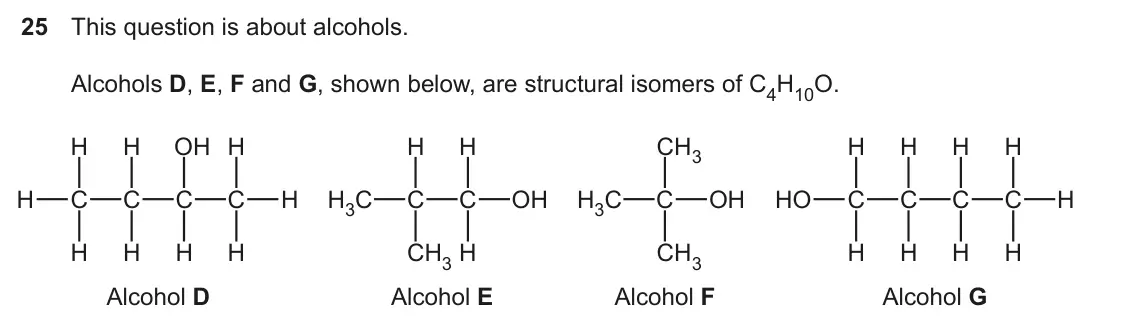
Q2(b)(i)
The whole paper ↗
Q2(b)(ii)
The whole paper ↗Q2(b)(iii)
The whole paper ↗- Your answer
- Your answer
Q21(c)
The whole paper ↗
Q4(b)(iii)
The whole paper ↗
- Your answer
Q19(b)
The whole paper ↗
Q16(b)(iii)
The whole paper ↗
Q6(e)
The whole paper ↗
- Your answer
- Your answer
Q22(c)
The whole paper ↗
- Your answer
Q2(a)(i)
The whole paper ↗
All 67 questions on Mass, gas volume and concentration calculations, as a list
- June 2025, Paper 3, Q2(b)(ii) (4 marks): The student uses the reaction of nuromol tablets with Na2CO3(aq) to determine the mass of ibuprofen and the mass of paracetomol in one nuromol tablet. The stude
- June 2025, AS Paper 1, Q21(d)(i) (3 marks): Calculate the concentration of HCl that the student used. Give your answer to 2 significant figures and in standard form. Concentration of HCl = mol dm–3 [3]
- June 2025, AS Paper 1, Q25(c) (5 marks): 25.9 g of alcohol F is completely combusted in oxygen at a temperature of 100 °C and 1.50 × 10⁵ Pa pressure. The equation for this reaction is: C4H10O + 6O2 4CO
- June 2025, AS Paper 2, Q2(b)(i) (2 marks): and pressure (RTP). Give your answer to 3 significant figures. Volume of gas cm3 [2]
- June 2025, AS Paper 2, Q2(b)(ii) (2 marks): The volume of gas collected is less than the calculated volume. Suggest two reasons for this difference. 1 2 [2]
- June 2025, AS Paper 2, Q2(b)(iii) (1 mark): Suggest one way in which the student could modify the apparatus to produce a volume closer to the calculated volume. [1]
- June 2024, Paper 2, Q6 (1 mark): 4.30 g of the alcohol C5H9OH, (Mr = 86.0), is burned in oxygen. C5H9OH(l) + 7O2(g) 5CO2(g) + 5H2O(l) Which volume of oxygen gas is needed, in dm3, for this comp
- June 2024, Paper 2, Q10 (1 mark): 1.35 g of ethylamine gas, CH3CH2NH2 (Mr = 45.0), is reacted with 20 cm3 of 2.0 mol dm–3 hydrochloric acid forming a solution of ethylammonium chloride. +(aq) +
- June 2024, AS Paper 1, Q21(c) (3 marks): The iron compound, Fe(NO3)3, decomposes when heated. The equation for the decomposition of Fe(NO3)3 is shown below. 4Fe(NO3)3(s) 2Fe2O3(s) + 12NO2(g) + 3O2(g) M
- June 2024, AS Paper 2, Q4(b)(iii) (3 marks): The student uses 50.0 cm3 of H2O2 in the experiment. Equation 4.1 shows the reaction that takes place. 2H2O2(aq) 2H2O(l) + O2(g) Equation 4.1 Calculate the conc
- June 2023, Paper 1, Q4 (1 mark): 40.0 cm3 of 0.200 mol dm–3 HCl is added to 60.0 cm3 of 0.100 mol dm–3 NaOH. 4 What is the concentration of the resulting solution? 0.0200 mol dm–3 HCl and 0.020
- June 2023, Paper 1, Q19(b) (5 marks): N2O4 reacts fully with oxygen to form a different oxide of nitrogen, oxide A, as the only product. Oxide A is collected and cooled to 75.0 °C at a pressure of 1
- June 2023, Paper 2, Q16(b)(iii) (3 marks): Organic compound B is formed by the substitution of some of the 14 H atoms in 2-methylpentane by Br atoms. 0.8649 g of compound B is heated until it is vaporise
- June 2023, Paper 3, Q6(e) (6 marks): This question is about nitric acid, hydrochloric acid and sulfuric acid. (e)* Three reactions involving sulfuric acid are shown below. Reaction 1 Dilute sulfuri
- June 2023, AS Paper 1, Q8 (1 mark): Magnesium nitrate, Mg(NO3)2, decomposes when heated: Mg(NO3)2(s) MgO(s) + 2NO2(g) + ½O2(g) 0.00250 mol of Mg(NO3)2 is decomposed. What is the volume of gas prod
- June 2023, AS Paper 1, Q10 (1 mark): 15.00 cm3 of 18.0 mol dm–3 concentrated hydrochloric acid is diluted with water to prepare 250 cm3 of dilute hydrochloric acid. What is the concentration, in mo
- June 2022, Paper 1, Q22(c) (6 marks): This question is about reactions of transition metal compounds. (c)* This question is about copper and copper compounds. Experiment 1 Hydrochloric acid, HCl (aq
- June 2022, Paper 2, Q9 (1 mark): The compound below reacts with hydrogen gas to form a saturated compound. CN What is the volume of hydrogen, measured at room temperature and pressure, that rea
- June 2022, Paper 2, Q17 (6 marks): This question is about an analysis of an unknown organic Compound X. Some properties of Compound X are shown in the table. Molecular formula Functional groups C
- June 2022, Paper 3, Q2(a)(i) (3 marks): 420 dm3 of chlorine, measured at RTP, is reacted with an excess of Ca(OH)2. The solid products are dissolved in water to form 4.00 m3 of solution. Calculate the
- June 2022, AS Paper 1, Q8 (1 mark): Which volume of 18.0 mol dm–3 hydrochloric acid should be diluted to 250.0 cm3 to prepare a 8 0.450 mol dm–3 solution of hydrochloric acid? 4.50 cm3 A 6.25 cm3
- June 2022, AS Paper 1, Q26(b) (5 marks): A bromoalkane D is a liquid at room temperature and pressure but can easily be vaporised. When vaporised, 0.330 g of D produces 74.0 cm3 of gas at 1.01 × 10⁵ Pa
- November 2021, Paper 1, Q6 (1 mark): A student is supplied with 100.0 cm3 of a solution of 0.400 mol dm–3 magnesium iodide, MgI2. 6 A student plans to dilute this solution so that the iodide concen
- November 2021, Paper 3, Q2(a) (2 marks): Draw a labelled diagram of suitable apparatus for this investigation. [2]
- November 2021, Paper 3, Q2(b) (3 marks): Analyse the student’s results to conclude which of Equation 1 or 2 or 3, is supported by the experimental results. Assume that the conditions in the laboratory
- November 2021, Paper 3, Q2(c) (2 marks): The student repeats the experiment but adds concentrated hydrochloric acid instead of dilute hydrochloric acid. The apparatus gets hot during the reaction. Pred
- November 2021, Paper 3, Q5(a)(ii) (5 marks): A 16.0 dm3 airbag is inflated at 17.0 ºC. The pressure in the inflated airbag is 1.20 × 10⁵ Pa. Calculate the mass of NaN3 that has decomposed. Give your answer
- November 2021, Paper 3, Q5(c) (6 marks): This question is about nitrogen and its compounds. (c)* This question is about two reactions of ammonia. Reaction 1 Excess ammonia is reacted with 4.77 g of cop
- November 2021, AS Paper 1, Q5 (1 mark): Which gas sample has the greatest mass at RTP? 50 cm3 of Ar(g) A 100 cm3 of O2(g) B 150 cm3 of N2(g) C 200 cm3 of Ne(g) D Your answer [1]
- November 2021, AS Paper 1, Q6 (1 mark): A student mixes 250.0 cm3 of 0.100 mol dm–3 KOH with 750.0 cm3 of 0.100 mol dm–3 Ca(OH)2. 6 What is the OH– concentration, in mol dm–3, in the resulting mixture
- November 2021, AS Paper 1, Q25(b) (5 marks): A gas cylinder has a gas volume of 9.39 dm3. The gas cylinder holds 1.69 kg of a gas at a pressure of 1.37 × 10⁷ Pa at 20 °C. Determine the molar mass and possi
- November 2020, Paper 1, Q21(c) (3 marks): Compound A contains bromine and fluorine only, and has a boiling point of 41 °C. 1.26 g of compound A is heated to 80 °C. The volume of gas produced is 0.209 dm
- November 2020, Paper 3, Q1(b)(ii) (6 marks): Amine A is a liquid at room temperature and pressure. When vaporised, 0.202 g of the amine produces 72.0 cm3 of gas at 1.00 × 10⁵ Pa and 100 °C. The 13C NMR spe
- November 2020, Paper 3, Q4(b)(i) (1 mark): Calculate the amount, in mol, of CO2 released in the reaction. Amount of CO2 = mol [1]
- November 2020, Paper 3, Q4(b)(ii) (3 marks): Calculate the molar mass of X2CO3 and identify metal X. Molar mass of X2CO3 = g mol−1 Metal X = [3]
- November 2020, Paper 3, Q4(c)(i) (1 mark): The student wondered whether the reaction was complete when the mass was recorded after 5 minutes (Step 3). How could the student modify the experimental proced
- November 2020, Paper 3, Q4(c)(ii) (2 marks): The student finds out that carbon dioxide is slightly soluble in water. State and explain how the solubility of CO2 would affect the calculated molar mass of X2
- November 2020, AS Paper 1, Q22(c) (5 marks): Bromine reacts with fluorine to form compound A. Compound A is a liquid at room temperature and pressure but can easily be vaporised. When vaporised, 0.428 g of
- November 2020, AS Paper 1, Q23(a) (3 marks): Barium hydroxide is an alkali which releases hydroxide ions, OH−, in aqueous solution. A barium hydroxide solution contains 3.89 g of Ba(OH)2 in 100 cm3 at 20 °
- November 2020, AS Paper 2, Q1(b)(i) (3 marks): Calculate the minimum volume, in cm3, of 0.150 mol dm–3 HCl (aq) that the student needs for the reaction. Give your answer to 3 significant figures. minimum vol
- November 2020, AS Paper 2, Q1(b)(ii) (1 mark): Calculate the volume of H2(g), in cm3, that would be produced at RTP. volume of H2(g) = cm3 [1]
- June 2019, Paper 1, Q10 (1 mark): Radical reactions are responsible for the catalysed breakdown of the ozone layer. The overall equation is shown below. 3O2 ∆rH = −284 kJ mol−1 2O3 The molar gas
- June 2019, Paper 1, Q18(c)(iii) (1 mark): Some iron supplements contain iron(II) sulfate or iron(II) fumarate. The information in Table 18.3 is taken from the labels of two iron supplements, A and B. Ma
- June 2019, Paper 3, Q1(d) (2 marks): What mass of carbon dioxide (in g) is formed by the complete combustion of 42.0 m3 (measured at RTP) of propane? mass = g [2]
- June 2019, Paper 3, Q6(b) (6 marks): This question is about reactions of iron compounds. (b)* Compound C is a hydrated ionic compound with the empirical formula: FeH18N3O18. A student investigates
- June 2019, AS Paper 1, Q6 (1 mark): What is the volume of 0.0100 mol of N2 at 350 °C and 200 kPa? 145 cm3 A 259 cm3 B 145 dm3 C 259 dm3 D Your answer [1]
- June 2019, AS Paper 1, Q25(b)(iii) (3 marks): Organic compound E is formed by the substitution of some of the H atoms in butane by Cl atoms. A chemist found that 0.636 g of compound E has a volume of 78.0 c
- June 2019, AS Paper 2, Q2(a) (6 marks): Magnesium nitrate is used in fertilisers as a source of nitrogen. (a)* A student plans to prepare 250.0 cm3 of a 0.4000 mol dm–3 solution of magnesium nitrate,
- June 2019, AS Paper 2, Q2(b) (3 marks): A solution of magnesium nitrate can be prepared by reacting magnesium carbonate, MgCO3, with nitric acid, HNO3(aq). The equation is shown below. MgCO3(s) + 2HNO
- June 2019, AS Paper 2, Q4(a) (3 marks): The student plans to react 50.0 cm3 of 0.100 mol dm–3 HCl with 0.200 g of zinc (an excess). Calculate the volume, in cm3, of hydrogen that should be produced at
- June 2018, Paper 1, Q20(c) (4 marks): Compound A is an oxide of chlorine that is a liquid at room temperature and pressure and has a boiling point of 83 °C. When 0.4485 g of A is heated to 100 °C at
- June 2018, Paper 2, Q19(c)(ii) (3 marks): Analyse the information to identify E, F and G. Show your working. [3]
- June 2018, Paper 3, Q1(a)(viii) (1 mark): The element which has a density of 1.33 × 10⁻³ g cm–3 at room temperature and pressure. [1]
- June 2018, Paper 3, Q2(a)(ii) (3 marks): The student allows the reaction in equation 2.1 to proceed until no more gas is evolved. The volume of O2 in the syringe is now 55 cm3, measured at RTP. Calcula
- June 2018, AS Paper 1, Q22(a)(ii) (3 marks): The student plans to add magnesium to 50.0 cm3 of 1.24 mol dm−3 H3PO4. Calculate the mass of magnesium that the student should add to react exactly with the pho
- June 2018, AS Paper 1, Q22(b)(i) (4 marks): 3.20 × 10⁻² mol of H3PO3 is completely decomposed by this reaction. Calculate the volume of phosphine gas formed, in cm3, at 100 kPa pressure and 200 °C. volume
- June 2018, AS Paper 2, Q4(a)(ii) (4 marks): 5.10 tonnes of NH3 are converted into NO. Calculate the energy released, in kJ, for this conversion. Give your answer in standard form and to an appropriate num
- June 2017, Paper 1, Q12 (1 mark): HA and HB are two strong monobasic acids. 25.0 cm3 of 6.0 mol dm–3 HA is mixed with 45.0 cm3 of 3.0 mol dm–3 HB. What is the H+(aq) concentration, in mol dm–3,
- June 2017, Paper 3, Q1(d) (4 marks): Calculate the volume of methane, in dm3, that would be released from the melting of each 1.00 kg of ‘methane hydrate’ at 101 kPa and 0 °C. Give your answer to t
- June 2017, Paper 3, Q4(c)(ii) (2 marks): A typical tablet of chromium(III) picolinate contains 200 μg of chromium. Calculate the mass, in g, of chromium(III) picolinate in a typical tablet. 1 μg = 10−6
- June 2017, AS Paper 1, Q25(b) (5 marks): An alkene D is a liquid at room temperature and pressure but can easily be vaporised. When vaporised, 0.1881 g of D produces 82.5 cm3 of gas at 101 kPa and 373
- June 2017, AS Paper 2, Q3(b)(ii) (3 marks): Use the graph to estimate the energy released during complete combustion of 1.80 g of pentane. Show relevant working below and on the graph. energy released = k
- June 2016, AS Paper 1, Q24(c) (2 marks): The 50.0 cm3 of KI(aq) used in the experiment contains 10% more KI than is needed to react with 50.0 cm3 of 1.50 mol dm–3 Pb(NO3)2(aq). Pb(NO3)2(aq) + 2KI(aq) →
- June 2016, AS Paper 2, Q1(c)(i) (2 marks): Draw a labelled diagram of the apparatus that can be used to carry out this experiment. [2]
- June 2016, AS Paper 2, Q1(c)(ii) (3 marks): Identify the Group 2 metal, M. Show your working. Group 2 metal = [3]
- June 2016, AS Paper 2, Q4(b) (4 marks): N2O is supplied as a compressed gas in steel cylinders for use as an anaesthetic. The cylinders are stored at 20.0 °C. Calculate the gas pressure, in Pa, in a 2
- June 2016, AS Paper 2, Q5(a)(ii) (3 marks): An excess of strontium carbonate, SrCO3, is mixed with 20.0 cm3 of 1.25 mol dm–3 nitric acid, HNO3. Calculate the mass of SrCO3 that reacts with the HNO3. mass
Questions, mark schemes and examiner’s reports are © OCR, from their published past papers. Plumi isn’t affiliated with any exam board. Want whole papers? OCR A-Level Chemistry A past papers, or our free OCR-style practice pack.
The Plumi iPad app also offers exam-style questions with AI feedback on your handwritten working.