 plumi
Electrophilic substitution of arenes: OCR A‑Level Chemistry A questions
OCR A-Level Chemistry A past-paper questions on 6.1.1.2 Electrophilic substitution of arenes, 2016–2025, with mark schemes and examiner’s reports where available.
Paper
All papers
Exam
All years
Calculations
Q20(c)(i)
The whole paper ↗
Q20(c)(ii)
The whole paper ↗Q21(a)(i)
The whole paper ↗
Q21(a)(ii)
The whole paper ↗Q18(a)
The whole paper ↗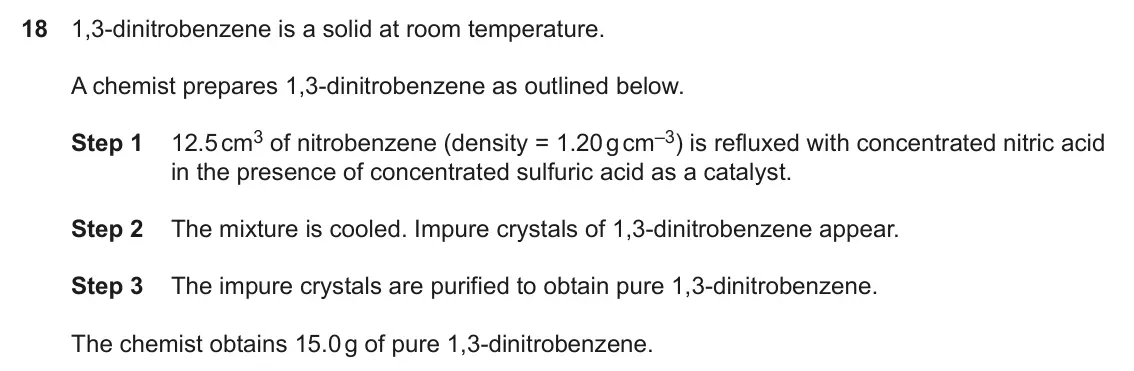
Q20(a)(iii)
The whole paper ↗
Q20(d)(i)
The whole paper ↗- Your answer
Q17(a)(i)
The whole paper ↗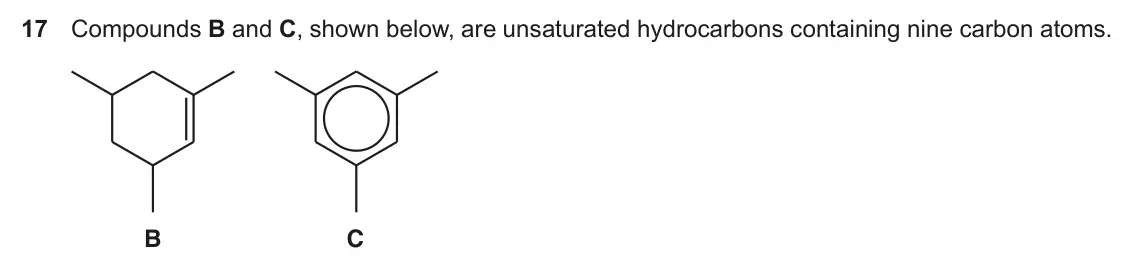
Q17(a)(ii)
The whole paper ↗Q17(a)(iii)
The whole paper ↗Q19(b)(iii)
The whole paper ↗
Q18(b)
The whole paper ↗
Q6(b)
The whole paper ↗
Q17(a)(i)
The whole paper ↗
Q17(b)(i)
The whole paper ↗
All 16 questions on Electrophilic substitution of arenes, as a list
- June 2025, Paper 2, Q20(c)(i) (1 mark): Suggest a reagent and halogen carrier that could be used in Stage 1 of Synthesis 1. [1]
- June 2025, Paper 2, Q20(c)(ii) (5 marks): Stage 2 of Synthesis 1 is the conversion of methylbenzene to compound G. Outline the mechanism for the reaction in Stage 2. Show the role of H2SO4 as a catalyst
- June 2024, Paper 2, Q21(a)(i) (1 mark): What is meant by the term electrophile? [1]
- June 2024, Paper 2, Q21(a)(ii) (5 marks): Outline the mechanism for this reaction, including the role of Al Cl 3 as a halogen carrier. [5]
- June 2023, Paper 2, Q18(a) (5 marks): Outline the mechanism for this reaction, including the role of H2SO4 as a catalyst. [5]
- June 2022, Paper 2, Q20(a)(iii) (4 marks): Compound J is substituted at the 2- and 4- positions by chlorine in the presence of a catalyst. Outline the mechanism for the 4 substitution of compound J by ch
- June 2022, Paper 2, Q20(d)(i) (2 marks): Add the reagents for each stage of this synthesis. CH2CH2OH Compound J CH2CH2OH CH2CH2OH Reduction NO2 NH2 [2]
- November 2020, Paper 2, Q15 (1 mark): Which compound(s) could be prepared by reacting benzene with an acyl chloride in the presence of a halogen carrier? CH2COCH3 1 CHO 2 COCH3 3 A 1, 2 and 3 B Only
- November 2020, Paper 2, Q17(a)(i) (2 marks): Draw the structures of the organic product of each reaction. Organic product with B Organic product with C [2]
- November 2020, Paper 2, Q17(a)(ii) (3 marks): Explain the relative resistance to chlorination of compound C compared with compound B. [3]
- November 2020, Paper 2, Q17(a)(iii) (5 marks): Outline the mechanism for the reaction of compound C with chlorine. Show the role of the halogen carrier. [5]
- June 2019, Paper 2, Q19(b)(iii) (5 marks): In the synthesis of compounds D and E, benzene is first reacted with ethanoyl chloride, CH3COCl, to form phenylethanone, shown below. O H3C C phenylethanone The
- June 2018, Paper 2, Q18(b) (3 marks): Methylbenzene reacts with sulfur trioxide, SO3, to form D, shown below. CH3 O O S O– D The electrophile in this reaction is SO3. Complete the mechanism for the
- June 2018, Paper 3, Q6(b) (6 marks): This question is about organic reactions. (b)* Many organic reactions use electrophiles as reagents. Explain the role of electrophiles in organic chemistry. You
- June 2017, Paper 2, Q17(a)(i) (5 marks): Outline the mechanism for this nitration of benzoic acid. Show how H2SO4 behaves as a catalyst. [5]
- June 2017, Paper 2, Q17(b)(i) (1 mark): State the trend in the relative ease of nitration of phenol, benzene, and benzoic acid. [1]
Questions, mark schemes and examiner’s reports are © OCR, from their published past papers. Plumi isn’t affiliated with any exam board. Want whole papers? OCR A-Level Chemistry A past papers, or our free OCR-style practice pack.
The Plumi iPad app also offers exam-style questions with AI feedback on your handwritten working.