 plumi
Reflux, distillation and purifying liquids: OCR A‑Level Chemistry A questions
OCR A-Level Chemistry A past-paper questions on 4.2.3.1 Reflux, distillation and purifying liquids, 2016–2025, with mark schemes and examiner’s reports where available.
Paper
All papers
Exam
All years
Calculations
- Your answer
Q19(b)(ii)
The whole paper ↗
Q5(c)
The whole paper ↗
Q23(a)
The whole paper ↗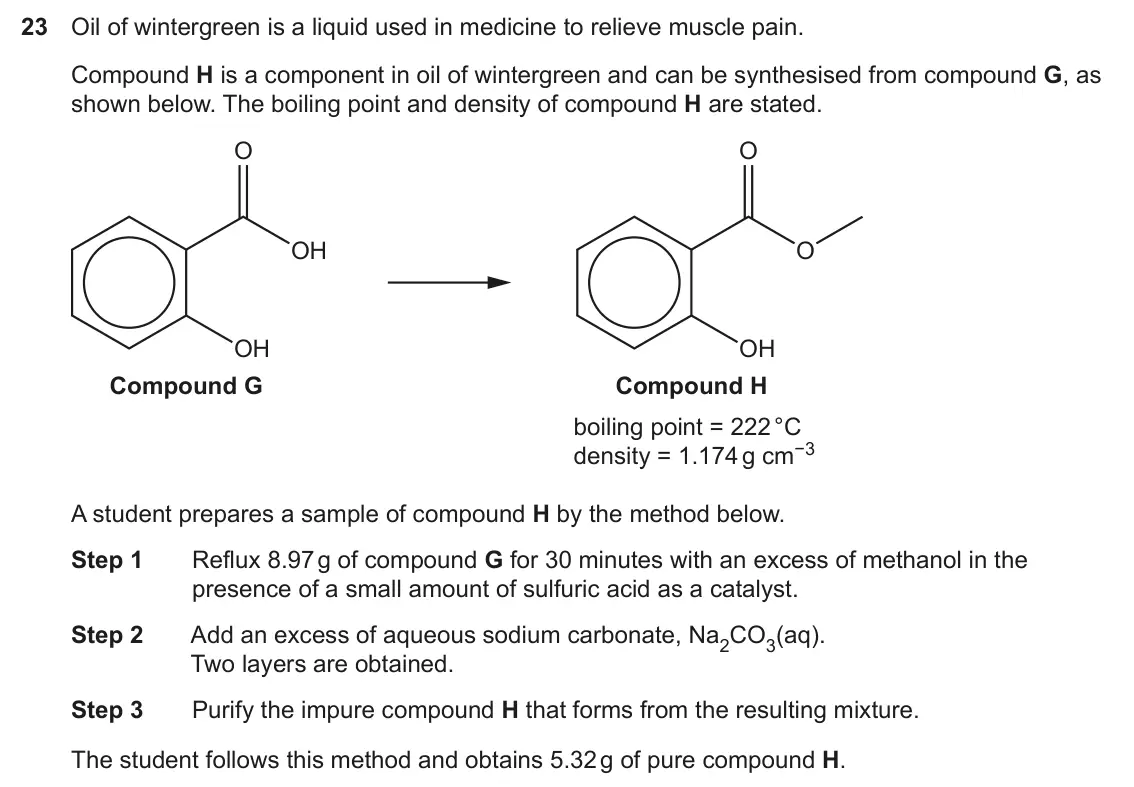
Q23(d)
The whole paper ↗Q25(c)
The whole paper ↗
Q5(b)(i)
The whole paper ↗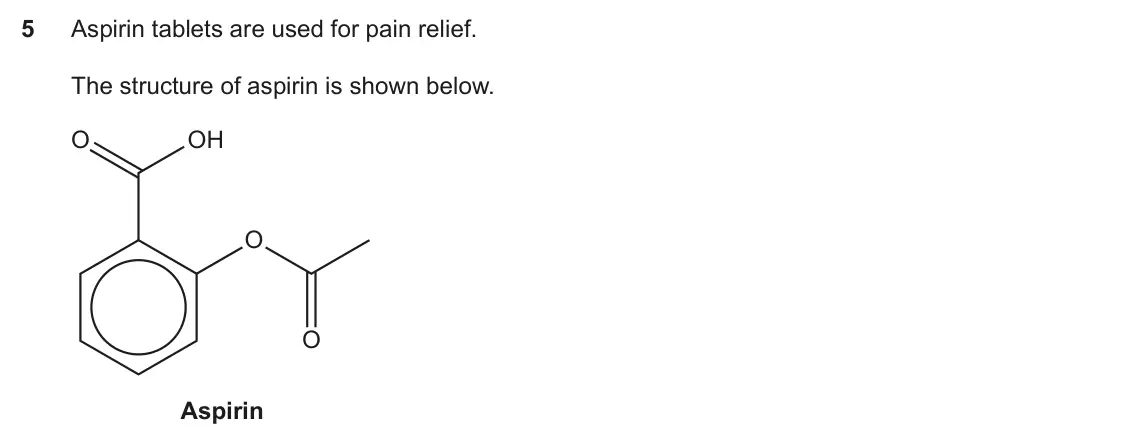
Q3(a)
The whole paper ↗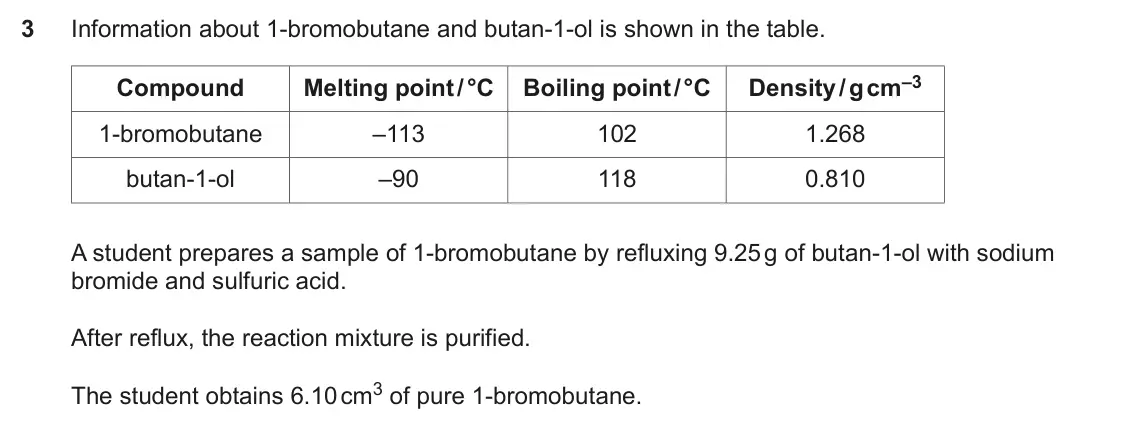
Q5(c)(ii)
The whole paper ↗
Q24(c)(ii)
The whole paper ↗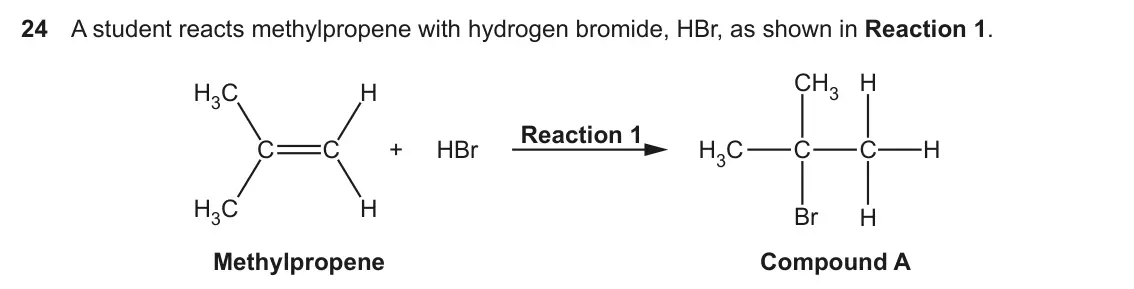
Q7(b)
The whole paper ↗
Q20(a)
The whole paper ↗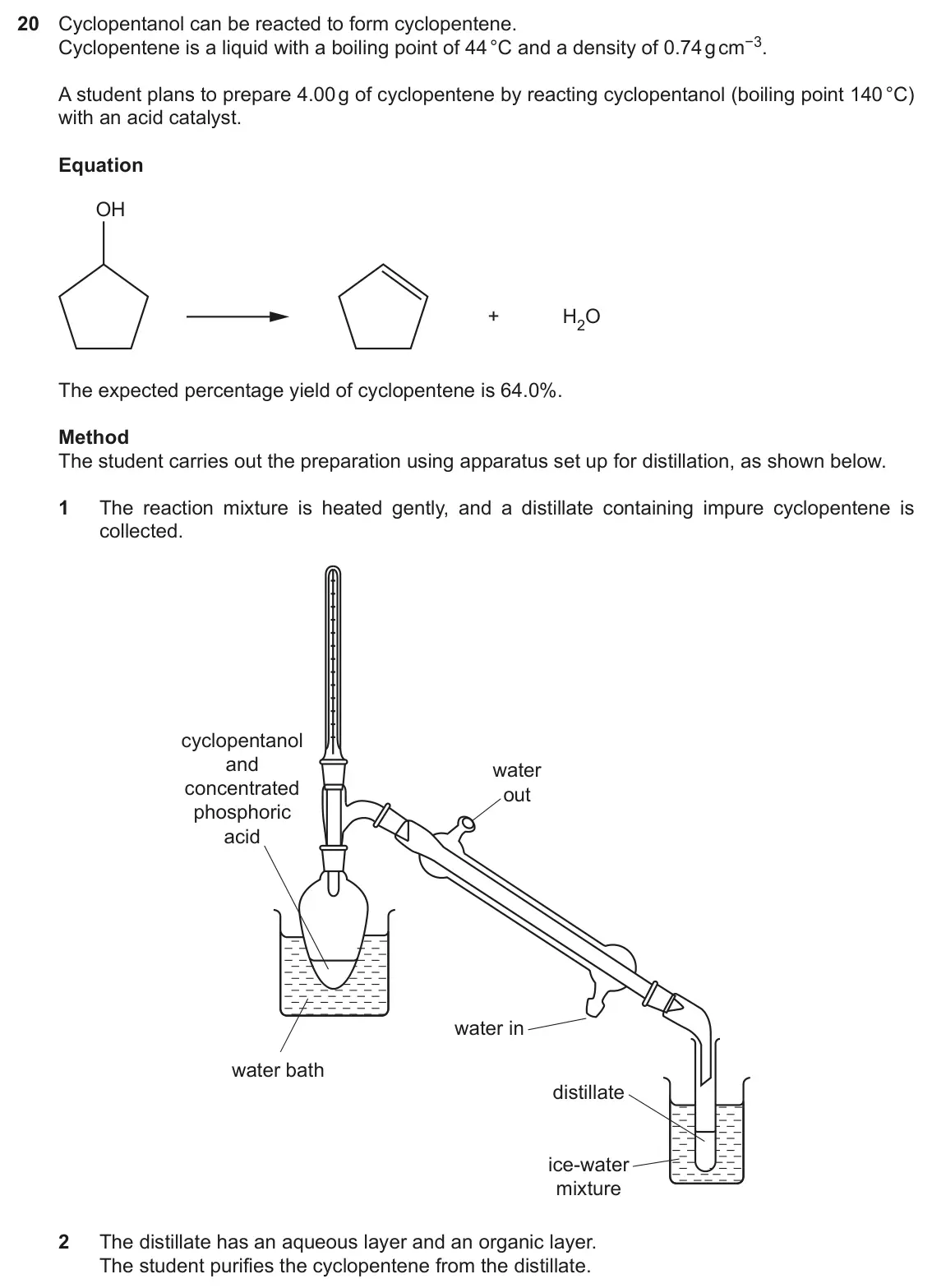
Q1(a)(i)
The whole paper ↗
Q5(b)(i)
The whole paper ↗
Q19(c)(i)
The whole paper ↗
Q5(a)(i)
The whole paper ↗Q4(c)
The whole paper ↗
Q6(c)(ii)
The whole paper ↗
All 18 questions on Reflux, distillation and purifying liquids, as a list
- June 2025, Paper 2, Q4 (1 mark): Which diagram shows the correct way to set up apparatus for converting ethanol to ethanoic acid? water out water in A B water in water out water out water in wa
- June 2025, Paper 2, Q19(b)(ii) (4 marks): The reaction to form 1-bromopropane from propan-1-ol is carried out in a flask. After the reaction, the flask contains a mixture of an organic layer (density =
- June 2025, AS Paper 2, Q5(c) (6 marks): This question is about haloalkanes. (c)* 2-Chlorobutane, CH3CH2CHCl CH3, is an organic liquid with a boiling point of 70 °C. A student prepares 2-chlorobutane f
- June 2024, Paper 2, Q23(a) (1 mark): Why does the student use reflux in Step 1? [1]
- June 2024, Paper 2, Q23(d) (4 marks): Describe how to purify the impure compound H from the two layers in Step 2. [4]
- June 2024, AS Paper 1, Q25(c) (2 marks): Primary alcohols can be oxidised under distillation to make aldehydes. Draw a labelled diagram to show how you would set up apparatus for distillation. [2]
- June 2023, Paper 3, Q5(b)(i) (2 marks): Draw a labelled diagram of suitable apparatus for reflux. [2]
- June 2022, Paper 3, Q3(a) (6 marks): Information about 1-bromobutane and butan-1-ol is shown in the table. Density / g cm–3 Compound Melting point / °C Boiling point / °C 1-bromobutane –113 102 1.2
- June 2022, AS Paper 2, Q5(c)(ii) (3 marks): The student mixes butan-2-ol, sodium bromide and sulfuric acid in a pear-shaped flask, and refluxes the mixture. After 1 hour, the mixture in the flask has sepa
- November 2021, AS Paper 1, Q24(c)(ii) (2 marks): Draw a labelled diagram to show how you would set up apparatus for reflux. [2]
- November 2021, AS Paper 2, Q7(b) (6 marks): 2-Chloro-2-methylpropane, (CH3)3CCl , is an organic liquid with a boiling point of 50 °C. A student prepares (CH3)3CCl by reacting 2-methylpropan-2-ol, (CH3)3CO
- November 2020, Paper 2, Q20(a) (6 marks): Cyclopentanol can be reacted to form cyclopentene. Cyclopentene is a liquid with a boiling point of 44 °C and a density of 0.74 g cm−3. A student plans to prepa
- November 2020, Paper 3, Q1(a)(i) (2 marks): Complete the missing labels on the diagram and name the technique. Heat Name of technique: [2]
- June 2019, AS Paper 2, Q5(b)(i) (6 marks): Hex-1-ene is a liquid with a boiling point of 63 °C and a density of 0.67 g cm–3. Hex-1-ene can be prepared by refluxing hexan-1-ol (boiling point 157 °C) with
- June 2018, Paper 2, Q19(c)(i) (2 marks): Draw a labelled diagram to show how the student would carry out the hydrolysis of haloalkane E. [2]
- June 2018, AS Paper 2, Q5(a)(i) (6 marks): 1-Bromobutane is an organic liquid with a boiling point of 102 °C. A student prepares 1-bromobutane by reacting butan-1-ol with sulfuric acid and sodium bromide
- June 2017, AS Paper 2, Q4(c) (6 marks): The hydroxyl group, –OH, is responsible for many properties of alcohols. (c)* Describe the oxidation reactions of butan-1-ol forming an aldehyde and a carboxyli
- June 2016, AS Paper 2, Q6(c)(ii) (2 marks): A student plans to carry out this oxidation using the apparatus shown in the diagram. Give one reason why the apparatus is not suitable and describe a more suit
Questions, mark schemes and examiner’s reports are © OCR, from their published past papers. Plumi isn’t affiliated with any exam board. Want whole papers? OCR A-Level Chemistry A past papers, or our free OCR-style practice pack.
The Plumi iPad app also offers exam-style questions with AI feedback on your handwritten working.