 plumi
Curly arrows and reaction mechanisms: OCR A‑Level Chemistry A questions
OCR A-Level Chemistry A past-paper questions on 4.1.1.5 Curly arrows and reaction mechanisms, 2016–2025, with mark schemes and examiner’s reports where available.
Paper
All papers
Exam
All years
Calculations
Q2(c)
The whole paper ↗
Q16(c)(ii)
The whole paper ↗
Q3(b)
The whole paper ↗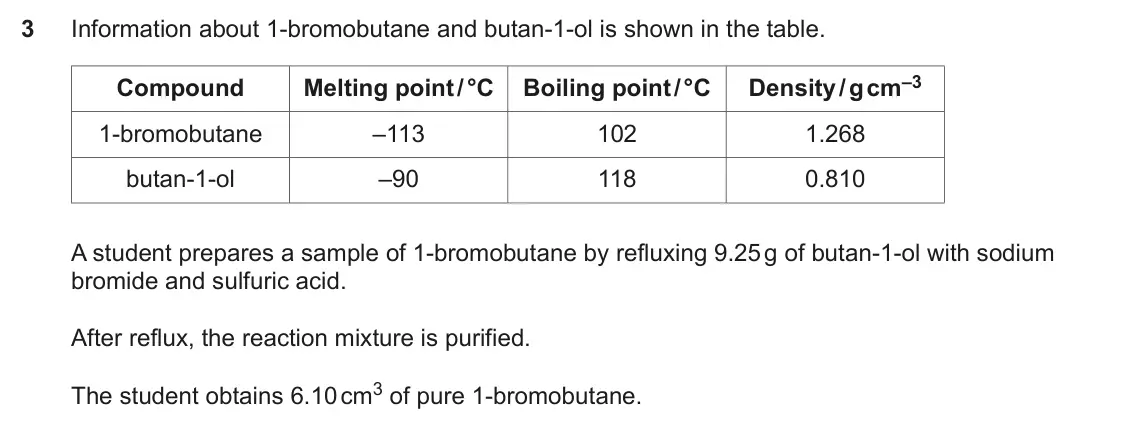
Q6(c)(i)
The whole paper ↗
Q16(d)(i)
The whole paper ↗
- Your answer
Q6(c)
The whole paper ↗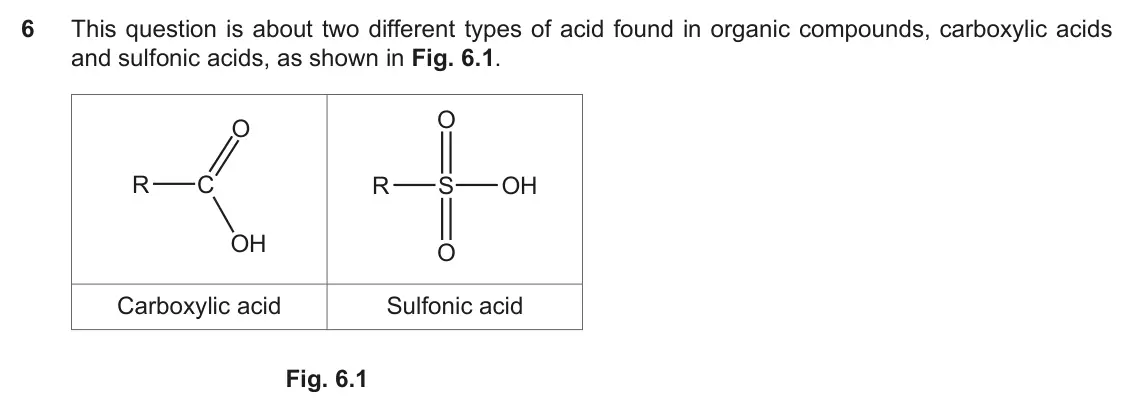
Q20(a)(i)
The whole paper ↗
Q20(a)(ii)
The whole paper ↗Q20(b)(i)
The whole paper ↗Q4(a)(ii)
The whole paper ↗
All 11 questions on Curly arrows and reaction mechanisms, as a list
- June 2023, Paper 3, Q2(c) (4 marks): The benzenediazonium ion, shown below, is stable at temperatures below 10 °C. + N N Benzenediazonium Above 10 °C, the benzenediazonium ion reacts with water to
- June 2022, Paper 2, Q16(c)(ii) (1 mark): The mechanism for ozonolysis takes place in several steps. The curly arrows in the first step in the ozonolysis of methylbut-2-ene are shown below. In the box,
- June 2022, Paper 3, Q3(b) (4 marks): Butan-1-ol reacts with sodium bromide and sulfuric acid to form 1-bromobutane by nucleophilic substitution. The mechanism for this reaction takes place by two s
- June 2022, Paper 3, Q6(c)(i) (2 marks): In aqueous solution, vitamin C donates a proton to water: – + H3O+ C6H8O6 + H2O C6H7O6 Add curly arrows to the diagram to suggest the mechanism for this process
- November 2021, Paper 2, Q16(d)(i) (2 marks): Add curly arrows to the diagram below to complete the mechanism for this Diels-Alder reaction. [2]
- November 2021, AS Paper 1, Q14 (1 mark): What do curly arrows always show in reaction mechanisms? A Movement of one electron. B Movement of a pair of electrons. C Movement of a lone pair of electrons.
- November 2020, Paper 3, Q6(c) (4 marks): Carboxylic acids and sulfonic acids both form esters. Sulfonic acid esters can be hydrolysed by aqueous alkali. The equation shows the alkaline hydrolysis of a
- June 2019, Paper 2, Q20(a)(i) (1 mark): What does a curly arrow show in a reaction mechanism? [1]
- June 2019, Paper 2, Q20(a)(ii) (2 marks): Draw structures to show the products in the reaction mechanism below. H H + O [2]
- June 2019, Paper 2, Q20(b)(i) (4 marks): Complete the mechanism by adding curly arrows and any missing species. – O O H3C C H3C C Cl Cl OH – OH O H3C C + ………… OH [4]
- June 2018, Paper 3, Q4(a)(ii) (2 marks): Cis-platin is prepared in a ligand substitution reaction which takes place in multiple steps. The equation for the final step forming cis-platin is shown below.
Questions, mark schemes and examiner’s reports are © OCR, from their published past papers. Plumi isn’t affiliated with any exam board. Want whole papers? OCR A-Level Chemistry A past papers, or our free OCR-style practice pack.
The Plumi iPad app also offers exam-style questions with AI feedback on your handwritten working.