 plumi
Dehydration and substitution of alcohols: OCR A‑Level Chemistry A questions
OCR A-Level Chemistry A past-paper questions on 4.2.1.3 Dehydration and substitution of alcohols, 2016–2025, with mark schemes and examiner’s reports where available.
Paper
All papers
Exam
All years
Calculations
Q19(b)(i)
The whole paper ↗
Q23(a)
The whole paper ↗
Q25(b)
The whole paper ↗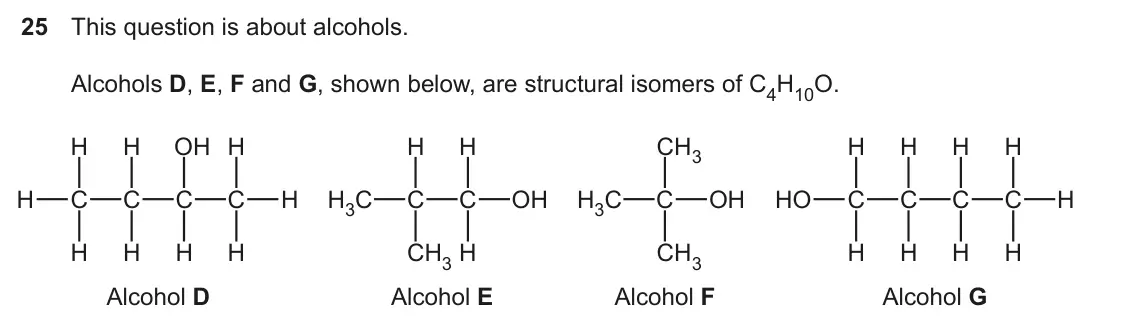
Q17(a)
The whole paper ↗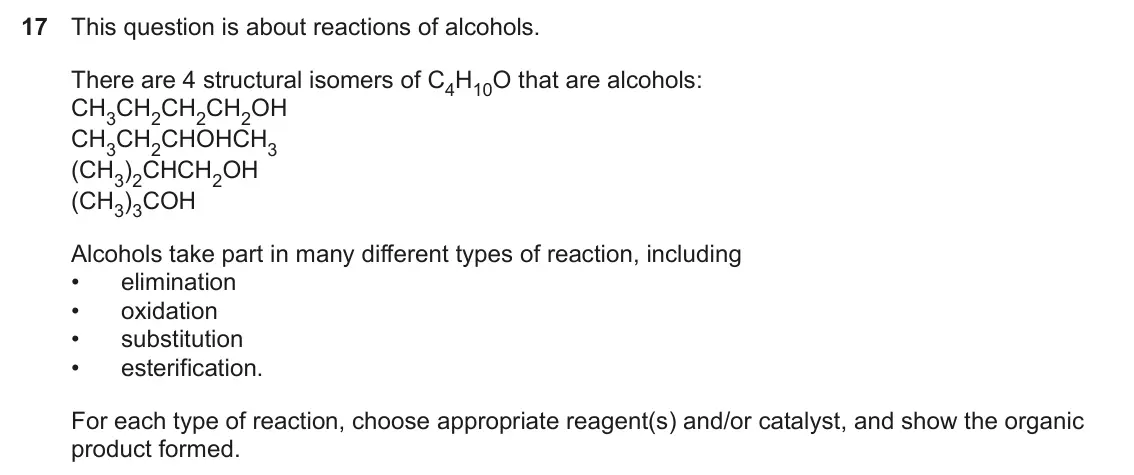
Q17(c)
The whole paper ↗Q17(c)(i)
The whole paper ↗
Q17(c)(ii)
The whole paper ↗- Your answer
Q5(a)(ii)
The whole paper ↗
Q20(e)
The whole paper ↗
Q3(b)
The whole paper ↗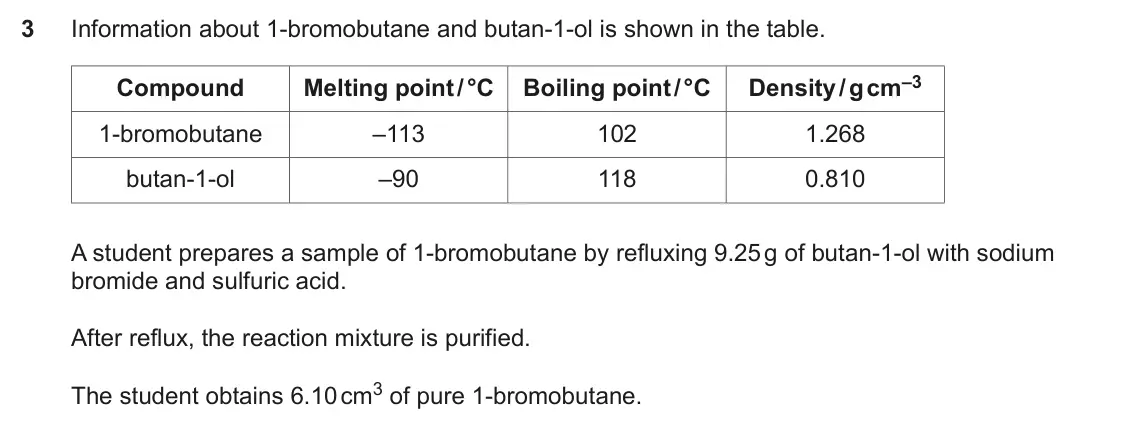
- Your answer
Q7(a)
The whole paper ↗
- Your answer
- Your answer
- Your answer
Q4(b)(iii)
The whole paper ↗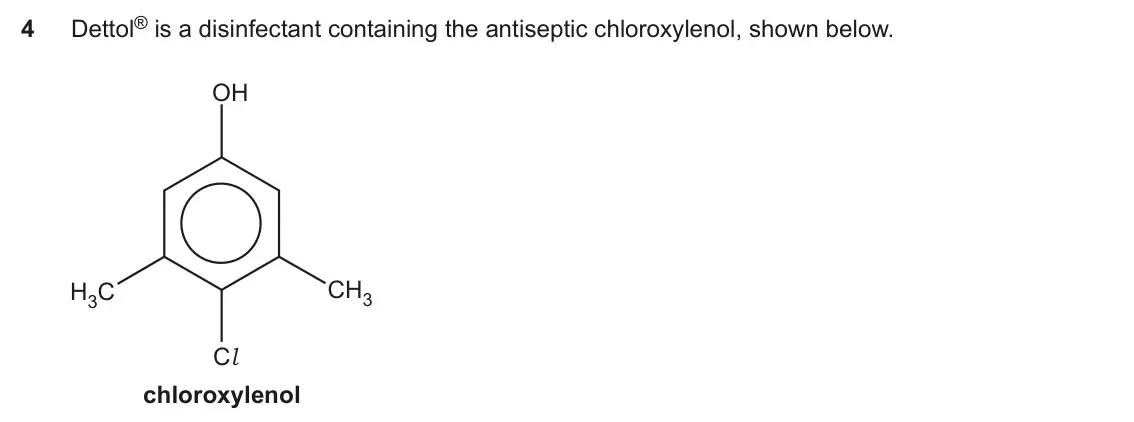
Q5(b)(ii)
The whole paper ↗
Q16(a)(iii)
The whole paper ↗
Q16(a)(iv)
The whole paper ↗
All 26 questions on Dehydration and substitution of alcohols, as a list
- June 2025, Paper 2, Q19(b)(i) (1 mark): Suggest suitable reagents for this reaction. [1]
- June 2025, Paper 2, Q23(a) (4 marks): Compound K, C4H10O, is refluxed with H2SO4 to form a mixture of compound L and compound M. The infrared spectrum of compound K is shown. 100 50 Transmittance (%
- June 2025, AS Paper 1, Q25(b) (1 mark): Alcohols D, E, F and G are each heated with concentrated H2SO4, which acts as an acid catalyst. Which alcohol forms a mixture of two alkenes that are structural
- June 2024, Paper 2, Q17(a) (2 marks): Elimination reaction of CH3CH2CH2CH2OH Reagent(s) and/or catalyst organic product [2]
- June 2024, Paper 2, Q17(c) (2 marks): Substitution reaction of (CH3)2CHCH2OH Reagent(s) and/or catalyst organic product [2]
- June 2023, Paper 2, Q17(c)(i) (3 marks): Draw the structures of the three isomers of C7H10 formed from compound D. [3]
- June 2023, Paper 2, Q17(c)(ii) (1 mark): A student converts compound D into a diiodoalkane. Suggest suitable reagents for this reaction. [1]
- June 2023, AS Paper 1, Q17 (1 mark): 3-Methylcyclohexanol is reacted with NaBr and H2SO4. What is the organic product? Br A Br B C D Your answer [1]
- June 2023, AS Paper 2, Q5(a)(ii) (2 marks): Alcohol A is refluxed with an acid catalyst. • A mixture of alkene isomers B, C and D is formed. • Alkenes B and C show E/Z isomerism but alkene D does not. Con
- June 2022, Paper 2, Q20(e) (4 marks): 1-phenylethanol is a naturally occurring compound found in many vegetables and flowers. 1-phenylethanol can be synthesised from 2-phenylethanol in two stages. H
- June 2022, Paper 3, Q3(b) (4 marks): Butan-1-ol reacts with sodium bromide and sulfuric acid to form 1-bromobutane by nucleophilic substitution. The mechanism for this reaction takes place by two s
- November 2021, Paper 2, Q7 (1 mark): Menthol, shown below, is heated with an acid catalyst. OH menthol Which structure could be formed? A B C D Your answer [1]
- November 2021, AS Paper 2, Q7(a) (2 marks): Write a balanced equation for this reaction. Use skeletal formulae for organic compounds. [2]
- November 2020, Paper 2, Q6 (1 mark): Which alcohol reacts with an acid catalyst to form a mixture of stereoisomers? A 3-methylbutan-2-ol B pentan-1-ol C 2-methylhexan-2-ol D heptan-4-ol Your answer
- November 2020, AS Paper 1, Q16 (1 mark): What are the correct reagents for the conversion below? CH3CH2CHOHCH3 → CH3CH2CHBrCH3 A Br2 and H2SO4 B Br2 and NaOH C NaBr and H2SO4 D NaBr and NaOH Your answe
- November 2020, AS Paper 1, Q17 (1 mark): Which compound could react with both • K2Cr2O7/H2SO4 in an oxidation reaction and • an acid catalyst (e.g. H2SO4) in an elimination reaction? A OH B OH C HO D H
- June 2019, Paper 3, Q4(b)(iii) (4 marks): α-Terpineol contains two functional groups. For each functional group, choose a reagent that reacts with that group only. Draw the structures for the organic pr
- June 2019, AS Paper 2, Q5(b)(ii) (2 marks): Another student suggested that hex-1-ene could be prepared from hexan-2-ol by the same method. Would you expect the percentage yield of hex-1-ene to be greater
- June 2018, Paper 2, Q16(a)(iii) (2 marks): The chemist heats alcohol A with an acid catalyst to form a mixture containing two alkenes. Draw the structures of the two alkenes formed in this reaction. [2]
- June 2018, Paper 2, Q16(a)(iv) (2 marks): The chemist heats alcohol A with sodium chloride and sulfuric acid. Construct a balanced equation for this reaction. Show structures for the organic compounds i
- June 2018, AS Paper 1, Q25(a)(i) (3 marks): Complete Fig. 25.1 to show the structures of the organic products formed in the reactions. F H2SO4 + heat CH3 H H3C C C OH H H E H2SO4 / K2Cr2O7 H2SO4 / K2Cr2O7
- June 2017, Paper 2, Q19(c)(i) (5 marks): Complete the flowchart by filling in each box. carbonyl compound reduction reagent(s): OH NaBr / H2SO4 compound K acid catalyst heat + structural isomers [5]
- June 2017, AS Paper 1, Q18 (1 mark): Which alcohol reacts with an acid catalyst to form E and Z stereoisomers? A pentan-3-ol B pentan-1-ol C 2-methylbutan-2-ol D 2,2-dimethylpropan-1-ol Your answer
- June 2017, AS Paper 2, Q6(a)(i) (2 marks): Suggest the structure of intermediate E and the reagent(s) and conditions for step 2. reagent(s) and conditions [2]
- June 2016, AS Paper 1, Q26(b) (2 marks): Some reactions involving compound B are shown in the flowchart below. Complete the flowchart, showing the structures of organic compounds C and D. H CH3 concent
- June 2016, AS Paper 2, Q3(b) (2 marks): Compound A can be made from alcohol B by heating with an acid catalyst. Suggest two possible structures for alcohol B. [2]
Questions, mark schemes and examiner’s reports are © OCR, from their published past papers. Plumi isn’t affiliated with any exam board. Want whole papers? OCR A-Level Chemistry A past papers, or our free OCR-style practice pack.
The Plumi iPad app also offers exam-style questions with AI feedback on your handwritten working.