 plumi
Reactions of halides and hydrogen halides: Edexcel International A Level Chemistry questions
Edexcel International A Level Chemistry past-paper questions on 8.C.3 Reactions of halides and hydrogen halides, 2019–2025, with mark schemes and examiner’s reports where available.
Paper
All papers
Exam
All years
Calculations
Q15(c)(i)
The whole paper ↗
Q15(c)(ii)
The whole paper ↗Q15(c)(iii)
The whole paper ↗Q2(b)(i)
The whole paper ↗
Q2(b)(ii)
The whole paper ↗Q3(b)(ii)
The whole paper ↗
Q1(a)(iii)
The whole paper ↗
- Your answer
Q1(b)(ii)
The whole paper ↗
- Your answer
Q1(a)(ii)
The whole paper ↗Q1(a)(i)
The whole paper ↗- Your answer
Q2(c)
The whole paper ↗
Q5(b)(iii)
The whole paper ↗
- Your answer
- Your answer
Q4(e)
The whole paper ↗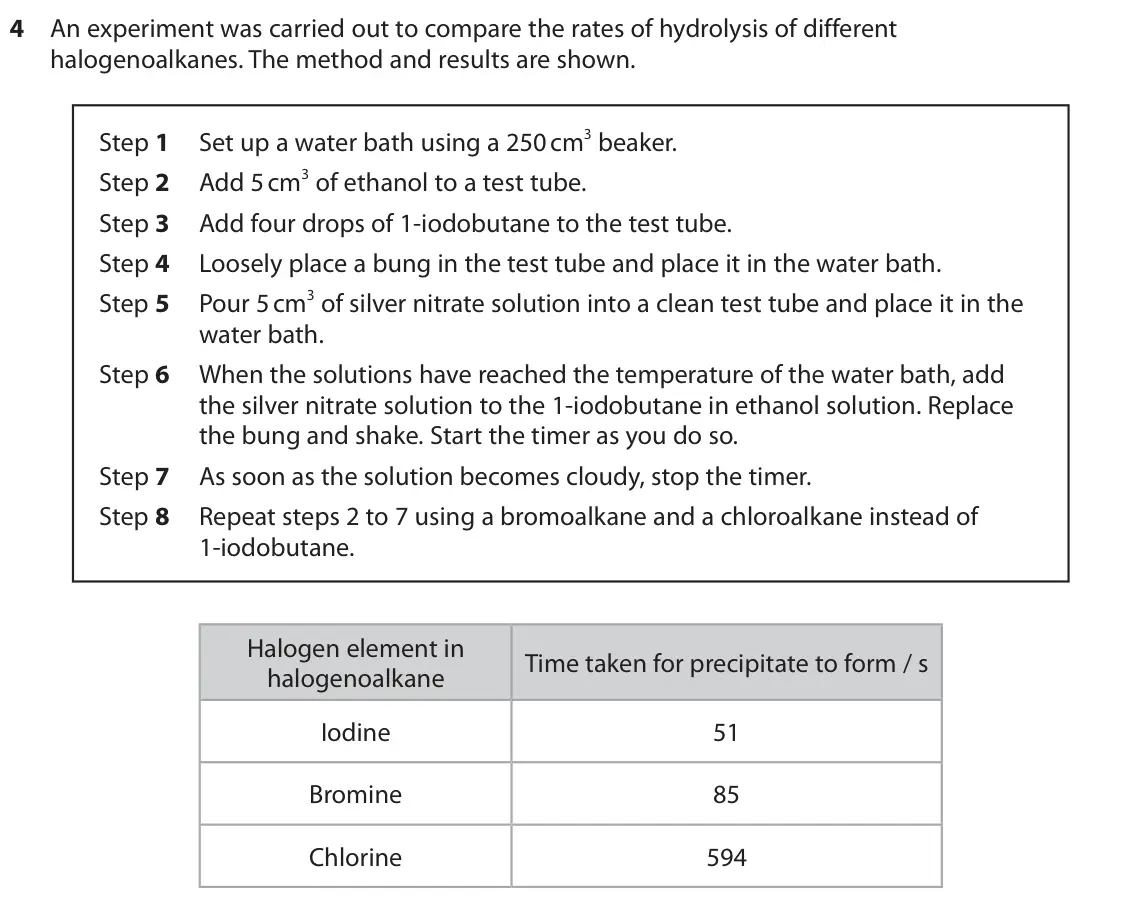
Q17(a)(ii)
The whole paper ↗
Q1(b)
The whole paper ↗
All 55 questions on Reactions of halides and hydrogen halides, as a list
- June 2025, AS Unit 2, Q15(c)(i) (1 mark): The equation for the reaction of concentrated sulfuric acid with potassium chloride is shown. H2SO4 + KCl → HCl + KHSO4 State why this is not a redox reaction.
- June 2025, AS Unit 2, Q15(c)(ii) (1 mark): The half-equation for the oxidation of iodide ions is shown. 2I– → I2 + 2e– The half-equation for the reduction of concentrated sulfuric acid to hydrogen sulfid
- June 2025, AS Unit 2, Q15(c)(iii) (2 marks): Explain the difference in the reaction of concentrated sulfuric acid with chloride ions and with iodide ions. (2)
- June 2025, AS Unit 3, Q2(b)(i) (2 marks): State the expected observations when acidified silver nitrate is added to each of these ions. (2) Chloride ion Bromide ion Iodide ion
- June 2025, AS Unit 3, Q2(b)(ii) (2 marks): Explain how the identity of the halide ion can be confirmed. (2)
- June 2025, AS Unit 3, Q3(b)(ii) (1 mark): Identify, by name or formula, one ion which might be present in tap water that might cause the formation of a white precipitate on the left-hand side of the fil
- June 2025, Unit 6, Q1(a)(iii) (2 marks): A white precipitate forms The formula (2) on adding a mixture of two of the anion in A is Cl–. solutions to a solution of A. The white precipitate dissolves on
- January 2025, AS Unit 2, Q9 (1 mark): Concentrated sulfuric acid reacts with sodium iodide. What is one role of the sulfuric acid? A oxidising agent B reducing agent C proton acceptor D lone pair do
- January 2025, AS Unit 3, Q1(b)(ii) (3 marks): To another test tube of the solution, the student added silver nitrate solution. A pale yellow precipitate was observed. The student then added an excess of dil
- October 2024, AS Unit 2, Q9 (1 mark): Which substance is formed when concentrated sulfuric acid reacts with solid potassium chloride? A Cl2 B S C H2S D KHSO4
- October 2024, AS Unit 3, Q1(a)(ii) (3 marks): Describe how the presence of chloride ions in the solutions of X, Y and Z could be identified and confirmed. (3)
- October 2024, Unit 6, Q1(a)(i) (4 marks): Complete the table to show, by name or formula, the products of the tests. (4) Test Observation Name or formula of product Aqueous silver nitrate and A yellow p
- June 2024, AS Unit 2, Q8 (1 mark): Two tests were performed on an unknown ionic compound. Silver nitrate solution was added to an aqueous solution of the compound, forming a white precipitate. A
- June 2024, AS Unit 3, Q2(c) (2 marks): Explain why an orange colour was seen in the round‑bottomed flask when it was first gently heated in Step 4. (2)
- June 2024, Unit 6, Q5(b)(iii) (2 marks): Give a chemical test, with the expected result, to confirm the identity of the halide ion in a sample of NH4X. (2)
- June 2024 (R), AS Unit 2, Q10 (1 mark): Which statement about the reaction between concentrated sulfuric acid and potassium bromide is correct? A bromide ions are reduced B hydrogen bromide and hydrog
- June 2024 (R), AS Unit 2, Q13 (1 mark): Compound X gives a red flame test and a solution of X produces a white precipitate when added to nitric acid and silver nitrate solution. Which could be compoun
- June 2024 (R), AS Unit 3, Q4(e) (1 mark): Under these conditions, all the silver halide precipitates can appear to be white. Identify, by name or formula, a compound, the solutions of which can be used
- January 2024, Unit 5, Q17(a)(ii) (5 marks): You are provided with three equimolar solutions of the three isomers. Suggest how you would quantitatively determine the relative numbers of free chloride ions
- January 2024, Unit 6, Q1(b) (3 marks): Adding dilute nitric acid followed by aqueous silver nitrate to A and B resulted in both forming precipitates. The student was not certain, but suggested that t
- October 2023, AS Unit 2, Q8 (1 mark): When sodium bromide reacts with concentrated sulfuric acid, sodium hydrogensulfate is always formed. What other product(s) are formed in this reaction? A hydrog
- October 2023, AS Unit 2, Q19(a)(i) (1 mark): State the colour of the solid in Step 3. (1)
- October 2023, AS Unit 3, Q1(b)(i) (1 mark): Identify, by name or formula, the three anions that could be present. (1)
- October 2023, AS Unit 3, Q1(b)(ii) (4 marks): Compounds A, B and C each contain a different anion. Describe the chemical tests on the precipitates formed in (b) that could be used to confirm which anion was
- June 2023, AS Unit 3, Q1(a)(ii) (1 mark): Aqueous silver nitrate, acidified with dilute nitric acid, was added to a sample of solid A dissolved in distilled water. A yellow precipitate formed. Identify,
- June 2023, AS Unit 3, Q1(a)(iv) (2 marks): The anion present in A can be shown by a different test on solid A. Give a suitable different test with the expected result to show the identity of this anion.
- June 2023, Unit 6, Q1(a)(iii) (1 mark): A few drops of dilute (1) nitric acid were added to 5 cm3 of a fresh sample of P The formula of the A few drops of aqueous A white precipitate silver nitrate we
- June 2023, Unit 6, Q1(b) (2 marks): State why, in the silver nitrate test on P, the nitric acid was not needed in this case. Justify your answer by considering the role of nitric acid in the silve
- January 2023, AS Unit 2, Q12 (1 mark): A fixed amount of concentrated H2SO4 is reacted separately with an excess of four solid potassium halides. In which reaction would the greatest number of moles
- January 2023, AS Unit 3, Q1(b) (2 marks): Q is a Group 1 halide which produces a lilac colour in a flame test. When a few drops of dilute nitric acid and aqueous silver nitrate are added to a solution o
- January 2023, Unit 6, Q1(d)(i) (1 mark): Identify, by name or formula, two anions which might give this precipitate. (1)
- January 2023, Unit 6, Q1(d)(ii) (2 marks): The precipitate formed in (d)(i) was separated from the mixture and aqueous ammonia was added. Describe how this test allows the student to distinguish between
- January 2023, Unit 6, Q1(d)(iii) (2 marks): Explain why, with solution A, the precipitate must be separated before adding aqueous ammonia. (2)
- October 2022, AS Unit 2, Q21(b) (6 marks): Concentrated sulfuric acid reacts with solid potassium chloride and with solid potassium iodide. Compare and contrast these reactions to show the difference in
- October 2022, AS Unit 3, Q1(b)(ii) (3 marks): State the test you would carry out on separate solutions of sodium bromide and barium chloride to show the anions present. Include the positive result for each
- June 2022, AS Unit 2, Q16(c) (1 mark): Hydrogen bromide and hydrogen iodide reduce sulfuric acid. Identify, by name or formula, the compound produced containing sulfur with its lowest oxidation numbe
- June 2022, AS Unit 3, Q2(c)(ii) (3 marks): Describe a test and the expected result to confirm the presence of the chloride ion in the white solid. (3)
- June 2022, Unit 6, Q1(a)(ii) (2 marks): The white precipitate is separated from the solution. Give a test on the precipitate and its positive result to confirm the identity of the anion in A. (2) Test
- January 2022, AS Unit 2, Q17 (1 mark): Four tests used to identify ions are shown: 1 flame test 2 addition of acidified barium nitrate solution 3 addition of acidified silver nitrate solution 4 addit
- January 2022, AS Unit 3, Q1(a)(i) (1 mark): State what would be seen on the addition of acidified silver nitrate solution to an aqueous solution of NH4Cl. (1)
- January 2022, AS Unit 3, Q3(b) (1 mark): Suggest why the red precipitate of silver chromate(VI) only forms after all the chloride ions have reacted. (1)
- October 2021, AS Unit 2, Q17 (1 mark): Solid potassium bromide reacts with concentrated sulfuric acid. Which of these substances does not form? A bromine B hydrogen bromide C hydrogen sulfide D sulfu
- October 2021, AS Unit 3, Q1(b) (2 marks): An unlabelled bottle was thought to contain solid strontium chloride. A sample of the solid was dissolved in distilled water for tests to identify the anion. Co
- June 2021, AS Unit 2, Q16 (1 mark): Which silver halides are soluble in concentrated aqueous ammonia? A AgBr and AgI B AgCl and AgI C AgCl and AgBr D AgCl only
- January 2021, AS Unit 2, Q6(a) (1 mark): Which of these would not be seen? (1) A misty fumes B black solid C yellow solid D dense white smoke
- January 2021, AS Unit 2, Q6(b) (1 mark): One of the reaction products is the gas H2S. What is the change in oxidation number of sulfur as H2S forms? (1) A −8 B −6 C −2 D +6
- January 2021, AS Unit 2, Q10 (1 mark): Which of these increases as Group 7 is descended? A oxidising ability of the molecular halogens B reducing ability of the halide ions C electrostatic attraction
- January 2021, AS Unit 2, Q22(c)(i) (3 marks): Describe a chemical test on a solution of these crystals to confirm that the impurities present are chloride ions rather than bromide ions. Include the expected
- January 2021, AS Unit 3, Q1(a)(iv) (3 marks): The student then mixed 1 cm3 samples of the remaining solutions as shown in Table 1. Solutions mixed Observation B and D no change B and E cream precipitate D a
- October 2020, AS Unit 2, Q9 (1 mark): The products of the reaction of sodium fluoride with concentrated sulfuric acid can be predicted by considering the trends for the other sodium halides. Which g
- October 2020, AS Unit 3, Q2(a) (3 marks): A student was provided with aqueous solutions of four compounds: hydrochloric acid potassium carbonate silver nitrate sodium chloride Four bottles, labelled B,
- January 2020, AS Unit 2, Q10(a) (1 mark): Which is correct for silver iodide? (1) Solubility in concentrated Colour of precipitate aqueous ammonia A yellow insoluble B yellow soluble C cream insoluble D
- January 2020, AS Unit 2, Q16(b) (4 marks): Compare and contrast the reactions of concentrated sulfuric acid with solid potassium chloride and with solid potassium bromide. (4)
- June 2019, AS Unit 2, Q5 (1 mark): Potassium chloride reacts with concentrated sulfuric acid, producing misty fumes. It can be deduced that A sulfuric acid is acting as an oxidising agent B chlor
- June 2019, AS Unit 2, Q15(a) (1 mark): What is the white solid, X? (1) A lithium chloride B calcium chloride C strontium bromide D barium bromide
Questions, mark schemes and examiner’s reports are © Pearson Edexcel, from their published past papers. Plumi isn’t affiliated with any exam board. Want whole papers? Edexcel International A Level Chemistry past papers.
The Plumi iPad app also offers exam-style questions with AI feedback on your handwritten working.