 plumi
Redox reactions and disproportionation of halogens: Edexcel International A Level Chemistry questions
Edexcel International A Level Chemistry past-paper questions on 8.C.2 Redox reactions and disproportionation of halogens, 2019–2025, with mark schemes and examiner’s reports where available.
Paper
All papers
Exam
All years
Calculations
Q15(b)
The whole paper ↗
Q4(d)
The whole paper ↗
Q19(b)(i)
The whole paper ↗
Q3(c)
The whole paper ↗
- Your answer
Q24(b)(i)
The whole paper ↗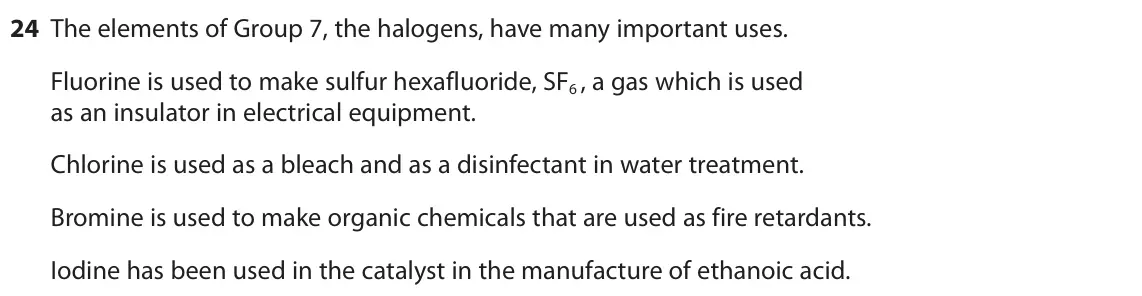
Q24(b)(ii)
The whole paper ↗Q24(b)(iii)
The whole paper ↗Q22(c)(i)
The whole paper ↗
Q22(d)
The whole paper ↗Q18(a)
The whole paper ↗
Q22(c)
The whole paper ↗
Q22(a)(i)
The whole paper ↗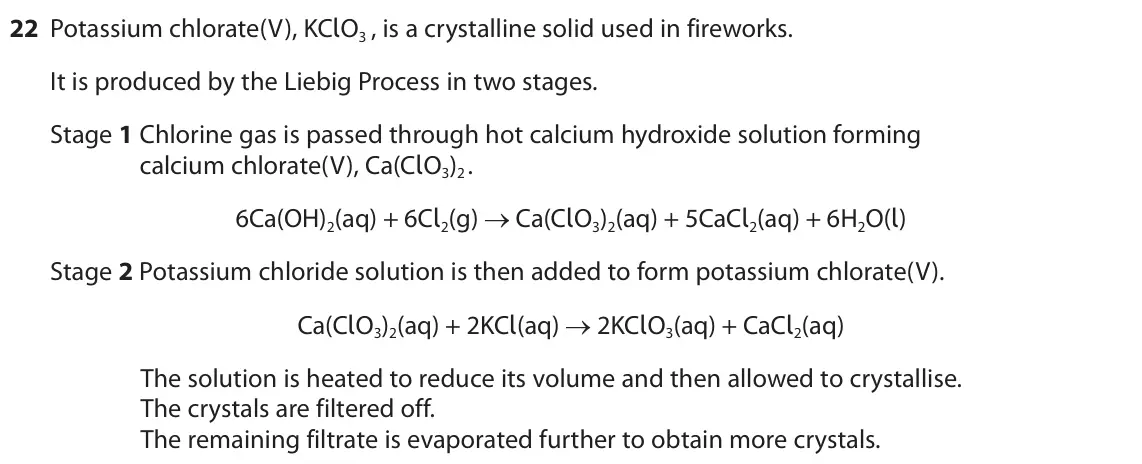
Q22(b)
The whole paper ↗- Your answer
All 15 questions on Redox reactions and disproportionation of halogens, as a list
- June 2025, AS Unit 2, Q15(b) (2 marks): Chlorine is used to treat drinking water. Cl2(g) + H2O(l) HClO(aq) + HCl(aq) By considering oxidation numbers, show that this equation represents a disproport
- June 2025, AS Unit 3, Q4(d) (1 mark): State the purpose of the sodium hydroxide. (1)
- October 2024, AS Unit 2, Q19(b)(i) (3 marks): Explain why this is a disproportionation reaction by referring to relevant oxidation numbers. (3)
- June 2024, AS Unit 3, Q3(c) (2 marks): The sodium hydroxide solution absorbs excess chlorine. Write the equation for the reaction between cold, dilute sodium hydroxide and chlorine. State symbols are
- June 2024 (R), AS Unit 2, Q9 (1 mark): What are the only products formed when chlorine reacts with cold aqueous sodium hydroxide? A sodium chloride, sodium chlorate(I) and water B sodium chloride, so
- January 2024, AS Unit 2, Q24(b)(i) (1 mark): Give the formula of the chlorine-containing species present at highest concentration in household bleach at pH 12. (1)
- January 2024, AS Unit 2, Q24(b)(ii) (3 marks): Explain why mixing strong acid with bleach is dangerous. Justify your answer using the equilibria shown. (3)
- January 2024, AS Unit 2, Q24(b)(iii) (2 marks): On heating, NaClO disproportionates to form sodium chloride and sodium chlorate(V). Give the equation for this disproportionation reaction. State symbols are no
- June 2023, AS Unit 2, Q22(c)(i) (3 marks): State the classification of this reaction. Justify your answer in terms of the relevant oxidation numbers. (3)
- June 2023, AS Unit 2, Q22(d) (2 marks): Toilet cleaners that remove limescale should not be mixed with chlorine‑based disinfectants. Explain, using the relevant equation, why these two types of toilet
- January 2023, AS Unit 2, Q18(a) (3 marks): State the type of reaction occurring in the production of Ca(ClO)2 . Justify your answer using oxidation numbers. (3)
- January 2022, AS Unit 2, Q22(c) (6 marks): Compare and contrast the reactions of chlorine with • water • cold, dilute aqueous alkali • hot, concentrated aqueous alkali Include an equation for each reacti
- January 2021, AS Unit 2, Q22(a)(i) (1 mark): Write the overall equation for the Liebig Process. State symbols are not required. (1)
- January 2021, AS Unit 2, Q22(b) (3 marks): Explain the type of reaction that takes place in Stage 1 of the Liebig Process, using oxidation numbers. 6Ca(OH)2(aq) + 6Cl2(g) → Ca(ClO3)2(aq) + 5CaCl2(aq) + 6
- January 2020, AS Unit 2, Q9 (1 mark): Iodine reacts with hot sodium hydroxide solution. a NaOH(aq) + b I2(aq) → c NaI(aq) + d NaIO3(aq) + e H2O(l) What are the coefficients (a, b, c, d and e) needed
Questions, mark schemes and examiner’s reports are © Pearson Edexcel, from their published past papers. Plumi isn’t affiliated with any exam board. Want whole papers? Edexcel International A Level Chemistry past papers.
The Plumi iPad app also offers exam-style questions with AI feedback on your handwritten working.