 plumi
Group 7 trends and displacement reactions: Edexcel International A Level Chemistry questions
Edexcel International A Level Chemistry past-paper questions on 8.C.1 Group 7 trends and displacement reactions, 2019–2025, with mark schemes and examiner’s reports where available.
Paper
All papers
Exam
All years
Calculations
- Your answer
Q15(a)
The whole paper ↗
- Your answer
- Your answer
- Your answer
- Your answer
- Your answer
- Your answer
- Your answer
Q3(c)(iii)
The whole paper ↗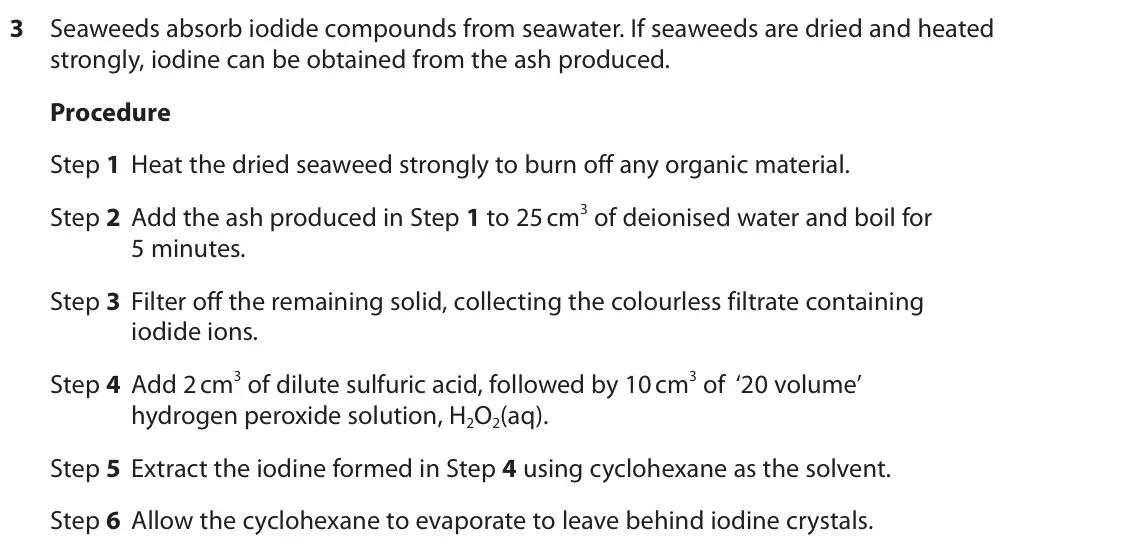
Q19(c)
The whole paper ↗
- Your answer
Q1(c)(i)
The whole paper ↗
Q1(c)(ii)
The whole paper ↗- Your answer
- Your answer
Q16(a)
The whole paper ↗
Q22(b)(ii)
The whole paper ↗
- Your answer
- Your answer
All 25 questions on Group 7 trends and displacement reactions, as a list
- June 2025, AS Unit 2, Q4 (1 mark): An aqueous solution of potassium chloride is added to a solution of iodine in hexane and shaken. After a time, two layers are formed. What is the colour of each
- June 2025, AS Unit 2, Q15(a) (1 mark): When chlorine water is added to a solution of potassium bromide, a pale brown colour is seen. Write an ionic equation for this reaction. State symbols are not r
- January 2025, AS Unit 2, Q11 (1 mark): Which is a displacement reaction that results in a visible colour change in solution? A 2NaCl + At2 → 2NaAt + Cl2 B 2NaBr + I2 → 2NaI + Br2 C 2NaI + Br2 → 2NaBr
- October 2024, AS Unit 2, Q10 (1 mark): What is the colour of the solution formed when iodine dissolves in cyclohexane? A blue-black B grey C purple D yellow
- June 2024, AS Unit 1, Q8 (1 mark): Which is the strongest oxidising agent in these displacement reactions? Cl2 + 2Br– → Br2 + 2Cl– Br2 + 2I– → 2Br– + I2 A chlorine B bromide ions C bromine D iodi
- June 2024, AS Unit 2, Q12 (1 mark): The boiling temperatures of the halogens increase down Group 7 because on descending the group the A bond polarities increase B covalent bond strengths increase
- June 2024, AS Unit 2, Q14 (1 mark): Cyclohexane (density = 0.78 g cm–3) and aqueous iodine (density > 1.0 g cm–3) are shaken and left to stand. What colours are the two layers that form? lower lay
- June 2024 (R), AS Unit 2, Q8 (1 mark): Which statement about the elements in Group 7 is not correct? A they all exist as diatomic molecules B electronegativity decreases down the group C reactivity i
- January 2024, AS Unit 2, Q12 (1 mark): Which row shows the correct trends down the group for the elements of Group 7? Reactivity as Boiling temperature Electronegativity oxidising agent A increases d
- January 2024, AS Unit 3, Q3(c)(iii) (1 mark): State the colour of the aqueous iodine solution formed in Step 4. (1)
- October 2023, AS Unit 2, Q19(c) (2 marks): Iodine may be obtained by bubbling chlorine gas through aqueous potassium iodide. When the reaction is complete, hexane is added and the mixture shaken. Two lay
- January 2023, AS Unit 2, Q11 (1 mark): Which equation shows a redox reaction that would not be expected to occur, based on the trend in reactivity of the halogens? A I2(aq) + 2At–(aq) → At2(aq) + 2I–
- January 2023, AS Unit 3, Q1(c)(i) (2 marks): Give an ionic equation for this reaction. Include state symbols. (2)
- January 2023, AS Unit 3, Q1(c)(ii) (3 marks): A portion of the organic liquid P is added to the red‑brown aqueous solution formed in (c)(i). The mixture is shaken and then allowed to stand for several minut
- October 2022, AS Unit 2, Q15 (1 mark): Which trend is not correct as Group 7 is descended? A atomic radius of the elements increases B boiling temperature of the elements increases C electronegativit
- June 2022, AS Unit 2, Q8 (1 mark): Aqueous chlorine is added to an aqueous solution of potassium iodide. A non-polar organic solvent is then added and the mixture is shaken. The layers are allowe
- June 2022, AS Unit 2, Q16(a) (2 marks): Descending the group from fluorine to iodine, the electronegativity of the atoms decreases even though their nuclear charge increases. Explain the trend in elec
- January 2022, AS Unit 2, Q22(b)(ii) (2 marks): Explain the trend in electronegativity down Group 7. (2)
- October 2021, AS Unit 2, Q14 (1 mark): Which statement about the Group 7 elements chlorine, bromine and iodine is not correct? A boiling temperature increases down the group B reactivity increases do
- October 2021, AS Unit 2, Q15 (1 mark): When iodine is dissolved in a non-polar organic solvent, the solution formed is A purple B orange C colourless D brown
- January 2021, AS Unit 2, Q10 (1 mark): Which of these increases as Group 7 is descended? A oxidising ability of the molecular halogens B reducing ability of the halide ions C electrostatic attraction
- January 2020, AS Unit 2, Q6(a) (1 mark): Which statement is correct? (1) A iodide ions oxidise chlorine B iodide ions reduce chlorine C chlorine reduces iodide ions D chlorine is neither oxidised nor r
- January 2020, AS Unit 2, Q6(b) (1 mark): When the reaction is complete, 10 cm3 of cyclohexane (density = 0.79 g cm−3) is added. The mixture is shaken and left to settle into two layers. Which descripti
- January 2020, AS Unit 3, Q1(a)(i) (2 marks): Bromine water was added to separate solutions of sodium chloride and sodium iodide. State one different observation for each reaction. (2) sodium chloride sodiu
- June 2019, AS Unit 2, Q19(b)(i) (2 marks): State the colour of each layer after separation. (2) Aqueous layer Cyclohexane layer
Questions, mark schemes and examiner’s reports are © Pearson Edexcel, from their published past papers. Plumi isn’t affiliated with any exam board. Want whole papers? Edexcel International A Level Chemistry past papers.
The Plumi iPad app also offers exam-style questions with AI feedback on your handwritten working.