 plumi
Rate-determining steps and mechanisms (SN1 and SN2): Edexcel International A Level Chemistry questions
Edexcel International A Level Chemistry past-paper questions on 11.1.5 Rate-determining steps and mechanisms (SN1 and SN2), 2019–2025, with mark schemes and examiner’s reports where available.
Paper
All papers
Exam
All years
Calculations
- Your answer
Q18(b)
The whole paper ↗
Q18(a)
The whole paper ↗
Q18(b)
The whole paper ↗
Q19(a)(ii)
The whole paper ↗
Q19(b)
The whole paper ↗Q1(d)
The whole paper ↗ Your answer
- Your answer
Q15(c)(iii)
The whole paper ↗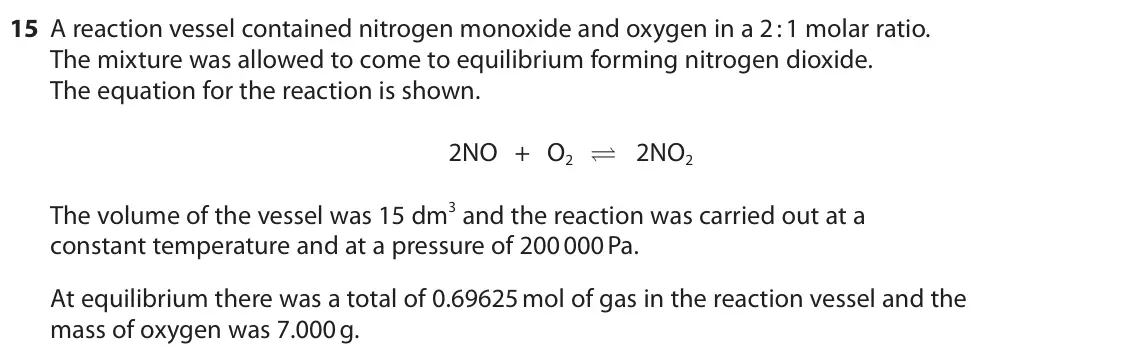
Q15(c)(iv)
The whole paper ↗- Your answer
Q19(b)
The whole paper ↗
- Your answer
Q2(c)
The whole paper ↗ Your answer
Q20(b)
The whole paper ↗
- Your answer
Q18(b)
The whole paper ↗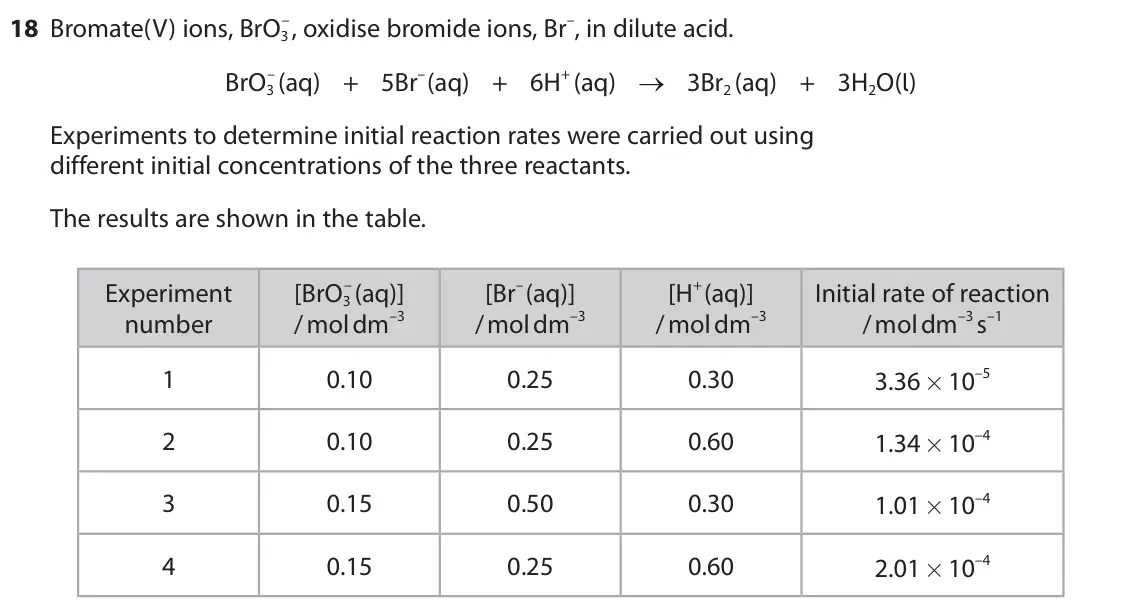
Q19(a)(iii)
The whole paper ↗
- Your answer
All 24 questions on Rate-determining steps and mechanisms (SN1 and SN2), as a list
- June 2025, Unit 4, Q11 (1 mark): A chloroalkane, RCl, undergoes hydrolysis according to the equation shown. RCl + OH− → ROH + Cl− The rate equation is rate = k[RCl] Which chloroalkane is most l
- June 2025, Unit 4, Q18(b) (2 marks): Two possible mechanisms have been suggested by students carrying out this reaction. Mechanism 1 Step 1 2H2O2(aq) → [H4O4] (aq) slow transition state [H4O4](aq)
- January 2025, Unit 4, Q18(a) (6 marks): Halogenoalkanes are hydrolysed by aqueous alkali to form alcohols. RX + OH– → ROH + X– The rate equations for these reactions with two halogenoalkanes are shown
- October 2024, Unit 4, Q18(b) (1 mark): Deduce the rate equation for the reaction using the mechanism in (a)(i). (1)
- October 2024, Unit 4, Q19(a)(ii) (3 marks): Show that the data in the table are consistent with the SN2 mechanism for this hydrolysis of 2‑bromobutane. (3)
- October 2024, Unit 4, Q19(b) (3 marks): 2‑Bromo‑2‑methylbutane, (CH3)2CBrCH2CH3 , can also be hydrolysed with hydroxide ions. The mechanism for the reaction is SN1 . The reaction profile is shown. Ene
- June 2024, Unit 4, Q1(d) (1 mark): The first four steps in the reaction mechanism are shown. Step 1 – + H+ → BrO3H BrO3 Step 2 BrO3H + H+ → BrO3H2 + Step 3 + + Br– → Br2O2 + H2O BrO3H2 Step 4 Br2
- June 2024, Unit 4, Q9 (1 mark): The rate equation for the hydrolysis of a halogenoalkane, RX, in aqueous alkali is shown. rate = k [RX] Which of these statements is true? A the mechanism invol
- October 2023, Unit 4, Q15(c)(iii) (1 mark): State why the reaction is unlikely to proceed in a single step. (1)
- October 2023, Unit 4, Q15(c)(iv) (2 marks): A student proposed the mechanism shown for this reaction. 2NO N2O2 slow N2O2 + O2 → 2NO2 fast Justify whether or not this mechanism is consistent with the ove
- June 2023, Unit 4, Q7 (1 mark): The decomposition of hydrogen peroxide is catalysed by iodide ions. I– 2H2O2(aq) 2H2O(l) + O2(g) The mechanism for this reaction is shown. Step 1: H2O2(aq) + I–
- June 2023, Unit 4, Q19(b) (4 marks): Draw the SN2 mechanism for the reaction of 1-bromopropane with hydroxide ions in aqueous solution. Include curly arrows, and relevant dipoles and lone pairs. (4
- January 2023, Unit 4, Q3 (1 mark): Two chemicals, E and F, react to form products G and H. E + 2F → G + H The mechanism for the reaction occurs in two steps via the formation of an intermediate J
- October 2022, Unit 4, Q2(c) (1 mark): The reaction mechanism occurs in three steps. Step 1 NO + NO N2O2 Step 2 N2O2 + H2 → N2O + H2O Step 3 N2O + H2 → N2 + H2O Which is the rate-determining step i
- June 2022, Unit 4, Q20(b) (3 marks): Draw the mechanism for this reaction that is consistent with your rate equation. Include curly arrows, and any relevant dipoles and lone pairs of electrons. (3)
- January 2022, Unit 4, Q10 (1 mark): When a single enantiomer of 2‑iodobutane reacts with sodium hydroxide, the product is a mixture of enantiomers. This is because A the reaction is a nucleophilic
- January 2022, Unit 4, Q18(b) (1 mark): Give one possible reason why the rate equation shows that the reaction cannot proceed in one step. (1)
- January 2022, Unit 4, Q19(a)(iii) (2 marks): KCN is a homogeneous catalyst in this reaction. Justify this description by referring to the mechanism. (2)
- October 2021, Unit 4, Q18 (6 marks): *18 The hydrolysis of halogenoalkanes by alkali is a nucleophilic substitution reaction. RX + OH− → ROH + X− The mechanism of this reaction for primary halogeno
- June 2021, Unit 4, Q5 (1 mark): The halogenoalkane 2-bromo-2-methylbutane was hydrolysed with sodium hydroxide solution, NaOH(aq). Which suggestion about the mechanism of this reaction is corr
- June 2021, Unit 4, Q6 (1 mark): Nitrogen monoxide and hydrogen react together to form nitrogen and water. 2NO + 2H2 → N2 + 2H2O The steps in the mechanism of the reaction are 2NO ⇌ N2O2 Step 1
- January 2021, Unit 4, Q7 (1 mark): Propanone reacts with iodine in the presence of a catalyst of dilute hydrochloric acid. The reaction occurs in aqueous solution. CH3COCH3 + I2 → CH3COCH2I + HI
- October 2020, Unit 4, Q5 (1 mark): The equation shows the hydrolysis of a bromoalkane. RBr + OH− → ROH + Br− The rate equation is rate = k[RBr] RBr is most likely to be A bromomethane B 2-bromopr
- January 2020, Unit 4, Q5 (1 mark): Which diagram shows the mechanism for the second order reaction between 1-bromoethane and potassium hydroxide in aqueous solution? Diagram 1 H H H H H H H į+ H
Questions, mark schemes and examiner’s reports are © Pearson Edexcel, from their published past papers. Plumi isn’t affiliated with any exam board. Want whole papers? Edexcel International A Level Chemistry past papers.
The Plumi iPad app also offers exam-style questions with AI feedback on your handwritten working.