 plumi
Optical activity as evidence for mechanisms: Edexcel International A Level Chemistry questions
Edexcel International A Level Chemistry past-paper questions on 15.A.3 Optical activity as evidence for mechanisms, 2019–2025, with mark schemes and examiner’s reports where available.
Paper
All papers
Exam
All years
Calculations
Q16(e)
The whole paper ↗
Q19(a)(iii)
The whole paper ↗
- Your answer
Q17(b)
The whole paper ↗
Q18(b)(ii)
The whole paper ↗
Q14(b)
The whole paper ↗
Q18(a)
The whole paper ↗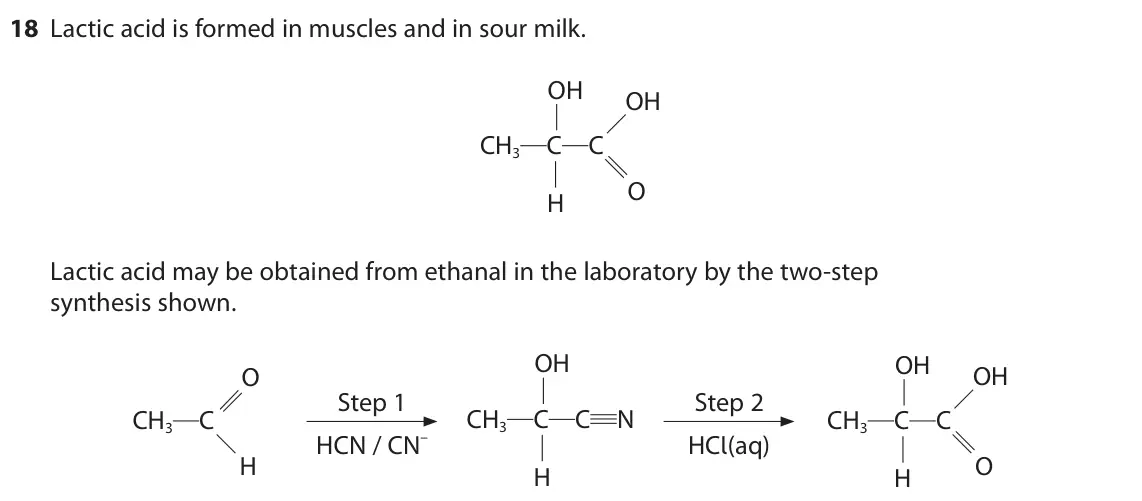
Q15(c)(iv)
The whole paper ↗
Q17(b)(iii)
The whole paper ↗
- Your answer
- Your answer
Q19(a)(ii)
The whole paper ↗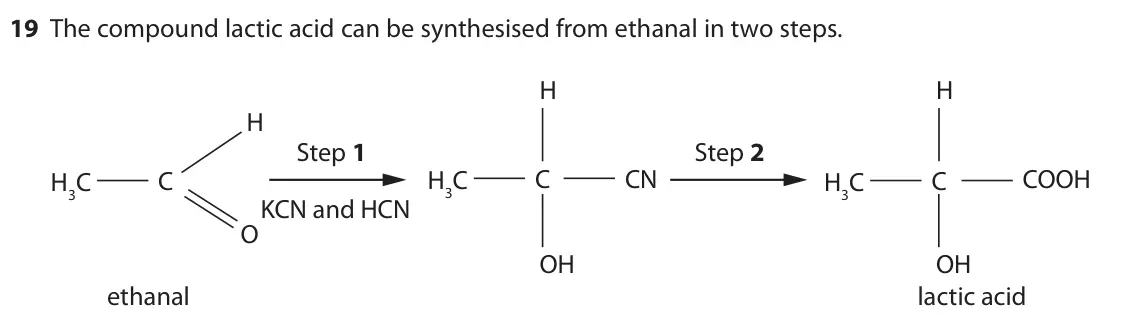
- Your answer
All 13 questions on Optical activity as evidence for mechanisms, as a list
- January 2025, Unit 4, Q16(e) (4 marks): Pentan‑2‑one and pentan-3-one both react with hydrogen cyanide in the presence of KCN. With pentan‑2‑one a racemic mixture is formed but with pentan‑3‑one there
- October 2024, Unit 4, Q19(a)(iii) (3 marks): In one experiment, a single stereoisomer of 2‑bromobutane was hydrolysed. Explain the stereochemistry of the product of this reaction. (3)
- June 2024, Unit 4, Q10 (1 mark): Propanone reacts with HCN in the presence of KCN. Which of these statements is incorrect? A CN– acts as a nucleophile in the reaction B a racemic mixture is for
- June 2024, Unit 5, Q17(b) (3 marks): One of the steps in the synthesis is shown. N H H N H H N H CN– / H+ Explain, with reference to the mechanism, why this step in the reaction sequence will not p
- January 2024, Unit 4, Q18(b)(ii) (3 marks): Explain why the 2‑hydroxypropanoic acid, CH3CH(OH)COOH, produced is not optically active. (3)
- October 2023, Unit 4, Q14(b) (2 marks): Explain why the product of the reaction is not optically active even though it contains a chiral carbon atom. (2)
- January 2023, Unit 4, Q18(a) (6 marks): Explain why lactic acid formed in muscles is optically active while lactic acid obtained using the laboratory synthesis is not. You should define any terms you
- October 2022, Unit 4, Q15(c)(iv) (2 marks): Explain, with reference to your mechanism in (c)(ii), why the lactic acid formed in this process is racemic. (2)
- June 2022, Unit 4, Q17(b)(iii) (2 marks): Explain, with reference to the reaction mechanism, why this reaction produces a racemic mixture. (2)
- January 2022, Unit 4, Q9 (1 mark): Which of these reactions does not result in the formation of a racemic mixture? A but‑2‑ene with HCl B but‑1‑ene with HCl C propanal with HCN D propanone with H
- January 2022, Unit 4, Q10 (1 mark): When a single enantiomer of 2‑iodobutane reacts with sodium hydroxide, the product is a mixture of enantiomers. This is because A the reaction is a nucleophilic
- June 2021, Unit 4, Q19(a)(ii) (3 marks): A student predicted that the product of Step 1 would rotate the plane of plane-polarised light. Comment on this prediction. (3)
- January 2021, Unit 4, Q12 (1 mark): A sample of a bromoalkane, RBr, containing a single optical isomer reacts with hydroxide ions in an SN1 mechanism. RBr + OH− o ROH + Br− The alcohol formed is a
Questions, mark schemes and examiner’s reports are © Pearson Edexcel, from their published past papers. Plumi isn’t affiliated with any exam board. Want whole papers? Edexcel International A Level Chemistry past papers.
The Plumi iPad app also offers exam-style questions with AI feedback on your handwritten working.