 plumi
Experimental methods for measuring rates: Edexcel International A Level Chemistry questions
Edexcel International A Level Chemistry past-paper questions on 11.1.2 Experimental methods for measuring rates, 2019–2025, with mark schemes and examiner’s reports where available.
Paper
All papers
Exam
All years
Calculations
- Your answer
Q18(a)(i)
The whole paper ↗
Q18(a)(ii)
The whole paper ↗Q18(c)(ii)
The whole paper ↗
Q4(a)(i)
The whole paper ↗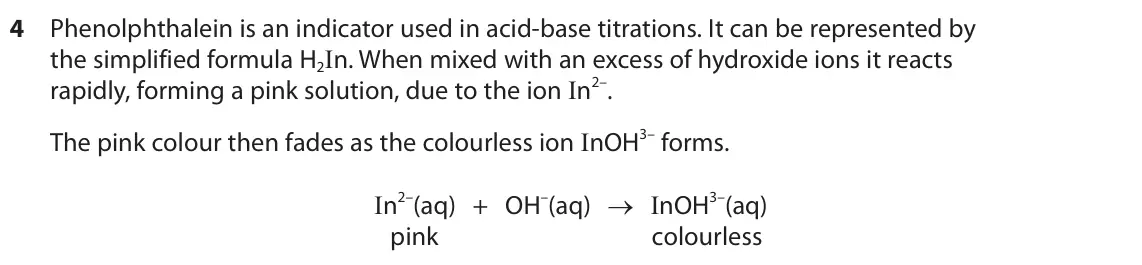
Q1(a)
The whole paper ↗ Your answer
Q3(a)(i)
The whole paper ↗
Q16(a)(i)
The whole paper ↗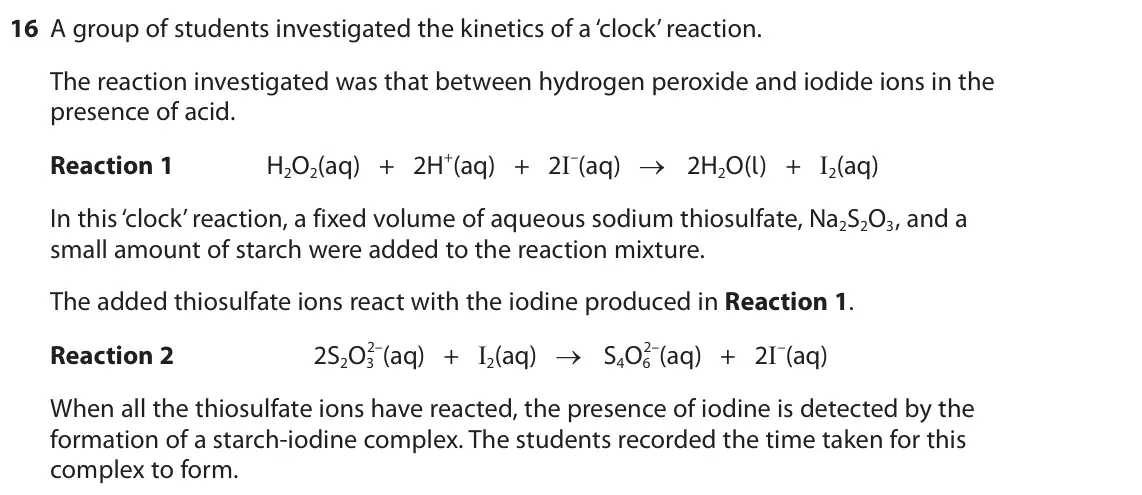
Q16(a)(ii)
The whole paper ↗Q16(b)(iii)
The whole paper ↗Q16(b)(iv)
The whole paper ↗Q1(a)
The whole paper ↗ Your answer
Q1(b)
The whole paper ↗Your answerQ15(c)(i)
The whole paper ↗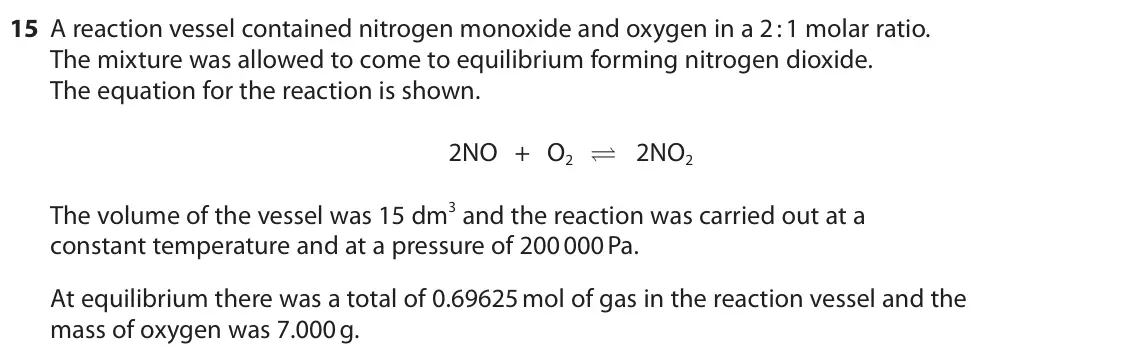
Q1(b)
The whole paper ↗ Your answer
Q17(a)(i)
The whole paper ↗
Q2(a)(i)
The whole paper ↗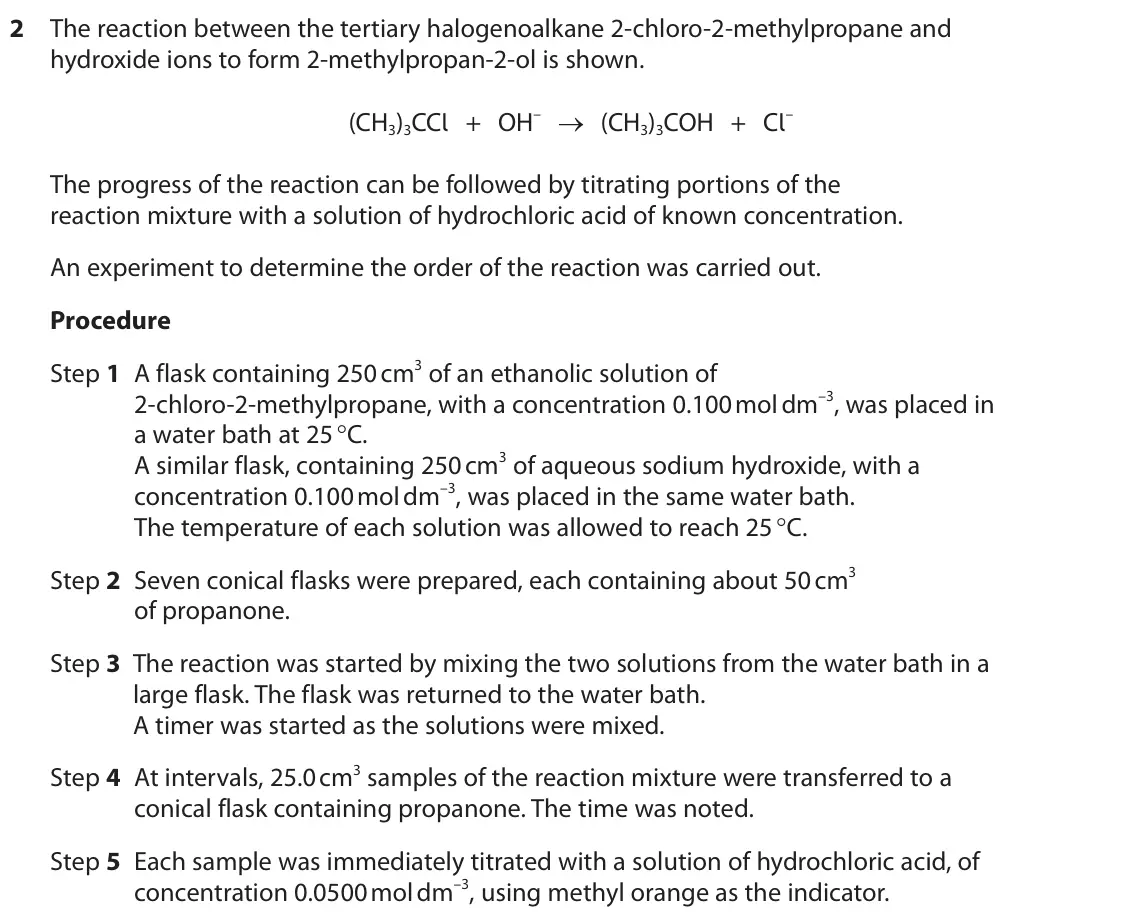
Q2(a)(ii)
The whole paper ↗- Your answer
Q4(a)
The whole paper ↗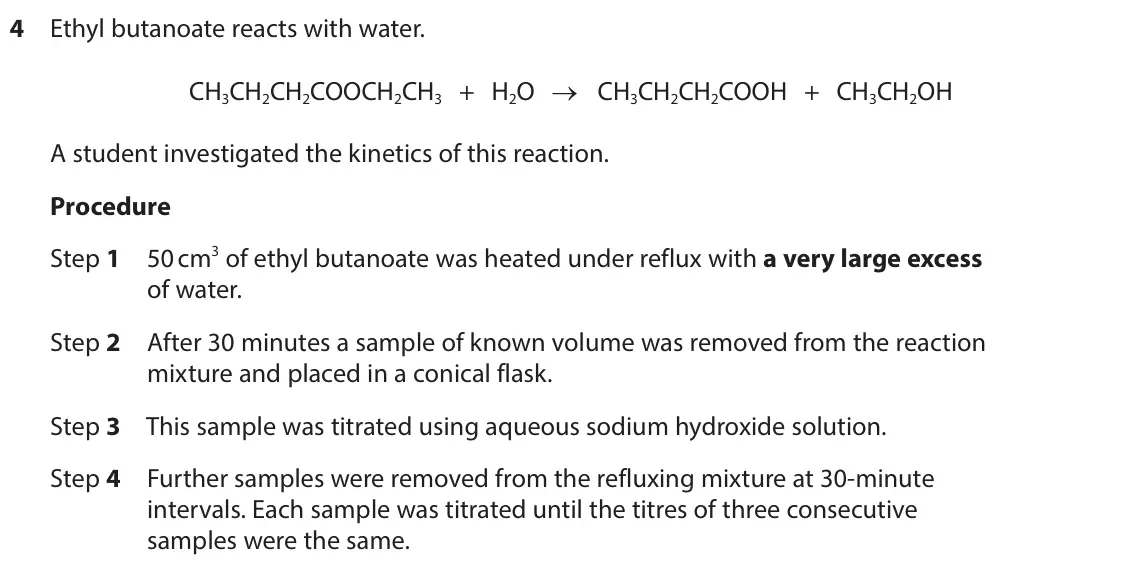
All 37 questions on Experimental methods for measuring rates, as a list
- June 2025, Unit 4, Q9 (1 mark): In an experiment to determine the rate of reaction between bromine and methanoic acid, which method would not be suitable? Br2(aq) + HCOOH(aq) → 2H+(aq) + 2Br−(
- June 2025, Unit 4, Q18(a)(i) (1 mark): The reaction in the sample stops immediately on removal from the reaction mixture. Suggest why this occurs. (1)
- June 2025, Unit 4, Q18(a)(ii) (1 mark): State why it is not necessary to calculate the concentration of hydrogen peroxide solution when trying to deduce the order of reaction with respect to hydrogen
- January 2025, Unit 4, Q18(c)(ii) (2 marks): The temperature of the reaction was changed to 75°C. Draw a line on the graph to show the possible results if this was the only change. Justify any similarities
- January 2025, Unit 6, Q4(a)(i) (1 mark): Give the name of the most suitable technique to monitor the concentration of In2– during the reaction. (1)
- June 2024, Unit 4, Q1(a) (1 mark): Which continuous monitoring method could be used to obtain kinetics data for this reaction? (1) A colorimetry B mass change C titration with sodium thiosulfate
- June 2024, Unit 6, Q3(a)(i) (2 marks): Explain why Step 3 effectively stops the reaction between potassium manganate(VII) and ethanedioate ions. (2)
- January 2024, Unit 4, Q16(a)(i) (1 mark): State the final colour of the mixture containing the starch‑iodine complex. (1)
- January 2024, Unit 4, Q16(a)(ii) (2 marks): Under appropriate conditions, the reciprocal of time can be used as an approximate measure of the initial rate of the reaction. Explain why the concentration of
- January 2024, Unit 4, Q16(b)(iii) (1 mark): All four mixtures contained 8.50 × 10⁻⁵ mol of sodium thiosulfate. Calculate the amount of iodine that had reacted with the sodium thiosulfate when the colour c
- January 2024, Unit 4, Q16(b)(iv) (2 marks): Calculate the rate of reaction, in mol dm–3 s–1, with respect to hydrogen peroxide using the answer from (b)(iii), the stoichiometry of Reaction 1 and data from
- October 2023, Unit 4, Q1(a) (1 mark): (CH3)2C (1) A colorimetry B measurement of change in volume C measurement of change in mass D quenching with ice‑cold water followed by titrating with acid
- October 2023, Unit 4, Q1(b) (1 mark): HCOOCH3(aq) + NaOH(aq) → HCOONa(aq) + CH3OH(aq) (1) A colorimetry B measurement of change in volume C measurement of change in mass D quenching with ice‑cold wa
- October 2023, Unit 4, Q15(c)(i) (1 mark): Give the reason why colorimetry can be used to monitor the rate of the reaction. (1)
- January 2023, Unit 4, Q1(b) (1 mark): Which two methods can be used for continuous monitoring of the progress of this reaction? (1) A colorimetry and titration B colorimetry and volume change C mass
- January 2023, Unit 4, Q17(a)(i) (3 marks): The rate of this reaction may be obtained by adding a fixed volume of sodium thiosulfate solution and a few drops of starch solution to the reaction mixture. Ex
- January 2023, Unit 6, Q2(a)(i) (1 mark): Give the expected colour change at the end‑point. (1)
- January 2023, Unit 6, Q2(a)(ii) (2 marks): Explain the effect on the volume of hydrochloric acid required if the titration was not carried out immediately after Step 4. (2)
- October 2022, Unit 4, Q1 (1 mark): Which continuous monitoring method could be used to obtain rate data for the reaction shown? C4H9Cl(l) + H2O(l) → C4H9OH(aq) + H+(aq) + Cl−(aq) A electrical con
- October 2022, Unit 6, Q4(a) (1 mark): Name the apparatus which is most suitable to remove the samples from the reaction mixture. (1)
- October 2022, Unit 6, Q4(b)(i) (1 mark): Give a reason why Vfinal – Vt is plotted on the y‑axis of the graph, rather than the concentration of sodium hydroxide solution for each titre. (1)
- October 2022, Unit 6, Q4(c) (2 marks): The student suggested placing ice in the conical flask before carrying out each titration. Explain whether or not this suggestion would improve the validity of
- June 2022, Unit 4, Q11(a) (1 mark): Which method would be most suitable for following this reaction? (1) A colorimetry B timing how long the solution takes to go cloudy C quenching and titrating w
- January 2022, Unit 6, Q3(a) (1 mark): Give one reason why the contents of beaker P are poured back into beaker Q in Step 3. (1)
- January 2022, Unit 6, Q3(b)(i) (2 marks): Explain why phenol is added to the reaction mixture. (2)
- January 2022, Unit 6, Q3(b)(ii) (1 mark): Give the colour of the reaction mixture before it turns colourless. (1)
- January 2022, Unit 6, Q3(b)(iii) (1 mark): Give the reason why the temperature is measured in Step 4. (1)
- January 2022, Unit 6, Q3(c)(i) (1 mark): Complete the table by calculating the remaining values of 1/t. (1)
- January 2022, Unit 6, Q3(c)(iii) (1 mark): State why the volume of KBr is proportional to the concentration of bromide ions in the reaction mixture. (1)
- October 2020, Unit 4, Q1 (1 mark): Bromine oxidises methanoic acid to carbon dioxide. The equation for the reaction is HCOOH(aq) + Br2(aq) → 2H+(aq) + 2Br −(aq) + CO2(g) Which of the following me
- October 2020, Unit 6, Q3(b) (2 marks): Explain the purpose of the phenol in this experiment. (2)
- October 2020, Unit 6, Q3(c) (1 mark): Suggest a way of making the disappearance of the methyl red colour easier to see. (1)
- October 2020, Unit 6, Q3(d)(i) (1 mark): State why the total volume of the mixture is kept constant. (1)
- October 2020, Unit 6, Q3(d)(iv) (1 mark): Reciprocal time (1/t) is used as a measure of rate in this experiment. Suggest the assumption on which this depends. Refer in your answer to the shape of a typi
- October 2020, Unit 6, Q3(d)(v) (2 marks): Another student accidentally measured 8.5 cm3 of potassium bromate(V) rather than 8.0 cm3 in Run 4. Explain whether or not this portion of potassium bromate(V)
- October 2020, Unit 6, Q3(e)(i) (1 mark): Give a reason why the potassium bromate(V) solution is first measured into a separate boiling tube rather than directly into the reaction mixture. (1)
- October 2020, Unit 6, Q3(f) (2 marks): State the changes that you would make to the procedure to obtain the data needed to determine the overall rate equation for the reaction between bromide and bro
Questions, mark schemes and examiner’s reports are © Pearson Edexcel, from their published past papers. Plumi isn’t affiliated with any exam board. Want whole papers? Edexcel International A Level Chemistry past papers.
The Plumi iPad app also offers exam-style questions with AI feedback on your handwritten working.