 plumi
Deducing orders from graphs and initial rates: Edexcel International A Level Chemistry questions
Edexcel International A Level Chemistry past-paper questions on 11.1.3 Deducing orders from graphs and initial rates, 2019–2025, with mark schemes and examiner’s reports where available.
Paper
All papers
Exam
All years
Calculations
Q18(a)(iii)
The whole paper ↗
Q18(a)(iv)
The whole paper ↗Q18(b)(ii)
The whole paper ↗
Q18(b)(iii)
The whole paper ↗Q4(a)(ii)
The whole paper ↗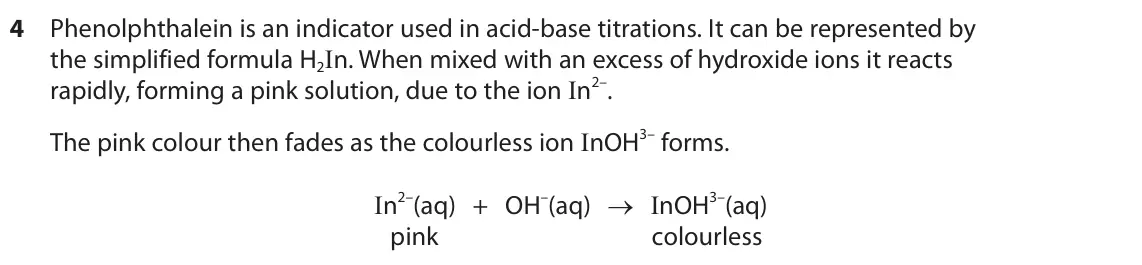
Q4(a)(iii)
The whole paper ↗Q4(a)(iv)
The whole paper ↗Q4(a)(v)
The whole paper ↗Q18(c)
The whole paper ↗
Q19(a)(ii)
The whole paper ↗
Q2(b)(ii)
The whole paper ↗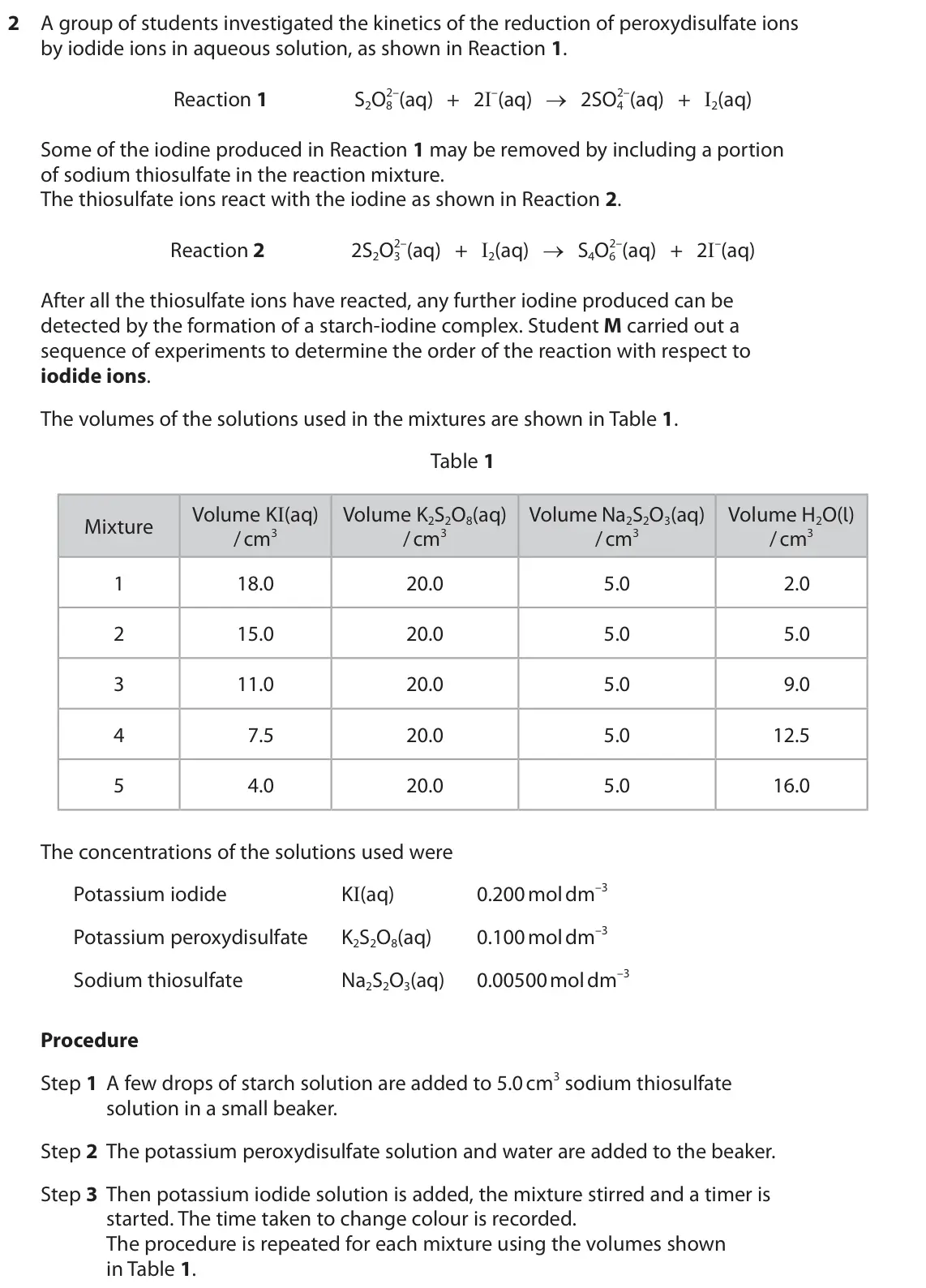
Q2(b)(iii)
The whole paper ↗Q16(a)(i)
The whole paper ↗
Q16(a)(ii)
The whole paper ↗Q16(b)(i)
The whole paper ↗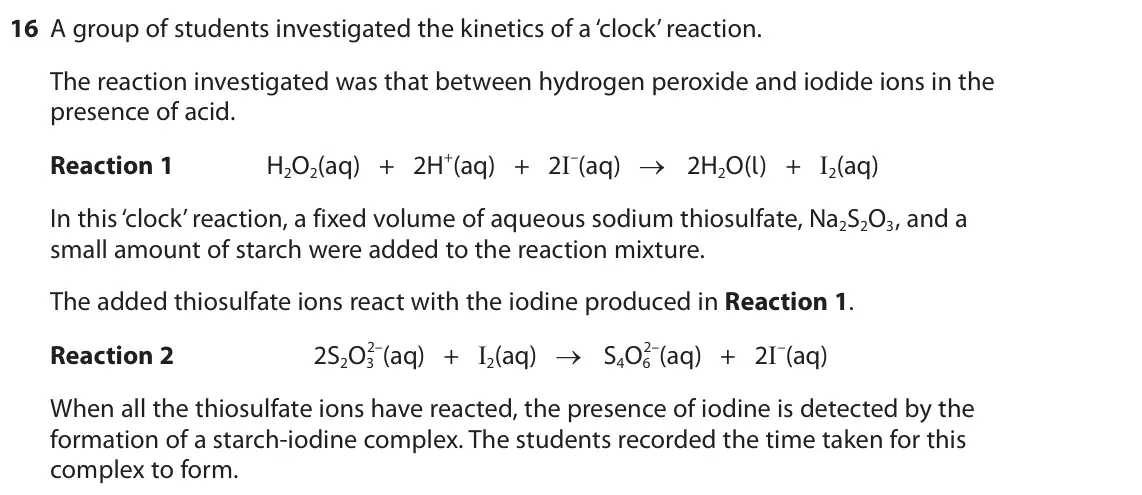
Q3(a)
The whole paper ↗ Your answer
Q18(a)(i)
The whole paper ↗
Q18(a)(ii)
The whole paper ↗Q18(a)(iii)
The whole paper ↗Q3(d)(iii)
The whole paper ↗
All 47 questions on Deducing orders from graphs and initial rates, as a list
- June 2025, Unit 4, Q18(a)(iii) (3 marks): Plot a graph of the volume of potassium manganate(VII) solution against time. (3)
- June 2025, Unit 4, Q18(a)(iv) (3 marks): Use your graph to show that the reaction is first order with respect to hydrogen peroxide. You must show your working on the graph. (3)
- January 2025, Unit 4, Q18(b)(ii) (3 marks): Plot a graph of reaction rate against volume of hydrogen peroxide. (3)
- January 2025, Unit 4, Q18(b)(iii) (1 mark): State and justify the reaction order with respect to hydrogen peroxide by using your graph. (1)
- January 2025, Unit 6, Q4(a)(ii) (3 marks): Plot a graph of the concentration of In2– against time. (3)
- January 2025, Unit 6, Q4(a)(iii) (2 marks): Determine two successive half-lives for the concentration of In2–. You must show your working on the graph. (2) First half‑life Second half‑life
- January 2025, Unit 6, Q4(a)(iv) (2 marks): Deduce the order with respect to In2–. Justify your answer. (2)
- January 2025, Unit 6, Q4(a)(v) (2 marks): Explain why the results of this experiment do not allow the overall order of the reaction to be determined. (2)
- October 2024, Unit 4, Q18(c) (1 mark): Sketch a line on the axes to show how the concentration of ethanal affects the rate of this reaction. (1) Rate / mol dm–3 s–1 [CH3CHO] / mol dm–3
- October 2024, Unit 4, Q19(a)(ii) (3 marks): Show that the data in the table are consistent with the SN2 mechanism for this hydrolysis of 2‑bromobutane. (3)
- October 2024, Unit 6, Q2(b)(ii) (2 marks): A group of students investigated the kinetics of the reduction of peroxydisulfate ions by iodide ions in aqueous solution, as shown in Reaction 1. 2–(aq) + 2I–(
- October 2024, Unit 6, Q2(b)(iii) (2 marks): A group of students investigated the kinetics of the reduction of peroxydisulfate ions by iodide ions in aqueous solution, as shown in Reaction 1. 2–(aq) + 2I–(
- June 2024, Unit 4, Q16(a)(i) (3 marks): Calculate the initial rate of reaction, in mol dm–3 s–1, at 1000 K. You must show your working on the graph. (3)
- June 2024, Unit 4, Q16(a)(ii) (2 marks): Deduce the rate equation for this reaction at 1000 K, by determining two half‑lives. You must show your working on the graph. (2)
- January 2024, Unit 4, Q16(b)(i) (3 marks): Use the results in the table to deduce the order of Reaction 1 with respect to hydrogen peroxide, hydrogen ions and iodide ions. Justify each answer by referrin
- October 2023, Unit 4, Q3(a) (1 mark): Which graph shows a reaction that is zero order with respect to reactant Q? (1) [Q] A Time B Rate [Q] [Q] C Time D Rate [Q]
- June 2023, Unit 4, Q18(a)(i) (1 mark): Draw a best-fit line on the graph. (1)
- June 2023, Unit 4, Q18(a)(ii) (1 mark): State how the graph shows that the reaction is not first order with respect to nitrogen monoxide. (1)
- June 2023, Unit 4, Q18(a)(iii) (2 marks): Deduce the orders of reaction with respect to NO and O2 , using the data from experiments 1–6. (2) Order with respect to NO = Order with respect to O2 =
- June 2023, Unit 6, Q3(d)(iii) (1 mark): State the order of reaction with respect to iodine. Justify your answer by referring to your graph. (1)
- June 2023, Unit 6, Q3(e)(i) (2 marks): A graph of the concentration of propanone against time is shown. 0.20 0.15 Concentration of propanone / mol dm–3 0.10 0.05 0 0 5 10 15 20 25 30 Time / s The rea
- January 2023, Unit 4, Q17(a)(ii) (3 marks): The student’s results are shown. [I–(aq)] / mol dm–3 [H2O2(aq)] / mol dm–3 [H+(aq)] / mol dm–3 Rate / mol dm–3 s–1 Run 1 0.0210 0.0198 0.00105 0.00181 2 0.0105
- January 2023, Unit 6, Q2(b)(i) (2 marks): An experiment was carried out using this procedure. The results are shown. Time / s 50 320 750 1200 2050 3180 4020 Volume of HCl / cm3 24.5 22.0 18.5 15.5 11.0
- January 2023, Unit 6, Q2(b)(ii) (2 marks): Determine two successive half‑lives for the reaction. You must show your working on the graph. (2)
- January 2023, Unit 6, Q2(b)(iii) (1 mark): State the order of this reaction. Justify your answer. (1)
- October 2022, Unit 4, Q2(b) (1 mark): Which graph is correct for this reaction? (1) A B [H2] Rate Time [H2] C D [NO] Rate [NO]2 Time
- October 2022, Unit 6, Q4(b)(ii) (2 marks): Explain how the data collected indicates first order kinetics. Show your working on the graph. (2)
- October 2022, Unit 6, Q4(b)(iii) (2 marks): The student concluded that the reaction is first order overall. Explain whether or not this statement is valid. (2)
- June 2022, Unit 4, Q10(a) (1 mark): Which graph shows the rate of reaction on the vertical axis plotted against concentration of the reactant on the horizontal axis for a zero order reaction? (1)
- June 2022, Unit 4, Q10(b) (1 mark): Which graph shows the rate of reaction on the vertical axis plotted against concentration of the reactant on the horizontal axis for a first order reaction? (1)
- June 2022, Unit 4, Q20(a)(i) (2 marks): Deduce the order of reaction with respect to 2‑bromobutane and with respect to hydroxide ions. Justify your answers. (2)
- January 2022, Unit 4, Q18(a)(i) (4 marks): Deduce the rate equation for the reaction. Justify your answer using the data. (4)
- January 2022, Unit 6, Q3(c)(ii) (3 marks): Plot a graph of 1/t against the volume of KBr. Include a line of best fit. (3) 0 0
- January 2022, Unit 6, Q3(c)(iv) (1 mark): State the order of reaction with respect to bromide ions, using your graph. (1)
- January 2022, Unit 6, Q3(d) (1 mark): After investigating the effect on the rate of the concentration of bromate(V) ions and the concentration of hydrogen ions, the student obtained the graphs shown
- October 2021, Unit 4, Q1(c) (1 mark): Which of these graphs represents this zero order reaction? (1) Rate Rate [NH3] [NH3] A B [NH3] [NH3] Time Time C D
- June 2021, Unit 4, Q16(a)(i) (3 marks): Use the results to plot a suitable graph that can be used to show that the reaction is first order with respect to bromate(V) ions. (3)
- June 2021, Unit 4, Q16(a)(ii) (1 mark): State how your graph shows that the reaction is first order with respect to bromate(V) ions. (1)
- June 2021, Unit 4, Q16(b)(i) (2 marks): Use these results and your answer to (a) to deduce the orders with respect to Br– ions and H+ ions. (2) Br– ions H+ ions
- January 2021, Unit 4, Q20(b)(i) (3 marks): Experiment 1 The concentration of Br− ions is determined at different times. − ions and H+ ions are in large excess and The concentrations of BrO3 effectively c
- January 2021, Unit 4, Q20(b)(ii) (3 marks): Experiment 2 − ions and H+ ions are changed and the initial The initial concentrations of BrO3 rate of reaction is determined. The initial concentration of Br−
- October 2020, Unit 4, Q2 (1 mark): The rate of the reaction between two compounds, Y and Z, was investigated. The results are shown. Initial concentration of Y Initial concentration of Z Initial
- October 2020, Unit 4, Q3 (1 mark): The inorganic anti-cancer drug cis-platin, Pt(NH3)2Cl2, is hydrolysed by water to make it active. The reaction is + H3N NH3 H3N NH3 + Cl− Pt + H2O Pt Cl Cl Cl H
- October 2020, Unit 6, Q3(d)(ii) (3 marks): Plot a graph of reciprocal time (1/t) against volume of bromate(V) solution. (3)
- October 2020, Unit 6, Q3(d)(iii) (1 mark): State the order of reaction with respect to bromate(V) ions. Justify your answer. (1)
- October 2020, Unit 6, Q3(f) (2 marks): State the changes that you would make to the procedure to obtain the data needed to determine the overall rate equation for the reaction between bromide and bro
- January 2020, Unit 4, Q14 (1 mark): A reactant Q is converted into two products. Which of these graphs shows that this reaction is first order with respect to Q? Graph 1 Graph 2 [Q] Rate time [Q]
Questions, mark schemes and examiner’s reports are © Pearson Edexcel, from their published past papers. Plumi isn’t affiliated with any exam board. Want whole papers? Edexcel International A Level Chemistry past papers.
The Plumi iPad app also offers exam-style questions with AI feedback on your handwritten working.