 plumi
Rate equations, orders and half-life: Edexcel International A Level Chemistry questions
Edexcel International A Level Chemistry past-paper questions on 11.1.1 Rate equations, orders and half-life, 2019–2025, with mark schemes and examiner’s reports where available.
Paper
All papers
Exam
All years
Calculations
- Your answer
Q18(a)(iv)
The whole paper ↗
- Your answer
Q4(a)(iii)
The whole paper ↗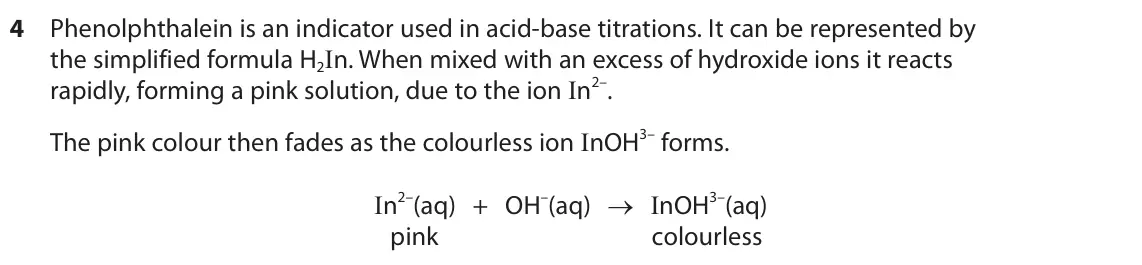
Q2(c)(ii)
The whole paper ↗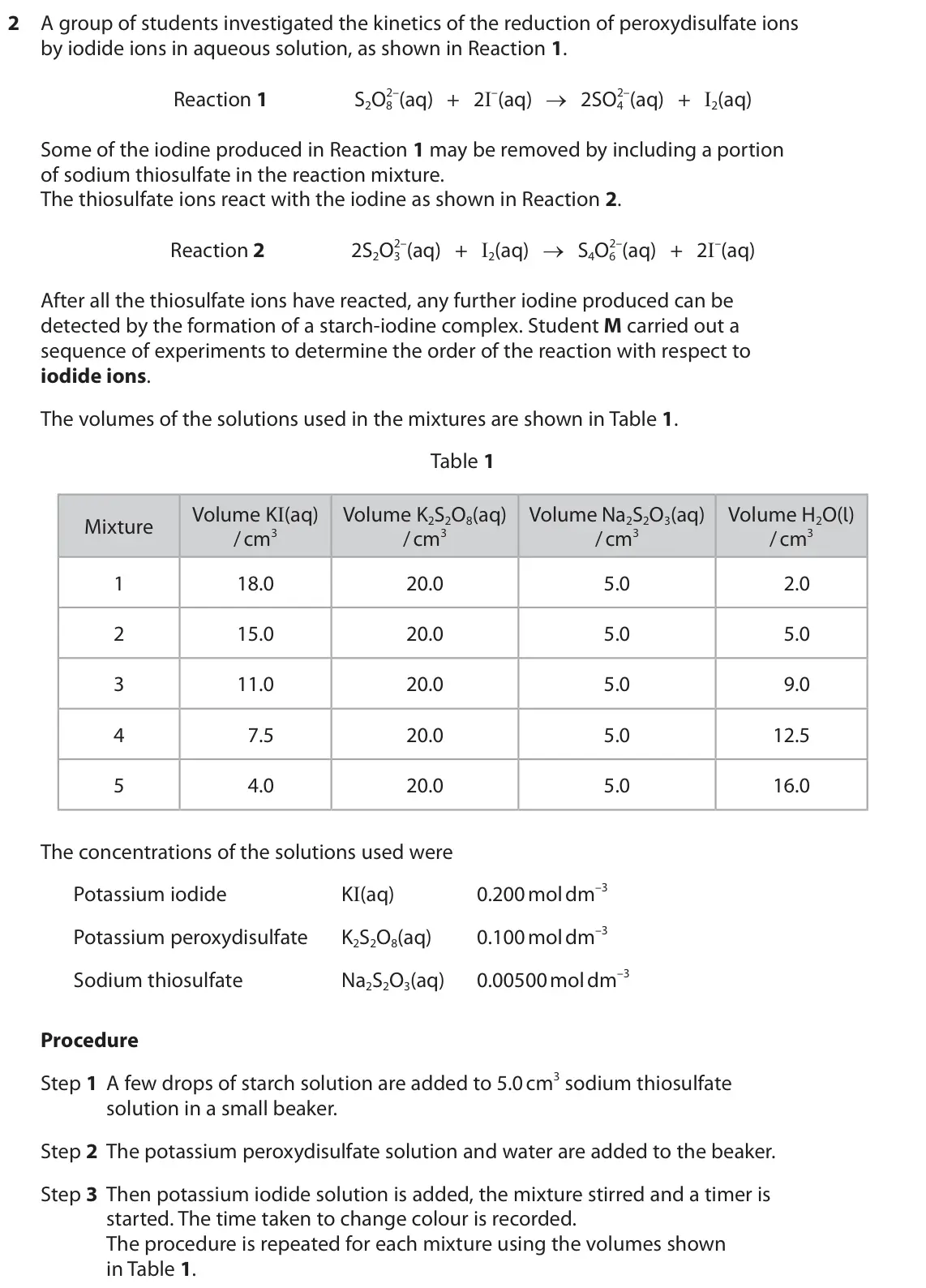
Q1(b)
The whole paper ↗ Your answer
Q1(c)
The whole paper ↗Your answer- Your answer
Q16(b)(ii)
The whole paper ↗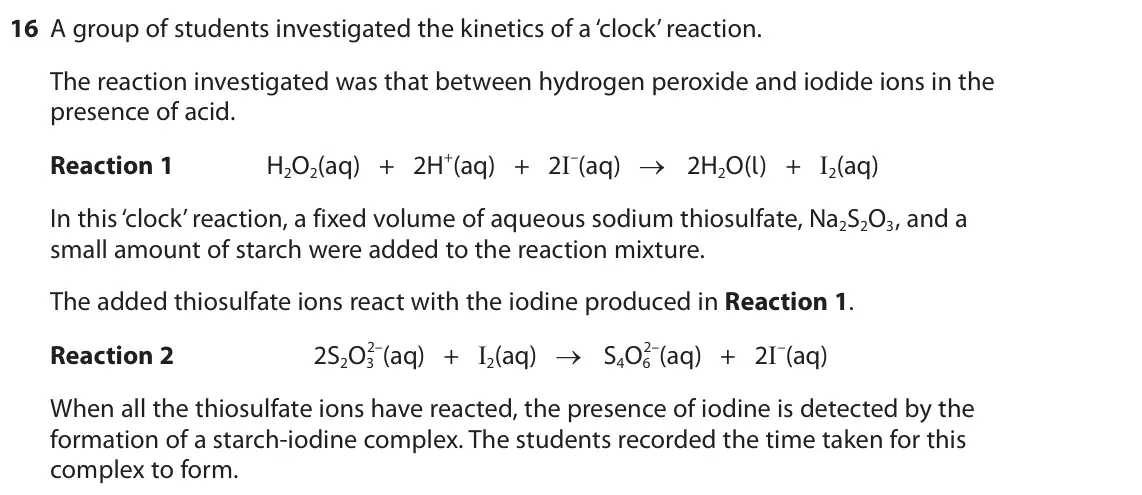
Q16(b)(v)
The whole paper ↗- Your answer
Q3(b)
The whole paper ↗ Your answer
Q15(c)(ii)
The whole paper ↗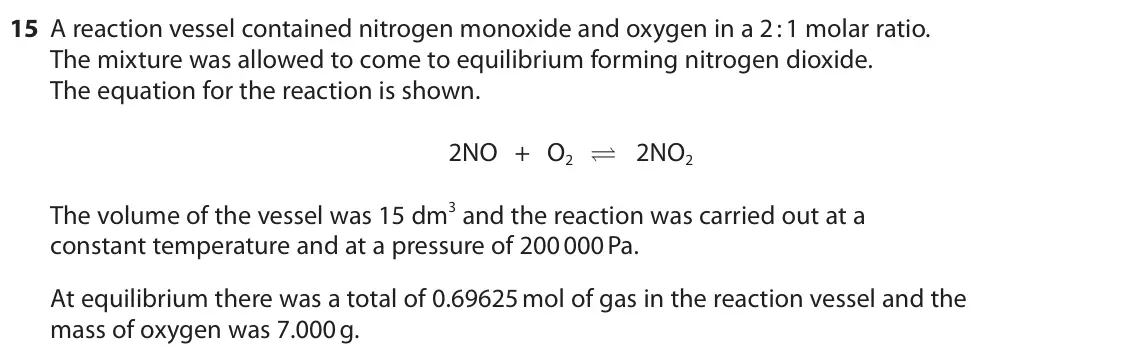
Q18(a)(iv)
The whole paper ↗
Q18(a)(v)
The whole paper ↗Q25(f)
The whole paper ↗
Q1(a)
The whole paper ↗ Your answer
- Your answer
Q17(a)(ii)
The whole paper ↗
Q17(a)(iii)
The whole paper ↗
All 44 questions on Rate equations, orders and half-life, as a list
- June 2025, Unit 4, Q10 (1 mark): The reaction shown is second order with respect to NO and first order with respect to O2 . 2NO(g) + O2(g) → 2NO2(g) If the concentration of NO is doubled and th
- June 2025, Unit 4, Q18(a)(iv) (3 marks): Use your graph to show that the reaction is first order with respect to hydrogen peroxide. You must show your working on the graph. (3)
- January 2025, Unit 4, Q15 (1 mark): A graph of the concentration of Q during decomposition is shown. 10 9 8 7 6 [Q] 5 / 10–3 mol dm–3 4 3 2 1 0 0 30 60 90 120 150 180 210 240 270 300 Time / minute
- January 2025, Unit 6, Q4(a)(iii) (2 marks): Determine two successive half-lives for the concentration of In2–. You must show your working on the graph. (2) First half‑life Second half‑life
- October 2024, Unit 6, Q2(c)(ii) (1 mark): A group of students investigated the kinetics of the reduction of peroxydisulfate ions by iodide ions in aqueous solution, as shown in Reaction 1. 2–(aq) + 2I–(
- June 2024, Unit 4, Q1(b) (1 mark): What are the units of the rate constant, k, for this reaction? (1) A mol dm–3 s–1 B dm3 mol–1 s–1 C dm6 mol–2 s–1 D dm9 mol–3 s–1
- June 2024, Unit 4, Q1(c) (1 mark): The concentrations of all reactants are halved. By what factor does the rate of reaction change? (1) 1 A 2 1 B 4 1 C 8 1 D 16
- January 2024, Unit 4, Q2 (1 mark): Nitrogen(V) oxide, N2O5, decomposes in a first order reaction. At 45 °C, the half‑life for this reaction is 1400 s. In an experiment, the initial concentration
- January 2024, Unit 4, Q16(b)(ii) (1 mark): Write the overall rate equation for Reaction 1 using your answers to (b)(i). (1)
- January 2024, Unit 4, Q16(b)(v) (2 marks): Calculate a value for the rate constant of Reaction 1 using data from Mixture 1 and your answers to (b)(ii) and (b)(iv). Include the units of the rate constant.
- October 2023, Unit 4, Q2 (1 mark): The equation for the reaction of bromate(V) ions with bromide ions in acid solution is shown. BrO– 3(aq) + 5Br–(aq) + 6H+ → 3Br2(aq) + 3H2O(l) The rate equation
- October 2023, Unit 4, Q3(b) (1 mark): The equation for a gas phase reaction is shown. A(g) → B(g) + C(g) The reaction is first order. When the initial pressure of A is 2 atm the half‑life of the rea
- October 2023, Unit 4, Q15(c)(ii) (2 marks): Use the data from Experiment 1 to find the value of the rate constant, k. Include units in your answer. (2)
- June 2023, Unit 4, Q18(a)(iv) (1 mark): Write the rate equation for the reaction, using your answer to (a)(iii). (1)
- June 2023, Unit 4, Q18(a)(v) (2 marks): Calculate the rate constant for this reaction using the data from experiment 1 and your rate equation. Include units in your answer. (2)
- June 2023, Unit 5, Q25(f) (3 marks): Articaine is metabolised in the body with a half-life of 20 minutes. A patient is given a dose of 100 mg of articaine. Calculate the mass of articaine in microg
- January 2023, Unit 4, Q1(a) (1 mark): Which pair of rate equations could be correct for this reaction? (1) Equation 1 Equation 2 rate = k[NO]2[O2] rate = k[NO]2[O2] A rate = k[NO]2[O2] rate = k[NO][
- January 2023, Unit 4, Q2 (1 mark): The half‑life of a first order chemical reaction is A half the time taken for the reaction to be complete B the time taken for the value of the rate constant to
- January 2023, Unit 4, Q17(a)(ii) (3 marks): The student’s results are shown. [I–(aq)] / mol dm–3 [H2O2(aq)] / mol dm–3 [H+(aq)] / mol dm–3 Rate / mol dm–3 s–1 Run 1 0.0210 0.0198 0.00105 0.00181 2 0.0105
- January 2023, Unit 4, Q17(a)(iii) (3 marks): Calculate the rate constant for this reaction at 293 K, using the results from Run 1. Include units with your answer. (3)
- January 2023, Unit 6, Q2(b)(ii) (2 marks): Determine two successive half‑lives for the reaction. You must show your working on the graph. (2)
- October 2022, Unit 4, Q2(a) (1 mark): The concentrations of both reactants are tripled. By what factor does the rate of reaction increase? (1) A 3 B 9 C 18 D 27
- October 2022, Unit 4, Q16(a) (1 mark): Write the rate equation for this first order reaction. (1)
- October 2022, Unit 4, Q16(b)(i) (2 marks): Determine values for the half-life, t1/2 , of the decomposition of azomethane from the graph, stating whether or not these data confirm that the reaction is fir
- October 2022, Unit 4, Q16(b)(ii) (2 marks): Calculate the rate constant, k, in s−1 , for the decomposition of azomethane at 573 K , using your answer to (b)(i) and the expression shown. = l n2 t 1/2 k (2)
- October 2022, Unit 6, Q4(b)(ii) (2 marks): Explain how the data collected indicates first order kinetics. Show your working on the graph. (2)
- June 2022, Unit 4, Q20(a)(ii) (1 mark): Write the rate equation for the reaction using your answer to (a)(i). (1)
- June 2022, Unit 4, Q20(a)(iii) (2 marks): Calculate the rate constant for Experiment 1. Include units in your answer. (2)
- January 2022, Unit 4, Q18(a)(ii) (3 marks): Use the data from Experiment 4 and your answer to (a)(i) to calculate the rate constant for the reaction. Include units in your answer. (3)
- October 2021, Unit 4, Q1(a) (1 mark): What is the rate equation for this reaction? (1) A rate = k B rate = k[NH3] C rate = k[NH3]2 D rate = k[N2][H2]3
- October 2021, Unit 4, Q1(b) (1 mark): What are the units of the rate constant, k, for this zero order reaction? (1) A no units B s−1 C mol dm−3 s−1 D dm3 mol−1 s−1
- October 2021, Unit 4, Q17(a)(i) (3 marks): Plot a graph of concentration of benzenediazonium chloride against time. (3)
- October 2021, Unit 4, Q17(a)(ii) (1 mark): Determine a value for the half-life, t½ , of this reaction. You must show your working on the graph. (1)
- October 2021, Unit 4, Q17(a)(iii) (2 marks): Calculate the rate constant, k, for the reaction at 333 K. Include units in your answer. Use the expression ln 2 = kt½ (2)
- June 2021, Unit 4, Q16(b)(ii) (1 mark): Write the rate equation for the reaction. (1)
- June 2021, Unit 4, Q16(b)(iii) (3 marks): Use the results for Run 1 and your rate equation from (b)(ii) to calculate the value for the rate constant, k. Include units in your answer. (3)
- January 2021, Unit 4, Q8 (1 mark): The rate equation for a reaction is rate = k[A]2[B]0 The initial rate of reaction is 9.0 × 10⁻⁵ mol dm−3 s−1 when [A] = 0.30 mol dm−3 and [B] = 0.20 mol dm−3. W
- January 2021, Unit 4, Q20(b)(iii) (2 marks): Give the overall rate equation for this reaction. Include the units for the rate constant. (2)
- January 2021, Unit 5, Q24(b)(ii) (2 marks): The removal of caffeine from the body is a first order reaction with a half-life of between three and seven hours for an adult. An adult drinks coffee containin
- October 2020, Unit 4, Q3 (1 mark): The inorganic anti-cancer drug cis-platin, Pt(NH3)2Cl2, is hydrolysed by water to make it active. The reaction is + H3N NH3 H3N NH3 + Cl− Pt + H2O Pt Cl Cl Cl H
- October 2020, Unit 4, Q4(a) (1 mark): Which of the following is true? (1) A the units for the rate constant are dm3 mol−1 s−1 B the reaction is a first order reaction overall C the units for the rat
- January 2020, Unit 4, Q15(a) (1 mark): Which statement is not correct? (1) A the reaction is third order overall B the units of the rate of the reaction are mol dm−3 s−1 C the rate of the reaction in
- January 2020, Unit 4, Q15(b) (1 mark): What are the units of the rate constant, k, for this reaction? (1) A dm9 mol−3 s−1 B mol3 dm−9 s−1 C mol2 dm−6 s−1 D dm6 mol−2 s−1
- January 2020, Unit 4, Q15(c) (1 mark): An experiment was carried out using 1.10 × 10⁻² mol dm−3 of oxygen and some nitrogen monoxide. The numerical value of the initial rate and rate constant were: •
Questions, mark schemes and examiner’s reports are © Pearson Edexcel, from their published past papers. Plumi isn’t affiliated with any exam board. Want whole papers? Edexcel International A Level Chemistry past papers.
The Plumi iPad app also offers exam-style questions with AI feedback on your handwritten working.