 plumi
Periodicity: trends in ionisation energy and melting temperature: Edexcel International A Level Chemistry questions
Edexcel International A Level Chemistry past-paper questions on 2.3.2 Periodicity: trends in ionisation energy and melting temperature, 2019–2025, with mark schemes and examiner’s reports where available.
Paper
All papers
Exam
All years
Calculations
Q21(b)(ii)
The whole paper ↗
Q21(c)(i)
The whole paper ↗Q10(a)
The whole paper ↗ Your answer
Q10(b)
The whole paper ↗Your answerQ20(a)(i)
The whole paper ↗
Q20(c)(i)
The whole paper ↗Q20(c)(ii)
The whole paper ↗Q16(b)(i)
The whole paper ↗
Q18(a)(i)
The whole paper ↗
- Your answer
- Your answer
Q22(a)(ii)
The whole paper ↗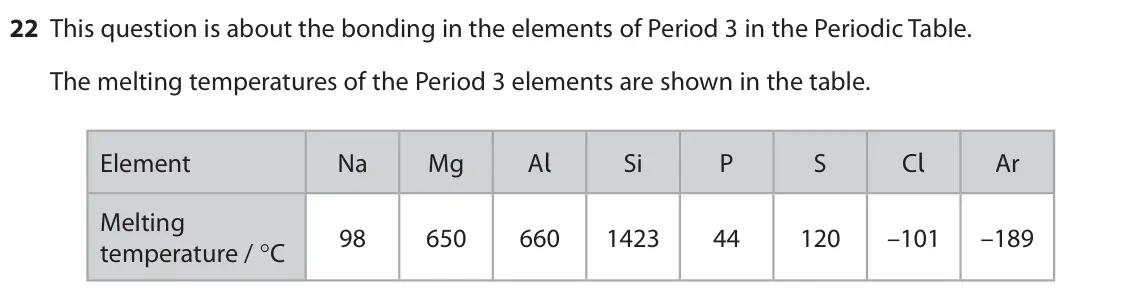
Q22(b)(ii)
The whole paper ↗Q23(a)(ii)
The whole paper ↗
- Your answer
Q14(b)(i)
The whole paper ↗
Q22(a)(i)
The whole paper ↗
Q22(a)(ii)
The whole paper ↗Q22(a)(iii)
The whole paper ↗Q22(b)
The whole paper ↗
All 30 questions on Periodicity: trends in ionisation energy and melting temperature, as a list
- June 2025, AS Unit 1, Q21(b)(ii) (1 mark): State the general trend in first ionisation energies across Period 3. (1)
- June 2025, AS Unit 1, Q21(c)(i) (3 marks): Plot the following first ionisation energies of the elements in Period 2 on the grid below. (3) Element Li Be B C N O F Ne 1st ionisation energy / kJ mol–1 520
- October 2024, AS Unit 1, Q10(a) (1 mark): Which statement is not correct for these Period 3 elements? (1) A atoms of Cl(g) have the highest first ionisation energy B ions of Cl–(g) and S2–(g) have the s
- October 2024, AS Unit 1, Q10(b) (1 mark): The melting temperatures of these elements are shown in the table. Element Na Mg Al Si P S Cl Melting temperature / K 371 922 933 1683 317 392 172 Which of the
- October 2024, AS Unit 1, Q20(a)(i) (2 marks): Explain the general trend in first ionisation energies for the Period 2 elements. (2)
- October 2024, AS Unit 1, Q20(c)(i) (2 marks): The diagram shows the melting temperatures of the elements in Period 2 from lithium to nitrogen. Complete the diagram by putting crosses to show the approximate
- October 2024, AS Unit 1, Q20(c)(ii) (3 marks): Explain why the melting temperature of carbon is high, with reference to its structure and bonding. (3)
- June 2024, AS Unit 1, Q16(b)(i) (3 marks): Explain the trend in the first ionisation energies of Al, Si and P. (3)
- October 2023, AS Unit 1, Q18(a)(i) (2 marks): Explain the general trend in first ionisation energy across Period 2. (2)
- January 2023, AS Unit 1, Q9 (1 mark): Which is a reason why fluorine has a higher first ionisation energy than oxygen? A a fluorine atom has fewer unpaired electrons B a fluorine atom has fewer shel
- June 2022, AS Unit 1, Q1 (1 mark): Elements in their most stable state exist as A atoms in giant structures only B atoms in molecules and atoms in giant structures only C isolated atoms and atoms
- January 2022, AS Unit 1, Q22(a)(ii) (3 marks): Melting temperature depends on the strength of metallic bonding. Explain why the metallic bonding in magnesium is much stronger than that in sodium. (3)
- January 2022, AS Unit 1, Q22(b)(ii) (3 marks): Explain why the melting temperature of silicon is much higher than that of phosphorus, by referring to their structures. (3)
- January 2022, AS Unit 1, Q23(a)(ii) (2 marks): Explain why there is a general increase in the first ionisation energy across the period. (2)
- October 2021, AS Unit 1, Q8 (1 mark): In which series are the elements in order of increasing melting temperature? A I2 < Br2 < Cl2 < F2 B Li < Be < B < C C Li < Na < K < Rb D Si < P < S < Cl
- October 2021, AS Unit 1, Q14(b)(i) (2 marks): Explain the general increase in the first ionisation energy from sodium to argon. (2)
- June 2021, AS Unit 1, Q22(a)(i) (2 marks): Plot a graph of atomic radius against atomic number. (2)
- June 2021, AS Unit 1, Q22(a)(ii) (1 mark): Use the graph to estimate the atomic radius of silicon, Si. (1)
- June 2021, AS Unit 1, Q22(a)(iii) (3 marks): Suggest an explanation for the decrease in atomic radius as atomic number increases across a period. (3)
- June 2021, AS Unit 1, Q22(b) (6 marks): The melting temperatures of sodium, sodium chloride and chlorine are given in the table. Complete the table to show the type of structure, the type of bond or f
- January 2021, AS Unit 1, Q7 (1 mark): The Period 2 element with the highest melting temperature is A aluminium B boron C carbon D silicon
- October 2020, AS Unit 1, Q18(d)(i) (3 marks): The log of the fourth ionisation energy for six elements is shown in the table. log10 (fourth ionisation energy / kJ mol–1) Element O 3.87 F 3.92 Ne 3.97 Na Mg
- October 2020, AS Unit 1, Q18(d)(ii) (1 mark): Use your graph to estimate the fourth ionisation energy for sodium, in kJ mol–1. (1)
- January 2020, AS Unit 1, Q19(a)(i) (2 marks): The student incorrectly plotted two values: one for a metal and one for a non-metal. Identify these elements, by name or formula. (2)
- January 2020, AS Unit 1, Q19(a)(ii) (3 marks): Explain, with reference to structure and bonding, why silicon has a very high melting temperature. (3)
- June 2019, AS Unit 1, Q14 (1 mark): The bar chart shows the melting temperatures of the first twenty elements. 4000 3500 3000 2500 Melting 2000 temperature / K 1500 1000 500 0 1 2 3 4 5 6 7 8 9 10
- January 2019, AS Unit 1, Q6 (1 mark): The diagram shows the first ionisation energy for the elements from sodium to silicon. 1100 1000 900 First 800 ionisation 700 energy / kJ mol−1 600 500 400 3001
- January 2019, AS Unit 1, Q22(a)(i) (1 mark): Complete the table. (1)
- January 2019, AS Unit 1, Q22(a)(ii) (3 marks): Plot a graph of log (ionisation energy) against ionisation number. (3)
- January 2019, AS Unit 1, Q22(a)(iii) (1 mark): Give a reason why the logarithm of the ionisation energy, rather than just the ionisation energy, is used to plot this graph. (1)
Questions, mark schemes and examiner’s reports are © Pearson Edexcel, from their published past papers. Plumi isn’t affiliated with any exam board. Want whole papers? Edexcel International A Level Chemistry past papers.
The Plumi iPad app also offers exam-style questions with AI feedback on your handwritten working.