 plumi
Ionic lattices, bond strength and ionic radii: Edexcel International A Level Chemistry questions
Edexcel International A Level Chemistry past-paper questions on 3.A.2 Ionic lattices, bond strength and ionic radii, 2019–2025, with mark schemes and examiner’s reports where available.
Paper
All papers
Exam
All years
Calculations
Q23(a)(i)
The whole paper ↗
Q23(a)(ii)
The whole paper ↗Q23(a)(iv)
The whole paper ↗- Your answer
Q11(a)
The whole paper ↗ Your answer
Q11(b)
The whole paper ↗Your answerQ15(a)(i)
The whole paper ↗
- Your answer
Q20(b)(ii)
The whole paper ↗
Q21(b)(ii)
The whole paper ↗
Q3(a)
The whole paper ↗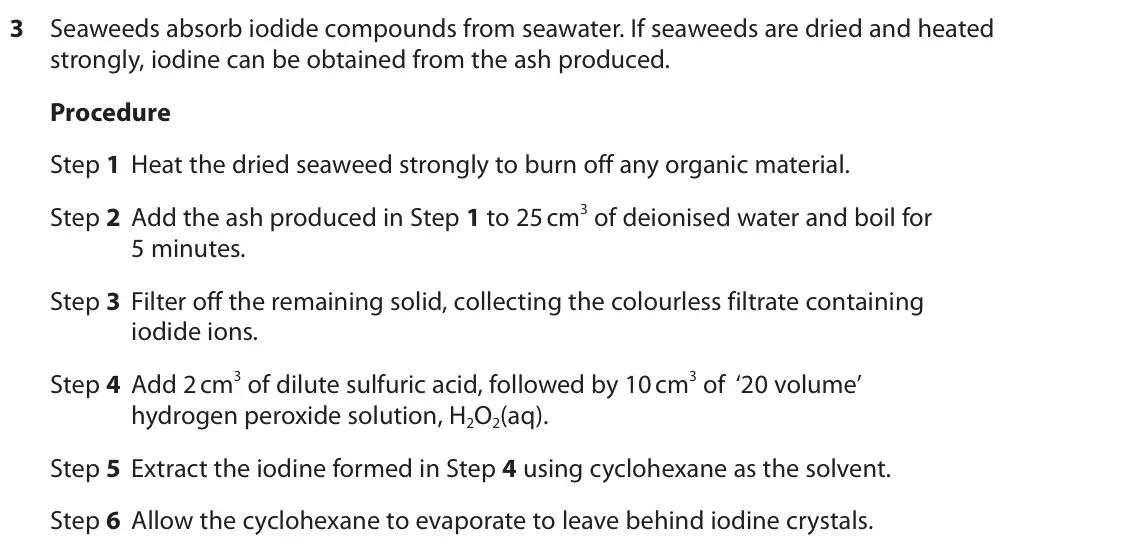
- Your answer
Q24(a)(i)
The whole paper ↗
Q24(a)(ii)
The whole paper ↗Q24(a)(iii)
The whole paper ↗Q24(b)(i)
The whole paper ↗- Your answer
- Your answer
- Your answer
- Your answer
All 32 questions on Ionic lattices, bond strength and ionic radii, as a list
- June 2025, AS Unit 1, Q23(a)(i) (1 mark): Describe ionic bonding. (1)
- June 2025, AS Unit 1, Q23(a)(ii) (2 marks): Explain why the ionic bonding in magnesium fluoride might be expected to be stronger than the ionic bonding in sodium fluoride. (2)
- June 2025, AS Unit 1, Q23(a)(iv) (2 marks): Draw the ionic lattice for sodium chloride. You should show at least nine ions. (2)
- January 2025, AS Unit 1, Q11 (1 mark): Which species are arranged in order of increasing radius? A K+ < Ar < Cl– < Br– B Cl– < Ar < K+ < Br– C Br– < Cl– < Ar < K+ D Cl– < Br– < Ar < K+
- June 2024, AS Unit 1, Q11(a) (1 mark): Which ions are shown in order of decreasing ionic radius? (1) A Na+ > Mg2+ > Al3+ B Mg2+ > Na+ > Al3+ C Al3+ > Na+ > Mg2+ D Al3+ > Mg2+ > Na+
- June 2024, AS Unit 1, Q11(b) (1 mark): Which ions are shown in order of increasing ionic radius? (1) A F– < O2– < N3– B F– < N3– < O2– C O2– < N3– < F– D N3– < O2– < F– Use this space for any rough w
- June 2024, Unit 4, Q15(a)(i) (2 marks): Complete the table, indicating the type of bonding in the reactants and products of this reaction. (2) Substance SiO2 Mg Mg2Si MgO Bonding type covalent
- January 2024, AS Unit 1, Q9 (1 mark): Which are the correct bonding and structure for one of the substances listed? Substance Bonding Structure A copper(II) sulfate covalent giant B graphene covalen
- January 2024, AS Unit 1, Q20(b)(ii) (2 marks): The melting temperatures of magnesium oxide and magnesium sulfate are 2852°C and 1124°C respectively. Explain why the melting temperature of magnesium oxide is
- January 2024, AS Unit 2, Q21(b)(ii) (3 marks): Complete the table to indicate the type(s) of bonding and structure in the species involved in this reaction. (3) Species Bonding Structure Ca(s) covalent giant
- January 2024, AS Unit 3, Q3(a) (1 mark): Suggest why the iodine‑containing compounds do not burn off in Step 1. (1)
- January 2023, AS Unit 1, Q11 (1 mark): Which combination of ions would be expected to form the compound with the highest melting temperature? A Li+ and Br– B Mg2+ and O2– C Sr2+ and S2– D Rb+ and Cl–
- January 2023, AS Unit 1, Q24(a)(i) (2 marks): Plot a graph of the data. (2) N3– O2– F– (Ne) Na+ Mg2+ Al3+
- January 2023, AS Unit 1, Q24(a)(ii) (2 marks): Predict the radius of the magnesium ion using a straight line of best fit on your graph. (2)
- January 2023, AS Unit 1, Q24(a)(iii) (3 marks): Explain the trend in the ionic radii from the nitride ion to the aluminium ion. (3)
- January 2023, AS Unit 1, Q24(b)(i) (1 mark): State the structure and bonding of sodium fluoride. (1)
- June 2022, AS Unit 1, Q10 (1 mark): Which row in the table shows the correct forces in a crystal of lithium iodide? Attractive forces Repulsive forces Some covalent between ions with between ions
- January 2022, AS Unit 1, Q2 (1 mark): Which of these compounds would you expect to have the highest melting temperature? A NaCl B NaF C KCl D KF Use this space for any rough working. Anything you wr
- January 2022, AS Unit 1, Q4 (1 mark): Which of these isoelectronic ions has the smallest ionic radius? A N3− B F− C Na+ D Al3+
- October 2021, AS Unit 1, Q5 (1 mark): In which series are the ions in order of decreasing ionic radius? A Al3+ > Mg2+ > Na+ B Li+ > Na+ > K+ C N3− > O2− > F− D O2− > S2− > Se2−
- June 2021, AS Unit 1, Q8 (1 mark): Which of these isoelectronic ions has the largest radius? A Na+ B Mg2+ C O2− D F−
- June 2021, AS Unit 1, Q22(b) (6 marks): The melting temperatures of sodium, sodium chloride and chlorine are given in the table. Complete the table to show the type of structure, the type of bond or f
- January 2021, AS Unit 1, Q9 (1 mark): Which of these ions has the greatest ionic radius? A N3- B F- C Na+ D Al3+
- January 2021, AS Unit 1, Q19(b)(i) (2 marks): Explain why PCl5 has a higher melting temperature than SbCl5 . (2)
- January 2021, Unit 4, Q4(a) (1 mark): Which of these compounds would be expected to have the least exothermic lattice energy? (1) A calcium chloride B magnesium chloride C potassium bromide D sodium
- October 2020, AS Unit 1, Q11 (1 mark): Which of these ions has the smallest ionic radius? A Al3+ B Ga3+ C Mg2+ D F–
- October 2020, Unit 4, Q16(c) (3 marks): The table shows the theoretical lattice energies of some chlorides of Group 2. magnesium calcium strontium barium Group 2 metal chloride chloride chloride chlor
- October 2020, Unit 5, Q25(c)(i) (2 marks): The Lanthanides The lanthanides form a series in the Periodic Table comprising the elements from lanthanum, La (Z = 57) to lutetium, Lu (Z = 71). They have impo
- January 2020, AS Unit 1, Q8 (1 mark): Which of these ionic compounds would be expected to have the highest melting temperature? A NaF B MgO C KCl D CaS
- June 2019, AS Unit 1, Q1 (1 mark): Which statement is not true for sodium chloride? A sodium chloride conducts electricity in aqueous solution B sodium chloride conducts electricity when molten C
- June 2019, AS Unit 1, Q5 (1 mark): Which pair of ions gives the strongest ionic bonding? A Na+ and F− B K+ and Br− C Mg2+ and O2− D Ca2+ and S2− Use this space for any rough working. Anything you
- January 2019, AS Unit 1, Q9 (1 mark): The ionic radius of Al3+ is smaller than that of N3−. This is because Al3+ has A fewer protons but more electrons than N3− B more protons but fewer electrons th
Questions, mark schemes and examiner’s reports are © Pearson Edexcel, from their published past papers. Plumi isn’t affiliated with any exam board. Want whole papers? Edexcel International A Level Chemistry past papers.
The Plumi iPad app also offers exam-style questions with AI feedback on your handwritten working.