 plumi
Ionisation energies, orbitals and the factors affecting them: Edexcel International A Level Chemistry questions
Edexcel International A Level Chemistry past-paper questions on 2.2.1 Ionisation energies, orbitals and the factors affecting them, 2019–2025, with mark schemes and examiner’s reports where available.
Paper
All papers
Exam
All years
Calculations
Q21(a)
The whole paper ↗
- Your answer
Q18(a)(i)
The whole paper ↗
Q18(a)(ii)
The whole paper ↗Q18(b)(i)
The whole paper ↗Q18(b)(ii)
The whole paper ↗- Your answer
- Your answer
Q14(a)(i)
The whole paper ↗
- Your answer
Q23(a)(i)
The whole paper ↗
Q23(a)(ii)
The whole paper ↗Q23(a)(iii)
The whole paper ↗- Your answer
- Your answer
- Your answer
Q21(b)(i)
The whole paper ↗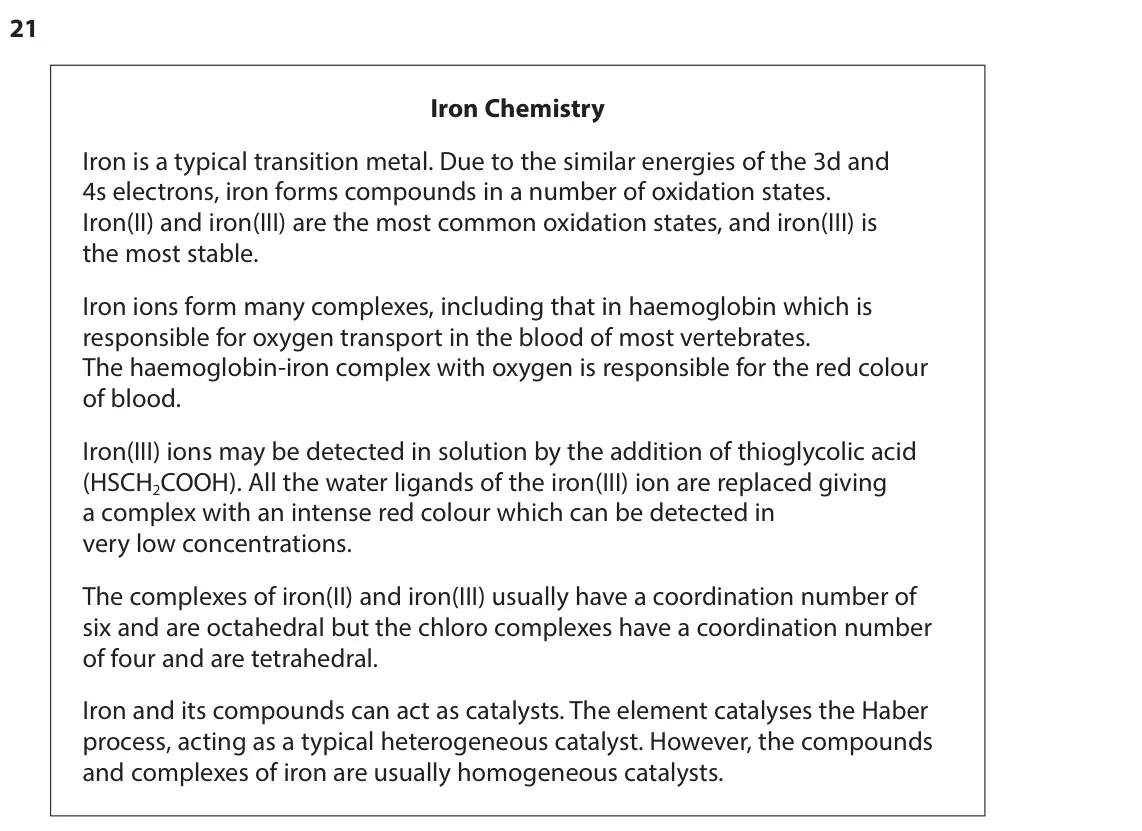
Q18(b)
The whole paper ↗
Q18(c)
The whole paper ↗- Your answer
All 27 questions on Ionisation energies, orbitals and the factors affecting them, as a list
- June 2025, AS Unit 1, Q21(a) (3 marks): Write the equation for the third ionisation energy of calcium. Include state symbols. (3)
- June 2024, AS Unit 1, Q10 (1 mark): Which equation represents the second ionisation energy of magnesium? A Mg(g) → Mg2+(g) + 2e– B Mg+(g) → Mg2+(g) + e– C Mg+(s) → Mg2+(s) + e– D Mg(g) → Mg+(g) +
- October 2023, AS Unit 1, Q18(a)(i) (2 marks): Explain the general trend in first ionisation energy across Period 2. (2)
- October 2023, AS Unit 1, Q18(a)(ii) (3 marks): Predict a value for the first ionisation energy of oxygen. Justify your answer. (3)
- October 2023, AS Unit 1, Q18(b)(i) (2 marks): Write the equation for the second ionisation energy of lithium. Include state symbols. (2)
- October 2023, AS Unit 1, Q18(b)(ii) (2 marks): Explain the large difference between the first and second ionisation energies of lithium. (2)
- January 2023, AS Unit 1, Q8 (1 mark): Which is the equation for the second ionisation of element J? A J(g) → J2+(g) + 2e– B J+(g) → J2+(g) + e– C J+(g) → J3+(g) + 2e– D J2+(g) → J3+(g) + e–
- January 2023, AS Unit 1, Q9 (1 mark): Which is a reason why fluorine has a higher first ionisation energy than oxygen? A a fluorine atom has fewer unpaired electrons B a fluorine atom has fewer shel
- October 2022, AS Unit 1, Q14(a)(i) (1 mark): Write an equation, including state symbols, for the third ionisation energy of barium. (1)
- June 2022, AS Unit 1, Q7 (1 mark): Which equation represents the first ionisation energy of iodine? A I2(s) → 2I+(g) + 2e− B I2(g) → 2I+(g) + 2e− C ½I2(s) → I+(g) + e− D I(g) → I+(g) + e− Use thi
- January 2022, AS Unit 1, Q23(a)(i) (1 mark): Give an equation that represents the first ionisation energy of lithium. Include state symbols. (1)
- January 2022, AS Unit 1, Q23(a)(ii) (2 marks): Explain why there is a general increase in the first ionisation energy across the period. (2)
- January 2022, AS Unit 1, Q23(a)(iii) (2 marks): Explain why the first ionisation energy of oxygen is lower than that of nitrogen. (2)
- October 2021, AS Unit 1, Q2 (1 mark): Which equation represents the second ionisation energy of chlorine? A Cl−(g) + e− → Cl2−(g) B Cl(g) + 2e− → Cl2−(g) C 2Cl(g) → 2Cl+(g) + 2e− D Cl+(g) → Cl2+(g)
- June 2021, AS Unit 1, Q4 (1 mark): Which equation represents the second ionisation energy of magnesium? A Mg(g) → Mg2+(g) + 2e− B Mg+(g) → Mg2+(g) + e− C Mg(s) → Mg2+(s) + 2e− D Mg+(s) → Mg2+(s)
- June 2021, AS Unit 2, Q8 (1 mark): Several factors may affect ionisation energies: I) the number of protons increases II) the outer electron is further from the nucleus III) the amount of shieldi
- June 2021, Unit 5, Q21(b)(i) (1 mark): Write the equation for the third ionisation energy of iron. Include state symbols. (1)
- January 2021, AS Unit 1, Q18(b) (2 marks): Write an equation for the first ionisation energy of sulfur. Include state symbols. (2)
- January 2021, AS Unit 1, Q18(c) (3 marks): Explain why the first ionisation energy of sulfur is less than the first ionisation energies of both phosphorus and chlorine. (3) . .
- October 2020, AS Unit 1, Q14 (1 mark): Which equation represents the third ionisation energy for element J? A J2+(g) → J3+(g) + e– B J3+(g) → J4+(g) + e– C J(g) → J3+(g) + e– D J(g) → J3+(g) + 3e–
- October 2020, AS Unit 1, Q18(d)(i) (3 marks): The log of the fourth ionisation energy for six elements is shown in the table. log10 (fourth ionisation energy / kJ mol–1) Element O 3.87 F 3.92 Ne 3.97 Na Mg
- October 2020, AS Unit 1, Q18(d)(ii) (1 mark): Use your graph to estimate the fourth ionisation energy for sodium, in kJ mol–1. (1)
- January 2020, AS Unit 1, Q18(b) (2 marks): Write an equation for the first ionisation energy of chlorine. Include state symbols. (2)
- January 2020, AS Unit 1, Q18(c) (3 marks): Explain the difference in the first ionisation energies of chlorine and bromine. (3)
- June 2019, AS Unit 1, Q9 (1 mark): Which sketch graph shows the trend in first ionisation energy values going down Group 1 in the Periodic Table? First ionisation A energy Atomic number First ion
- June 2019, AS Unit 1, Q13 (1 mark): Which is the equation for the second ionisation energy of an element, A? A A(g) o A2+(g) + 2e− B A+(g) o A2+(g) + e− C A2+(g) o A3+(g) + e− D A2+(g) o A4+(g) +
- January 2019, AS Unit 1, Q22(a)(v) (3 marks): Explain why the first ionisation energy of oxygen is lower than that of nitrogen. (3)
Questions, mark schemes and examiner’s reports are © Pearson Edexcel, from their published past papers. Plumi isn’t affiliated with any exam board. Want whole papers? Edexcel International A Level Chemistry past papers.
The Plumi iPad app also offers exam-style questions with AI feedback on your handwritten working.