 plumi
Iodine-propanone, clock reaction and activation energy (Core Practicals 9 and 10): Edexcel International A Level Chemistry questions
Edexcel International A Level Chemistry past-paper questions on 11.2.3 Iodine-propanone, clock reaction and activation energy (Core Practicals 9 and 10), 2019–2025, with mark schemes and examiner’s reports where available.
Paper
All papers
Exam
All years
Calculations
Q3(a)
The whole paper ↗
Q3(b)
The whole paper ↗Q3(c)
The whole paper ↗Q3(d)(i)
The whole paper ↗Q3(d)(ii)
The whole paper ↗Q18(b)(i)
The whole paper ↗
Q2(a)(i)
The whole paper ↗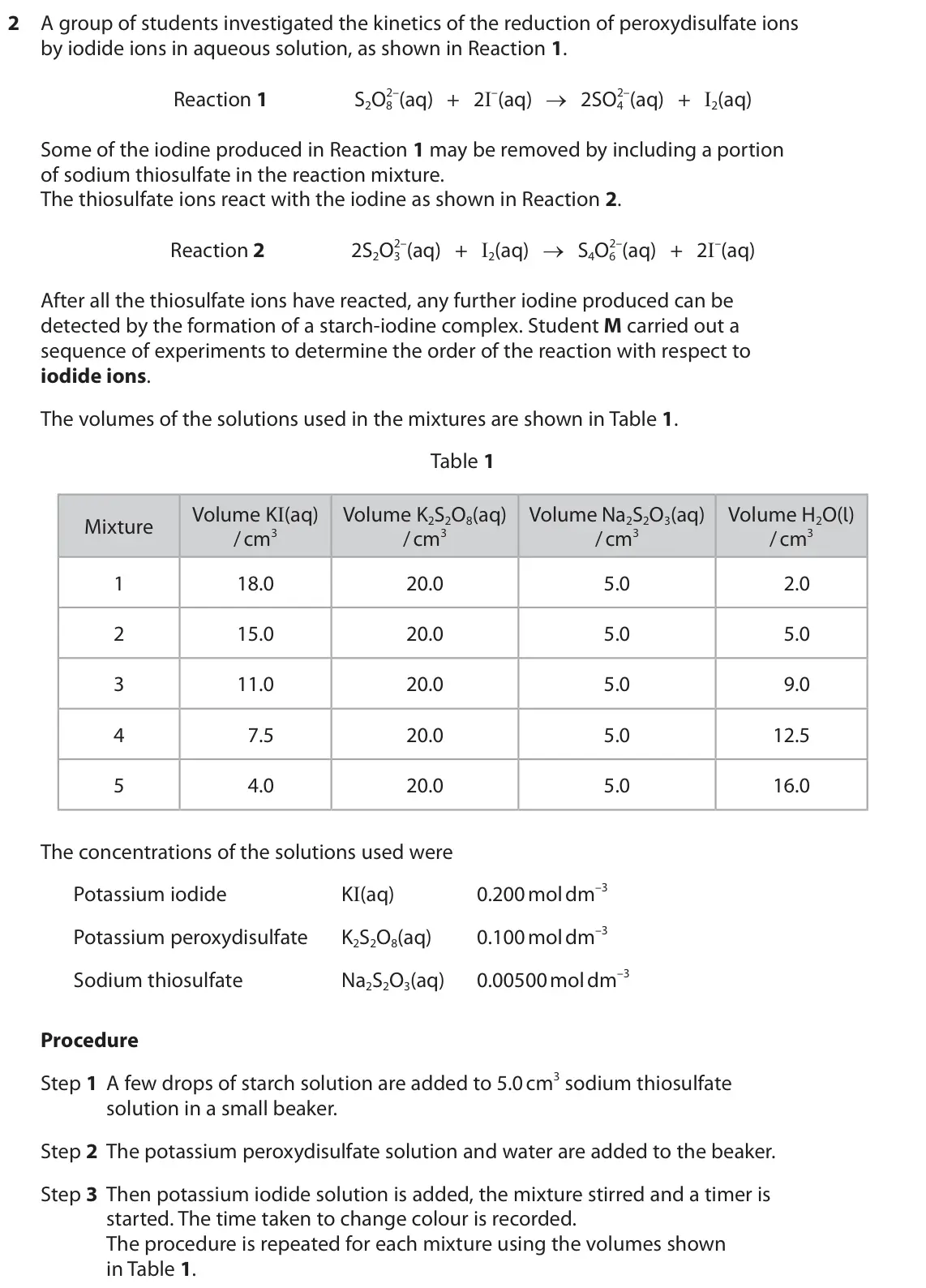
Q2(a)(ii)
The whole paper ↗Q2(a)(iii)
The whole paper ↗Q2(a)(iv)
The whole paper ↗Q2(b)(i)
The whole paper ↗Q2(c)(i)
The whole paper ↗Q3(a)(i)
The whole paper ↗
Q16(a)(i)
The whole paper ↗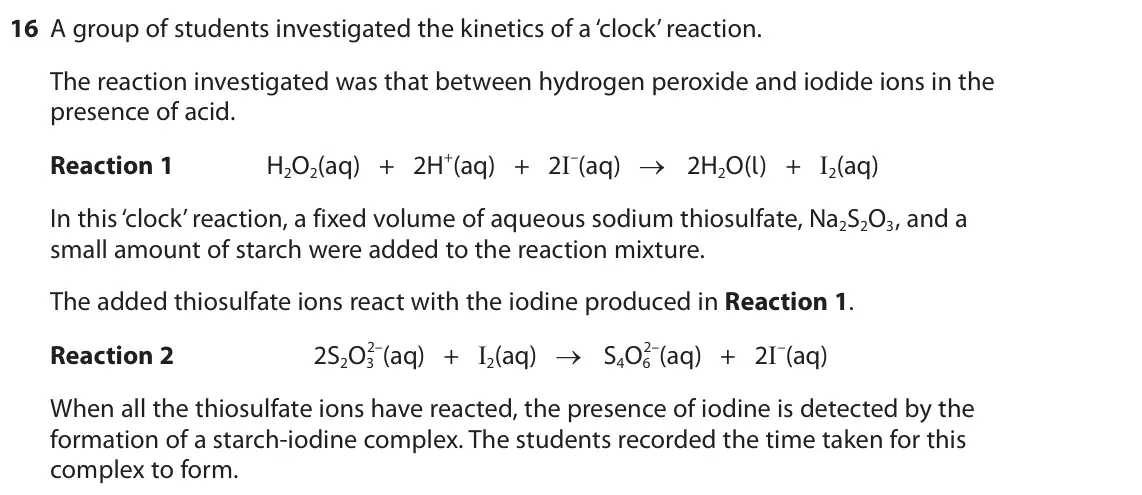
Q16(a)(ii)
The whole paper ↗Q3(a)
The whole paper ↗
Q3(b)
The whole paper ↗Q3(c)
The whole paper ↗Q17(a)(i)
The whole paper ↗
All 19 questions on Iodine-propanone, clock reaction and activation energy (Core Practicals 9 and 10), as a list
- June 2025, Unit 6, Q3(a) (2 marks): Explain why thiosulfate ions, S2O3 2–(aq), are added to the reaction mixture. (2)
- June 2025, Unit 6, Q3(b) (2 marks): Explain why a burette, and not a measuring cylinder, is used to add the starch solution in Step 3, even though the concentration of starch indicator does not ne
- June 2025, Unit 6, Q3(c) (2 marks): State the colour change in Step 5. (2) Colour change from to
- June 2025, Unit 6, Q3(d)(i) (3 marks): Complete the table. (3)
- June 2025, Unit 6, Q3(d)(ii) (1 mark): The experimental data was plotted on a graph of ln (1 / t) against 1 / T, giving a straight line with gradient, m = –6045 K. Calculate the activation energy, Ea
- January 2025, Unit 4, Q18(b)(i) (2 marks): Give the colour change after all the thiosulfate is used up. (2)
- October 2024, Unit 6, Q2(a)(i) (1 mark): A group of students investigated the kinetics of the reduction of peroxydisulfate ions by iodide ions in aqueous solution, as shown in Reaction 1. 2–(aq) + 2I–(
- October 2024, Unit 6, Q2(a)(ii) (1 mark): A group of students investigated the kinetics of the reduction of peroxydisulfate ions by iodide ions in aqueous solution, as shown in Reaction 1. 2–(aq) + 2I–(
- October 2024, Unit 6, Q2(a)(iii) (1 mark): A group of students investigated the kinetics of the reduction of peroxydisulfate ions by iodide ions in aqueous solution, as shown in Reaction 1. 2–(aq) + 2I–(
- October 2024, Unit 6, Q2(a)(iv) (1 mark): A group of students investigated the kinetics of the reduction of peroxydisulfate ions by iodide ions in aqueous solution, as shown in Reaction 1. 2–(aq) + 2I–(
- October 2024, Unit 6, Q2(b)(i) (1 mark): A group of students investigated the kinetics of the reduction of peroxydisulfate ions by iodide ions in aqueous solution, as shown in Reaction 1. 2–(aq) + 2I–(
- October 2024, Unit 6, Q2(c)(i) (2 marks): A group of students investigated the kinetics of the reduction of peroxydisulfate ions by iodide ions in aqueous solution, as shown in Reaction 1. 2–(aq) + 2I–(
- June 2024, Unit 6, Q3(a)(i) (2 marks): Explain why Step 3 effectively stops the reaction between potassium manganate(VII) and ethanedioate ions. (2)
- January 2024, Unit 4, Q16(a)(i) (1 mark): State the final colour of the mixture containing the starch‑iodine complex. (1)
- January 2024, Unit 4, Q16(a)(ii) (2 marks): Under appropriate conditions, the reciprocal of time can be used as an approximate measure of the initial rate of the reaction. Explain why the concentration of
- June 2023, Unit 6, Q3(a) (1 mark): State why the sulfuric acid and propanone concentrations are both much larger than the iodine concentration. (1)
- June 2023, Unit 6, Q3(b) (1 mark): State why sodium hydrogencarbonate is used in Step 3. (1)
- June 2023, Unit 6, Q3(c) (2 marks): Name the indicator that would be used for the titration in Step 4, stating the colour change that would be seen at the end‑point of the reaction. (2)
- January 2023, Unit 4, Q17(a)(i) (3 marks): The rate of this reaction may be obtained by adding a fixed volume of sodium thiosulfate solution and a few drops of starch solution to the reaction mixture. Ex
Questions, mark schemes and examiner’s reports are © Pearson Edexcel, from their published past papers. Plumi isn’t affiliated with any exam board. Want whole papers? Edexcel International A Level Chemistry past papers.
The Plumi iPad app also offers exam-style questions with AI feedback on your handwritten working.