 plumi
Disproportionation: Edexcel International A Level Chemistry questions
Edexcel International A Level Chemistry past-paper questions on 8.A.3 Disproportionation, 2019–2025, with mark schemes and examiner’s reports where available.
Paper
All papers
Exam
All years
Calculations
- Your answer
Q15(b)
The whole paper ↗
- Your answer
Q19(b)(i)
The whole paper ↗
Q18(b)(iii)
The whole paper ↗
Q18(b)(v)
The whole paper ↗Q24(b)(iii)
The whole paper ↗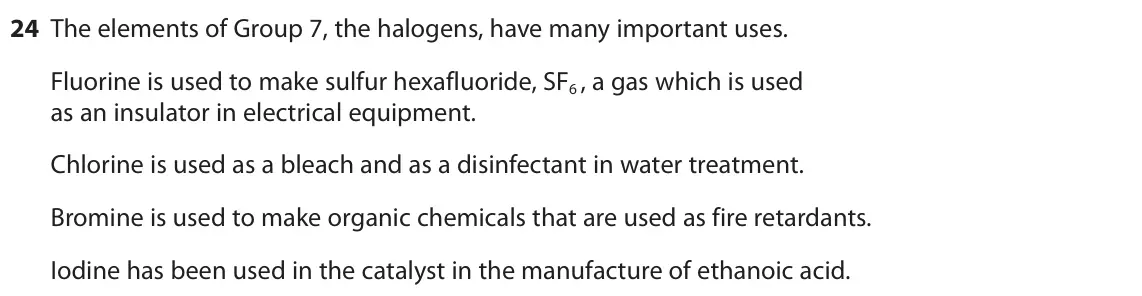
- Your answer
Q22(c)(i)
The whole paper ↗
Q18(a)
The whole paper ↗
Q20(c)
The whole paper ↗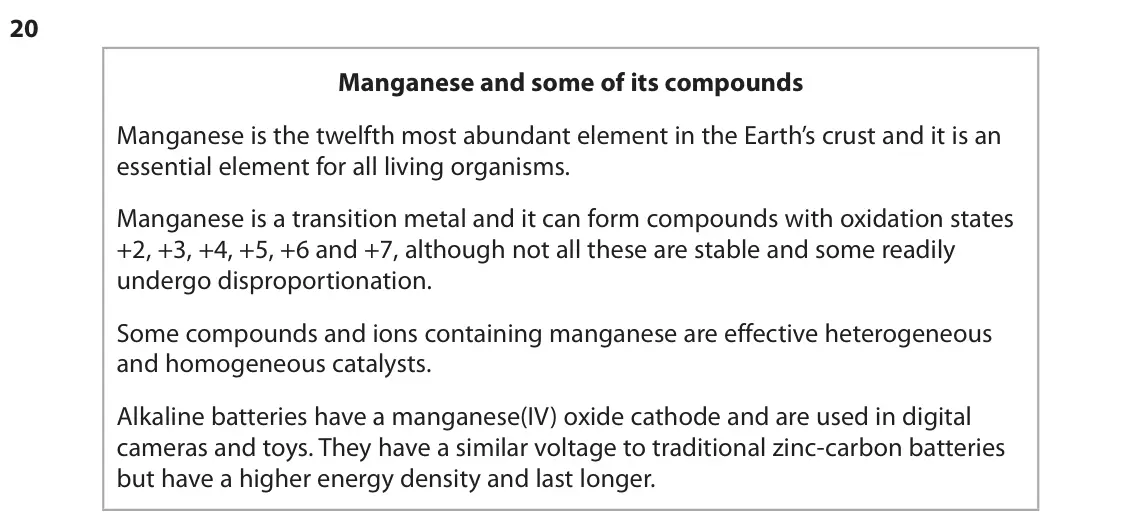
- Your answer
Q16(b)
The whole paper ↗
- Your answer
Q22(b)
The whole paper ↗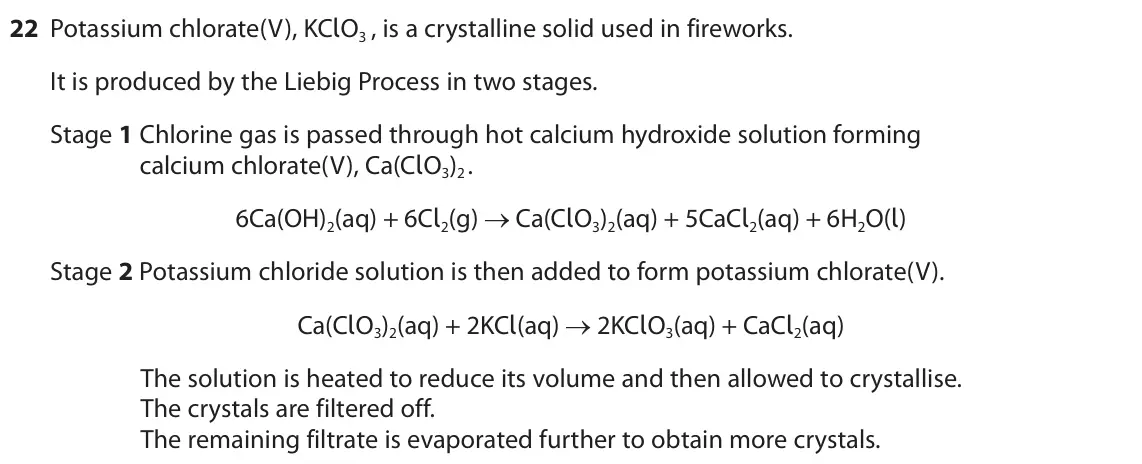
Q5(a)
The whole paper ↗ Your answer
Q18(d)(iii)
The whole paper ↗
- Your answer
All 18 questions on Disproportionation, as a list
- June 2025, AS Unit 2, Q6 (1 mark): The most common sources of iodine contain the iodate ion IO3 – . Iodate ions react with iodide ions in acidic conditions as shown. 5I– + IO3 – + 6H+ → 3I2 + 3H2
- June 2025, AS Unit 2, Q15(b) (2 marks): Chlorine is used to treat drinking water. Cl2(g) + H2O(l) HClO(aq) + HCl(aq) By considering oxidation numbers, show that this equation represents a disproport
- January 2025, AS Unit 2, Q10 (1 mark): Which equation is not an example of disproportionation? A Cu2O + H2SO4 → Cu + CuSO4 + H2O B 3HNO2 → HNO3 + 2NO + H2O C 3ClO– → 2Cl– + ClO3 – D Mg + 2HCl → MgCl2
- October 2024, AS Unit 2, Q19(b)(i) (3 marks): Explain why this is a disproportionation reaction by referring to relevant oxidation numbers. (3)
- June 2024, AS Unit 2, Q18(b)(iii) (2 marks): In Step 2, compound A undergoes disproportionation. Deduce the possible range of oxidation numbers for the chlorine in compound A. Justify your answer. (2)
- June 2024, AS Unit 2, Q18(b)(v) (2 marks): Write an equation for each of the two steps in the formation of chlorine dioxide, using your answers in (b). State symbols are not required. (2)
- January 2024, AS Unit 2, Q24(b)(iii) (2 marks): On heating, NaClO disproportionates to form sodium chloride and sodium chlorate(V). Give the equation for this disproportionation reaction. State symbols are no
- October 2023, AS Unit 2, Q7 (1 mark): Which equation shows a disproportionation reaction? A Cu + 4HNO3 → Cu(NO3)2 + 2H2O + 2NO2 B I2 + 5O3 + H2O → 2HIO3 + 5O2 C 2MnO4 – + MnO2 + 4OH– → 3MnO4 2– + 2H
- June 2023, AS Unit 2, Q22(c)(i) (3 marks): State the classification of this reaction. Justify your answer in terms of the relevant oxidation numbers. (3)
- January 2023, AS Unit 2, Q18(a) (3 marks): State the type of reaction occurring in the production of Ca(ClO)2 . Justify your answer using oxidation numbers. (3)
- January 2023, Unit 5, Q20(c) (1 mark): Potassium manganate(VI), K2MnO4 , is a green solid. In acidic solution, the manganate(VI) ions disproportionate to form manganate(VII) ions and manganese(IV) ox
- October 2022, AS Unit 2, Q14 (1 mark): Which reaction is not a disproportionation? A 3Cl2(g) + 6NaOH(aq) → NaClO3(aq) + 5NaCl(aq) + 3H2O(l) B 2H2O2(l) → 2H2O(l) + O2(g) C Cl2(g) + H2O(l) → HCl(aq) +
- June 2022, AS Unit 2, Q16(b) (2 marks): Iodate(V) ions, IO3 − , react with iodide ions in acid solution. IO3 − + 5I− + 6H+ → 3I2 + 3H2O Explain, in terms of the oxidation numbers of iodine in the thre
- June 2021, AS Unit 2, Q7 (1 mark): Hydrogen peroxide, H2O2 , breaks down into water and oxygen. In terms of oxidation and reduction, how do hydrogen and oxygen change in this reaction? Hydrogen O
- January 2021, AS Unit 2, Q22(b) (3 marks): Explain the type of reaction that takes place in Stage 1 of the Liebig Process, using oxidation numbers. 6Ca(OH)2(aq) + 6Cl2(g) → Ca(ClO3)2(aq) + 5CaCl2(aq) + 6
- October 2020, AS Unit 2, Q5(a) (1 mark): What type of reaction occurs? (1) A displacement B disproportionation C elimination D hydrolysis
- January 2020, AS Unit 2, Q18(d)(iii) (3 marks): The ammonia produced by the hydrolysis of urea reacts with nitrogen monoxide and oxygen to produce nitrogen gas and water. Reaction 2 4NH3(g) + 4NO(g) + O2(g) 4
- June 2019, AS Unit 2, Q7 (1 mark): Which of these is a disproportionation reaction? A 2NaOH + H2SO4 → Na2SO4 + 2H2O B 6NaOH + 3Br2 → 5NaBr + NaBrO3 + 3H2O C 2NaOH + 2Al + 2H2O → 2NaAlO2 + 3H2 D N
Questions, mark schemes and examiner’s reports are © Pearson Edexcel, from their published past papers. Plumi isn’t affiliated with any exam board. Want whole papers? Edexcel International A Level Chemistry past papers.
The Plumi iPad app also offers exam-style questions with AI feedback on your handwritten working.